R E S E A R C H
Open Access
Adaptive control of multiple chaotic
systems with unknown parameters in two
different synchronization modes
Xiangyong Chen
1,2, Jinde Cao
1,3*, Jianlong Qiu
2*, Ahmed Alsaedi
4and Fuad E Alsaadi
5*Correspondence: [email protected]; [email protected] 1Department of Mathematics, Southeast University, Nanjing, 210096, China
2School of Automation and Electrical Engineering, Linyi University, Linyi, Shandong 276005, China
Full list of author information is available at the end of the article
Abstract
This paper investigates the synchronization of multiple chaotic systems with unknown parameters using adaptive control method, and two kinds of different synchronization modes are considered here. One is that more response systems synchronize with one drive system, and the other is the ring transmission
synchronization, which guarantees that all chaotic systems can synchronize with each other. The definition of adaptive synchronization of multiple chaotic systems with unknown parameters is given, and then based on the idea of adaptive control method, adaptive laws are derived to estimate the unknown parameters, and nonlinear adaptive controllers are developed to ensure the asymptotical stability of two classes of error systems. Finally, simulation results are presented to verify the effectiveness of proposed synchronization schemes.
Keywords: multiple chaotic systems; unknown parameters; adaptive control; synchronization modes; stability analysis
1 Introduction
In recent years, chaos synchronization [] of multiple chaotic systems has became a much-studied topic in nonlinear research area. It is in favor of its potential applications in multi-lateral communications, secret signaling, and many other engineering fields [, ]. Various kinds of synchronization of multiple chaotic systems have been discussed by using some advanced control techniques. Lü and Liu addressed complete synchronization ofN cou-pled chaotic systems with chain and ring connection based on feedback control methods []. Tang and Fang extended the work of [] to multiple fractional-order chaotic systems []. Chenet al.used the direct design method to study complete synchronization, anti-synchronization and hybrid anti-synchronization among multiple chaotic systems [, ]. Sun
et al.and Jianget al.investigated generalized combination synchronization of multiple chaotic systems in [, ], respectively. Sunet al.discussed compound synchronization among four memristor chaotic oscillator systems based on the adaptive techniques []. For a special ring connection structure of multiple chaotic systems, a new transmission synchronization mode of multiple chaotic systems was proposed in []. Xiet al.proposed adaptive function projective combination synchronization of three different fractional-order chaotic systems []. It should be pointed out that most of aforementioned results
are only concerned with the synchronization of multiple systems based on knowing ex-actly the system parameters, and the influences of unknown parameters for such systems are not considered. In fact, chaotic systems are unavoidably affected by unknown param-eters, and it is hard to exactly know the values of the systems parameters in a priori. Thus, it is a challenging problem to study the synchronization among multiple chaotic systems with unknown parameters, which is the main motivation of this work.
On another research frontier, adaptive control method [] is an effective way to es-timate the unknown parameters due to its advantages on witnessed rapid and impres-sive developments leading to global stability and tracking results for nonlinear systems. It has been successfully applied to synchronize chaotic systems with unknown parame-ters, and many important results have been presented. For example, Park studied adap-tive synchronization of a unified chaotic systems with an unknown parameter [, ]. Zhanget al.proposed the adaptive controllers and adaptive laws to synchronize two dif-ferent chaotic systems with unknown parameters []. In [], the adaptive complete syn-chronization between chaotic systems with fully uncertain parameters were realized. Li
et al.gave a deeply research on adaptive impulsive synchronization for fractional-order chaotic systems with unknown parameters []. In [], adaptive synchronization of two different chaotic systems was addressed by considering the time varying unknown param-eters. Adaptive added-order and reduced-order anti-synchronization of chaotic systems were investigated in [, ], respectively. Heet al.made a thorough inquiry about syn-chronization of hyperchaotic systems with multiple unknown parameters []. Zhaoet al.presented a discussion of chaos synchronization between the coupled systems on net-work with unknown parameters based on adaptive control method []. Liu developed adaptive anti-synchronization of chaotic complex nonlinear systems with unknown pa-rameters []. Wu and Yang achieved the adaptive synchronization of coupled nonidenti-cal chaotic systems with complex variables and stochastic perturbations []. However, all of these works only deal with the synchronization problems between two chaotic systems with unknown parameters. Up to now, no related results have been established for the synchronization of multiple chaotic systems with unknown parameters, which is another motivation of this paper.
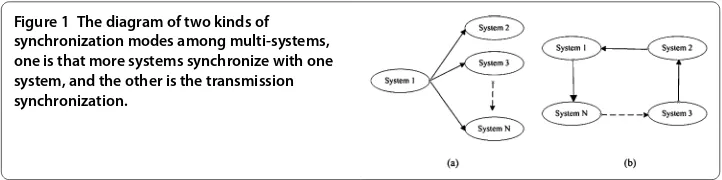
Figure 1 The diagram of two kinds of synchronization modes among multi-systems, one is that more systems synchronize with one system, and the other is the transmission synchronization.
This synchronization mode is quite different from the first mode, and it can overcome the trouble of the occurrence of a fault without affecting multiple system’s synchronization. Sunet al.adopted an impulsive control technique to deal with the transmission synchro-nization problem for multi-systems with delayed coupling []. Chenet al.addressed the transmission synchronization in an array of nonidentical coupled chaotic systems based on a special antisymmetric structure []. Meanwhile, the transmission synchronization mode has good applications in multilateral communications [] and signal transmission on complex networks with a ring connection withNnodes [–]. Hence, it is highly de-sirable to discuss the adaptive control problem of multiple chaotic systems with unknown parameters by considering the above synchronization modes.
In response to the above discussions, in this paper, the adaptive control method is adopted to investigate the synchronization of multiple chaotic systems with unknown pa-rameters by considering two different synchronization modes. By designing the adaptive controllers and the adaptive laws, the sufficient conditions are derived to guarantee the asymptotical stability of the error dynamic systems. Simulation results show the effective-ness of the presented schemes. The main contributions of this paper lie in the following. () The results in [, , , , ] are extended to multiple chaotic system with un-known parameters. () Transmission synchronization of multiple chaotic systems with unknown parameters is first discussed with the special connection structure for such sys-tems. () The proposed controllers and adaptive laws effectively realize the synchroniza-tion of multiple uncertain chaotic systems and estimate precisely unknown parameters.
2 Adaptive synchronization of multiple chaotic systems with unknown parameters
In this section, the synchronization problems of multiple chaotic systems with unknown parameters are taken into account, which has two kinds of different synchronization modes. The controllers and adaptive laws are designed using adaptive control method, respectively. Furthermore, two examples are give to demonstrate the effectiveness of the synchronization schemes.
2.1 Adaptive synchronization between more response systems and one drive system
Considering the following multiple chaotic systems with unknown parameters, one drive system is described by
⎧ ⎪ ⎪ ⎪ ⎪ ⎨ ⎪ ⎪ ⎪ ⎪ ⎩
˙
x(t) =f(x(t), . . . ,xn(t)) +F(x(t), . . . ,xn(t))θˆ,
˙
x(t) =f(x(t), . . . ,xn(t)) +F(x(t), . . . ,xn(t))θˆ, ..
.
˙
xn(t) =fn(x(t), . . . ,xn(t)) +Fn(x(t), . . . ,xn(t))θˆn,
where x(t) = [x,x, . . . ,xn]T is the state of the drive system (.),fi(x(t), . . . ,xn(t)) (i= , . . . ,n) is a continuous function and f(x(t)) = [f,f, . . . ,fn]T; Fi(x(t), . . . ,xn(t)) (i= , . . . ,n) is the matrices function andF(x(t)) = [F,F, . . . ,Fn]T;θˆi (i= , . . . ,n) is the unknown parameter andθˆ= [θˆ,θˆ, . . . ,θˆn]T.
The otherN– response systems can be given by
⎧
Then the above multiple chaotic systems can be rewritten into the following form:
⎧
and the definition of the adaptive synchronization of multiple chaotic systems is first given, which hasN– response systems and one drive system with unknown parameters.
Definition ForNchaotic systems (.), if there exist controllersu(t), . . . ,uN–(t) such
thatx(t) and all other trajectories vectorsx(t), . . . ,xN(t) in (.) with any initial condition (x(), . . . ,xN()) satisfy the following conditions:
lim
t→∞ei(t)=tlim→∞xi+(t) –x(t)= , i= , . . . ,N– , (.) then it is said that they are the adaptive synchronization amongNsystems.
Remark According to Figure (a) and Definition , the errors dynamic systems are ob-tained as follows:
The adaptive control method is used to ensure the asymptotical stability of the error dynamic systems (.), the control lawsu(t), . . . ,uN–(t) can be proposed as
ui=Kiei+f(x) –fi(xi) +F(x)θ–Fi(xi)θi, i= , . . . ,N, (.)
where Ki is the coefficient matrix, and Ki =Ki +Ki, where KiT = –Ki and Ki =
diag(ki, . . . ,kin),kij< (j= , . . . ,n). The estimations for the unknown parametersθˆandθˆi (i= , . . . ,N) can be defined asθandθi(i= , . . . ,N). In order to deal with the unknown parameters, the appropriate adaptive laws are given as follows:
˙
θ= –FT(x)ei–, θ˙i=FiT(xi)ei–, i= , . . . ,N,
θ() =θ, θi() =θi,
(.)
whereθandθiare the initial values of the adaptive lawsθandθi(i= , . . . ,N).
Theorem If the error systems (.)can be controlled by the controllers (.)and the adaptive laws(.),then the error system(.)is asymptotically stable,which means the adaptive synchronization is reached between multiple controlled response systems and one drive system.
Proof The error systems (.) can be rewritten as
˙
ei–=fi(xi) –f(x) +Fi(xi)θˆi–F(x)θˆ+ui. (.)
Choose the following Lyapunov function:
Vi–=
eTi–ei–+θ¯Tθ¯+θ¯iTθ¯i
, (.)
whereθ¯=θ–θˆandθ¯i=θi–θˆi(i= , . . . ,N) are the parameter errors, and it is clear that
˙¯
θ=θ˙,θ˙¯i=θ˙i.
Taking the derivative ofVialong the trajectory of (.), one has
˙ Vi=
˙
eiT–ei–+eTi–e˙i–+θ˙¯Tθ¯+θ¯Tθ˙¯+θ˙¯iTθ¯i+θ¯iTθ˙¯i
=
fi(xi) –f(x) +Fi(xi)θˆi–F(x)θˆ+ui
T
ei–
+ ei–
Tf
i(xi) –f(x) +Fi(xi)θˆi–F(x)θˆ+ui
+
˙
θTθ¯+θ¯Tθ˙+θ˙iTθ¯i+θ¯iTθ˙i
. (.)
Substituting (.) into equation (.), one can easily get
˙ Vi–=
Kiei–+F(x)(θ–θˆ) –Fi(xi)(θi–θˆi)
T
ei–
+ e
T i–
Kiei–+F(x)(θ–θˆ) –Fi(xi)(θi–θˆi)
+
˙
θTθ¯+θ¯Tθ˙+θ˙iTθ¯i+θ¯iTθ˙i
=
F(x)θ¯–Fi(xi)θ¯i
T +
e T i–
ei–+F(x)θ¯–Fi(xi)θ¯i
+
˙
θTθ¯+θ¯Tθ˙+θ˙iTθ¯i+θ¯iTθ˙i
. (.)
Inserting the adaptive laws (.) into equation (.), one obtains
˙ Vi–=
e
T i–
KiT+Ki
ei–.
Therefore, it is easy to see that
˙ Vi–=
e
T i–
KiT +KiT+Ki+Ki
ei–= e
T i–
KiT+Ki
ei–< ;
then the error system (.) is asymptotically stable, that is, adaptive synchronization be-tweenN– respond systems and one drive system is achieved. The proof is completed.
Remark According to Theorem , the adaptive control method is used to estimate un-known parameters, which are directly used in the adaptive synchronization controllers. When adaptive controllers are designed, special consideration is necessary of convergence and robustness issues. Lyapunov stability theory is typically used to derive adaptive con-trol laws and show convergence.
2.2 Adaptive transmission synchronization of multiple chaotic systems with unknown parameters
In this subsection, the first chaotic system is described as follows:
⎧ ⎪ ⎪ ⎪ ⎨ ⎪ ⎪ ⎪ ⎩
˙
y=Ay(t) +g(y(t), . . . ,yn(t)) +G(y(t), . . . ,yn(t))φˆ,
˙
y=Ay(t) +g(y(t), . . . ,yn(t)) +G(y(t), . . . ,yn(t))φˆ,
· · · ˙
yn=Anyn(t) +gn(y(t), . . . ,yn(t)) +Gn(y(t), . . . ,yn(t))φˆn,
(.)
whereA(t) = [A,A, . . . ,An]T is the coefficient matrix,y(t) = [y,y, . . . ,yn]T is the state of the system (.),gi(y(t), . . . ,yn(t)) (i= , . . . ,n) is a continuous function and
g(y(t)) = [g,g, . . . ,gn]T; Gi(y(t), . . . ,yn(t)) (i= , . . . ,n) is the matrix function and
G(y(t)) = [G,G, . . . ,Gn]T;φˆi(i= , . . . ,n) is for the unknown parameters andφˆ= [φˆ,φˆ, . . . ,φˆn]T.
The otherN– chaotic systems are given by
⎧ ⎪ ⎪ ⎪ ⎨ ⎪ ⎪ ⎪ ⎩
˙
yj=Ajy(t) +gj(yj(t), . . . ,yjn(t)) +Gj(yj(t), . . . ,yjn(t))φˆj+vj–,,
˙
yj=Ajy(t) +gj(yj(t), . . . ,yjn(t)) +Gj(yj(t), . . . ,yjn(t))φˆj+vj–,,
· · · ˙
yjn=Ajnyn(t) +gjn(yj(t), . . . ,yjn(t)) +Gjn(yj(t), . . . ,yjn(t))φˆjn+vj–,n,
(.)
ˆ
φj= [φˆj,φˆj, . . . ,φˆjn]T, and the control input is vj–= [vj–,,vj–,, . . . ,vj–,n]T. If Ai=Aj (i,j= , . . . ,N,i=j),gi(yi)=gj(yj) (i,j= , . . . ,N,i=j) andGi(yi)=Gj(yj) (i,j= , . . . ,N,i=j), then the systems (.) and (.) are an array of nonidentical chaotic systems.
In accordance with (.) and (.), the aboveNchaotic systems can be rewritten as
⎧
In the framework of the transmission synchronization mode, the state error can be de-fined asej(t) =yj+(t) –yj(t),j= , . . . ,N– , then the definition of adaptive transmissions synchronization ofNsystems is obtained.
Definition ForNchaotic systems described by (.), if there exist adaptive controllers
v(t), . . . ,vN–(t) such that the error dynamic systems
satisfy the following condition:
lim
t→∞ej(t)=tlim→∞yj+(t) –yj(t)= , j= , . . . ,N– , (.) it is said that the adaptive transmission synchronization are realized amongN systems with unknown parameters.
Now, adaptive control method is used to design the controllers and adaptive laws to achievelimt→∞ej(t)= , and the synchronization among (.) and (.) are realized
fol-lows:
⎧ ⎪ ⎪ ⎪ ⎨ ⎪ ⎪ ⎪ ⎩
˙
φ= –GT(y)e,
˙
φj=GTj (yj)ej–= –GTj(yj)ej, j= , . . . ,N– ,
˙
φN =GTN(yN)eN–,
φ() =φ, φj() =θj, φN() =θN.
(.)
Theorem Considering the error dynamic systems ej(t)with the controllers in(.)and
adaptive laws in(.),it is easy to ensure that the error dynamic systems ej(t)are
asymp-totically stable, and adaptive transmission synchronization among N systems with un-known parameters is realized.
Proof First of all, the first error dynamic systeme˙(t) =y˙(t) –y˙(t) is considered. Choose the following Lyapunov function fore(t),
V=
eTe+φ¯Tφ¯+φ¯Tφ¯
,
whereφ¯=φ–φˆandφ¯=φ–φˆare the parameters errors.
Similarly to Theorem , substituting the adaptive lawsφ˙= –GT(y)eandφ˙=GT(y)e and the controllervinto the derivative ofV, one has
˙ V=
e
T
AT +A+H+HT
e.
By constructing the appropriate coefficient matrixH, one can guaranteeV˙< , then the error dynamic systemse(t) is asymptotically stable, that is, the adaptive synchronization between the first system and the second system is achieved.
Second, for the error dynamic systemej(t) (j= , . . . ,N– ) between thejth system and the (j+ )th system, a proper Lyapunov function forej(t) is constructed as
Vj=
eTj ej+φ¯jTφ¯j+φ¯Tj+φ¯j+
,
whereφ¯j=φj–φˆjandφ¯j+=φj+–φˆj+are the parameters errors. Introducing the controller
vj–vj–=
Aj+ej– (Aj+–Aj)xj–gj+(yj+) +gj(yj) –Gj+(yj+)φj++Gj(yj)φj+Hjej
,
j= , . . . ,N– ,
into the derivative ofVj, one can easily obtain
˙ Vj=
˙
eTj ej+eTje˙j+φ˙¯jTφ¯j+φ¯jTφ˙¯j+φ˙¯Tj+φ¯j++φ¯Tj+φ˙¯j+
=
Aj+ej+ (Aj+–Aj)yj+gj+(yj+) –gj(yj) +Gj+(yj+)φˆj+–Gj(yj)φˆj+vi–vj–
T
ej
+ ej
TA
j+ej+ (Aj+–Aj)yj+gj+(yj+) –gj(yj)
+Gj+(yj+)φˆj+–Gj(yj)φˆj+vi–vj–
+
˙
φjTφ¯j+φ¯jTφ˙j+φ˙Tj+φ¯j++φ¯Tj+φ˙j+
=
Aj+ej+Gj(yj)(φj–φˆj) –Gj+(yj+)(φj+–φˆj+) +Hjej
T
ej
+ ej
TA
j+ej+Gj(yj)(φj–φˆj) –Gj+(yj+)(φj+–φˆj+) +Hjej
+
˙
φjTφ¯j+φ¯jTφ˙j+φ˙Tj+φ¯j++φ¯Tj+φ˙j+
= e
T j
ATj++Aj++Hj+HjT
ej+
¯
φjTGTj(yj)ej–φ¯jT+GTj+(yj+)ej
+
ejTGj(yj)φ¯j–ejTGj+(yj+)φ¯j+
+
˙
φjTφ¯j+φ¯jTφ˙j+φ˙Tj+φ¯j++φ¯Tj+φ˙j+
. (.)
Substituting the adaptive lawsφ˙j= –GTj(j)ejandφ˙j+=GTj+(yj+)ejinto (.) and sim-plifying it, one has
˙ Vj=
e
T j
ATj++Aj++Hj+HjT
ej. (.)
Similarly, by constructing the appropriate coefficient matrixHjto guaranteeV˙j< , the error dynamic systemsej(t) will be asymptotically stable, that is, the adaptive synchro-nization between thejsystem and thej+ system is realized. With the above discussions, it is easy to see that the adaptive transmission synchronization is reached amongN
sys-tems with unknown parameters. Hence, the proof is completed.
Remark According to Theorem , when the unknown parametersφjandφj+are esti-mated and the adaptive synchronization between thejth system and the (j+ )th system is investigated, the adaptive laws should satisfyφ˙j= –GTj (yj)ejandφ˙j+=GjT+(yj+)ej+. For the (j– )th system and thejth system, when the unknown parametersφj–andφjare es-timated, the conditionsφ˙j–= –GTj–(yj–)ej–andφ˙j=GTj(yj)ejshould hold, then it is easy to conclude that
˙
φj=GTj(yj)ej–= –GTj(yj)ej, j= , . . . ,N– . (.)
Remark According to Definition and Theorem , the transmission synchronization
with ring connection can be effectively applied in the many engineering fields, such as circuits, mobile ad hoc networks, etc. [–]. The nodes in such networks can exhibit phase synchronization or can be synchronized in the same state to keep such networks stable.
3 Numerical examples and simulation
Example Consider one Lorenz system [] and two Lü systems [] as an example, which can be described as follows:
⎧
The error dynamic systems can be obtained:
According to (.) and (.), the proper coefficient matrices are constructed as
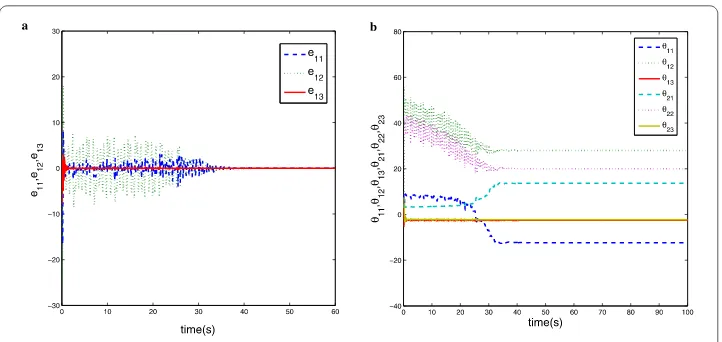
Figure 2 Synchronization errorse11,e12,e13between drive system (3.1) and response system (3.2),
and the time response of the adaptive vector parametersθ11,θ12,θ13,θ21,θ22,θ23.
then the controllers and the adaptive laws can be obtained as follows:
⎧
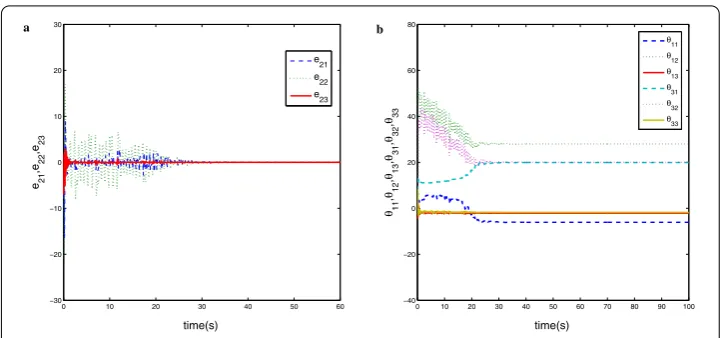
Figure 3 Synchronization errorse21,e22,e23between drive system (3.1) and response system (3.3),
and the time response of the adaptive vector parametersθ11,θ12,θ13,θ31,θ32,θ33.
systems converge to quickly, and synchronization among the three chaotic systems is achieved. From Figure (b) and Figure (b), it is easy to see that all adaptive laws converge to some fixed values, which realize the estimation of the unknown parameters of chaotic systems.
Remark In the above simulations, the reasonable valueK andK can be chosen ac-cording to the corresponding chaotic complex system to achieve the desired result in the simple way.
whereaˆ,bˆ,ˆc,dˆ,rˆ,aˆ,bˆ,ˆc,dˆ, andaˆ,bˆ,cˆ,dˆ,rˆare the systems parameters. When
According to (.) and (.), the controllers and the adaptive laws can be designed as
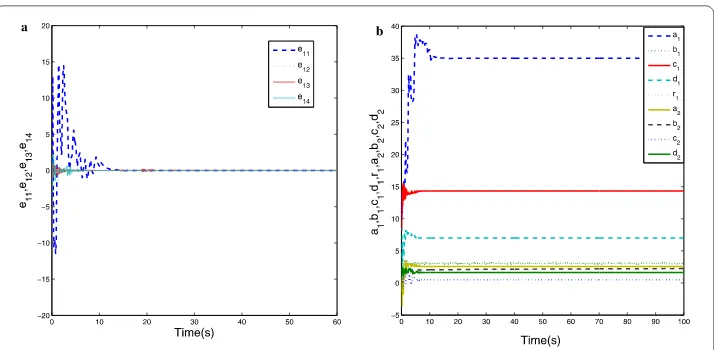
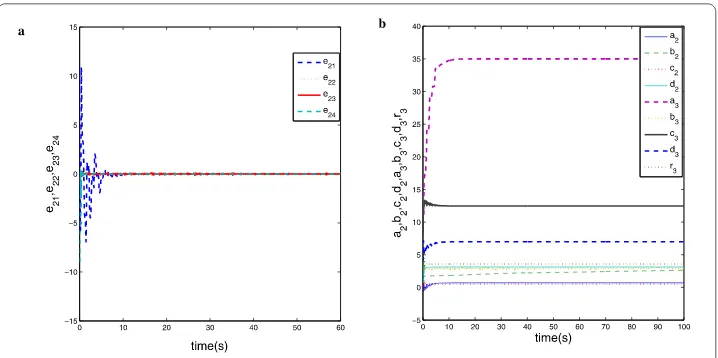
Figure 4 Synchronization errorse11,e12,e13,e14between drive system (3.5) and response system
(3.6) in (a), and the time response of the adaptive vector parametersa1,b1,c1,d1,r1,a2,b2,c2,d2in (b).
⎡ ⎢ ⎢ ⎢ ⎣
˙ a
˙ b
˙ c
˙ d
⎤ ⎥ ⎥ ⎥ ⎦=
⎡ ⎢ ⎢ ⎢ ⎣
ye
e –ye
ye
⎤ ⎥ ⎥ ⎥ ⎦= –
⎡ ⎢ ⎢ ⎢ ⎣
ye
e –ye
ye
⎤ ⎥ ⎥ ⎥ ⎦,
whereHandHcan be constructed as
H=
⎡ ⎢ ⎢ ⎢ ⎣
h
h
h
h
⎤ ⎥ ⎥ ⎥ ⎦=
⎡ ⎢ ⎢ ⎢ ⎣
– –
–
–
–
⎤ ⎥ ⎥ ⎥
⎦, H=
⎡ ⎢ ⎢ ⎢ ⎣
h
h
h
h
⎤ ⎥ ⎥ ⎥ ⎦=
⎡ ⎢ ⎢ ⎢ ⎣
– –
–
–
–
⎤ ⎥ ⎥ ⎥ ⎦,
anda,b,c,d,r,a,b,c,d,a,b,c,d,rare the estimations of the unknown param-etersaˆ,bˆ,ˆc,dˆ,rˆ,aˆ,bˆ,ˆc,dˆ,aˆ,bˆ,cˆ,dˆ,rˆ.
The initial conditions of three chaotic systems are chosen as (y(),y(),y(),
y()) = (, –, –, –), (y(),y(),y(),y()) = (, –, , –), (y(),y(),y(),
y()) = (, –, –, –), respectively. The initial values of the adaptive parameters can be assumed as (a,b,c,d,r) = (a,b,c,d,r) = (, , , , ), (a,b,c,d) = (, , ., .). The state trajectories of the error dynamic systemse andeare shown in Figure (a) and Figure (a). Meanwhile, the adaptive lawsa,b,c,d,r,a,b,c,d,a,
b,c,d,rcan be found in Figure (b) and Figure (b). It implies that the error dynamic systemseandeconverge to quickly, that is, (.) synchronizes with (.), and (.) syn-chronizes with (.). It is concluded that adaptive transmission synchronization among three chaotic systems is achieved. According to Figure (b) and Figure (b), it is clear that the designed adaptive laws (.) are appropriate, and they converge to some fixed values, which realize the estimation of the unknown parameters of chaotic systems.
trans-Figure 5 Synchronization errorse21,e22,e23,e24between drive system (3.6) and response system
(3.7) in (a), and the time response of the adaptive vector parametersa2,b2,c2,d2,a3,b3,c3,d3,r3in (b).
mission synchronization for special networks connection composed of chaotic systems lead to improved applications in secure communications [] and other fields.
4 Conclusions
In this paper, we have introduced two classes of different chaos synchronization modes among multiple chaotic systems, and we discussed the adaptive synchronization prob-lems of multiple chaotic systems with unknown parameters. By using the adaptive control method, adaptive controllers and adaptive laws have been designed, and new synchro-nization criteria are given, which can effectively stabilize the error systems and estimate the unknown parameters, Simulation results have shown the effectiveness of the proposed controllers for synchronizing multiple uncertain chaotic systems by using adaptive control techniques. The main limitation of this work is that the synchronization problems of mul-tiple chaotic systems with unknown parameters are only discussed. To investigate the syn-chronization among multiple chaotic systems with uncertainty and external disturbances, and to have do rigorous research on their application on multilateral communications [] and signal transmission of ring networks [–] are our future works.
Competing interests
All authors declare that they have no competing interests to this work.
Authors’ contributions
Each of the authors contributed to each part of this work equally and all authors read and approved the final manuscript.
Author details
1Department of Mathematics, Southeast University, Nanjing, 210096, China.2School of Automation and Electrical Engineering, Linyi University, Linyi, Shandong 276005, China.3Department of Mathematics, Faculty of Science, King Abdulaziz University, Jeddah, 21589, Saudi Arabia.4Nonlinear Analysis and Applied Mathematics (NAAM) Research Group, Department of Mathematics, Faculty of Science, King Abdulaziz University, Jeddah, 21589, Saudi Arabia.5Department of Electrical and Computer Engineering, Faculty of Engineering, King Abdulaziz University, Jeddah, 21589, Saudi Arabia.
Acknowledgements
Received: 29 June 2016 Accepted: 30 August 2016 References
1. Pecora, LM, Carroll, TL: Synchronization in chaotic systems. Phys. Rev. Lett.64(8), 821-824 (1990) 2. Lian, KY, Chiang, TS, Chiu, CS, Liu, P: Synthesis of fuzzy model-based designs to synchronization and secure
communications for chaotic systems. IEEE Trans. Syst. Man Cybern. B31(1), 66-83 (2001)
3. Tang, S, Liu, J: Chaos synchronization in semiconductor lasers with optoelectronic feedback. IEEE J. Quantum Electron.39(6), 708-715 (2003)
4. Liu, Y, Lü, L: Synchronization of N different coupled chaotic systems with ring and chain connections. Appl. Math. Mech.29(10), 1181-1190 (2008)
5. Tang, Y, Fang, J: Synchronization of N-coupled fractional-order chaotic systems with ring connection. Commun. Nonlinear Sci. Numer. Simul.15(2), 401-412 (2010)
6. Chen, X, Wang, C, Qiu, J: Synchronization and anti-synchronization of N different coupled chaotic systems with ring connection. Int. J. Mod. Phys. C25(5), 1440011 (2014)
7. Chen, X, Qiu, J, Cao, J, He, H: Hybrid synchronization behavior in an array of coupled chaotic systems with ring connection. Neurocomputing173(3), 1299-1309 (2006)
8. Jiang, CM, Liu, ST: Generalized combination complex synchronization of new hyperchaotic complex Lü-like systems. Adv. Differ. Equ.2015, 214 (2015)
9. Sun, J, Shen, Y, Zhang, GD: Combination-combination synchronization among four identical or different chaotic systems. Nonlinear Dyn.73, 1211-1222 (2013)
10. Sun, J, Shen, Y, Yin, Q, Xu, CJ: Compound synchronization of four memristor chaotic oscillator systems and secure communication. Chaos23, 013140 (2013)
11. Sun, J, Shen, Y, Zhang, GD: Transmission projective synchronization of multi-systems with non-delayed and delayed coupling via impulsive control. Chaos22, 043107 (2012)
12. Xi, HL, Li, YX, Huang, X: Adaptive function projective combination synchronization of three different fractional-order chaotic systems. Optik126(24), 5346-5349 (2015)
13. Sinha, S, Ramaswamy, R, Rao, JS: Adaptive control in nonlinear dynamics. Physics43, 118-128 (1990)
14. Park, JH: Adaptive synchronization of a unified chaotic system with an uncertain parameter. Int. J. Nonlinear Sci. Numer. Simul.6(2), 201-206 (2005)
15. Park, JH: Adaptive modified projective synchronization of a unified chaotic system with an uncertain parameter. Chaos Solitons Fractals34(5), 1552-1559 (2007)
16. Zhang, HG, Huang, W, Wang, ZL, Chai, TY: Adaptive synchronization between two different chaotic systems with unknown parameters. Phys. Lett. A350(5), 363-366 (2006)
17. Lu, JQ, Cao, JD: Adaptive complete synchronization of two identical or different chaotic (hyperchaotic) systems with fully unknown parameters. Chaos15, 043901 (2005)
18. Li, D, Zhang, XP, Hu, YT, Yang, YY: Adaptive impulsive synchronization of fractional order chaotic system with uncertain and unknown parameters. Neurocomputing167(1), 165-171 (2015)
19. Salarieha, H, Shahrokhib, M: Adaptive synchronization of two different chaotic systems with time varying unknown parameters. Chaos Solitons Fractals37(1), 125-136 (2008)
20. Shi, XR, Wang, ZL: Adaptive added-order anti-synchronization of chaotic systems with fully unknown parameters. Appl. Math. Comput.215(5), 1711-1717 (2009)
21. Mossa Al-sawalha, M, Noorani, MSM: Adaptive reduced-order anti-synchronization of chaotic systems with fully unknown parameters. Commun. Nonlinear Sci. Numer. Simul.15(10), 3022-3034 (2010)
22. He, JB, Cai, JP, Lin, J: Synchronization of hyperchaotic systems with multiple unknown parameters and its application in secure communication. Optik127(5), 2502-2508 (2016)
23. Zhao, JK, Wu, Y, Liu, QF: Chaos synchronization between the coupled systems on network with unknown parameters. Appl. Math. Comput.229(25), 254-259 (2014)
24. Liu, ST, Liu, P: Adaptive anti-synchronization of chaotic complex nonlinear systems with unknown parameters. Nonlinear Anal., Real World Appl.12(6), 3046-3055 (2011)
25. Wu, EL, Yang, XS: Adaptive synchronization of coupled nonidentical chaotic systems with complex variables and stochastic perturbations. Nonlinear Dyn.284(1), 261-269 (2016)
26. Lu, J, Cao, J: Adaptive synchronization in tree-like dynamical networks. Nonlinear Anal., Real World Appl.8, 1252-1260 (2007)
27. Chen, X, Qiu, J: Synchronization of N different chaotic systems based on antisymmetric structure. Math. Probl. Eng.
2013, 742765 (2013)
28. Tang, Z, Park, JH, Lee, TH, Feng, JW: Random adaptive control for cluster synchronization of complex networks with distinct communities. Int. J. Adapt. Control Signal Process.30(3), 534-549 (2016)
29. Tang, Z, Park, JH, Lee, TH: Distributed adaptive pinning control for cluster synchronization of nonlinearly coupled Lur’e networks. Commun. Nonlinear Sci. Numer. Simul.39, 7-20 (2016)
30. Yang, XS, Song, Q, Liang, JL, He, B: Finite-time synchronization of coupled discontinuous neural networks with mixed delays and nonidentical perturbations. J. Franklin Inst.352(10), 4382-4406 (2015)
31. Chen, X, Cao, J, Qiu, J, Yang, C: Transmission synchronization control of multiple non-identical coupled chaotic systems. Lect. Notes Comput. Sci.9719, 284-291 (2016)
32. Müller, G, Rannenberg, K (eds.): Multilateral Security in Communications: Technology, Infrastructure, Economy. Addison-Wesley, Reading (1999)
33. Kyprianidis, I, Stouboulos, I: Chaotic synchronization of three coupled oscillators with ring connection. Chaos Solitons Fractals17, 327-336 (2003)
34. Chen, YS, Lin, TH, Lin, SM: RAA: a ring-based address autoconfiguration protocol in mobile ad hoc networks. Wirel. Pers. Commun.43, 549-571 (2007)
35. Mewanou, R, Pierre, S: Link-state-based algorithms for dynamic routing in all-optical networks with ring topologies. Photonic Netw. Commun.11, 5-11 (2006)
37. Chen, GR, Ueta, T: Chaos in Circuits and Systems. World Scientific, Singapore (2002)