
© 2015, IRJET.NET- All Rights Reserved
Page 80
Energy Efficient Techniques in WSN: A Review
M. D. Umale
1, S. S. Awate
2, V. N. Gavali
31 2 3
Lecturer, DCOER, Maharashtra, India
---***---Abstract -
Energy consumption is major issue inWireless Sensor Network (WSN). As the battery-powered sensor nodes are greatly constrained in energy supply, it is of tremendous significance to investigate energy optimization methods to prolong WSN lifetime. For Energy optimization various approaches have been worked out by researchers. The one of approaches introduces reliable routing and networking protocol. The networking protocol provides reliable data delivery and minimizes energy overhead. Some other approach tackles the problem of energy consumption by the cross layer energy efficient model with two modulation scheme Frequency shift keying (FSK) and Pulse Position modulation (PPM) with randomly deployed sensor node in small scale WSN. In this model PPM modulation scheme provides better energy optimization than FSK modulation for both general and dense WSN. Third technique solves the energy consumption in multiple target coverage problems (MTC) with two sensor scheduling scheme one is optimization scheme and other is heuristic scheme. Above approaches have limitation of Dynamic energy management hence the target tracking concept of WSN which has effective and efficient energy management can be proposed. The grid exclusion and Dijkstra algorithm used for coverage metric and energy metric respectively in target tracking.
Key Words: Wireless Sensor Network, energy
optimization, heuristic, energy overhead, target
tracking, scheduling.
1. INTRODUCTION
A WSN is different from other popular wireless networks like cellular network, wireless local area network (WLAN) and Bluetooth in many ways. Compared to other wireless networks, a WSN has much more nodes in a network, distance between the neighboring nodes is much shorter and application data rate is much lower also. Due to these characteristics, power consumption in a sensor network should be minimized. A primary principle of wireless sensor network is energy efficiency. To avoid this issue of energy consumption different techniques are invented.
The sensor nodes are generally inaccessible after deployment and normally they have a finite source of energy that must be optimally used for processing and communication to extend their lifetime. It is a well known fact that communication requires significant energy. In order to make optimal use of energy, therefore communication should be minimized as much as possible.
Link rating parameter proposed by [1] can be used by Hello message exchange to obtain link quality in the form of statistics. Link rating is the average of ratios of the measured link reliabilities to the power setting needed to achieve those reliabilities.
© 2015, IRJET.NET- All Rights Reserved
Page 81
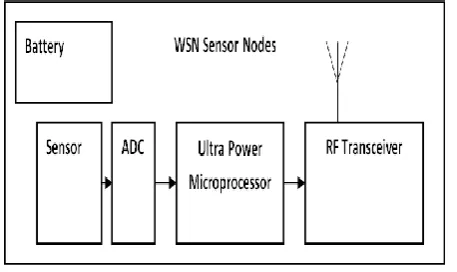
Fig. 2: Wireless Sensor Network ComponentThe cross layer efficiency model [2] consist of FSK and PPM modulation scheme, non linearity of the battery discharge, randomly deployed nodes ,time slot TDMA. As the time assigned to each link this minimizes the energy consumption and routing techniques of dense and general WSN are derived. This conclude that in general WSN the multi-hop routing is optimize more energy than single hop routing whereas the dense WSN gives better result of energy optimization in single-hop routing.
Sung-Yeop Pyunand Dong-Ho Cho [3], proposed maximizing the energy efficiency scheduling scheme for MTC. The scheduling scheme has two scheme one is optimization which models an integer programming and second is heuristic scheme to reduce complexity in optimization. Focusing on the energy efficiency problem in target tracking of WSN, [5] proposed a cluster-based dynamic energy management mechanism. Grid exclusion algorithm is used to optimize coverage whereas Dijkstra’s algorithm is used to calculate shortest path but Floyd warshall algorithm can be optimize more energy. Then PF is applied to predict the target position, which is used to estimate the idle interval of each sensor node according to its sensing and transmission task.
2. RELATED WORK
To get high reliability on given link minimum transmission power should be obtained. Hello messages exchange introduces non negligible energy overhead. This overhead may reduce or cancel the energy savings gained by the proposed algorithms [1]. The hello message exchange has two methods one is optimizing the hello message exchange and second is broadcasting of hello message exchange. In [6], two energy efficiency FSK and PPM schemes are discussed for low rate setup of WSN. But in [2] this method is extended for better result. To maximize the network lifetime the power limited sensors are used.
Hence M. Cardei et al. [7] proposed scheduling scheme to organize sensors into disjoint sets. In [3], sensor scheduling schemes for MTC which remove redundancy of overlapped targets and maximizing energy efficiency. To reduce complexity of optimized scheduling heuristic scheduling scheme used.
A distributed adaptive clustering approach is investigated to form a reasonable routing framework which has uniform cluster head distribution [8]. The methods which are proposed above among which distributed energy optimization of target tracking for parallel deployment of sensors and energy management is advanced. This method describes Grid exclusion algorithm and shortest path algorithms (Dijkstra) for coverage metric and energy metric respectively. It results in proficient energy and coverage optimization
1.1 Link Rating Mechanism to Control Power
In monitoring each communication link for hello message exchange, although there is no additional overhead, the transmit power has no control. Consequently the reliable protocol proposed by [1] analyses the comparative result of APTEEN protocol and reliable protocol. Network consist some parameters which includes hard and soft threshold values for environmental variables to monitor the network which is similar to APTEEN protocol
.
The nodes firmware will be preprogrammed with the frequency of sending the one hop Hello messages, the number of message types and the reliability required for each of these types. The nodes will also be programmed with the minimum number of Hello messages needed per link per power level. This is the number of Hello messages needed before collected statistics about the reliability of the level can be used by the protocol. While the link statistics are being collected, the protocol will behave similar to APTEEN. This setting will persist until enough link statistical information becomes available for the proposed cluster head selection and the individualized link power setting algorithms to use. There are many ways to develop algorithms to ensure that the statistics collected are not used until the minimum exchange conditions are met.
© 2015, IRJET.NET- All Rights Reserved
Page 82
2.2 Cross Layer Model for Energy EnhancementThe cross-layer energy efficient model minimizes the network energy consumption and used to analyze its energy efficiency. This model consists of routing design and link design. In routing design source nodes are deployed randomly and sink node is located at the edge of the sensing field. There are N sensor nodes in the network. The sink node is denoted as the N th node. The other N −1 nodes are source nodes for generating their own data to send to node N directly by single hop routing, or resort to other source nodes to relay the data to node N by multiple hop and even multiple paths routing. TDMA variable time slot applied to the model to eliminate the interference link state.
For Decreasing link energy consumption two modulation schemes used i.e. PPM and FSK which are used orthogonal modulation. These takes work or sleep operating modes with non coherent detection. When a node transmits data during the time slot assigned by the TDMA scheme, it commonly works in active mode. After finishing the data transmission, it turns off all the circuits to be in the sleep mode. Specially, PPM could work with active/ sleep modes even during every symbol period due to its intermittent pulse waveform.
The observed result of PPM and FSK schemes for general WSN and densely deployed WSN are as shown in figure 2 and figure 3 respectively.
Fig 2: Routing for general WSN [2]
Fig 3: Routing for dense WSN [2]
For reducing the energy consumption in each link optimal routings are derived for dense WSN and general WSN. This conclude that in general WSN the multi-hop routing is optimize more energy than single hop routing whereas the dense WSN gives better result of energy optimization in single-hop routing.
The PPM results in 99% decreasing in energy consumption whereas FSK have 93% results. From results it can be observed that, the FSK perform less for active /sleep operating mode as compared to PPM.
2.3 MTC Scheduling Scheme
In sensor scheduling scheme first a sink node collects the information of sensors then sink node executes proposed sensor scheduling schemes based on collected data informs schedule to sensors. According to received schedule, sensor goes to active or sleep mode to avoid the idle mode. MTC scheduling scheme has two method optimization scheme and heuristic scheme. The proposed schemes make groups of sensors based on the coverage relationship between sensors and targets such that each sensor can be included in multiple groups and each group.
Fig 4: Overlapped target and sensors in joint set [3]
© 2015, IRJET.NET- All Rights Reserved
Page 83
The proposed schemes can further improve the networklifetime of WSNs even if computational complexity increases to remove the redundancy of overlapping targets. Although the proposed scheme is modeled as a centralized scheme to present the theoretical upper bound of the network lifetime, the concept of eliminating the redundancy of overlapping targets can be directly applied to other distributed schemes.
3. PROPOSED TARGET TRACKING AND ENERGY
MANAGEMENT
The proposed dynamic energy management mechanism is particularly exploited for target tracking applications. For the purpose of target tracking, an improved version of the PF algorithm, called PF-RBF, is developed. In PF-RBF, the radial basis function network (RBFN) is utilized to approximate the target trajectory. Thereby, the sleeping time of sensor node is prolonged by dynamic awakening approach with the predicted target position. With the predicted target position, sensor nodes selection is performed in advance in the vicinity of target for the next sensing instant. Thereby, the sensing accuracy is guaranteed and energy consumption is minimized in WSN.
1.1 Target Tracking In WSN
Target tracking deals with finding spatial coordinates and detect track for location. A target tracking system through WSNs can have several advantages (i) qualitative and fidelity observations; (ii) signal processing accurately and timely; and (iii) increased system robustness and tracking accuracy. However, the use of sensor networks for target tracking presents a number of new challenges. These challenges include limited energy supply and communication bandwidth, distributed algorithms and control, and handling the fundamental performancelimits of sensor nodes, especially as the size of the network becomes large. Unlike traditional networks, a WSN has its own design and resource constraints.
3.2 Proposed System for Energy Management
The sensing field is divided for parallel sensor deployment optimization. For each cluster, the coverage and energy metrics are calculated by grid exclusion algorithm and Dijkstra’s algorithm, respectively. Cluster heads perform parallel particle swarm optimization to maximize the coverage metric and minimize the energy metric. Particle filter is improved by combining the radial basis function network, which constructs the process model. Thus, the target position is predicted by the improved particle filter. Here, stationary sensor nodes are clustered by MEC to obtain an energy-efficient infrastructure for the parallel energy-efficient coverage problem. In each separated
sensing area, the coverage and energy performance is concerned for potential mobile sensor node deployment.
Fig 5: Block Diagram of proposed system
1. Network Formation: and to enhance scalability. Here, stationary sensor nodes are clustered by MEC to obtain an energy-efficient infrastructure for the parallel energy-efficient coverage problem. In each separated sensing area, the coverage and energy performance is concerned for potential mobile sensor node deployment. The area which satisfies this reliability requirement in the whole sensing field can reflect the coverage performance. An energy-efficient communication framework can be established by the lowest cost paths in each cluster. This framework indicates the lowest energy consumption level which can be provided by potential deployment of WSN. Then, PPSO algorithm is presented to optimize the network performance, where the optimization task is assigned among the cluster heads.
3. Particle swarm Optimization:
© 2015, IRJET.NET- All Rights Reserved
Page 84
increases, the time cost of PSO algorithm will increasesharply. Actually, each clustered can acquire the partial coverage and energy metrics. Therefore, PPSO can be achieved utilizing the computing capacity of these cluster heads without any other hardware support. Then, the optimization results are broadcasted over the network so that WSN can be self-organized.
4. Energy Optimization:
The protocol is optimized dynamically by a constrained optimization problem. The objective function is the total energy consumption for transmitting and receiving packets. The constraints are given by the end-to-end packet reception probability and end-to-end delay probability. There would be extremely large energy consumption for two sensor nodes which are far away from each other transmitting data directly. Multi hop communication has potential to save energy. For each cluster, sensor nodes detect the target in its sensing range and transmit information to the cluster head. The cluster head processes the information and reports the target position to sink node. As the data amount of the target position report is small, the related energy consumption is not considered here. Packages should be forwarded along the lowest cost path to each cluster head. In cluster, the lowest cost path from each sensor node to cluster head is demanded. Dijkstra’s algorithm is utilized to find the shortest paths from a single destination vertex to all the other vertices. The cluster head is regarded as the destination vertex. Dijkstra’s Algorithm, Floyd Warshall’s Algorithm and Bellman-Ford’s Algorithm are shortest path algorithms. The Dijkstra’s Algorithm is used for routing through shortest path in a Wireless Sensor Network. The Floyd-Warshall’s Algorithm is not used for routing in Wireless Sensor Network; it computes shortest paths between different nodes in an ordinary graph. Thus, the Floyd-Warshall’s Shortest Path Algorithm has been modified and a new algorithm has been proposed for routing in the wireless sensor networks [10].
5. Analysis:
The following parameters should be analyzed in proposed model
i) End to End Delay: End-to-end Delay is time duration between packet’s generation at the sender and the receiver getting it.
Mathematically, end-to-end delay is given by the formula,
End to End Delay =
ii) Throughput: Amount of data delivered or sent to a particular node over the period of time. Overall system throughput can be calculated by cumulating the
throughput of all the nodes in the system. The throughput for different scenarios depends on the speed and path of the nodes or vehicles in that scenario. As the communication range widens, throughput gets affected. Node throughput can be calculated by the following obtained by two methods, either by calculating percentage of recipients of broadcast packet or by calculating percentage of packets successfully received by receiving nodes from a specific sender.
3. CONCLUSION
The proposed target tracking method is presented here in order to improve the limitations of conventional methods. The main idea is focusing on parallel deployment optimization and dynamic energy management. The assessment of distributed energy optimization of target tracking concluded as follows:
1. Target tracking in WSN- for effective and efficient energy management in which stationary and mobile sensor nodes are clustered to enhance the performance of WSN.
2. The modified Floyd Warshall algorithm will be obtains better energy optimization than Dijkstra’s.
REFERENCES
[1] Ahmed Badi, Imad Mahgoub and Mohammad Ilyas,” Using Individualized Link Power Settings for Energy Optimization in Hierarchical Wireless sensor networks” , 2009 IEEE.
© 2015, IRJET.NET- All Rights Reserved
Page 85
[3] Sung-Yeop Pyun and Dong-Ho Cho ,”Energy EfficientEfficient Scheduling for Multiple-target Coverage in WSN”, 978-1-4244-2519-8/10 IEEE
[4] http://blogs.dolcera.com/
[5] Xue Wang, Junjie Ma, Sheng Wang and Daowei Bi,” Distributed Energy Optimization for Target Tracking in Wireless Sensor Networks” ,IEEE transactions on mobile computing, vol. 9, no. 1, january 2009
[6] Q. Tang, L. Yang, G. B. Gannakis, and T. Qin, “Battery power efficiency of modulation schemes in wireless sensor networks,” IEEETransactions on Wireless Communications, vol. 6(4), pp. 1308-1319,March,2007
[7] M. Cardei, D. MacCallum, X. Cheng, M. Min, X. Jia, D. Li, and D. -Z. Du, ”Improving wireless sensor network lifetime through power aware organization”, ACM Wireless Networks, vol 11, no. 3, pp.333-340,May.2005.
[8] Xue Wang , Jun-Jie Ma,Sheng Wang and Dao-Wei Bi “Cluster-based Dynamic Energy Management for Collaborative Target Tracking in Wireless Sensor Networks”, State Key Laboratory of Precision Measurement Technology and Instrument, Department of Precision Instruments, Tsinghai University, Beijing 100084, P. R. China
[9] A. Manjeshwar and D. Agrawal, “Apteen: a hybrid protocol for efficient routing and comprehensive information retrieval in wireless sensor networks,” International Parallel and Distributed Processing SymposiumIPDPS,2.
[10] Niladri Chakraborty ,” Modification Of Floyd-Warshall’s Algorithm Into A Shortest Path Algorithm Applicable For Routing In Wireless Sensor Networks “ ,
![Fig. 1: Wireless Sensor Network [4]](https://thumb-us.123doks.com/thumbv2/123dok_us/972273.1119459/1.595.307.555.363.673/fig-wireless-sensor-network.webp)
![Fig 4: Overlapped target and sensors in joint set [3]](https://thumb-us.123doks.com/thumbv2/123dok_us/972273.1119459/3.595.308.561.411.563/fig-overlapped-target-and-sensors-in-joint-set.webp)
