© 2015, IRJET.NET- All Rights Reserved
Page 405
PCA BASED FACE RECOGNITION ON REDUCED DIMENSIONS
Jiger P.Acharyauthor
1, Prof. A.B.Nandurbarkar
21
P.G.Student of L.D.College of Engg.Lecturer (GES – CL-II),Computer Dept., Govt. Polytechnic-Dahod, Gujarat, India
2
Prof.A.B.NandurbarkarAuthor, E.C. Department, L.D.College of Engg, Gujarat, India
---***---Abstract -
Face recognition has been a fast growing,challenging and interesting research field in computer vision, pattern recognition and machine learning communities with real time applications. A large number of face recognition algorithms have been developed in last decades on both analytic and holistic approach of image based face recognition.PCA is the linear method based on holistic approach which perform dimension reduction and Gabor wavelet is the most efficient method for feature extraction so hybrid approach utilize for recognition task. This paper explains the reduced dimension statistic for Face recognition
Key Words: PCA,DWT,L2 norm ,LL components
1. Introduction
PCA based proposed algorithm is appearance based linear method based on Holistic Approach in which features are extracted by Gabor Filters then dimension reduction is achieve by PCA and classification is based on Euclidean distance between training and testing images. The major limitation of the PCA method is the Large size of covariance matrix makes computation more memory and time consuming size reduction logic is employed on original face image of database. Further if only the LL components of each image from face database is applied to Gabor filter banks then Gabor wavelets or features are extracted then they are applied to PCA for dimension reductions then classification with L2 norm is carried out.
Concept of PCA was given by Karl Pearson in 1901 as an analogue of the Principal axes theorem in mechanics and independently developed and named by Harold Hotelling in the 1930 which was widely used as a tool for exploratory data analysis and to predict the model. In 1986 idea of using PCA for human face was given by Kirby and Sirovich. In 1991PCA [8] approach is used by Turk and Pentaland in Eigenface method also known as Karhunan-Loeve transform.PCA is the simplest true eigenvector based multivariate analyses can be thought of as revealing the internal structure of the data in a way that best explain the variance in the data. If a multivariate dataset is visualized as a set of coordinates in a high dimensional data space (1 axis per variable).PCA can supply the user with a lower dimensional picture, a
projection on “shadow” of this object when viewed from its most informative view point. This is done by using only the first few principal components so that the dimensionality of the transformed data is reduced. Such process known as Feature extraction which represents an important preprocessing step in the analysis of multivariate statistical data. The primary objective of feature extraction is dimensionality reduction, that is, the attributes of data are combined into a smaller set of features. Feature extraction for classification achieves this dimensionality reduction by maximizing a suitable objective function, thus preserving or enhancing the class separability in the feature domain. This process is generally referred to as discriminant feature extraction (DFE). PCA can be thought of as fitting an n-dimensional ellipsoid to the data, where each axis of the ellipsoid represents a principal component. If some axis of the ellipse is small, then the variance along that axis is also small, and by omitting that axis and its corresponding principal component from our representation of the dataset, we lose only a commensurately small amount of information. To find the axes of the ellipse, we must first subtract the mean of each variable from the dataset to center the data around the origin. Then, we compute the covariance matrix of the data, and calculate the eigenvalues and corresponding eigenvectors of this covariance matrix. Then, we must orthogonalize the set of eigenvectors, and normalize each to become unit vectors. Once this is done, each of the mutually orthogonal, unit eigenvectors can be interpreted as an axis of the ellipsoid fitted to the data. The proportion of the variance that each eigenvector represents can be calculated by dividing the eigenvalue corresponding to that eigenvector by the sum of all eigenvalues. Such dimensionality reduction can be a very useful step for visualising and processing high-dimensional datasets, while still retaining as much of the variance in the dataset as possible. But PCA suffer from major limitations like:
1. High consumption of time and memory
2. Hard to scale up
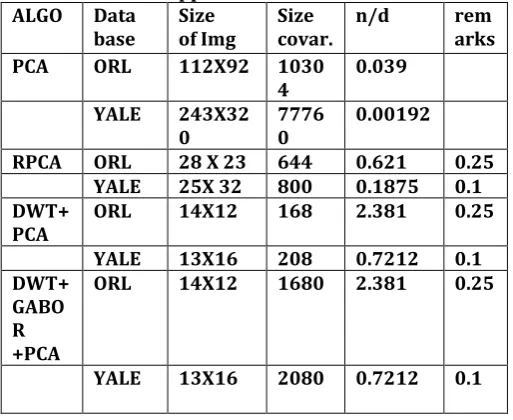
3. Very small sample to dimension ratio (n/d)
4. Sensitivity to scaling, light and rotation
© 2015, IRJET.NET- All Rights Reserved
Page 406
J.Yang et al [9] introduced the concept of two dimensionalPCA(2DPCA) to reduced the time and memory requirement of the original large size of covariance matrix which make size of covariance matrix and the implicit eigenvector have smaller dimensions. But need more coefficient to represent an image than PCA of [8] by 2005 H.Kong et al[12] make the concept generalized. To overcome the limitation of [9] D. Zhang et al[14] introduced the new concept of two directional two dimensional PCA (2D2DPCA)which use two covariance matrices two sets of principal directions are obtained and an image is projected on both sets of principal directions(both side projection).In 2008 Safayani et al[10] carried out extended two dimensional PCA(E2DPCA )which contain richer information than 2DPCA [9] by 2010 S.Nedevschi et al [13] combined the both approach[10] and [14] Diag PCA and introduced Diagonal E2D2PCA which having advantages of both approaches. Author shows comparison with PCA and its various variants for efficiency, execution time (training set and testing set),dimensions of projected matrix and eigenvectors for mxn image on ORL database PCA and all its variants compute the covariance matrix ,symmetric and with real eigen values and diagonalizable by some orthogonal transformation given by its eigenvectors.
2. Hard to scale up: when we add any image to database we require to calculate the covariance matrix from scratch.To overcome this method many IPCA method which not required to recomputed the covariance matrix from scratch can be divided into two categories: First compute the Principal Components (PCs) without computing the covariance matrix [16], and second the candid covariance free IPCA (CCIPCA) algo developed by Weng at el[17]in 2003which generate ”observation” in a complementary space for calculating high order PCs .It estimate PCs by Stochastic Gradient Analysis(SGA) [18]. As PCs are obtained sequentially and the computation of the (i+1) th PC depend on the ith PCand accumulated in the process. Although the estimated vector vi(n) converges to the PC no detailed error analysis was presented in [17].
3. Very small sample to dimension ratio (n / d) : Weng et al[12] definded a sample –to –dimension n/d where n is the no of training samples and d is the dimensions of the sample space.If the ratio is small it may be a problem from statistical estimation point of view. In[12] FRT problems generally the images are high dimensions so by reducing the dimensions of image we can increase the sample to dimension ratio so it can applicable to face recognition.
4. Scaling lighting and rotation sensitivity: Face image can be represented by a combination of large and small scale features. Light variations mainly affect the large scale feature(low frequency components) and not much affect small scale(high frequency components)which required to extract to make recognition light invariant.
Discrete Wavelet Transform (DWT) divide the wavelet transform decomposes the image into three spatial directions, i.e. horizontal, vertical and diagonal. Magnitude of DWT coefficients is larger in the lowest bands (LL) at each level of decomposition and is smaller for other bands (HH, LH, and HL). Face image can be represented by a combination of large and small scale features. Light variations mainly affect the large scale feature (low frequency components) and not much affect small scale(high frequency components).Circular Gabor wavelets created by Gabor filter bank can resolve this issues.
Design of Gabor filter bank:
A column vector with length (m*n*u*v)/(d1*d2).This vector is the Gabor feature vector of an m by n image. u is the number of scales and v is the number of orientations in 'Gabor Array'.m x n input image dimensions (rxc) for feature extraction and d1 and d2 is the down sampling rate for row and column wise so size of feature array is 1680( ORL) and 2080( YALE)
u =5 (no of frequencies), v=8(no of orientations) and m=14, n=12 ,d1=d2=2(ORL)
• u =5 (no of frequencies), v=8(no of orientations) and m=13, n=16 ,d1=1,d2=4(YALE)
• the no of scale or no of frequency is • fu = fmax/(sqrt 2)^u where u=0,1,…U-1
• the no of orientation theta=(pie)*v/V where v=0,1,…V-1
Fig -1: Magnitudes of Gabor filter
© 2015, IRJET.NET- All Rights Reserved
Page 407
1.1
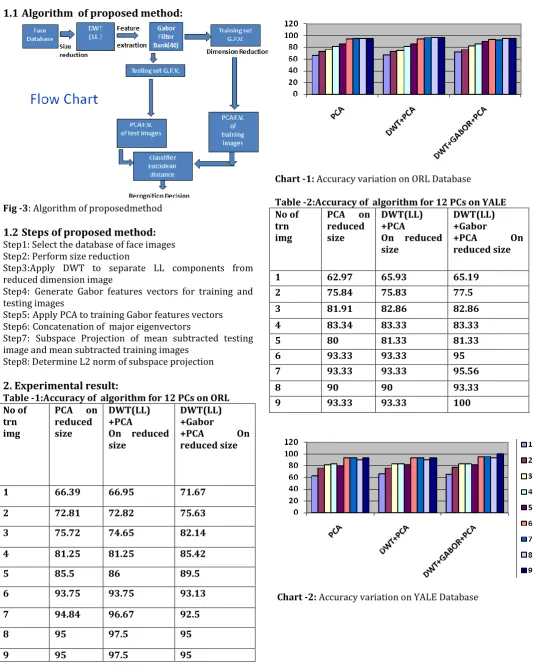
Algorithm of proposed method:
Fig -3: Algorithm of proposedmethod
1.2
Steps of proposed method:
Step1: Select the database of face images Step2: Perform size reduction
Step3:Apply DWT to separate LL components from reduced dimension image
Step4: Generate Gabor features vectors for training and testing images
Step5:Apply PCA to training Gabor features vectors Step6:Concatenation of major eigenvectors
Step7: Subspace Projection of mean subtracted testing image and mean subtracted training images
Step8: Determine L2 norm of subspace projection
2. Experimental result:
Table -1:Accuracy of algorithm for 12 PCs on ORL No of
trn img
PCA on reduced size
DWT(LL) +PCA
On reduced size
DWT(LL) +Gabor
+PCA On reduced size
1 66.39 66.95 71.67
2 72.81 72.82 75.63
3 75.72 74.65 82.14
4 81.25 81.25 85.42
5 85.5 86 89.5
6 93.75 93.75 93.13
7 94.84 96.67 92.5
8 95 97.5 95
9 95 97.5 95
Chart -1: Accuracy variation on ORL Database
Table -2:Accuracy of algorithm for 12 PCs on YALE No of
trn img
PCA on reduced size
DWT(LL) +PCA
On reduced size
DWT(LL) +Gabor
+PCA On reduced size
1 62.97 65.93 65.19
2 75.84 75.83 77.5
3 81.91 82.86 82.86
4 83.34 83.33 83.33
5 80 81.33 81.33
6 93.33 93.33 95
7 93.33 93.33 95.56
8 90 90 93.33
9 93.33 93.33 100
Chart -2: Accuracy variation on YALE Database
© 2015, IRJET.NET- All Rights Reserved
Page 408
significance of reduced dimension which make PCA more applicable in F.R.T on both ORL and YALE database. Computational cost, complexity, memory and time requirement greatly decrease. Gabor filter bank of 40 filters for feature extraction in pre-processing step to extract tolerance free local features from face image so that it can be applicable to uncontrolled real time recognition application under varying light, scaling and shifting conditions.ACKNOWLEDGEMENT
We heartly thankful to Prof.M.V.Goyani(Computer Department) and Prof.P.J.Bhrambhatt(E.C.Department) of L.D.College of Engg. for their generous support.
REFERENCES
[1]Turk, M., Pentland, A.Eigenfaces for recognition.J. Cognitive Neurosci. 3,1, 71–86 (1991).
[2]Yang, J., Zhang, D., Frangi, A.F., Yang, J. Two-Dimensional PCA: A New Approach to Appearance- Based Face Representation and Recognition. IEEE Trans. Pattern Anal. Machine Intell. Vol. 26, No. 1,131–137 (2004).
[3]Mehran Safayani, Mohammad T. Manzuri-Shalmani,Mahmoud Khademi, Extended Two-Dimensional PCA for Efficient Face Repre- sentation and Recognition Proc. of 4th International Conference on Intelligent Computer Communication and Processing (ICCP), luj- Napoca, Romania, pp. 295–298, 2008.
[4] Daoqiang Zhang and Zhi-Hua Zhou and Songcan Chen :Diagonal principal component analysis for face recognition Pattern Recognition, vol 39, nr. 1, p. 140-142, 2006.
[5]Kong, H., Wang, L., Teoh, E.K., Li, X., Wang, J.G., Venkateswarlu, R. Generalized 2D principal component analysis for face image representation and recognition. Neural Netw. 18, 585–594, (2005).
[6] Nedevschi, S. and Peter, I.R. and Dobos, I.-A. and Prodan, C., An improved PCA type algorithm applied in face recognition Proc of 2010 IEEE International Conference on Intelligent Computer Communication and Processing (ICCP), 2010, 256-262.
[7]Zhang, D., Zhou, Z.H.: (2D)2PCA: Two-directional two-dimensional PCA for efficient face representation and recognition Neurocomputing 69. 224–231 (2005)
[8]Marsico M., Nappi M., Riccio D., Wechsler H.,: Robust Face Recognition for Uncontrolled Pose and Illumination Changes. IEEE transaction on Systems, Man, And Cybernetics : System, Vol 43, No.1, January 2013
[9]Xie X.,Zheng,Lai J.,Yuen P.C.Suen Ching Y.Normalization of face illumination based on large and small scale features.IEEE transaction on Image Processing ,Vol 20, No.7, July 2011
[10]Li Z.,Park U.,Jain A.K.,:A Discriminative Model for Age Invariant Face Recognition. IEEE transaction on Information Forensics And Security ,Vol 6, No.3, September 2011
[11]J.T. Kwok and H. Zhao :Incremental eigen decomposition:,inProc.ICANN,Istanbul,Turkey,June 2003 ,pp.270-273
[12]YangM.:Kerneleigenfacesversuskernel fisherfaces:face recognition using kernel methods”
[13] Oja E.,Karhunen:On stochastic approximation of the eigenvectors and eigenvectos and eigenvalues of the
expectation of a random
matrix”,J.Math.Anal.Appl.vol.106,no 1.pp69-84,1985
[14] Chen Li fen et al of: Why recognition in a statistics-based recognition system should be statistics-based on pure face portion :a Probabilstic decision Proof ,Dept.of Comp. Sci & Info.Sci. University of Taiwan
© 2015, IRJET.NET- All Rights Reserved
Page 409
High Intensity Gabor Wavelet Responses:A StatisticalApproach‖, International Journal of computer Science & Emerging Technologies 178 Volume 2, Issue 1, February 2011
[16]Lades M, Vorbruggen J, Buhmann J, Lange J, Cvd Malsburg, Wurtz R, Konen W Distortion invariant object recognition in the dynamic link architecture. IEEE TransComput 42(3):300–311,1993
[17] Wiskott L, Fellous JN, Kruger N, Cvd Malsburg Face recognition by elastic bunch graph matching. IEEE TransPAMI 19(7):775–779,1997
[18] Shan S, Yang P, Chen X, Gao W AdaBoost Gabor Fisher classifier for face recognition. In Proceedings ofternational workshop on analysis and modeling of faces and gestures (AMFG 2005), LNCS 3723, pp 278–291,2005
[19]D. Gabor, Theory of communication, J. Inst. Elec. Eng. 93, 429-457 (1946)
[20] D. Dunn, W. Higgins and J. Wakeley, Texture segmentation using 2-D Gabor elementary function, IEEE Trans. Pattern Analysis Mach. Intell. 16, 130-149 (1994)
[21K. R. Namuduri, R. Mehrotra and N. Ranganathan, Efficient computation of Gabor filter based multi resolution responses, Pattern Recognition 27, 925-938 (1994)
BIOGRAPHIES
Jiger P.Acharya is Lecturer in Goverment Polytechnic Dahod in computer department .He doing his Master in Communication System Engineering (E.C.).His dissertation on Face Recognition in Image Processing Domain. He posses more than 14 years of teaching experience in computer department.