National conference on Engineering Innovations and Solutions (NCEIS – 2018)
International Journal of Scientific Research in Computer Science, Engineering and Information Technology
© 2018 IJSRCSEIT | Volume 4 | Issue 6 | ISSN : 2456-3307
Implementation of MPPT Algorithm for Solar PV cell using P&O,
Incremental Conductance and Constant Voltage Method
Namitha B G, Pooja S P, Sanjana V, Sowndarya Gowda D M, Dhanalaxmi H R
Students of 8thsem,Assistant Professor, Department of EEE,GSSSIETW, Mysuru, Karnataka, India
ABSTRACT
The conventional energy source are depleting day by day at an alarming rate. In the present era, there is an acute shortage of energy source for the production of electricity . The feasible alternative is non- conventional energy source. This paper deals with modelling of PV array including the effects of temperature and irradiation. The DC-DC converter is used for boosting low voltage of the PV array to high DC voltage. Since the efficiency of a PV array is around 13% which is low, it is desirable to operate the module at the peak power point to improve the utilization of the PV array.
A maximum power point tracker (MPPT) is used for extracting the maximum power from the solar PV array and transferring that power to the load. Implementation of MPPT technique has been developed using P&O, incremental conductance and constant voltage algorithm has been done using MATLAB based M file programming scheme.
Keywords. Photovoltaic (PV) array, Maximum power point tracking(MPPT), DC-DC converter, Modelling of PV array.
I.
INTRODUCTION
As the sources of conventional energy depleting day by day, resorting to alternative sources of energy like solar and wind energy has become need of the hour. A field of photovoltaic solar energy has experienced a remarkable growth for two decades
A photovoltaic system directly converts sunlight into electricity. Due to its low power, it is necessary to combine multiple cells into series or into parallel, forming a PV module and modules are further connected into series or into parallel with the required values of current and voltage to form a photovoltaic array. But this photovoltaic system has two major drawback one is that the conversion efficiency required for electrical power generation is very low especially during low irradiation condition may be the efficiency is around 9 to 17%, the second
drawback is that the P-V and I-V characteristics of solar cell is non-linear and it also varies depending upon the temperature and irradiance.
In P&O method [3], [4], there is a perturbation in the operating voltage in the PV array. However, the P&O algorithm cannot compare the array terminal voltage with the actual MPP voltage, since the change in power is only consider to be a result of the array terminal voltage perturbation. As a result, they are not accurate enough and it also slows in finding the MPP if the voltage is far away from the MPP. Thus there are some disadvantages with this method where they fail under rapidly change in atmospheric conditions [5].
Incremental conductance method is the method which overcomes the drawback of the P&O method. In this method the array terminal voltage is always adjusted according to the MPP voltage. It is based on incremental and instantaneous conductance of the PV module [6], [5], [7], [8].
The open circuit voltage d is based on observation that the voltage of the maximum power point is always close to a fixed percentage of the open circuit voltage.
II.
METHODS AND MATERIALFigure 2.2. Block Diagram of MPPT model.
2.1 MODELLING OF SOLAR CELL
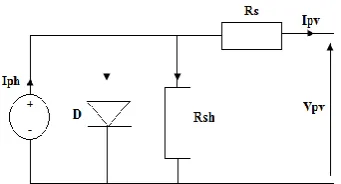
A solar cell is the building block of a solar panel. A photovoltaic module is formed by connecting many solar cells in series and parallel. To understand the Physical behavior of a solar cell, it is useful to create a model which is electrically equivalent, and is based on discrete electrical components whose behavior is well known. This model is known as a single diode model of solar cell.
Figure 2.2. Single diode model of solar cell
The I-V characteristics of the equivalent solar cell circuit can be determined by following equations [1]. The current through diode is given by.
ID = I [exp (q (V + I RS)/KT) – 1] …(1) While, the solar cell output current. I = IL – IL – ISH …(2)
I = IL – I [exp (q(V + I RS)/KT)) – 1] – (V + IRS)/ RSH… (3)
Where.
I = Solar cell current (A) I= Light generated current (A) ID= Diode saturation current (A) q = Electron charge (1.6×10⁻¹⁹ C) K= Boltzmann constant (1.38×10⁻²³ J/K) T= Cell temperature in Kelvin (K) V =solar cell output voltage (V) RS=Solar cell series resistance (Ω) RSH=Solar cell shunt resistance (Ω)
The I-V and P-V curves for a solar cell are given in the following figure. It can be seen that the cell operates as a constant current source at low values of operating voltages and a constant voltage source at low values of operating current.
2.2 MAXIMUM POWER POINT TRACKING The efficiency of a solar cell is very low. In order to increase the efficiency, methods are to be undertaken to match the source and load impedances properly. One such method is the Maximum Power Point Tracking (MPPT). This is a technique used to obtain the maximum possible power from a varying source. In photovoltaic systems the I-V curve is non-linear, thereby making it difficult to be used to power a certain load. This is done by utilizing a dc-dc converter whose duty cycle is varied by using a MPPT algorithm.
MPPT or Maximum Power Point Tracking is algorithm that included in charge controllers used for extracting maximum available power from PV module under certain conditions. The voltage at which PV module can produce maximum power is called “maximum power point‟ (or peak power voltage).
FLOW CHART OF MPPT ALGORITHMS
The most widely used methods for maximum power point tracking are studied here. The methods are
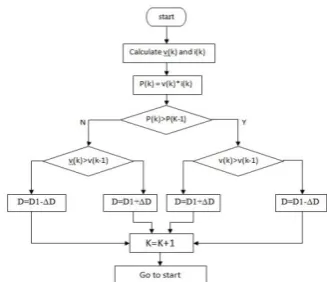
1. Perturb & Observe Method Algorithm
Figure 2.2.1 Flowchart of Perturb & Observe Method
2. Incremental Conductance Method Algorithm
Figure 2.2.2 Flowchart of Incremental Conductance Method
3. Constant Voltage Method
Figure 2.2.3 Flowchart of Constant Voltage Method
III.
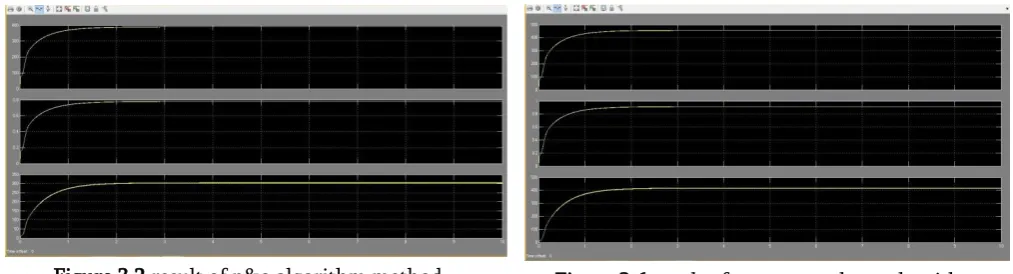
RESULTS AND DISCUSSIONFigure 3.2 result of p&o algorithm method
Figure 3.3 Simulink model of Incremental Conductance Algorithm
Figure 3.4 result of incremental conductance algorithm method
Figure 3.5 Simulink model of Constant Voltage Algorithm
Figure 3.6 result of constant voltage algorithm method
IV.
CONCLUSIONP&O and incremental conductance and constant voltage methods are implemented with MATLAB-SIMULINK for simulation. The MPPT method simulated in this paper is able to improve the dynamic and steady state performance of the PV system simultaneously. Through simulation, it is observed that the system completes the maximum power point tracking successfully despite of fluctuations. When the external environment changes suddenly, the system can track the maximum power point
V.
REFERENCES1. D. P. Hohn and M. E. Ropp ”Comparative study of maximum power point tracking algorithms”, progress in photovoltaic research and applications, 2003, 11.47-62.
2. Monoj kumar, F. Ansari, A. K. Jha “maximum power point tracking using perturbation and observation as well as incremental conductance algorithm”, UREAS, ISSN2294-3905, vol.1, issue 4(2011), pp. 19-31.
3. Femia N petrone G, Spagnuolo G, Vetelli M. ”predictive and adaptive MPPT perturb and observe method”, IEEE Trans. Aerosp. electron. Syst., 2007; 43(3). 934-950.
5. Hussein KH, Muta I, Hoshino T, Osakada M. Maximum photovoltaic power tracking. and algorithm for rapidly changing atmospheric conditions, proc.inst. elect. Eng-gener., transmiss. Distrib., 1995. 14(1). 59-64.
6. Liu F, Duan S, Liu F, Liu B, and Y. Kang Y. A variable step size INC MPPT method for PV systems, IEEE Trans. Ind. Electron., 2008; 55(7). 2622-2628.
7. Liu B, Duan S, Liu F, Xu P. Analysis and improvement of maximum power point tracking algorithm based on incremental conductance method for photovoltaic array, in proc. IEEE PEDS, 2007. 637-641.
8. Kuo Y-C Liang T-G, Chen J-F. “Novel maximum-power-point tracking controller for photovoltaic energy conversion system”, IEEE Trans.Ind. Electron, 2001; 48(3). 594-601.
9. Sera D, Kerekes T, Teodorescu R, Blaabjreg F. Improved MPPT algorithms for rapidly changing environmental conditions. Aalborg, Denmark; Aalborg Univ, Inst. Energy Technol., 2006. 10. Esram T, Chapman PL. Comparison of
photovoltaic array maximum power point tracking techniques, IEEE Trans. Energy convers., 2007; 22(2). 439-449.
11. Chan, D.S., Phang, J.C.H.,. Analytical methods for the extraction of solar-cell single- and double-diode model parameters from I–V characteristics. IEEE Transactions on Electron devices 34, 1987, 286–293.
12. Basim Alsayid Modeling and Simulation of Photovoltaic Cell-Module-Array with Two-Diode Model ? International Journal of Computer Technology and Electronics Engineering (IJCTEE) Volume 1, Issue 3, June 2012.
13. Larranaga Lesaka, J.; Zulueta Guerrero,E; P Perez, E ? Modeling of photovoltaic module? International Conference on renewable Energies and Power Quality (ICRERPQ’10), Canada (Spain), 23th to 25th March,2010;
14. W.De Soto, S.A.Klein, W.A.Beckman
?Improvement and validation of a model for
photovoltaic array performance? solar Energy 80 (2006) 78-88;
15. M.T. Benmessaoud_, F.Z. Zerhouni, M. Zegrar, A. Boudghene Stambouli, M. Tioursi? New approach modeling and a maximum power point tracker method for solar cells? Computers and Mathematics with Applications 60 (2010) 1124-1134,