DOI : https://doi.org/10.32628/CSEIT1952171
AI Based Student Bot for Academic Information System using Machine
Learning
Vijayakumar R, Bhuvaneshwari B, Adith S, Deepika M
Computer science And Engineering/Rajalakshmi Engineering College, Thandalam, Tamil Nadu, India
ABSTRACT
In General all the institutions like colleges sends their notes and information to students individually.
Sometimes the student can’t access it quickly and repetition of data also increased. The realm of this work is to
create a Chatbot for the college purpose. Our work reduces the human work to send every details and notes to all departments by email or some other medium. In this work, academic information's /details feed it to the database which will be available for the long time period. The academic information consists of information about placements details, exam time tables, semester notes and upcoming events. A Chatbot is a computer program or an artificial intelligence which conducts a conversation via auditory or textual methods. The chat bot stores the data by key words and when the user entered data is matched with the key it reply the assigned data for it. The Chatbot is created by using python language and Natural language processing. This project make use of the MySQL database to store the information. With the help of natural language processing the bot AI understand the message sent by the user and reply with the matched key value. In this Chatbot the user first need to login by their college roll number and Department. When the valid person asks about the particular information by text the information gets retrieved from the updated database that related to their department. Through this chat box the student can easily access whenever they want and the data need not to be update more than once.
Keywords : NLP, AI, Chatbot, MySQL
I. INTRODUCTION
Chatbot programs are often designed to convincingly simulate how a human would behave as a conversational partner, thereby passing the Turing test. Chat bots are usually used in dialogue systems for various practical reasons, for example, automated online assistants, giving them the ability to engage the customer. STUDENT BOT is a native Chabot that
will analyze and understand user’s queries and reply
appropriately. A native Chabot is a Chat bot technology which interacts with users in the website browser or any application. This system is a web
service which will provide answers to the queries of the system user.
Artificial intelligence (AI) is the simulation of human intelligence processes by machines, especially computer systems. AIML is a one of the most commonly using algorithm for the artificial intelligence in NLP processing.
Natural Language Processing or NLP is a part of artificial intelligence that will be used to analyze the
user’s queries. Users won’t have to go to the college
college-related information such as timetables, notes, etc. This system also helps the user to get the updated
information’s about the college activities. The query
will be answered on the basis of the knowledge base. The keywords will be fetched from the natural language processing algorithms and a relevant answer will be provided to the user. In case the answer is not available in the knowledge base or the question is irrelevant then the default message will be displayed. A. AIML
Artificial Intelligence Markup Language (AIML) [5] is a set of possible queries and their respective responses. AIML consists of 3 elements such as: categories, pattern and template. Every category consists of a pattern and a template. Patterns are the possible queries that the bot-user may type in and template is the response to the respective pattern. Here, the template is programmed to fetch the data
accordingly from the analytics raw data, if it’s a
domain related query.
Fig 1. Simple AIML Code
B .Natural language Processing
Natural Language Processing (NLP) is the area of research and application that investigates and analyse how the computational techniques can be used to
perceive and alter the user’s human language text or
speech inputs. Natural Language Processing (NLP) techniques can be used in various applications such as machine translations, natural language processing, multilingual and cross language information retrieval (CLIR), speech recognition and Artificial intelligence
system [3]. For this chatbot natural language processing of text inputs are done by dialogflow.
RELATEDWORK
Md Md. Shahriare Satu and Md. Hasnat Prvez [1],
gives us a review of systems which uses AIML based Chatbot to interact with user. He points out that by integrating such Chatbot to system, it can give service around the clock and is low cost. Priyanka Shetty, AdityaKotian[2] developed PantoMath College
Inquiry chatbot by using NLP and Dialogflow to analyses college event query for the user request. Sarthak V. Dothi and his team [3] proposed an android
application that uses AIML interpreter to interact with users using texts and voice responses by using NLP.
Rinkal D. Dharani and Dr. A. C. Suthar [4], proposed a
model in which AIML based chatter bot is integrated with WhatsApp to receive news update. CHARLIE [5],
is an AIML based chatterbot that is used in the field of education. CHARLIE connects students to Intelligent Educational System (INES). It is programmed to maintain general conversation with the students about the learning materials.
IJNTR [6]: April 2017 Intelligent behavior shown by
Alice chatbot system by using AIML, DFS and Pattern matching algorithm for language recognition, implementation of ALICE Chatbot system as a domain specific chatterbox which is a student information system that helps users in various queries related to students and universities. Index al. Artyom keydunow [7], Robert shen-Statsbot for
Personal analytics assistant using linear regression, K means and Decision trees to predict the personality behavior of a human.
MAC 304-2016[8]: Amazon Alexa which is a most
support. SIRI by [9] Apple in 2014 by using Machine
Learning and Automatic speak recognition (ASR) for intelligence behavior.Mind browser[10] journal of go
to platform by IBM Watson by using Natural Language processing and Spontaneous answering software development kit for spontaneous answering.
The section II (PROPOSED SYSTEM), describes about the system architecture in detail and working of each modules. The section 111(IMPLEMENTATION) describes the tools used for front-end, back-end & integration process. The section IV (RESULTS) shows the output of the implementation process. The section V (CONCLUSION) concludes the working system. The section VI (REFERENCE) are the IEEE papers we referred to create our project>
II. PROPOSED SYSTEM
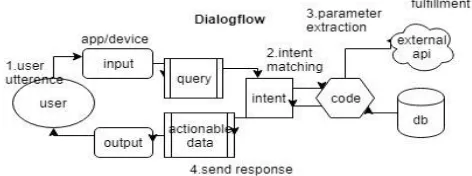
Fig 2. Architecture Diagram
In Fig 2, first the user need to enter his query (input) on the user interface. Then the query is passed to the dialogflow for Pre-processing of the query. For
example, if The query is “what are the subjects for CSE first year”, then the proposed system going to
remove phrases like 'is', 'the' using preprocessing technique. Then the system fetches the keywords from the query and Matches the fetched keywords with the keywords in Knowledge base (intents), and provide an appropriate response. The keywords will be matched with the help of keyword matching algorithm. After this process has been completed the system returns the response as an output to the user. In this proposed system gives the responses in the
format of text. For notes it’s provide a links for the
corresponding document so students can click that to access the notes.
WORKING OF MODULES
The StudBot has 3 modules and there are two types of users. one user is a student and another is an administrator. There three modules in this work. The three modules are login window, Database window and chat window. In the login window the user need to login by their mobile number verified by OTP number. Once they logged in they can access it anywhere at any time. For the administrator special
permission for inserting notes and information’s over
database. In the database window the staff can login and can add academic information's like notes, department updates, events notification and timetables.
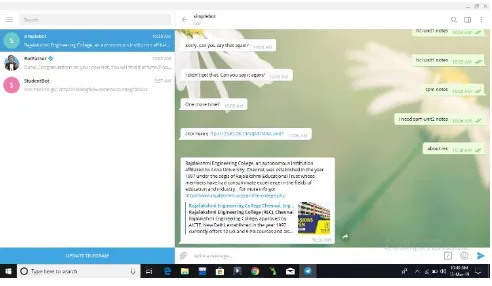
Fig 3. Chat Window
The chat UI shown in the fig 3. and used in chat. In this chat window the user can raises their queries and details that they want and it retrieved from the database for their response. The responses are the immediate reaction over the internet.
III. IMPLEMENTATION
For the implementation of our chatbot here we used the dialogflow AI that provided by google.
and to build engaging voice and text based conversational interfaces powered by artificial intelligence. It does all the heavy lifting of parsing
user’s text or voice and identifying user’s intention. It
uses machine learning to identify the user is chatting or talking. Here we used the dialogflow for the backend process of our process. Machine learning is a field of computer science that gives computers being explicitly programmed and machine learning system improves with experience. The dialogflow has five main parts in it for the implementation of any bot.
INTENT
To define how conversations work, you create intents in your agent that map user input to responses. In each intent, you define examples of user utterances that can trigger the intent, what to extract from the utterance, and how to respond. Intents consist of four main components that allow you to map what your user says to what your agent responds with. These components include the following:
Intent name: The name of the intent. The intent name is passed to your fulfillment and identifies the matched intent.
Fig.4 Dialogflow Agents
Training phrases: Examples of what users can say to match a particular intent. Dialogflow automatically expands these phrases to match similar user utterances.
Action and parameters: Defines how relevant information (parameters) are extracted from user utterances. Examples of this kind of information include dates, times, names, places, and more. You
can use parameters as input into other logic, such as looking up information, carrying out a task, or returning a response.
Response: An utterance that's spoken or displayed back to the user
Fig .5 Intent Training
ENTITIES
Entities are Dialog flow’s mechanism for identifying
and extracting useful data from natural language inputs. While intents allow your agent to understand the motivation behind a particular user input, entities are used to pick out specific pieces of information that your users mention — anything from street addresses to product names or amounts with units. Any important data you want to get from a user's request will have a corresponding entity.
Carrot, scallion, green onion, bell pepper, sweet pepper
When editing an entity type from the Dialogflow console, each row of the display is an entity entry. When using the API, the term entity entry refers to an Entity object. Entity Entry would be a better name than Entity for this object, but we need to maintain backwards compatibility when improving the API.
CONTEXTS
Contexts represent the current state of a user's request and allow your agent to carry information from one intent to another. You can use combinations of input and to control the conversational path the user takes through your dialog.
EVENTS
Events allow you to invoke intents based on something that has happened instead of what a user communicates. Dialogflow supports events from several platforms (like Google Assistant, Slack, and more) based on actions users take on those platforms. You can also create your own custom events that can be triggered via fulfillment or the detect Intent.
Fig 5. Entity Training
FULFILLMENT
Fulfillment is code that's deployed as a webhook that lets your Dialogflow agent call business logic on an intent-by-intent basis. During a conversation, fulfillment allows you to use the information
extracted by Dialog flow’s natural language
processing to generate dynamic responses or trigger actions on your back-end.
Most Dialogflow agents make use of fulfillment. The following are some example cases where you can use fulfillment to extend an agent: To generate dynamic responses based on information looked up from a database. To place orders based on products a customer has asked for. To implement the rules and winning conditions for a game.
After completing all this we get our agent ready. When the user enter his query from the raw data the structured data is derived and its match with the key value and parameters.
When the key is matched the defined responses is will generated on the chat window. If the key parameter value is not matched it return the default value. The key and parameter value are scanned from the entity field.
INTEGRATION TOOLS
When our agent is trained all the data’s it is
integrated for the better user interface. In Dialogflow so many integration tools are there such as with Facebook Messenger, Telegram, webhook, web demo, slack and amazon Alexa and etc. In our chatbot we integrate our bot with Node.js with angular js framework.
ANGULAR JS
AngularJS is a JavaScript framework. It can be added to an HTML page with a <script> tag. AngularJS extends HTML attributes with Directives, and binds data to HTML with Expressions. In this work, The AngularJS and NodeJS is used in UI implementations.
developing dynamic, single page web apps and supports the (MVC) programming structure.
Fig 6. Basic Conversation NODE.JS
Node.js is an open source, cross stage platform built on Google chrome V8 JavaScript runtime engine for developing fast, scalable and lightweight web applications. Node.js applications are written in JavaScript. This application can runs within the Node.js runtime on Linux and Microsoft Windows. This framework offers a rich library of various JavaScript modules to simplify web development process. The runtime condition translates JavaScript
with use of Google’s V8 JavaScript motor. Node.js is
highly scalable because it is capable of handling a large number of simultaneous connections with high output. APi.ai (Dialogflow) package allows integrating agents from the Api.ai natural language processing service with a web application.
IV.RESULTS
The fig 6 shows the implementation of the successful basic conversation of the bot with the user. Initially StudenrBot welcomes the user with welcome message as shown in fig 6. The responses from this proposed system are in the format of text as well as hyperlink. The hyperlink responses provide additional information about the particular query from the google feed. The Hyperlink response shows
the .pdf files links for the notes provided by the Student Bot. When student clicks on the link, the system redirect to the notes with the supported application that can open the particular document.
Fig 7. Hyperlink Response
V. CONCLUSION
In this work, the proposed StudentBot would enable bot users to just type the query related to their college and department and will get response immediately. The proposed system needs to develop a database where all the related data will be stored and to develop a web interface or app interface for the user to access it. The tool was evaluated based on the quality of response and it performed well.
VI.REFERENCES
[1]. Md. Shahriare Satu, Md. Hasnat Parvez, and Shamim-Al-Mamun, “Review of integrated applications with AIML based chatbot,” 1st
International Conference on Computer & Information Engineering, November 2015. [2]. Priyanka Shetty, Aditya Kotian, Dhanashree
Narsale, Prof. Chhaya Narvekar,”International
journal of research in applied science and
research” for pantomath Chatbot in Volume 6
issue III ,march 2018.
[3]. Maria das Graças Bruno Marietto, Rafael Varago de Aguiar, Gislene de Oliveira Barbosa, Wagner Tanaka Botelho, Edson Pimentel, Robson dos Santos França, and Vera Lúcia da
Silva, “ARTIFICIAL INTELLIGENCE
MARKUP LANGUAGE: A BRIEF TUTORIAL,”
International Journal of Computer science and engineering Survey(IJCSES), July 2013.
[4]. Sartahk V. Doshi, Suprabha B. Pawar, Akshay G. Shelar and Shraddha S. Kulkarni, “Artificial
Intelligence Chatbot in Android System using Open Source Program-O,” International
Journal of Advanced Research in Computer and Communication Engineering, April 2017. [5]. Rinkal D. Dharani, and Dr. A.C. Suthar,
“INTEGRATION OF AIML CHATTER BOT
FOR NEWS APPLICATION ON WHATSAPP,”
International Research Journal of Engineering and Technology (IRJET), May 2016.
[6]. Mikic, Fernando A., Juan C. Burguillo, Martin Llamas, Daniel A. Rodriguez, and Eduardo
Rodriguez, “CHARLIE: An AIML-Based
Chatterbot Which Works as an Interface
among INES and Humans.” EAEEIE Annual
Conference, 2009.
[7]. Vibhor Sharma, Monika Goyal, Drishti
Malik,”An intelligent behaviour by alice Chatbot,” International journal of new
technology and research, ISSN: 2454-4116, Volume-3, Issue-4, and April 2017.
[8]. Artyom keydunow,Robben shen ,”International
journal of pure and applied mathematics”,for
alexa Volume 119 no.12 2018,229-238
[9]. Thomas N. T, “An e-business chatbot using
AIML and LSA”, International Conference on
Advances in Computing, Communications and Informatics (ICACCI), September 2016.
[10]. A. Phippen, L. Sheppard, and S. Farnell, “A
practical evaluation of
web analytics,”in mind browser, Internet
Research , 284-293, 2004.
Cite this article as :
Vijayakumar R, Bhuvaneshwari B, Adith S, Deepika M, "AI Based Student Bot for Academic Information System using Machine Learning", International Journal of Scientific Research in Computer Science, Engineering and Information Technology (IJSRCSEIT), ISSN : 2456-3307, Volume 5 Issue 2, pp. 590-596, March-April 2019. Available at doi : https://doi.org/10.32628/CSEIT1952171