How Well Conditional Random Fields
Can be Used in Novel Term Recognition
Xing ZHANGa, Yan Songb, and Alex Chengyu Fangb
a
Department of Chinese, Translation and Linguistics, City University of Hong Kong
Kowloon, Hong Kong SAR
Department of Chinese, Translation and Linguistics, City University of Hong Kong
Kowloon, Hong Kong SAR {yansong, acfang} @cityu.edu.hk
Abstract. In this paper, we describe the construction of a machine learning framework that exploit syntactic information in the recognition of biomedical terms and present the limits of machine learning in generating a novel term candidate list. Conditional random fields (CRF), is used as the basis of this framework. We make an effort to find the appropriate use of syntactic information, including parent nodes, syntactic paths and term ratios under this machine learning framework. The experiment results show that CRF model can achieve good precision in term recognition if trained with known term list. However, with regard to discovering potential novel terms for terminology lexicon editors, CRF model fails to show good performance, if trained with known term list only to predict novel terms in testing corpus. Therefore, this result suggests that more semantic information may be needed to determine a word to be a novel term during a specific period.
Keywords: term recognition, novel term recognition, conditional random fields
1
Introduction
This paper explores the use of Conditional Random Fields (CRF) in novel term recognition. It investigates the recognition of medical terms using CRF model. A variety of methods have been used in term recognition, some are linguistics focused, some are statistically motivated, and a large part of approaches combine these two together. Recently, with the development of machine learning models, a lot of work has attempted to extract terms using machine learning methods.
The usual practice of machine learning depends on training data and a set of discriminating features. Then, machine learning systems use training data to “learn” features useful for term recognition. The widely used standard features for machine learning include orthographic features, POS tags, prefix, and suffix information (Krauthammer and Nenadic, 2004). However, few studies have tried to make use of dynamic linguistic features in respect of term usage in real text. As Zhang and Fang (2009) found out, syntactic functions can be used effectively in selecting and ranking term candidates, which means termhood can be captured by computing term ratios in syntactic paths.
The work reported in this paper was supported in part by research grants from the City University of Hong Kong (Project No. 9610126, 7008002, 7002387 and 7002190).
partitioned this corpus into 10 subsets, each consisting of 2002 abstracts. After parsing, each sentence will be changed into a parsing tree with tags indicating syntactic functions in both phrasal level and clausal level.
Three lists of medical terms were created from Medical Subject Headings beforehand as gold standard. The first term list collects terms from 1954 to 2009 and this list is released in 2010 (MeSH 2010). This MeSH term list consists of 602,436 terms and is referred as general term list in this study. The second term list used in this study is novel term list in 2009. This novel term list collects this special group of terms which are included into MeSH in the year of 2009 and are considered as novel terms of 2009 in current study. This novel term list contains 422 terms (New MeSH term in 2009). The third term list collects terms from 1954 to 2008 and contains 594,854 terms. This MeSH list was released in 2009, therefore referred as MeSH 2009.
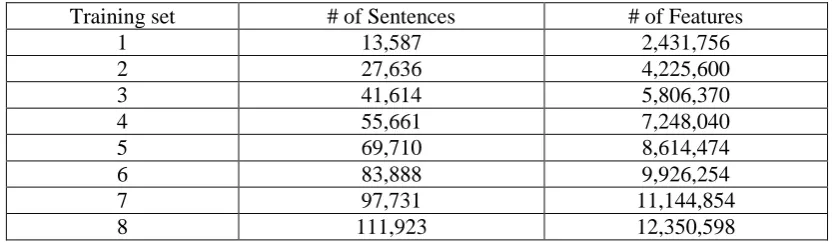
For different experiments in this study, different training and testing sets are constructed. As for experiments on effects of different training sizes, different training sets are constructed. We are going to examine how the system performs when trained on corpora of different sizes while tested on the same corpus. We set the training corpora to testing corpora ratio to be ranged from 1 to 1 to 8 to 1. Basic statistics for training and testing corpora are shown in following table (Table 2). Training set 1 contains one subset of corpus, training set 2 contains two subsets of corpora and training set 3 contains subsets of corpora. The other training sets are constructed in the same fashion. Also, the testing set contains one subset of corpus. Therefore, the training to testing ratio of training set 1 over testing set is 1 to 1 and of training set 2 is 2 to 1, and of training set 3 is 3 to 1. Likewise, the other training sets have corresponding training and testing ratios. As a result, the training to testing corpora ratio of training set 1 to training set 8 is increased from 1 to 1 to 8 to 1.
Table 2: Basic statistics for training and testing sets for effects of training size.
Training set # of Sentences # of Features
1 13,587 2,431,756
2 27,636 4,225,600
3 41,614 5,806,370
4 55,661 7,248,040
5 69,710 8,614,474
6 83,888 9,926,254
7 97,731 11,144,854
8 111,923 12,350,598
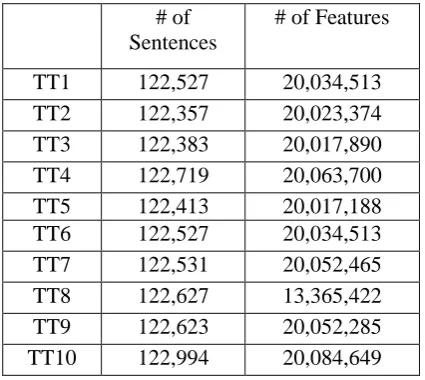
Table 3: Basic statistics of 10 subsets for cross validation. # of
Sentences
# of Features
TT1 122,527 20,034,513 TT2 122,357 20,023,374 TT3 122,383 20,017,890 TT4 122,719 20,063,700 TT5 122,413 20,017,188 TT6 122,527 20,034,513 TT7 122,531 20,052,465 TT8 122,627 13,365,422 TT9 122,623 20,052,285 TT10 122,994 20,084,649
4.2
Conversion from Parsing Sentences to Matrixes
Feature selection is very important in machine learning systems. In this study, we use syntactic information, including POS tags, parent nodes, single or compound, syntactic paths and term ratios. After parsing by The Survey Parser, MEDLINE abstracts will be tagged and presented in syntactic trees. The next work is to convert each syntactic tree into a matrix that can be processed by CRF model, and each matrix is composed of 7 features (see Table 1).
For the feature „Scale of Term Ratio‟, it means a scale from 1 to 3 to indicate three categories of term ratios. More specifically, term ratios of syntactic paths are obtained from training corpus under a separate system (Zhang and Fang, 2010). At first, the training corpora will be matched against the MeSH term list and term occurrence frequencies in each syntactic path will be calculated, and then the proportion of term occurrence frequencies in this syntactic path over all term occurrence frequencies is defined as term ratios.
Then in order to convert term ratios into an index that can be recognized by CRF, a scale from 1 to 3 is adopted instead. This index is based on the span between minimum term ratio and maximum term ratio calculated from all the sentences among training corpora. This span is divided into 3 scales, numbered as 1 (the weakest level), 2 (the middle level) and 3 (the strongest level). 1 means the term ratio of this syntactic path falls within the first scales, 2 means the middle scale and 3 the last.
In addition, the feature „Single or Compound‟ indicates whether a token is one single word or part of a compound. More precisely, if it is part of a compound, which part it occurs in? Is the beginning of this compound (B), or the ending of it (E), or in the middle (I). As there are compounds consisting of more than 3 words, we tag the first word to be B, the last to be E, and the rest in the middle to be I. The reason to split compounds into single words is because that CRF framework requires the matrix for it handles single tokens in sequence.
4.3
Evaluation
The evaluation will use the standard formula F-score, which is defined as F = (2PR)/ (P + R), where P denotes the precision and R denotes the recall.
4.3.1 Experiments on Training Size
The experiments in this round are conducted 8 times to look at effects from increasing the training corpora. The ratio of training corpora to testing corpora will be controlled from 1 to 1 to 8 to 1. The performance on each set is shown in Table 4. And in training corpora, tokens matched with MeSH 2010 will all be tagged terms; furthermore, for these matched with new MeSH term list (new MeSH term list in 2009), they are tagged as novel terms specifically.
Table 4: Performance on novel terms.
Training and Testing Ratio Precision Recall F-score
1 to 1 0.917 0.048 0.091
2 to 1 0.911 0.286 0.435
3 to 1 0.908 0.286 0.435
4 to 1 0.906 0.286 0.434
5 to 1 0.905 0.429 0.582
6 to 1 0.904 0.476 0.624
7 to 1 0.903 0.524 0.663
8 to 1 0.903 0.524 0.663
From above tables, it can be noted that under this CRF framework, precisions for novel term extraction are all above 90%. These results are much better than aforementioned precision of 75% (Utsuro et al., 2006). Thus, it is fair to conclude that syntactic features as parent nodes, syntactic paths and term ratios can be used as effective features under CRF framework in respects of novel term recognition.
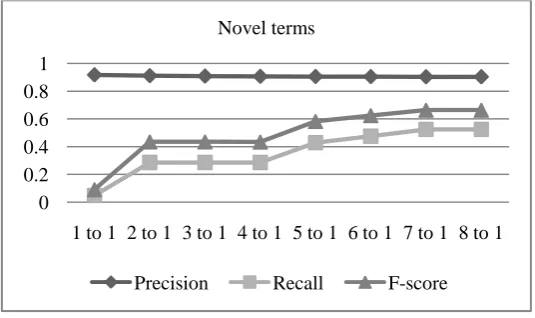
Moreover, we can find some general trends in following figure.
Figure 1: Performance on novel terms.
In Figure 1, which describes performance on novel terms, line describing precision is opposite to the other two lines of recall and F-score, which are in accordance with the graph of logarithmic function. It shows when training and testing ratio is set as 1 to 1, the precision is highest, while the recall and F-score are lowest. On the contrary, when training and testing ratio is increased to 8 to 1, the recall and F-score are highest while precision is lowest. Generally, the
0 0.2 0.4 0.6 0.8 1
1 to 1 2 to 1 3 to 1 4 to 1 5 to 1 6 to 1 7 to 1 8 to 1 Novel terms
precision of novel terms extraction is decreased consistently from the training and testing ratio of 1 to 1 to 8 to 1, while recall and F-score are increased consistently.
4.3.2 Experiments on 10-folds Cross Validation
The experiment for 10-folds cross validation is conducted 10 times on 10 sets of corpora. Each set has the same training to testing ratio of 9 to 1. The performances on each set are shown separately in following table (Table 5) and descriptive statistics of these performances are shown in table 6.
Table 5: Performance on novel terms of 10 subsets.
Novel terms Precision Recall F-score
TT1 0.902 0.538 0.674
TT2 0.902 0.500 0.643
TT3 0.902 0.459 0.609
TT4 0.900 0.472 0.620
TT5 0.900 0.724 0.803
TT6 0.902 0.538 0.674
TT7 0.900 0.765 0.827
TT8 0.901 0.767 0.828
TT9 0.901 0.615 0.731
TT10 0.900 0.591 0.713
Average 0.901 0.598 0.712
Table 6: Descriptive statistics for novel terms.
For the average performance of these 10 subsets (see Table 6), the highest recall among these 10 subsets only reaches 0.767 and the highest F-score is 0.828. However, we can see precisions across the 10 subsets are around 0.901 on average, which is a satisfying result of applying CRF model into recognizing novel terms, especially considering that only syntactic knowledge is used in this experiment.
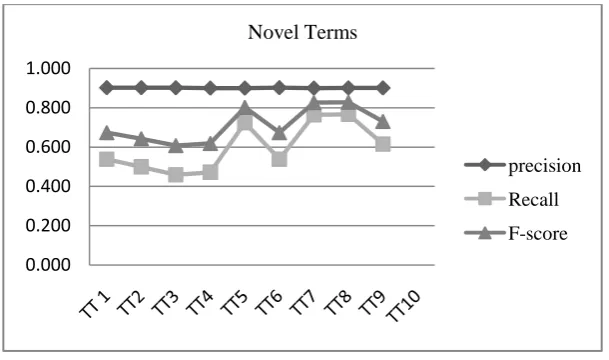
However, in Figure 2 we can find greater fluctuations in lines of either recall or F-score for novel terms. This may indicate novel term recognition is greatly affected by sampling. The possible reason may be that novel terms are far sparser than general terms. They are scattered more broadly across testing corpora.
Descriptive Statistics Precision Recall F-score
Mean 0.901 0.597 0.712
SD 0.001 0.111 0.079
Minimum 0.900 0.459 0.609
Figure 2: Performance on novel terms of 10 subsets.
4.3.3 Generation of Novel Term Candidates List
As introduced earlier, the final objective of this study is to generate a novel term candidate list for human experts to discover novel terms. Therefore, a novel term candidate list is generated. To evaluate this candidate list, the novel term MeSH term list in 2009 (New MeSH term in 2009) is used as gold standard in this regard. While for training, term list „MeSH 2009‟ is used, which has no overlap with term list „New MeSH term in 2009‟.
After testing, CRF framework will have tagged 1 or 0 to a token in a matrix if it judges this token be MeSH term or not. Therefore, all these tokens tagged as 1 are terms recognized by CRF. However, for tokens labeled as B, I, or E, the situation is more complicated as these labels indicate there is originally a compound. For this reason, for a token labeled as either B, or I or E, and if it is also labeled as 1, this token will be combined with tokens immediately close to it to generate term candidates. Specifically, only tokens between the same group of B and E should be taken into consideration for combination. And furthermore, tokens within this group will only be combined in sequence. To illustrate this process, the combining principles are listed as following:
Rule 1: for token labeled as S, if it is labeled 1, add this token to term candidate list. Rule 2 and Rule 3 are applied for token that is part of a compound.
Rule 2: for token labeled as B, or I, or E, if it is labeled 1, combine B+I, B+I+E and I+E, and then add these combinations to term candidate list.
Rule 3: for token labeled as B, or I, or E, if it is labeled 1, and if there are more token labeled as I, e.g. I1 and I2, combine I1+I2, B+I1+I2, B+ I1+I2+E, I1+I2+E, and add these combinations to term candidate list.
In addition, all these candidates will be matched against MeSH 2009 at first to check if this term is already included into MeSH 2009. If it is not, this term will be considered as novel term candidates in 2009 in a comparative sense
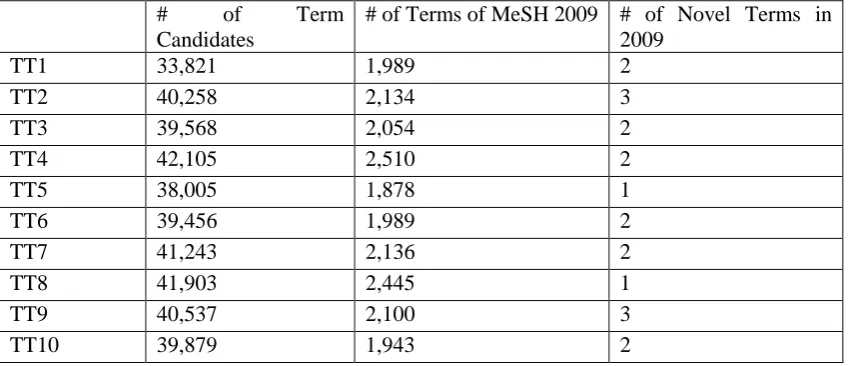
As we have testified that when ratio of training to testing corpora is set as 9 to 1, the recall of novel terms will be higher than other ratios. In this case, we choose training to testing corpora of the ratio 9 to 1 to conduct following experiment to generate novel candidate list. And the results are shown in Table 7.
The first column is the number of candidates that generated by above combining rules together. And the second column is the number of terms already included in MeSH 2009 among these term candidates. The third column is the number of terms that appear in new MeSH term list in 2009 and are considered as the novel terms predicted by current experiment.
As we can see from Table 7, there are only a small number of novel terms predicted by CRF model. Moreover, we have no confidence to say that this number could be increased if we increase the training corpora to be big enough, as currently the training corpus has already
0.000 0.200 0.400 0.600 0.800 1.000
Novel Terms
precision
Recall
around 122,000 sentences. The ability of CRF model to discover novel terms from large amount of corpora is not successful in this study.
Table 7: Novel terms discovered.
# of Term
Candidates
# of Terms of MeSH 2009 # of Novel Terms in 2009
TT1 33,821 1,989 2
TT2 40,258 2,134 3
TT3 39,568 2,054 2
TT4 42,105 2,510 2
TT5 38,005 1,878 1
TT6 39,456 1,989 2
TT7 41,243 2,136 2
TT8 41,903 2,445 1
TT9 40,537 2,100 3
TT10 39,879 1,943 2
5
Conclusion
Therefore, through above data analysis of the first and second experiment, we find increasing training size will help retrieve sparse novel terms, but the precision of novel term recognition will be impacted. This proves performance is influenced by sampling more greatly. Different sampling will have quite different recalls. The reason maybe as novel terms scattered sparsely in corpora, if some novel terms never appeared in training corpora, there is no chance that CRF model could learn its features and label it correspondingly. In such case, it would not be tagged as true term in testing corpora; therefore, this term would not be retrieved.
The third experiment explores to generate a novel term candidate list for human experts to judge before they decide which will be included into existing terminology lexicon. The results show that only few of novel terms are discovered by CRF model, though training corpora are quite large. This restriction may be caused by the fact that novel terms are quite sparse compared to existing terminology lexicon.
References
Chandra, Ashok K., Dexter C. Kozen, and Larry J.Stockmeyer. (1981). Alternation. Journal of the Association for Computing Machinery, 28(1):114-133.
Justeson, J. S., and Katz, S.M. (1995). Technical Terminology: some linguistic properties and an algorithm for identification in text. Natural Language Engineering 1(1):9--27.
Krauthammer, M. and Nenadic, G. (2004). Term identification in the biomedical literature. J Biomed Inform, 37(6):512-526.
Lafferty, J. D., McCallum, A. and Pereira, F. C. N.: Conditional random fields: Probabilistic models for segmenting and labeling sequence data. In ICML '01: Proceedings of the Eighteenth International Conference on Machine Learning, pp 282-289, San Francisco, CA, USA, 2001.
National Library of Medicine. Fact sheet: medical subject headings (MeSH). [Web document]. Bethesda, MD: National Institutes of Health. 2010. [Last updated: 01 April 2010; cited 9 April 2000]. <http://www.nlm.nih.gov/pubs/factsheets/mesh.html>.
Song Y., Kit, C.Y., Xu, R.F., Zhao, H. How Unsupervised Learning Affects Character Tagging based Chinese Word Segmentation: A Quantitative Investigation, in Proceedings of International Conference on Machine Learning and Cybernetics, Jul, 2009.
Song Y., Kit, C.Y. PCFG parsing with CRF tagging for head recognition, in Proceedings of CIPS-ParsEval-2009, pp.133-137. Nov, 2009.
Takeuchi, K., and Collier, N. (2004). Bio-medical entity extraction using support vector machines, Artificial Intelligence in Medicine, Volume 33, Issue 2, Pages 125-137.
Tsai, T.H., Chou, W.C. and Wu, S.H.(2005). Integrating linguistic knowledge into a conditional random field framework to identify biomedical named entities. Expert Systems Appl. v30 i1. 117-128.
Utsuro, T., Kida, M., Tonoike, M., Sato, S. (2006). Collecting novel technical term from the Web by estimating domain specificity of a term. In: Matsumoto, Y., Sproat, R.W., Wong, K.-F., Zhang, M. (eds.) ICCPOL 2006. LNCS (LNAI), vol. 4285, pp. 173–180. Springer, Heidelberg.
Zheng, D, Zhao, T. and Yang, J. (2009). Computer Processing of Oriental Languages. Language Technology for the Knowledge-based Economy, Proceedings of 22nd International Conference, ICCPOL 2009, Hong Kong, March 26-27.
Zhao H., Huang C.N., and Li M.
An Improved Chinese Word Segmentation System with Conditional Random Field,
Proceedings of the Fifth SIGHAN Workshop on Chinese Language Processing (SIGHAN-5), pp.162-165, Sydney, Australia, July 22-23, 2006.