Research on concept-sememe tree and semantic relevance
computation
GuiPing Zhang 1, Chao Yu1, DongFeng Cai1, Yan Song1, JingGuang Sun1 1 Natural Language Processing Laboratory, Shenyang Institute of Aeronautical Engineering
P.O.box 118, No.52 North Huanghe Street, Shenyang, Liaoning, China, 110034. Email: [email protected], [email protected], [email protected],
[email protected] , [email protected]
Abstract. In this paper, we parse the hierarchy relation of concepts in HowNet, with the parsing we design a concept-sememe tree structure, which can make it easy to understand the relations between the sememes in concepts. The tree structure can easily describe the relationship between sememes in concept and make it more convenient to process by computer. The steps of building the tree are also presented in this paper. We then discuss the relevance computation based on HowNet. The preliminary experiment shows the relevance computation method can achieve satisfying results.
Keywords: HowNet; relevance; concept-sememe tree.
1 Introduction
The computation of similarity and relevance between words has wide application in the fields of machine translation, sense disambiguation, IR etc. In some cases, similarity and relevance may be confused. Similarity between words refers to the feature of clustering while relevance refers to the extent of association [1]. The two words with similar semantic relationship may have similar associated words such as the words “医生(doctor)” and “护士(nurse)”, both have the same associated words as “医 院(hospital), 病人(patient), 打针(have an injection), 吃药(drug)” etc. However, associated words usually have no similarity such as the word pair “吃 (eat)” and “食物(food)” etc.
Researches on computation of similarity and relevance are widely spread in the world. Recently, there are two semantic similarity computation methods based on HowNet: one is described by Professor Liu Qun in [2] and the other is described by professor Dong ZhenDong in [3]. In this paper, we describe how to build concept-sememe tree on the basis of decomposing word concept definition (DEF). The concept-sememe tree illustrates DEFs of the words and makes them easy to process by computer.
2
Concept similarity computation and the implementation of the
concept-sememe tree
Concept is a kind of description of word sense. Polysemous words have several different concepts. Because polysemous words contain several concepts, we must ascertain the DEFs of the polysemous words before we compute the semantic similarity of the word pairs. Thus the computation of the semantic similarity is, in fact, to compute the similarity of the concepts.
2.1 HowNet based concept similarity computation
form and the same structure of these concepts. In practical computation, it is not easy to determine whether two concept nodes are with the same structure. In this paper we design the concept-sememe tree which translates concept DEF into tree structure, it can make us convenient to understand the hierarchy structure of concept DEF and also can make it easy to process by computer. For example, the concept DEF of the concept “医生(doctor)” and “护士(nurse)” are shown as:
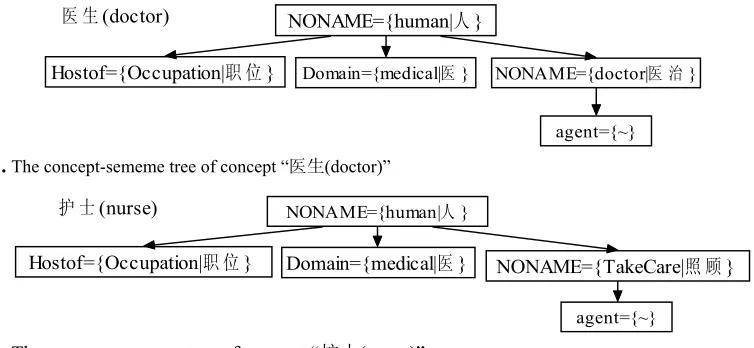
“医 生(doctor)”:DEF={human|人:HostOf={Occupation|职 位},domain={medical|医},{doctor|医 治:agent={~}}};“护 士(nurse)”:DEF={human|人:HostOf={Occupation|职 位},domain={medical| 医},{TakeCare|照料:agent={~}}}
Through the analysis of the concept DEF we develop a program to decompose concept DEF and build concept-sememe tree as fig1 and fig2:
Domain={medical|医}
NONAME={human|人}
NONAME={doctor|医 治}
Hostof={Occupation|职 位}
agent={~}
医 生(doctor)
Fig. 1.The concept-sememe tree of concept “医生(doctor)”
Domain={medical|医}
NONAME={human|人}
NONAME={TakeCare|照 顾}
Hostof={Occupation|职 位}
agent={~}
护 士(nurse)
Fig. 2. The concept-sememe tree of concept “护士(nurse)”
We can see there are five concept nodes in the concept-sememe tree of “doctor” and “nurse” respectively. Seen from the character form, there are four same pairs of the concept node, they are: “NONAME={human|人}”, “Hostof={Occupation|职位}”, “Domain={medical|医}” and “agent={~}”. But we will find from the concept-sememe tree of concept “医生(doctor)” that the father node of concept node “agent={~}” is “NONAME={doctor|医治}”,and so to the concept-sememe tree “护士 (nurse)”, the father node of “agent={~}” is “NONAME={doctor|照顾}”,that is ,their corresponding father nodes are different, so we consider the concept node “agent={~}” of concept “医生(doctor)” is different from that of concept “护士(nurse)” in structure. That is, in these two concepts with five concept nodes, the same number of concept nodes is three, which is the most important reference to similarity computation between concepts. The computation is described in detail in [3].
2.2 The process of building concept-sememe tree
1:We categorize the concept node into two types, one type is the “dynamic role = {value}” which has been fully described. The partly described ones are classified to the other type. For example, in the concept DEF of “医生(doctor)” “HostOf={Occupation|职位}” is the first type and “human|人”, “doctor|医治” is the second type.
2:The method of searching the father node to one concept node of the first type: to any concept node (Node(i)), find the nearest colon j which is ahead of Node(i), if the number of the symbol “{” equals to the number of “}” between the area of Node(i) and colon j, so the concept node which is ahead of colon j is the father node of Node(i). Otherwise find the next position of the colon which is ahead of colon j, continues the same judgment.
node which is ahead of colon j is the father node of Node(i). Otherwise find the next position of the colon which is ahead of colon j, continues the same judgment.
4:When father nodes of all concept nodes are found, we can easily describe the relationship of the sememes through concept-sememe tree.
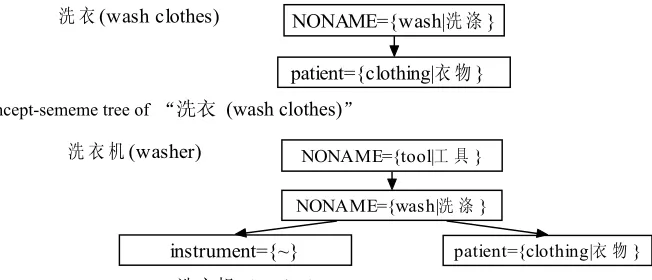
Now we make an example to illustrate the use of concept-sememe tree: The DEFs of the words “洗衣 (wash clothes)” and “洗衣机(washer)” are “{wash|洗涤:patient={clothing|衣物}}” and “{tool| 用 具 :{wash| 洗 涤 :instrument={~},patient={clothing| 衣 物 }}}” respectively. According to procedure mentioned above we can build concept-sememe tree as fig 3, 4 shows:
patient={clothing|衣 物}
NONAME={wash|洗 涤}
洗 衣(wash clothes)
Fig. 3. Concept-sememe tree of “洗衣 (wash clothes)”
NONAME={wash|洗 涤} NONAME={tool|工 具}
patient={clothing|衣 物}
instrument={~}
洗 衣 机(washer)
Fig. 4. Concept-sememe tree of “洗衣机 (washer)”
It is easily seen from fig 3,4 that the concepts “洗衣(wash clothes)” and “洗衣机(washer)” have two same concept nodes which are concept node “wash|洗涤” and concept node “patient={clothing|衣 物}” in the form of character. But the ancestral nodes of the two concept-sememe trees are “wash|洗 涤” and “tool|工具” respectively. Then there won’t be any same concept nodes between them. Thus the value of similarity between concepts “wash clothes (洗衣)” and “washer (洗衣机)” is small in HowNet.
3 Semantic relevance computation
Semantic relevancy refers to how close of the relationship between two words is. In this paper, we decide to implement conceptrelevance computation by using HowNet. The sememes in concept of the words and related concepts field[4] in HowNet provide anapproach for relevance computation.
Relevant concepts are the concepts which are associated with the concept of a given word. Related concepts field is a set of relevant concepts, which is figured by words.
3.1 Compute the relevance Rel1 of the sememes of DEFs between two words
The expression of the sememes of the word concept provides clues for us to build the association relationship of the words. We separate the DEF into the set of sememes. The overlap of the sememes indicates the extent of semantic relevancy, here we describe it as Rel1. See the following formula (1):
1( , ) | |
| |
A B
A B
Sememe Sememe Rel A B
Sememe Sememe
= ∩
∪ (1)
4 Experiment
After the computation of Rel1(A, B)、Rel2(A, B)、Rel3(A, B), we can use formula (4) to
compute the concept relevance between words A and B.
1 1 2 2 3 3
( , ) ( , ) ( , ) ( , )
Rel A B =βRel A B +β Rel A B +β Rel A B
(4)
Here βi is an adjustable weight coefficient and the sum is 1. In our experiment, these parameters are:
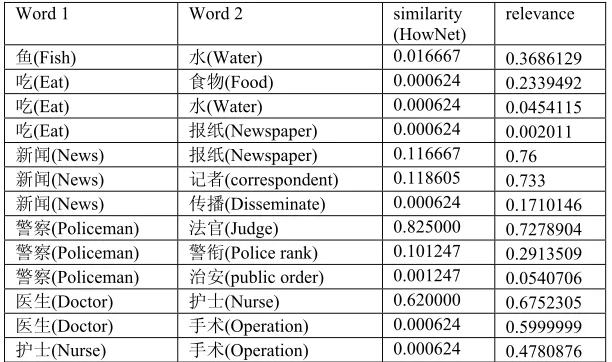
β1=0.3,β2=0.2,β3=0.5. Here we list some experimental results in table 1: Table 1. relevance computation results
Word 1 Word 2 similarity
(HowNet) relevance 鱼(Fish) 水(Water) 0.016667 0.3686129 吃(Eat) 食物(Food) 0.000624 0.2339492 吃(Eat) 水(Water) 0.000624 0.0454115 吃(Eat) 报纸(Newspaper) 0.000624 0.002011 新闻(News) 报纸(Newspaper) 0.116667 0.76 新闻(News) 记者(correspondent) 0.118605 0.733 新闻(News) 传播(Disseminate) 0.000624 0.1710146 警察(Policeman) 法官(Judge) 0.825000 0.7278904 警察(Policeman) 警衔(Police rank) 0.101247 0.2913509 警察(Policeman) 治安(public order) 0.001247 0.0540706 医生(Doctor) 护士(Nurse) 0.620000 0.6752305 医生(Doctor) 手术(Operation) 0.000624 0.5999999 护士(Nurse) 手术(Operation) 0.000624 0.4780876
From the table we can see that most experimental results are satisfying. The words with strong similarity also get high relevance value such as the words “警察(policeman)” and “法官(judge)”. The words with strong relevancy usually do not show strong similarity such as words “新闻(news)” and “记 者(correspondent)” etc.
5 Conclusion
The experimental result is acceptable and conforms to human’s intuition. In the future work, we will make some further researches on semantic information of concept of word and we will classify the concepts to make the relevance value more reasonable.
References
1. Dagan I., Lee L. and Pereira F. (1999), Similarity-based models of word cooccurrence.
2. LiuQun, LiSuJian, word similarity computation based on HowNet http:/ /www.keenage.com, 2002.
3. Dong ZhenDong, HowNet and Computation of Meaning[M] Singapore:World Scientific press, p197-206 2006. 4. Dong Qiang, Dong ZhenDong, related concepts field’s building based on HowNet[J] Language Computing and