Towards an Ontology for a Human Genome Knowledge Base
Judit Feliu, Jorge Vivaldi, M. Teresa Cabré
Institute for Applied Linguistics, Universitat Pompeu Fabra La Rambla 30-32, 08002 Barcelona, Spain
[email protected]; [email protected]; [email protected]
Abstract
Ontology, usually understood as a particular representation of a given domain, will become an essential item in the information retrieval system we aim to build. Our research activities are developed on the communicative terminology framework, that is, we mainly deal with units effectively contained in specialized discourse. Bearing in mind this theoretical approach, we consider essential to establish a link between the specialized knowledge units appearing in specialized texts and the concepts organized in a particular ontology. Having the specialized knowledge units closely linked to a conceptual organization will lead us to propose an information retrieval system based on a Human Genome Ontology that should perform better than the current state-of-the-art systems.
1. Introduction
The aim of this paper is three fold: first, we will briefly describe two of the actual projects carried on by the IulaTerm group1 in the Institute for Applied Linguistics (IULA). Second, we will summarize the results obtained from an analysis of some already existent ontologies. Lastly, we will briefly introduce main features of the ontology we are currently building.
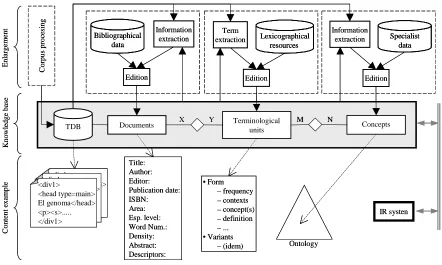
As for the ongoing projects (section 2), we are working with the final objective to build a Human Genome Knowledge Base integrating the following four modules: a textual database that contains specialised texts of this particular domain; a factographic and documental database containing the metainformation about the tagged texts in the corpus; a terminological database including the linguistic units transferring specialized knowledge, and a human genome ontology, which will be the basis for establishing a conceptual link between terminological units and the concepts they transfer. This paper will focus on the process of building the ontology module.
At the moment of starting to work on the ontology module, we realised that it was necessary to review some of the main existent ontologies in order to analyse the characteristics that we have to consider before the design of our ontology. For this reason, we established the main parameters to take into account and we compared several ontologies in order to decide whether it was possible to reuse and/or to expand an already built ontology or if it was more useful for the project purposes to build a new ontology. In section 3, we summarize some results obtained from our analysis.
In section 4, we point out some of the characteristics of the ontology we are building and we emphasize on the way this ontology can be expanded in a future in order to cover some other specialized domains.
2. Project
Description
The Institute's ongoing project, the so-called Human Genome Knowledge Base Project, is carried on within the framework of two public funded projects2: TEXTERM
1
The research activities of this group follow the theoretical approach to terminology established by Cabré (1999).
2
TEXTERM: Textos especializados y terminología: selección y
recuperación automática de la información (BFF2000-0841),
and RICOTERM. The TEXTERM project aims to go a step forward in discourse, grammar and semantic analysis of specialised texts. It is more specifically devoted to the characterization of the lexical (simple or complex) and phraseological units, which constitute the terminology of those domains, with the final purpose of building an automatic detection system of the cognitive underlying structures in specialised texts. The main goal of this first project is to provide a sound theoretical basis for computer-aided unit detection and semi-automatic mapping of cognitive nodes and conceptual relations. It is foreseen that our working methodology —oriented to improve information retrieval (IR) systems— would combine strategies both from the cognitive sciences and linguistics. We will also resort to indexation strategies and thesaurus building standards, coming from information science, and some other linguistic engineering working lines, such as natural language processing and statistical analysis.
Traditionally, most information retrieval systems have been based on strategies of formal string detection, complemented with the statistical analysis of text properties. These systems have some constraints because they do not use the semantic and pragmatic information associated to these strings and their context. For this reason, the main objective of the RICOTERM project is to build an IR system prototype, capable of improving current systems using terminological control. We hope to reach such an objective by taking profit of the grammatical, semantic and pragmatic information associated with the units that convey specialised knowledge.
The methodology to be used should integrate a tool for natural language processing (NLP), which includes structural mark-up, morphological and syntactic analysis, disambiguation, and a terminology extraction system based on heterogeneous strategies combination and lexical ontologies (Vivaldi et al., 2002). Ground criteria will be refined by standards for the identification and mark-up of semantic and pragmatic elements within a restricted domain.
The two projects briefly described above are carried on bearing in mind one general goal : the construction of the
lead by M. T. Cabré; and RICOTERM: Sistema de recuperación
de información con control terminológico y discursivo
machine translation system would be very different.
c) Top nodes of the ontology. Traditionally, top nodes of ontologies have been entities, properties and relations. However, in some cases the number of top nodes may increase and differ (for example, WN uses eleven tops and it does not include relations among them).
d) The conceptual relations allowed in the ontology. “Is-a” is the basic relation of any ontology but some other conceptual relations are also possible and even necessary for some applications. Then, the number of conceptual relations is not a closed list. Some general relations such as meronymy are generally used while specific relations such as “affects” are more present in specific domain ontologies (see UMLS for medicine). Enlarging the number of relations enriches the ontology but it makes it difficult to maintain consistence.
e) Use of inheritance. Inheritance is a general mechanism to add information to a particular node in a compact and easy to maintain way. According to this mechanism, the corresponding node and all its hyponyms share such information. The “simple monotonic inheritance” is the simplest mechanism. It means that each node inherits properties only from a single ancestor and the inherited value cannot be overwritten at any point of the ontology. This inheritance method has problems to manage real situations (like exceptions handling). This situation may be overcome by using “multiple inheritance” (each node may inherit properties from one or more ancestors) and/or “default inheritance” (a node may locally overwrite the value of an inherited property). Contradiction arises when a node inherits incompatible values for a single property coming from different ancestors. Mechanisms mentioned above do not solve this problem but some solutions mainly based on a deep control of the hierarchy have been proposed. For example, the “orthogonal inheritance” suggests gathering the data and allowing multiple inheritance from different groups only.
f) Node representation. Concepts may be indicated by means of a label (case letter, numbers, etc.) or structured information (feature structure).
Traditionally, and besides the above mentioned criteria, ontologies are usually classified from different points of view:
- general (i.e., WN [Fellbaum et al., 1998]) or domain specific (i.e., ULMS [NLM, 1998]), - generic (i.e., EWN) or built for a particular
application (i.e., .RVPRV),
- episodic or encyclopedic ontologies (i.e., Cyc [Lenat et al., 1990]),
- lexical (i.e., EWN) or conceptual (i.e., Cyc) ontologies.
The analysis of the above mentioned ontologies has allowed us to isolate the main characteristics concerning their criteria design and general structure. Our analysis4 covers in depth the following five well known
4
See Feliu et al. (2001) for a more detailed description of each ontology.
ontologies: Cyc, EuroWordNet, µkosmos, SIMPLE5 and UMLS.
3.2. Comparative
analysis
In this section, and having reviewed most outstanding features of the five former selected ontologies, we will analyse some of the key parameters that have to be taken into account in order to evaluate an ontology. It has to be pointed out that since they are very different ontologies, a direct comparison is a very difficult task.
However, some characteristics are in fact comparable. In this sense, the elements reviewed in the comparative analysis are the following: management facilities, expressiveness, application field, ontology type and size, granularity and completeness. We want to explicitly mention at this point that, from now on, all information given about µKosmos has been extracted through the management tool OntoTerm®, which has allowed us to have access in depth to the ontology organization.
3.2.1. Management facilities (enlargement and modification)
A very important aspect in developing an ontology is the availability of tools helping to keep consistency in the whole system. This section reflects the tools that could be used to update each resource. As far as we know, the available tools are the following:
Cyc. No indication has been found about the existence of management tools.
EuroWordNet. For Spanish and Catalan versions of EWN, there are some management tools, mainly designed to enlarge the ontology. There is also a browser in Internet.6
.RVPRV. The tool used for this evaluation is OntoTerm®, an ontology management application. It provides a user friendly interface for adding concepts, relations and lexical entries.7
SIMPLE. In Bel et al. (2000) it has been mentioned the existance of some tools at least for the Spanish and Catalan language.
UMLS. The only tool included in the UMLS distribution is MetamorphoSys, a systems that allows to customize and create subsets of the UMLS Metathesaurus in order to better meet the user needs.8
3.2.2. Expressiveness
All ontologies analysed present very different types of formalisms. One of the main distinctive parameters in order to evaluate these ontologies is the concept and the expression of relations in each of these formalisms.
5
SIMPLE is not oriented to build an ontology as it is understood in this paper. In contrast, it represents an attempt to encode lexical semantics information for an important number of languages.
6
The browser is reachable at the following url:
http://nipadio.lsi.upc.es/cgi-bin/public/wei2.html. 7
A demo version of this tool is available at:
http://www.ontoterm.com. 8
A brief comment on these characteristics is indicated below:
Cyc: It uses CycL, a representation language, which is essentially a form of First Order Predicate Calculus with some additional features such as: equality, augmentations for default reasoning, skolemization, and some second-order features (e.g., quantification over predicates is allowed in some circumstances).
EuroWordNet: It describes concepts (called synsets) as a set of variants. There are a finite number of relations and its management tool is restrictive about the type of relations included. It defines a top ontology according to main lexical-semantics9 principles. Semantic information for each concept is inherited from its ancestors except for the cases where some parts of this information are redefined.
µKosmos: Concepts are described by their position in the ontology and by the indication of their properties and values.10 Relations are not restricted in number but it is required to define, for each direct one, the corresponding inverse relation. µKosmos allows multiple inheritance which, using the management tool, can be visualized as exclusive or cumulative for every concept.
SIMPLE: Each lexical unit is described using a system of types organized through the principles of orthogonal inheritance (according to Pustejovsky 1995). All semantic information is added to refine linguistic information (i.e. semantic types for each kind of argument, relations between semantic units).
UMLS: Each concept placed in the semantic network is just described by a denominative tag. Concepts are related among each other by a rich set of medical-specific, controlled number of relationships. UMLS presents a priori a simple inheritance mechanism but it is possible to block this process when needed.
Two different groups can be differentiated from the analysed ontologies. A first group with ontologies that have hierarchies and information associated to each node of the hierarchical structure (i.e.: EWN, µKosmos and UMLS). A second group, constituted by the other two ontologies mentioned (Cyc and SIMPLE), where the information is quite differently organised and represented.
However, all ontologies include some kind of definition for the concepts contained. The expression of definitions in natural language is given in a number of different ways: formal definition, glossa, examples, explanatory context, and so on.
3.2.3. Application field
Most of the ontologies analyzed in this paper are not domain-specific. Keeping aside UMLS, which is devoted to the medicine domain, all other ontologies cover general information. In spite of the later consideration it has to be mentioned that the general ontologies do not have all the domains equally developed. Thus, µKosmos has considerably developed
9
These semantic principles of the lexicon are established following Pustejovsky (1995).
10
A natural language definition of most concepts can be visualized using the management tool OntoTerm®.
those branches of the ontology concerned with the joint-venture domain. Finally, EWN has asymmetrically developed the different domains it tackles.
3.2.4. Ontology Type
Talking about the ontology type, it is important to notice that both EWN and SIMPLE are conceived from the point of view of the lexicon, that is, they are lexical ontologies. Conversely, µKosmos, UMLS and Cyc may be classified as conceptual ontologies. Except for the later, information is represented by concepts which are expressed with different labels containing all information required (see expressiveness above) in order to convey their meaning.
3.2.5. Size, granularity and completeness
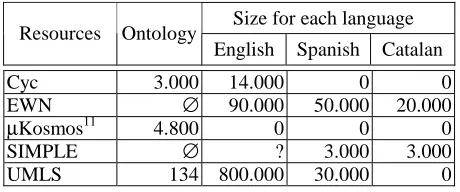
The size of all the resources analysed is very different. Table 1 shows the global sizes for each resource in the different languages considered.
Size for each language Resources Ontology
English Spanish Catalan
Cyc 3.000 14.000 0 0
EWN ∅ 90.000 50.000 20.000
µKosmos11 4.800 0 0 0
SIMPLE ∅ ? 3.000 3.000
UMLS 134 800.000 30.000 0
Table 1. Analysed resources: size comparison
4. Genome Ontology Building Process
Outline
In this section, we make some brief comments on the decision to build a new ontology taking profit of some information and design parameters of the ontologies reviewed. Finally, we also present some relevant aspects of the new ontology we are still working on.
Aiming at a general ontology that allows enlargement, we had to leave aside Cyc, UMLS and SIMPLE. In the case of Cyc, it is produced by a private company and it is not publicly available. Moreover, and according the information retrieved from literature, it seems difficult to deal with. As for UMLS, it is a domain-specific ontology about medicine. SIMPLE is oriented to add lexical semantics information to a dictionary and it can not be considered as an ontology itself. However, UMLS has been an important source to enlarge the selected ontology for our project and SIMPLE has also been useful in order to complete and refine linguistic information for NLP.
Both remaining ontologies, µKosmos and EWN, are general domain ontologies that satisfied the basic
11
There are a number of lexical modules (English, Japanese
DQG 6SDQLVK IRU .RVPRV EXW WKH QXPEHU RI OH[LFDO HQWULHV LV
Fellbaum, C. (ed.) (1998). WordNet: An Electronic Lexical Database. MIT Press. Cambridge.
Feliu, J. (2000) Relacions conceptuals I variació functional: elements per a un sistema de detecció automática. Ph. Dissertation draft, non published. Barcelona: Institut Universitari de Lingüística Aplicada.
Feliu, J.; J. Vivaldi and M. T. Cabré (2002). Ontologies: A Review. Research Working Paper. Barcelona: Institut Universitari de Lingüística Aplicada.
Lenat D. y R. Guha (1990) «Building Large Knowledge-based systems: Representation and Inference in the CYC project». Addison Wesley. Moreno Ortiz A. y C. Pérez Hernández (2000).
“Reusing the Mikrokosmos Ontology for Concept-Based Multilingual Terminology Databases”. Proceedings of 2nd International Conference on Language Resources and Evaluation (LREC-2000). Atenas, 31 de mayo-2 de junio, pp. 1061-1067. NLM (1998) “UMLS Knowledge Sources”. National
Library of Medicine. U.S. Dept. of Health and Human Services, 8th edition.
Pustejovsky, J. (1995) The Generative Lexicon. Cambridge, Massachusetts / London, England: The MIT Press.
Vivaldi J. and H. Rodríguez (2002). “Improving Term Extraction by combining Different techniques”. Terminology, Vol. 7-1. John Benjamins Publishing Co. pp. 31-47.