DOI : https://doi.org/10.32628/CSEIT195521
Advance Technological Approach for Maize Seed Variety
Identification Using Image Processing
Satish Hakkalli*1, Varun C R2, Pavankumar Naik3
1,2Lecturer, Department of Computer Science, Al khateeb Polytechnic Bhoopasandra, Bangalore, Karnataka, India
3Assistant Professor, Department of Computer Science & Engineering, SKSVMACET, Karnataka, India
ABSTRACT
In imaging science, image processing is processing of images using mathematical operations by using any form of signal processing for which the input is an image, a series of images, or a video, such as a photograph or video frame. Our approach is to make an automatic method for identifying different varieties of maize seed using Image processing technology. As we have different tools for image processing we have used MatLab for implementing the proposed system. By maintaining some standardization in your proposed system we prepared the dataset using different verities of maize seed images and These images are compared against the sample seed image (input image), if input image is same as one of the dataset image verity than your proposed system displays the seed is recognized as of respected variety.
Keywords : Matlab, Tested seeds, Sample seed, Image Processing, Threshold
I. INTRODUCTION
Seed analysis and classification are made to obtain information about seed type, variety, quality and the production. Pure, disease-free and insect-free seeds can be defined as quality seeds. Determination of the type, variety and quality of seeds, is necessary for certification procedures. And also, it is the first step of the seed processing operation in the seed separation machines. Use of certified seeds, increases the quality and quantity of yield. Typically, for the certification, the analysis and classification process are made by experts using visual characteristics of the seeds. These conventional methods are very time consuming, very tedious, costly, and depend on the person. In the seed separation machines, the determination of the seed properties process, identification of the seed type, varieties and identification of diseased and structural deformed seeds operations are performed. In the
present seed processing machines, these processes used mechanical operations as well as optical, spectrographic and chromatographic methods based on knowledge of colors. Different type of rice grain varieties is studied using image processing techniques. In the present work a digital imaging approach has been devised in order to investigate different types of characteristics to identify the rice varieties. Two different common rice varieties were used in tests for defining. These include existing standards for rice length, area and aspect ratio features of rice. It successfully shows the effectiveness of compactness as its features. When the data base of this work can recognize the rices, which has been trained then data in number of time; and hence it has been identified[1].
(PSIRS)”.The system consists of 5 processing modules, namely: 1) image acquisition, 2) image preprocessing, 3) feature extraction, 4)image recognition, and 5) display result. The experiment was conducted on more than 1,000 seed images by employing the Euclidean distance technique to recognize them. The precision rates of the system were 95.1 percent for correct matching in the training data set and 64.0 percent for unknown in the untrained data set. The average access time was 8.79 secondsper image[2].
The consumer concern on the originality of rice variety and the quality of rice leads to originality certification of rice by existing institutions. Technology helps human to perform evaluations of food grains using images of objects. This study developed a system as a tool to identify rice varieties. Identification process was performed by analyzing rice images using image processing. The analyzed features for identification consist of six color features, four morphological features, and two texture features. Classifier used LVQ neural network algorithm. Identification results using a combination of all features gave average accuracy of 70.3% with the highest classification accuracy level of 96.6% for Mentik Wangi and the lowest classification accuracy of 30% for Cilosari[3].
Image processing has been applied to various process of agricultural industry in order to achieve fast and accurate operation. Applying image processing techniques to classify wheat seeds based on their varieties is also objective method in real time applications. Seed analysis and classification can provide additional knowledge in their production, seeds quality control and in impurities identification. Also, it is very important to confirm the variety of the wheat before planting. Because each variety needs its own condition for taking good yield. In this study, a method is proposed to identify the wheat varieties grown in Turkey by using image analysis techniques, with the motivation of developing a fully automatic
grain typeand variety identification system. The proposed method is basedon texture analysis (Gray Level Co-occurence Matrix (GLCM)and Linear Binary Pattern (LBP) methods) and k-Nearest Neighbor type classifier[4].
The paper is proposed to present a review of seed technology, seed germination and vigor methods using image processing. Computer–aided image analysis techniques have been recently developed in monitoring seed growth and vigor. Their integration with the standard germination test is needed to describe the germination performance of a seed sample with high accuracy. The use of various modern image acquisition techniques combined with image processing techniques have allowed developing automated seed quality tests,. The two main limitations of performing a vigor test manually are 1) results of a vigor test may vary from laboratory to laboratory because of the subjective nature of most vigor tests and 2) many vigor tests take excessive time to acquire results. These two limitations can be addressed by designing computer software that measures the seedlings represented by a digital image and computes the vigor index from those measurements. Several theories of seed germination and vigor are briefly mentioned. Methods are classified into several groups[5]
II. PROBLEM STATEMENT
seeds for classification grades of seeds. Digital imaging is recognized as an efficient technique to extract the features from seeds in a non-contact manner. Images are acquired for Maize using camera. Conversion to gray scale, Median smoothing, Adaptive thresholding, Sobel edge Detection, Canny edge detection, Morphological operations, Extraction of quantitative information are the checks that are performed on the acquired image using image processing technique. This work has been done to identify the relevant quality category for a given seed sample based on its parameters.
III. PROPOSED METHODOLOGY
The system to recognize different seed variety that is proposed uses Image processing technology. The system starts with user taking a seed image by using a digital camera.
Figure 1. Block diagram of proposed System.
Then the seed image is sent to a computer system for recognizing. After that, the system compares the seed image with all seed images in the system database. Finally, then it displays the recognition results. The Block diagram in Figure 1 shows the overall concept of seed recognition system, where input is given by user and output is again fed back to the user.
IV. SYSTEM DESIGN AND IMPLEMENTATION
System design is the process of defining the architecture, components, modules, interfaces, and
data for a system to satisfy specified requirements. In this they are consists of 5modules They are as follows.
• Image Acquisition. • Image Preprocessing. • Feature Extraction. • Image Recognition. • Display Result.
Image Acquisition:
Image Acquisition means before any video or image processing can commence an image must be captured by a camera and converted into a manageable entity. This is the process known as image acquisition.
There are some standards that are maintained to take the images of seeds, The standards have to be followed in image acquisition phase. Those standards are as follows
• The image of seed have to be taken from camera and seed should be placed in parallel to camera. • Images have to be taken with 10cm distance from
seed.
• The background for the image should be BLACK • The image should not be taken in too much
brightness and too much darkness, uniform light has to be maintained for the seed
• The camera to take the seed has to be atleast 8MP. • Here in these project capturing seeds image of
keeping different types of seeds with certain different distance i.e. about 5,10,15 cm are as shown in the below Table.
Seed Varity we tested
•NK6240 corn •Bodacious
Table 1: Input Images
Edge Detected Images of Hybrid Corn variety Table1 (a) image is captured from 5cm distance, Fig2(b) 10cm, Fig3 (c) 15 cm. after exprementing on the images shown in table 1, We have chosen image captured from 10cm distance to get accurate output. Because Fig (a) in table 1 is more accurate than Fig (b) and Fig(c).
Image Preprocessing
Image Pre-processing is a common name for operations with images at the lowest level of abstraction both input and output are intensity images. The aim of pre-processing is an improvement of the image data that suppresses unwanted distortions or enhances some image features important for further processing.
Image pre-processing includes following steps • Cropping
• Resizing
• Conversion to Gray Image • Enhancement
• Binarization • Image Filtering
Cropping
If the input image taken is had some unwanted objects in it ,then cropping of image will remove that distraction and retain the region of interest for further processing.
Resized Image
The input images may have different sizes which can affect the results. imresize resize the input image. When scale parameter is specified, the width and height of the image is resized in the same scale.
Conversion to Gray Image
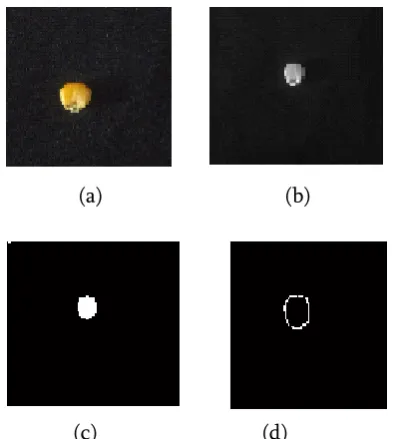
The system changes an RGB color image to a gray-scale image.converts the true color image RGB to the grayscale intensity image. The rgb2gray function converts RGB images to grayscale by eliminating the hue and saturation.
Enhancement
The system performs morphological closing to close any opening area in the seed image. Then the system fills holes and removes noise to get an enhanced binary image.The image is enhanced after the when image of seed is converted to gray.
Binarization
Image Filtering
Filtering is a technique for modifying or enhancing an image. Image filtering is used to do the following activities
• Remove noise • Sharpen contrast • Highlight contours • Detect edges
Feature Extraction
The feature extraction finds four seed features, namely : Shape, seed edge, seed roundness, seed ripple In this project , we are besically concentrating on Shapes so efficient algorithm have been designed to extarct the Edges for identification of seed varity.
Edge Detection
Edge detection technique is its ability to extract the exact edge line with good orientation as well as more. literature about edge detection has been available in the past three decades. Edge detection is a fundamental tool for image segmentation. Edge detection methods transform original images into edge images benefits from the changes of grey tones in the image. In image processing especially in computer vision, the edge detection treats the localization of important variations of a gray level image and the detection of the physical and geometrical properties of objects of the scene.
Canny Edge Detection
The Canny edge detection technique is one of the standard edge detection techniques. It was first created by John Canny for his Master’s thesis at MIT in 1983, and still outperforms many of the newer algorithms that have been developed. To find edges by separating noise from the image before find edges of image the Canny is a very important method. Canny method is a better method without disturbing the features of the
edges in the image afterwards it applying the tendency to find the edges and the serious value for threshold.
(a) (b)
(c) (d)
Figure 1 : Image preprocessing and edge detection (a) Original Image (b) Gray Image (c) Black and white image (d) Canny edge detected image.
Image Recognition
The feature extracted from the images is stored in array, Edge is a feature that is extracted from the image using canny edge detection method. The tested images are stored in database and they are compared against the sample image and if the sample image is matched with any of the images stored in the database,then output is displayed as image is recognized else output will be image not recognized.
V. CONCLUSION & FUTURE SCOPE
and matched against the trained dataset. This project can also be extended to extract size, color and texture of any seeds.
VI.REFERENCES
[1] R.Kiruthika1, S.Muruganand2, Azha Periasamy “MATCHING OF DIFFERENT RICE GRAINS USING DIGITAL IMAGE PROCESSING” ISSN 2320 – 3765, Vol. 2, Issue 7, July 2013.
[2] Benjamaporn Lurstwut and Chomtip Pornpanomchai, Member, IACSIT Plant Seed Image Recognition System (PSIRS) IACSIT International Journal of Engineering and Technology, Vol. 3, No. 6, December 2011. [3] Lilik Sumaryanti, Aina Musdholifah, Sri Hartati
“Digital Image Based Identification of Rice Variety Using Image Processing and Neural Network” Department of Informatics, Engineering Faculty, Musamus University, Merauke, Indonesia ,Department of Computer Science and Electronics,
FMIPA UGM,
Yogyakarta,Indonesia,Correspondingauthor,email :[email protected],[email protected] 2,[email protected],TELKOMNIKA
Indonesian Journal of Electrical Engineering Vol. 16, No. 1, October 2015.
[4] T. Ojala, M. Pietikainen, and T. Maenpaa, “Multiresolution Gray-Scale and Rotation Invariant Texture Classification with Local Binary Patterns”, IEEE Trans. on Pattern Analysis and Machine Intelligence, Vol. 24, No.7, pp. 971-987, 2002
[5] Utami E, Hartati S. Perancangan Perangkat Lunak untuk Pengenalan Karakter ASCII dari Gambar Bitmap Menggunakan Jaringan Syaraf Tiruan Metode Propagasi Balik. Jurnal Teknologi ACADEMIA ISTA. 2008; 2(2): 212-222.
Cite this article as :
Satish Hakkalli, Varun C R, Pavankumar Naik, "Advance Technological Approach for Maize Seed Variety Identification Using Image Processing ", International Journal of Scientific Research in Computer Science, Engineering and Information Technology (IJSRCSEIT), ISSN : 2456-3307, Volume 5 Issue 5, pp. 106-111, September-October 2019.
Available at doi :
https://doi.org/10.32628/CSEIT195521