Chinese under the framework of the Generative Lexicon, and to see whether such mechanism would apply across different languages.
2.
Semantic Classification in Noun-Noun Compounds
In English and Chinese noun-noun compounds, the most common construction is modifier-head with the head on the right. For example,in bookstore, the modifier is book
and the head is store; in shā-táng (sand-sugar) 'sugar', the modifier is shā and the head noun is táng. However, such analysis is derived on the basis of syntax rather than semantics. Since this present work focuses on the meaning relationship between the components of a given compound, we may encounter noun-noun compounds in which the head noun can be both the word on the left and the word on the right.
When choosing examples, we eliminate compound-like words which are composed of the construction of a word and an affix. For instance, some Chinese noun-noun compounds may be composed of a noun and an affix, such as zhuō-jiǎo (table-leg) 'table leg', in which zhuō is an affix rather than a word. This sort of compound is not taken into consideration due to the fact that an affix, which cannot stand alone as an individual word, is not a noun.
Moreover, in other languages, especially modern Romance languages, we may also find different constructions of noun-noun compounds from those found in English and Chinese. For example, in Italian, a noun-noun compound is composed as head-preposition-modifier, such as succo di limone (juice-preposition-lemon) „lemon juice‟; in French, café au lait (coffee-preposition-milk) „white coffee‟ is also composed as head-preposition-modifier; Spanish has cuchillo de cocina (knife-preposition-kitchen) „kitchen knife‟. In the Romance languages mentioned above, the semantic head noun is usually located before the preposition, which means that the preposition in a noun-noun compound can function as an indicator for the head noun, while Chinese does not have this linguistic property.
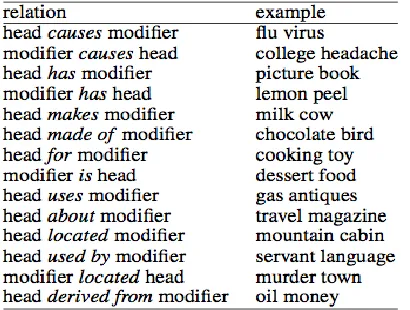
In the semantic analysis of nominal compounds, Gagne and Shoben [1] first proposed a set of „thematic relations‟, which are claimed to cover the majority of semantic relations between modifier and head in English noun-noun compounds:
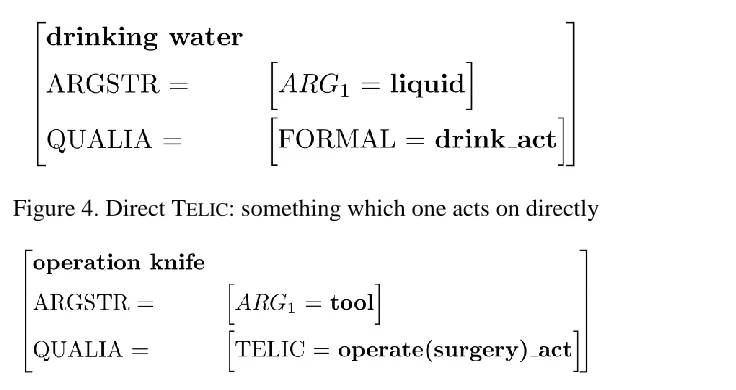
In jewelry box, jewelry indicates the function of box, which means that the box is used to contain jewelry; in bookstore, the function of store is to sell books; in operation knife, knife is with the function of surgical operation; in drinking water, water is with the function of being safely drunk by people. Here, the examples demonstrate the TELIC quale. In adenovirus pneumonia, adenovirus is a sort of virus that causes pneumonia; in
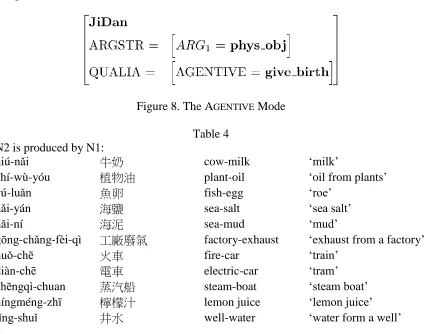
steamboat, steam is the power for boat; in turtle egg, turtle is the producer of egg. Here, the examples demonstrate the AGENTIVE quale.
3.2
The Base Modes of the Qualia Structure
In this research, we use a lexical entry of the GL Theory in order to represent the structure of noun-noun compounds as follows: (α as the term itself; TYPESTR as type structure; ARG as argument; ARGSTR as argument structure; EVENTSTR as event structure)
Figure 1. The Base Mode of the Qualia Structure
The representation of the CONSTITUTIVE quale is as the following:
Figure 2 The Mode of the CONSTITUTIVE Quale
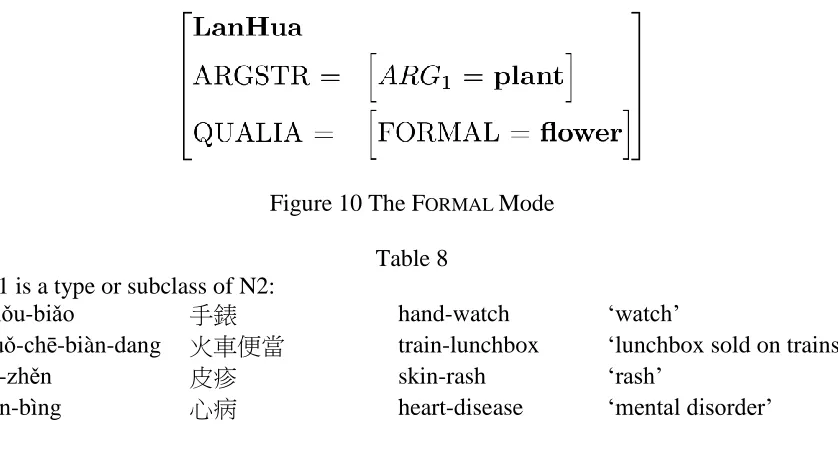
For the FORMAL quale, Pustejovsky [4] interprets the FORMAL quale with the GL Theory into two structures: (a). Simple Typing: value of FORMAL role is identical to sortal typing of the argument. (b). Complex Typing: value of FORMAL role defines the relation between the arguments of different types. The base mode of the FORMAL quale is as the following form:
The GL Theory interprets the TELIC quale into two base modes as described below:
Figure 4. Direct TELIC: something which one acts on directly
Figure 5. Purpose TELIC: something which is used for facilitating a particular activity
Also, the AGENTIVE quale can be interpreted by the GL Theory with the base mode as the following:
Figure 6. Types of the FORMAL quale
The next section is going to discuss the modification of the qualia structure in the GL Theory with cross-language data for comparison.
4.
Qualia Modification
In previous sections, we discuss the morphology of Chinese compounds and the GL Theory. In this section, we are going to discuss the mapping of qualia in Chinese compounds. The proposed qualia structure in GL theory can be used to provide the lexical connection which binds semantic contributions of modifying nouns and the head noun in the compound [5].
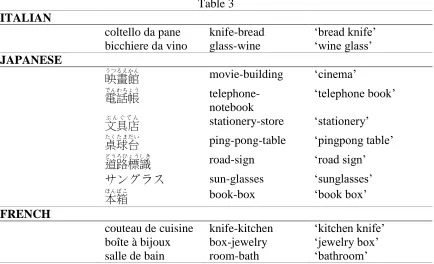
In the Headedness PrinciplePackard [3] noted that there are two kinds of headedness, one is structurally (syntactically), the other is semantically. For example,
GERMAN
Lebensmittelgeschäft foodstuff-store „grocery store‟ Briefmarke letter-mark „stamp‟
Buchhandlung book-action „book store‟ SPANISH
cuchillo de cocina knife-kitchen „kitchen knife‟ plato de arroz plate-rice „rice plate‟ vaso de vino glass-wine „wine glass‟ manguera de agua hose-water „water hose‟ bus escolar bus-school „school bus‟
For example, the Italian complex nominal coltello da pane „bread knife‟ shows the quale of coltello and pane, the preposition da is used as a connector. There are also examples from other languages.
4.2
AGENTIVEQualia Modification
The AGENTIVE quale explains how something comes into being. In compounds, the modifier brings out the head noun. In the Chinese compound jī-dàn „egg‟, the modifier jī brings out the head noun dàn.
Figure 8. The AGENTIVE Mode
Table 4 N2 is produced by N1:
niú-nǎi 牛奶 cow-milk „milk‟
zhí-wù-yóu 植物油 plant-oil „oil from plants‟
yú-luǎn 魚卵 fish-egg „roe‟
hǎi-yán 海鹽 sea-salt „sea salt‟
hǎi-ní 海泥 sea-mud „mud‟
gōng-chǎng-fèi-qì 工廠廢氣 factory-exhaust „exhaust from a factory‟
huǒ-chē 火車 fire-car „train‟
diàn-chē 電車 electric-car „tram‟
zhēngqì-chuan 蒸汽船 steam-boat „steam boat‟
níngméng-zhī 檸檬汁 lemon juice „lemon juice‟
5.
Discussion
In previous sections, we choose the word that serves the primary semantic content of the compound to be the head noun. Although the syntactic head noun and semantic head noun are the same in our examples, there are words that the syntactic head noun is not the same as semantic head noun. For example, in Chinese làng-huā (wave-flower) „surf‟, if we assume that the syntactic head noun is huā, there is a semantic confusion due to the fact that intuitively, làng-huā is not a kind of huā, but the shape of làng, and therefore
làng serves the primary semantic content. Thus we say the head noun is làng rather than
huā. Similar examples are huǒ-huā 'sparkle', dàn-huā 'egg flower', xuě-huā 'snowflake' and shuǐ-huā 'water spray'.
Still, there are some words that cannot fit into anyone of the four quales, even though they are individual words. For example, in Chinese shān-jiǎo (mountain-leg)„the base of a mountain‟, we cannot judge which quale in which the modifier shān fits if we take jiǎo as the semantic head noun.
6.
Conclusion and Future Works
In this paper, we only discuss noun-noun compounds. However, in the study of Chinese morpho-syntax, there are other sorts of construction within compounds, such as noun-verb, verb-noun, verb-noun-verb, etc. For further study on the qualia structure of compounds, other constructions can also be taken into consideration.
References
[1] C. L. Gagne and E. J. Shoben. “Influence of thematic relations on the comprehension of modifier-noun combinations”. Journal of Experimental Psychology: Learning,
Memory and Cognition. 1997.
[2] G. F. Arcodia, “Chinese: A Language of Compound Words?” Selected Proceedings of the 5th Décembrettes: Morphology in Toulouse, ed. Fabio Montermini, Gilles Boyé, and Nabil Hathout, 79-90, Somerville, Giorgio Francesco, 2007.
[3] J. L. Packard, The Morphology of Chinese, New York, Cambridge University Press, 2000.
[4] J. Pustejovsky, The Generative Lexicon, Cambridge, The MIT Press, 1995.