CSEIT1722314 | Received : 16 April 2017 | Accepted : 26 April 2017 | March-April-2017 [(2)2: 1041-1047]
International Journal of Scientific Research in Computer Science, Engineering and Information Technology © 2017 IJSRCSEIT | Volume 2 | Issue 2 | ISSN : 2456-3307
1041
Efficient Feature Selection and Classification Technique For
Large Data
1P. Arumugam
,
P. Jose21
Department of Statistics, Manonmaniam Sundaranar University, Tirunelveli, Tamilnadu, India 2
Research scholar, Department of Statistics, Manonmaniam Sundaranar University, Tirunelveli, Tamilnadu, India
ABSTRACT
Grey wolf optimizer (GWO) is a Heuristic evolutionary algorithm recently proposed, it is inspired by the leadership hierarchy and hunting mechanism of grey wolves in nature. In order to reduce the data set without affecting the classifier accuracy. The feature selection plays a vital role in large datasets and which increases the efficiency of classification to choose the important features for high dimensional classification, when those features are irrelevant or correlated. Therefore, feature selection is considered to use in pre-processing before applying classifier to a data set. Thus, this good choice of feature selection leads to the high classification accuracy and minimize computational cost. Though different kinds of feature selection methods are investigate for selecting and fitting features, the best algorithm should be preferred to maximize the accuracy of the classification. This paper proposes intelligent optimization methods, which simultaneously determines the parameter values while discovering a subset of features to increase SVM classification accuracy. In this paper, initial subset selection is based on the latest bio inspired Grey wolf optimization technique proposed. Which take off the hunting process of gray wolve. This optimizer search the feature space for optimal feature solution in diverse directions in order to minimize the option of trapped in local minimum and enhance the convergence speed. The Novel approach aimed to speed up the training time and optimize the SVM classifier accuracy automatically. The proposed model used to select minimum number of features and providing high classification accuracy of large datasets.
Keywords: Feature Selection, Classification, PSO, GWO , SVM
I.
INTRODUCTION
Building accurate and efficient classifiers for large databases is one of the essential tasks of data mining and machine learning research. Usually, classification is a preliminary data analysis step for examining a set of cases to see if they can be grouped based on similarity to each other. The ultimate reason for doing classification is to increase understanding of the domain or to improve predictions compared to unclassified data. Many types of classification techniques have been proposed in literature that includes DT-SVM, SMO, etc. SVM is a learning machine used as a tool for data classification, Function approximation, etc., due to its generalization ability and has found success in many applications [7-11]. Feature of SVM is that it minimizes and upper bound of
whatever processes distinguish the classes. In this paper, we concentrate on GWO, developed by Mirjalili et al. [7] in 2014 based on simulating hunting behavior and social leadership of grey wolves in nature. Numerical comparisons showed that the superior performance of GWO is competitive to that of other population-based algorithms. Because it is simple and easy to implement and has fewer control parameters, GWO has caused much attention and has been used to solve a number of practical optimization problems [16– 18]. However, like other stochastic optimization algorithms, such as PSO and GA, as the growth of the search space dimension, GWO algorithm provides a poor convergence behavior at exploitation [19, 20].Therefore, it is necessary to emphasize that our work falls in increasing the local search ability of GWO algorithm According to [21].
1. Support Vector Machine
SVM structured as a two-class problem, where the classes are separable linearly. The input dataset D be represent in 2D as (x1, y1), (x2, y2)…. (x|D|, y|D|), where xi is the set of training tuples and yi is the class label associated with training sample. In a training sample, SVM constructs a line of separation for two attributes (x, y) and a plane of separation for three attributes and a hyper plane of separation for n dimensions. To make the SVM optimization problem accurately obedient by writing Minimize in Equation (1), where 𝜀
∑ (𝜀) (1)
2. Grey Wolf Optimization
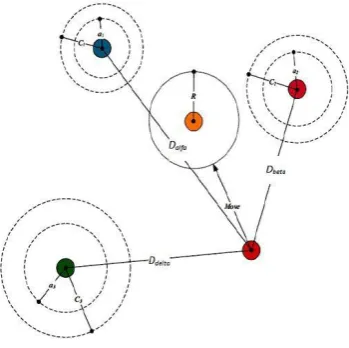
GWO algorithm consider alpha (α) wolves are the fittest solution inside the pack, while the second and third best solutions are named Beta (β) and delta (δ) respectively. The result of solutions inside the pack (population) are considered omega (ω). The process of hunting a prey is guided by α, β and ω.
The first step of hunting a prey is circling it by α, β and
ω. The mathematical model of circling process as shown in equations 2.
X( t+1) = Xp (t) + A⋅D (2)
Where X is the grey wolf position. t is the number of iteration. p X is prey position and D is evaluated from Equation (3).
D=|C.Xp(t+1)-x(t)| (3)
The A and C are coefficient vectors are evaluated based on Equations (4) and (5) respectively.
A = 2a ⋅r1 − a (4)
C = 2r2 (5)
Where a is a linearly decreased from 2 to 0 through the number of iterations, which is used to control the tradeoff between exploration and exploitation. Equation (6) used to update the value of variable a, where NumIter is the total number of iterations. Two random vectors between [0,1] namely 1 r and 2 r to simulate hunting a prey (find the optimal solution). The solutions alpha, beta and delta are considered to have a good knowledge about the potential location of prey. These three solutions helps others wolves (omega) to update their positions according to the position of alpha, beta and delta. Equation 6 presents the formula of updating wolves’ positions.
a = 2 − t (2 NumIter ) (6) X t +1 = X 1+ X 2+ X 3 (7)
The values of X1, X2 and X3 is evaluated as in Equations (8) (9) and (10) respectively.
X1 = |Xα– A1 Dα | (8) X2 = |Xβ– A2⋅Dβ | (9) X3 = |Xδ– A3⋅D δ | (10)
The X1, X2 and X3 are the best 3 solutions in the population at iteration t. The values of A1, A2 and A3 are evaluated in Equation (3). The values of D α, D β
and D δ are evaluated as shown in Equations (11) (12) and (13) respectively.
D α= |C1⋅X α– X| (11)
Dβ= |C2⋅Xβ– X| (12)
Dδ= |C2⋅Xδ– X| (13)
wolves is divided into four groups: alpha (a), beta (b), delta (d), and omega (w). In every iteration, the first three best candidate solutions are named a, b, and d. The rest of the grey wolves are considered as w, and are guided by a, b, and d to find the better solutions. The mathematical model of the w wolves’ encircling
process is as follows
1) Social hierarchy
In the mathematical model of the social hierarchy of the grey wolves, alpha (α) is considered as the fittest solution. Accordingly, the second best solution is named beta (β) and third best solution is named delta (δ) respectively. The candidate solutions that are left over are taken as omega (ω). In the GWO, the optimization (hunting) is guided by alpha, beta, and delta. The omega wolves have to follow these wolves.
2) Encircling Prey
The grey wolves encircle prey during the hunt. The encircling behavior can be mathematically modeled as follows [18]
Where A and C are coefficient vectors, X p is the preys position vector, X denotes the grey wolf’s position vector and „t‟ is the current iteration. The calculation of vectors A and C is done as follows in Equation (14),(15)
A = 2. a . r 1. a (14) C = 2. r 2 (15) Where values of „a ‟are linearly reduced from 2 to 0 during the course of iterations and r1, r2 are arbitrary vectors in gap [0, 1].
3) Hunting
The hunt is usually guided by the alpha, beta and delta, which have better knowledge about the potential location of prey. The other search agents must update their positions according to best search agents position. The update of their agent position can be formulated as follows [18]:
4) Search for prey and attacking prey
The A is an arbitrary value in the gap [-2a, 2a].
When |A| < 1, the wolves are forced to attack the prey. Attacking the prey is the exploitation ability and searching for prey is the exploration ability. The random values of „A‟ are utilized
to force the search agent to move away from the prey.
When |A| > 1, the grey wolves are enforced to diverge from the prey.II.
METHODS AND MATERIAL
One
of
the
recently
proposed
heuristic
evolutionary algorithms is the GWO, inspired by
the leadership hierarchy and hunting mechanism of
grey wolves in nature. This paper presents an
extended GWO algorithm. The GWO algorithm,
proposed by Mirjalili et al. (2014) [7],is inspired
by the hunting behavior and social leadership of
grey wolves in nature. It is similar to other Meta
heuristics, and in GWO algorithm, the search
begins by a population of randomly generated
wolves (candidate solutions). In order to formulate
the social hierarchy of wolves when designing
GWO, in this the population is split into four
groups: alpha (𝛼), beta (𝛽), delta (𝛿), and omega
(𝜔).Over the course of iterations, the first three
best solutions are called
𝛼,
𝛽, and 𝛿, respectively.
The respite of the candidate solutions are named as
𝜔. Herein algorithm, the hunting (optimization) is
guided by
𝛼,
𝛽, and 𝛿. The 𝜔 wolves are required
to encircle
𝛼,
𝛽, and
𝛿 to find better solutions.
Over the previous few years, statistical learning
has become a precise discipline. Indeed, many
scientific domains need to analyze data which are
increasingly complex in the field of medical
research, financial analysis, Business analysis and
computer vision provide very high dimensional.
Classifying such data is a very challenging
problem. In high dimensional feature spaces, the
performances of learning methods suffer from the
curse of dimensionality, which degrades both
classification accuracy and efficiency. In this
paper initial subset selection is based on Grey wolf
optimization technique. It shows in Fig.1
The proposed method involves
1. Initial subset selection using GWO
1. Initial subset selection using GWO
The pre-processed dataset undergoes initial subset
selection optimized by using GWO. It initializes
the number of wolves in the pack n. In the first
stage, GWO is used to pass through a filter out the
redundant and irrelevant information by adaptively
searching for the best feature combination in the
medical data. In the proposed GWO, is firstly used
to generate the initial positions of population, and
then GWO is utilized to update the current
positions of population in the discrete searching
space. In the second stage, the effective and
efficient GWOSVM classifier is conducted based
on the optimal feature subset obtained in the first
stage. Figure 2 presents a detailed flowchart of the
updating position of the grey wolf. The GWO is
mainly used to adaptively search the feature space
for best feature combination. The best feature
combination
is
the
one
with
maximum
classification accuracy and minimum number of
selected features. The fitness function used in
GWO to evaluate the selected features is shown as
the following equation(16) where 𝑃 is the accuracy
of the classification model,
𝐿 is the length of
selected feature subset,
𝑁 is the total number of
features in the dataset, and
𝛼 and
𝛽 are two
parameters corresponding to the weight of
classification accuracy and feature selection
quality, 𝛼 ∈ [0,1] and 𝛽 = 1 − 𝛼.
Fitness = 𝛼𝑃+ 𝛽
(16)
Figure 1. Flow chart of Proposed method
Figure 2. Updating Position of Grey Wolf
Algorithm1.Grey wolf optimization
Input: Initialize the number of wolves in the
pack n
Total number of iterations for optimization
N
iMaximum number of Iteration M
iBest fitness value f(x
α)
Begin
Generate the initial population of grey wolves
position
Initialize α ,A,C
Calculate the fitness of each gref wolf
X
α-grey wolf with first maximum fitness
X
β- grey wolf with first maximum fitness
X
δ-grey wolf with first maximum fitness
while k < M
ifor each wolf
iupdate the position of the current grey wolf
by eq()
end for
update α,A,C
Calculate the fitness value of all grey wolves
Update X
α,X
β,X
δK=k+1;
End while
End
In these formulas, it may also be observed that
there are two vectors and
obliging the GWO
algorithm to explore and exploit the search space.
With decreasing
, half of the iterations are
devoted to exploration (| ≥ 1|) and the other half
are dedicated to exploitation (| | < 1). The range of
is 2 ≤
≤ 0, and the vector
also improves
exploration when
> 1 and the exploitation is
emphasized when
< 1. Note here that
is
decreased linearly over the course of the iterations.
In contrast, is generated randomly whose aim is
to emphasize exploration/exploitation at any stage
avoiding local optimal. The main steps of grey
wolf optimizer are given in Algorithm 1.
2. Modeling the distribution of support vectors
Once all the SV and outliers of C have been
identified in the previous stage.
3. Training the GWOSVM
In this study, the data were scaled into [−1, 1] by
normalization for the facility of computation. In
order to acquire unbiased classification results, the
k-fold cross validation (CV) was used [40]. This
study took 10-fold CV to test the performance of
the proposed algorithm. However, only one time
of running the 10-fold CV will result in the
inaccurate evaluation. So the 10-fold CV will run
ten times regarding the parameter choice of SVM,
different penalty parameters
= {2−5, 2−4, . . . ,
24, 25} and different kernel parameters
𝛾 = {2−5,
2−4, . . . , 24, 25} were taken to find the best
classification results. Therefore,
and
𝛾 for
GWOSVM are set to 32 and 0.5 in this study,
respectively. The global and algorithm specific
parameter setting is outlined in Table 2. To the
optimization of parameter C is handling by GWO
Algorithm, it consists of following steps. The
search performance of is using a population
(swarm) of Individuals called particles. It starts
with random Initialization of particles. This work
is proposed as a fitter with Feature Selection (FS).
FS act as a fitness function value each particle
objective function value is decided by this fitness
function. The Novel approach aimed to speed up
the training time and optimize the SVM classifier
accuracy automatically. The proposed model used
to select minimum number of features and
providing high classification accuracy of high
dimensional datasets. It has been successfully
applied to optimizing various continuous functions.
In general, subset C is used to compute a model of
the optimal separating hyperplane. This is not
optimal generally because of random selection of
examples from training dataset discard important
objects.
III. COMPUTATIONAL RESULTS
In the experiments, when using the proposed intelligent optimization methods, we considered the nonlinear SVM based on the popular Gaussian kernel (referred to as SVM-RBF). And [10−3, 3], so as to cover high and small regularization of the classification model, as well as thin kernels, respectively. The related parameters C
Machine Learning Databases). The dataset contains instances. Training size, testing size11 and features be described with the use of proposed algorithm be evaluated. Table.1 Shows Data set description, Table.2 Represent Accuracy evaluation, Fig.3 shows Parameters evaluations. Concerning the PSO algorithm, we considered the following standard parameters: swarm size S = 20, inertia weight w = 1, acceleration constants c1 and c2 equal to 2, and maximum number of iterations fixed at 300. The parameters setting are summarized in Table 1.
TABLE 1
TABLE 2:ACCURACY EVALUATION
The proposed construction consists of two main stages, which are feature selection and classification, respectively. Firstly, an improved grey wolf optimization was proposed for selecting the most informative features in the specific medical data. Secondly, the effective GWOSVM classifier was used to perform the prediction based on the representative feature subset obtained in the first stage. The proposed method is compared against well-known feature selection methods including GA and GWO on the two
disease diagnosis problems using a set of criteria to assess different aspects of the proposed framework. The simulation results have demonstrated that the proposed IGWO method not only adaptively converges more quickly, producing much better solution quality, but also gains less number of selected features, achieving high classification performance. In future works, we will apply the proposed methodology to more practical problems The proposed algorithm handle large datasets and performs higher accuracy even with high speed it sedating important features and building effective classifiers based on GWO, the method scans the entire data and obtains a small subset of data points the used to reduce the training data sets. Using this detection of critical instances determine the decisive boundaries for this PSO algorithm and find a fitness function to discriminates between support and non support vectors from a small data set to select the best data points in the entire data set. The novel approach captures the pattern of the data and provides enough information to obtain a good performance it obtain high accuracy with less number of support vectors.
IV. REFERENCES
[1].
Han-Pang Huang Y H L, Fuzzy Support VectorMachines for Pattern Recognition and Data mining, International Journal of Fuzzy Systems, pp. 826-835, (2002).
[2].
Joachims T (1998) Making large-scale supportvector machine learning practical. Advances in Kernel Methods: Support Vector Learning. MIT Press, Cambridge, MA, 169-184.
[3].
Zhang C H, Tian Y J, Deng N Y, The newinterpretation of Support Vector Machines on Statistical Learning Theory, Science China Mathematics pp.151-164, (2010).
[4].
Deng N Y , Tian Y J, Zhang C H , Support VectorMachines, Optimization Based Theory,
Algorithms and Extensions.CRC Press, (2012).
[5].
Cristianini N, Shawe-Taylor J, An Introduction toSupport Vector Machines and other Kernel
based Learning Methods,1st edition. Cambridge
University Press,(2000).
[6].
Chang F, Guo C Y, Lin X R, Lu C J, Treedecomposition for large scale SVM problems,
Journal of Machine
[7].
Guyon I , Weston J, Barnhill S and Vapnik V, Gene Selection for Cancer Classification using Support Vector Machines, Machine Learning ,pp. 389-422, (2002) optimization: developments, applications and resources. Proc. congress on evolutionary computation 2001[11].
Wang R, He Y L,Chow C Y, Ou F F, Zhang J, Learning ELM tree from big data based on uncertainty reduction, Fuzzy Sets System (2014)[12].
Chih-Chung Chang and Chih-Jen Lin, LIBSVM A library for support vector machines. ACM Transactions on Intelligent Systems and Technology,pp.1–27,(2011). Software available at http://www.csie.ntu. edu.tw/~cjlin/libsvm[13].
Mukherjee S, Tamayo P, Mesirov J P, Slonim D, Verri A, and Poggio T, Support Vector Machine Classification of microarray data. Technical Report 182, (1999).[14].
Arun Kumar M, Gopal M, A hybrid SVM baseddecision tree, Pattern
Recognition,43(12),pp.3977-3987,(2010).
[15].
Cervantes J, Lopez A, Garcia F, Trueba A, A fast SVM training Algorithm based on a decision tree data filter,in Advances in Artificial Intelligence ,vol.7094 of Lecture Notes in Computer Science,Springer,pp.187-197,(2011).[16].
Furey S, Nigel Duffy, Nello Cristianini, David Bednarski, Michel Schummer, and David Haussler, Support Vector Machine Classification and Validation of Cancer Tissue Samples UsingMicroarray Expression Data. Terrence
Bioinformatics. pp.906-914( 2000).
[17].
Platt J,Fast training of support vector machines using Sequential Minimal Optimization, in Advance kernel methods Support Vector Machine.pp.185-208.(1998)[18].
Chang C. C., and Lin C. J. Training support vector classifiers, Theory and algorithms. Neural Computation vol.13,pp. 214-219,(.2001)[19].
Khan J, et al., Classification and diagnostic prediction of cancers using gene expressionprofiling and artificial neural networks, Nature Med. vol .7,pp.673 (2001) .
[20].
Furey T S, et al., Support Vector Machine Classification and validation of cancer tissue samples using microarray expression data, Bioinformatics, vol .16,pp.906, (2000) .[21].
Pochet N, De Smet F, Suykens J A, De Moor B L, Systematic benchmarking of microarray data classification assessing the role of nonlinearity and dimensionality reduction, Bioinformatics, vol.20,pp.3185 (2004).[22].
Xing E P, Jordan M I, Karp R M, Feature selection for high-dimensional genomic microarray data, in Proceedings of the 18th International Conference on Machine Learning, (2001)[23].
Venkatesh and Thangaraj, Investigation of Micro Array Gene Expression Using Linear Vector Quantization for Cancer", International Journal on Computer Science and Engineering, Vol. 02, No. 06, pp. 2114-2116, (2010).[24].
Ye J, Li T, Xiong T, and Janardan R, Using uncorrelated discriminant analysis for tissueclassification with gene expression
data, IEEE/ACM Transactions on Computational Biology and Bioinformatics, vol. 1, no. 4, pp. 181–190, (2004).
[25].
Peng Y, Li W, and Liu Y, A hybrid approach for biomarker discovery from microarray gene expression data for cancer classification, Cancer Informatics, vol. 2, pp. 301–311, (2007).[26].
Bharathi A and Natarajan A, Cancer classification of bioinformatics data using ANNOVA, International Journal of Computer Theory and Engineering, vol. 2, no. 3, pp. 369– 373, (2010).[27].
Peng Y, A novel ensemble machine learning for robust microarray data classification, Computers in Biology and Medicine, vol. 36, no. 6, pp. 553– 573, (2006).[28].
Lee C and Leu Y, A novel hybrid featureselection method for microarray data
analysis, Applied Soft Computing Journal, vol. 11, no. 1, pp. 208–213, (2011).