A Model for the Cross-Modal Influence of
Visual Context upon Language Processing
Patrick McCrae
CINACS Graduate Research Group
Department of Informatics
Hamburg University
Vogt-K¨olln-Straße 30, 22527 Hamburg, Germany
patrick.mccrae
@
informatik.uni-hamburg.de
Abstract
In this paper, we present a novel, cognitively mo-tivated framework for modelling the cross-modal influence of visual scene context upon language processing. We illustrate how semantic relations in a knowledge representation of visual scene context can effect syntactic attachment modulations in a weighted-constraint dependency parser. In line with a central tenet of conceptual semantics, visual scene context and linguistic processing are hypothesised to interact via an intermediate, cross-modally integrated level of semantic representation. Cross-modal interaction in our model is restricted by conceptual compatibility between the concepts activated linguistically and contextually.
We apply our framework to syntactically ambiguous sentences of German and parse them in the presence of biasing visual scene contexts. The observed modulations in syntactic attachment support our two modelling hypotheses: 1) The influence of visual context upon syntactic processing is mediated by semantics. 2) The compatibility of concepts from different modalities is a suitable criterion to restrict the scope of cross-modal interaction.
Keywords
Cross-Modal Interaction, Parsing, Syntax-Semantics Interface, Context Integration, Information Fusion.
1 Introduction
The vision-language interface has become considerably more accessible to scientific enquiry with the advent of eye tracking technology. [3] showed a semantic interaction between vision and language for single-word processing with co-present visual stimuli as early as 1974. About two decades later, [13] investigated subjects’ eye movements for syntactically ambiguous sentences with a particular fo-cus on the aspect of incrementality in linguistic processing. Yet another decade later, [1] investigated whether the eye movement patterns observed as a result of the interaction between vision and language were contingent upon the vi-sual stimulus being co-present with the linguistic stimulus. In this paper we present a successful implementation of a framework for the integration of visual context infor-mation into the process of syntactic parsing. Starting from the review of central empirical investigations of the
vision-language interface, we begin with the identifica-tion of elementary requirements for the design of a cog-nitively motivated framework for the cross-modal integra-tion between vision and language. Adopting a weighted-constraint model of language processing, we outline how in our framework the interpretation of visual context con-stitutes an additional constraint on the cross-modally inte-grated semantic representation which is built up based on linguistic and contextual input.
In the following section, we provide a brief overview over selected key findings from milestone experiments at the vision-language interface to motivate the requirements for our framework. In Section 3, we outline how the compo-nents of our framework interact with each other and which procedures we employ to achieve cross-modal interaction. In Section 4, we provide experimental results from the in-tegration of visual context into parsing for a particular class of syntactically ambiguous sentences. In Section 5, we summarise our central points and draw conclusions.
2 Milestone Investigations into the
Vision-Language Interface
Cooper demonstrated that spoken word semantics in-fluenced subjects’ fixation patterns on co-present visual stimuli [3]. More specifically, Cooper was able to show that, from a selection of nine co-present visual stimuli, subjects preferably fixated those that were either direct depictions of referents denoted by the words heard or depictions of items semantically related to the words’ referents. Cooper interpreted these eye movement patterns as a reflection of the on-line activation of word semantics from speech.1
In another milestone investigation into the vision-language interface, [13] recorded subjects’ eye movements when presented with a visual scene depiction and syntactically ambiguous sentences. With their focus on eye movements in incremental sentence processing, Tanenhaus et al. concluded that ”people seek to establish reference (. . . ) during the earliest moments of linguistic processing”. The eye movement patterns observed support their hypothesis
1Moreover, Cooper had the foresight that this novel methodology
con-stituted an experimental paradigm whose ”linguistic sensitivity (. . . ) together with its associated small latencies suggests its use as a practi-cal new research tool for the real-time investigation of perceptual and cognitive processes”. His methodology subsequently became known as thevisual-world paradigm.
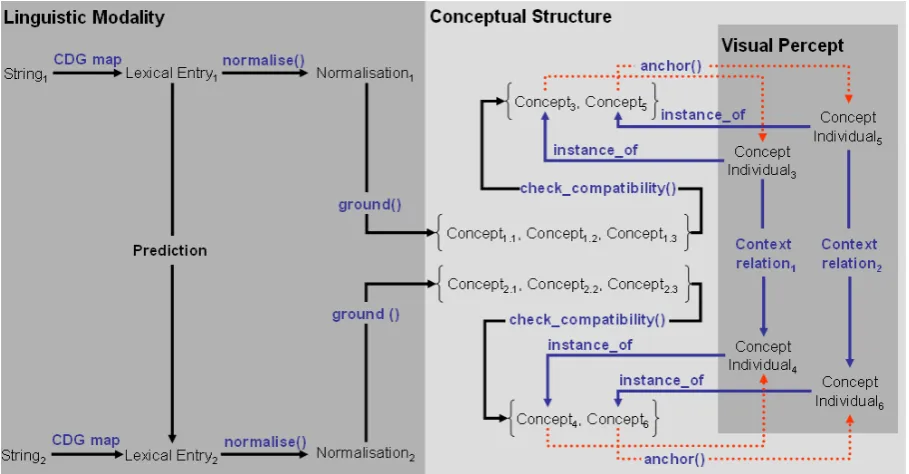
Fig. 2:Mapping procedure in cross-modal integration.
The latter class of ambiguity phenomena has already been envisioned as a possible application of the framework by [8].
While a detailed discussion of the application of the frame-work to these classes of syntactic ambiguities is beyond the scope of this paper, we now discuss how the framework processes one globally ambigous sentence that is represen-tative of the class of German Genitive-Dative ambiguities in feminine nouns as studied by [14]. To improve compa-rability of the sentences, we have normalised the different introductory main clauses to ‘Er weiß, dass . . . ’ He knows that . . . for all sentences. Consider (1) with the structural ambiguity highlighted.
(1) Er weiß, dass die ¨Arztinder Patientinden Leidenden pr¨asentierte.
He knows that . . .
a. Binary Situation (Genitive reading)
. . . the female patient’s female doctor presented the male sufferer.
b. Ternary Situation (Dative reading)
. . . the female doctor presented the male sufferer to the female patient.
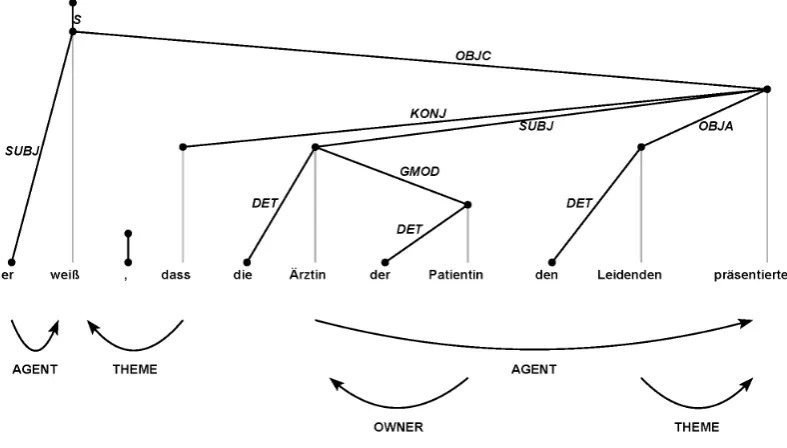
The parser’s default analysis of (1) in the absence of contextual information is the Dative reading which cor-responds to the syntactic structure shown in Figure 4. We can, however, modulate the semantic representation – and via the syntax-semantics interface also the syntactic analysis – by integrating a visual context that corresponds to the Genitive reading in (1) b.
The question arises how detailed such a context repre-sentation needs to be in order to be cognitively plausible and have the desired effect upon the integrated semantic representation in the parser. How, for instance, would
one be able to differentiate based on the visual modality alone whether the observed scene was a ‘pr¨asentieren’to present or a ‘zeigen’ to show situation? In [11] Spivey argues for a level of representational detail which balances the economy of information storage against the need for access to cognitively salient information. Spivey concludes that while the mental representation of visual context need not necessarily be complete it must provide anchor points for access to information not stored in the representation via the process of active vision.
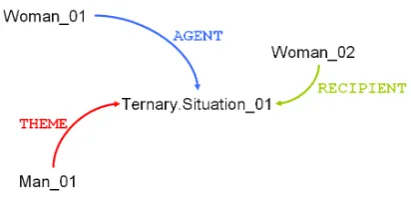
To preempt a discussion on the level of representational granularity provided by the visual modality, we have reduced the level of detail provided by the visual modality to the situation arity – i.e. the number of situation partic-ipants –, the particpartic-ipants’ ontological category as well as their thematic role in the situation. Our model hence does not impose any restriction on how specific the ontological categorisation of participants or the situation verb needs to be. A typical context model is visualised in figure 3. The concept instances we include need to be general enough to be attainable based on visually perceptible fea-tures. In Figure 3 we have identified the central situation verb as an instance of a generic binary situation concept and thus have intentionally underspecified the specific nature of the observed action. This visual context can be interpreted as ‘I can see who is doing something to whom – even if I cannot discern exactly what it is that they are doing’.
Fig. 3:Representation of visual context for the ternary sit-uation (Dative reading) of sentence (1).
instances of less specific concepts. Less specific concepts are superclasses of the more specific concepts in the ontology and therefore exhibit equally or a less restrictive concept compatibility. Our results from larger evaluations show that even such rather general context information is sufficient to impart the correct situation arity to the parser’s semantic representation.
The result of integrating the binary visual context into the parsing of (1) is the syntactic dependency structure in Figure 4. Integration of a visual context corresponding to the Genitive reading (1) a. has indeed succeeded in overriding the parser’s default ternary situation analysis which previously was obtained in the absence of a visual context.
5 Conclusions
In this paper we have described the implementation of a framework for the cross-modal influence of visual context upon linguistic processing in a weighted constraint depen-dency parser. Our framework utilises semantic relations between concept instances in combination with structural constraints to achieve cross-modal interaction between vi-sual context and syntactic analysis. In our implementa-tion, semantic information from a parser-external knowl-edge representation of visual context is aligned with the semantic representation in the parser. Syntactic analysis is modulated via the syntax-semantics interface.
We have outlined that in the parser correspondence rule constraints demand the alignment between the syntactic and semantic levels of analysis and another class of con-straints – the integration concon-straints – demand alignment of the thematic dependencies on the semantic levels with the thematic relations asserted in visual context. We found that concept instantiations related by thematic relations provide a suitable first approximation for the representation of vi-sual context. Our account concludes with the discussion of an application of our framework to a sentence representa-tive of an entire class of syntactic ambiguities in German. The example shows how the integration of visual context in our model permits to modulate syntactic attachment de-cisions.
Acknowledgements
This work has been generously funded by the German Re-search Foundation (DFG) as part of the CINACS project
“Multimodal Representations in Communication”. We would also like to express our sincere thanks to the five anonymous reviewers for their detailed and constructive feedback on an earlier version of this paper.
References
[1] G. T. M. Altmann. Language-mediated eye movements in the absence of a visual world.Cognition, 93:B79–B87, 2004.
[2] E. W. Bushnell. The development of intersensory perception: comparative perspectives, chapter A Dual-Processing Approach to Cross-Modal Matching: Implications for Development, pages 19–38. Lawrence Erlbaum Associates, 1994.
[3] R. M. Cooper. The control of eye fixation by the meaning of spoken language. a new methodology for the real-time investigation of speech perception, mem-ory, and language processing.Cognitive Psychology, 6:813–839, 1974. [4] FaCT-PlusPlus Download Page. http://code.google.com/p/
factplusplus/, 2009. Link verified: 20 April 2009.
[5] K. A. Foth.Hybrid Methods of Natural Language Analysis. PhD thesis, De-partment of Informatics, Hamburg University, Germany, 2007.
[6] R. S. Jackendoff. Semantics and Cognition. Cambridge, MA: MIT Press, 1983.
[7] R. S. Jackendoff.Patterns in the Mind. New York: Basic Books, 1994. [8] P. McCrae. Integrating cross-modal context for PP attachment disambiguation.
InProceedings of the 3rd International Conference on Natural Computation, Haikou (ICNC 2007), volume 3, pages 292–296, Los Alamitos, CA, 2007. IEEE.
[9] P. McCrae and W. Menzel. Towards a system architecture for integrating cross-modal context in syntactic disambiguation. In B. Sharp and M. Zock, editors,
Proceedings of the 4th International Workshop on Natural Language Process-ing and Cognitive Science, Madeira (NLPCS 2007), pages 228–237. INSTICC Press, 2007.
[10] I. Schr¨oder.Natural Language Parsing with Graded Constraints. PhD thesis, Department of Informatics, Hamburg University, Germany, 2002. [11] M. J. Spivey, D. C. Richardson, and S. A. Fitneva. The Interface of Vision,
Language, and Action, chapter Thinking outside the brain: Spatial indices to linguistic and visual information, pages 161–189. Number 5. New York: Psy-chology Press, 2004.
[12] STTS Tag Set. http://www.sfs.nphil.uni-tuebingen.de/ Elwis/stts.html, 2009. Link verified: 24 July 2009.
[13] M. K. Tanenhaus, M. J. Spivey-Knowlton, K. M. Eberhard, and J. C. Sedivy. Integration of visual and linguistic information in spoken language compre-hension.SCIENCE, 268:1632–1634, 1995.
Fig. 4:The parser’s default analysis in the absence of visual context (Dative reading).