Temporal Relation Extraction Using Expectation Maximization
Seyed Abolghasem Mirroshandel
Sharif University or Technology, Iran
[email protected]
Gholamreza Ghassem-Sani
Sharif University or Technology, Iran
[email protected]
Abstract
The ability to accurately determine temporal relations between events is an important task for several natural language processing applications such as Question Answering, Summarization, and Information Extraction. Since current supervised methods require large corpora, which for many languages do not exist, we have focused our attention on approaches with less supervision as much as possible. This paper presents a fully generative model for temporal relation extraction based on the expectation maximization (EM) algorithm. Our experiments show that the performance of the proposed algorithm, regarding its little supervision, is considerable in temporal relation learning.
1
Introduction
Lately, the increasing attention to the practical NLP applications such as question answering, information extraction, and summarization have resulted in a growing demand of temporal information processing (Tatu and Srikanth, 2008). In question answering, one may expect the system to answer questions such as “when an
event occurred”, or “what is the chronological
order of some desired events”. In text
summarization, especially in the multi-document type, knowing the order of events is a useful source of correctly merging related information.
Unlike problems such as part-of-speech tagging, morphological analysis, parsing, and named entity recognition which have been recently addressed with satisfactory results by combining statistical and symbolic methods (Mani et al., 2006), temporal relation extraction that requires deeper semantic analysis are yet to be worked on. One of recent efforts has disclosed
that this task is a complicated task, even for human annotators (Mani et al., 2006).
Based on the type of corpora that different temporal relation learning methods use, these methods are divided into three major categories: supervised, semi-supervised, and unsupervised. Supervised methods normally rely on the correct temporal relations of training sentences of a manually tagged corpus. Semi-supervised methods often rely on a partially tagged corpus and need less supervision. Finally, unsupervised methods rely only on raw sentences without any temporal relation annotation. It is obvious that producing the necessary training data (corpora) of supervised and to a less extent semi-supervised methods is a time consuming, hard, and expensive work. Besides, it is very difficult to adapt such methods for new tasks, languages, and/or domains. Consequently, it is in fact the corpus availability that directs the research in this area. For mentioned reasons, we have focused on unsupervised and weakly supervised temporal relation learning.
This paper presents a novel usage of expectation maximization (EM) algorithm for temporal relation learning. The algorithm also employs Allen's interval algebra (Allen, 1984). Our experiments show that the performance of the proposed algorithm is acceptable with respect to little usage of tagged corpora which is used.
The remainder of the paper is organized as follows: section 2 is about previous works on temporal relation extraction. Section 3 explains our proposed method. Section 4 briefly presents the characteristic of the corpora that we have used. Section 5 demonstrates the evaluation of the proposed algorithm. Finally, section 6 includes our conclusions and some possible future works.
2
Temporal Relation Extraction
For a given ordered pair of components (x1, x2), where x1 and x2 are times and/or events, a
temporal information processing system identifies the type of relation that temporally links x1 to x2. The relation type can for instance be one of the 14 types proposed in TimeML (Pustejovsky et al., 2003). For example, in “If all
the debt is converted (e7) to common, Automatic
Data will issue (e8) about 3.6 million shares; last
Monday (t24), the company had (e25) nearly 73
million shares outstanding.”, taken from
document wsj_0541 of TimeBank (Pustejovsky et al., 2003), there are two temporal relations between pairs (e7, e8) and (t24, e25). The task of temporal relation extraction is to automatically tag these pairs respectively with the BEFORE
and INCLUDES relations.
2.1 Related Work
There are numerous ongoing researches focused on temporal relation extraction. Existing methods of temporal relation learning, which are mainly fully supervised, can be divided into three categories: 1) Pattern based; 2) Rule based, and 3) Anchor based. These categories are respectively discussed in the next three sub-sections.
Pattern Based Methods
Pattern based methods extract some generic lexisyntactic patterns for events co-occurrence. Extracting such patterns can be done manually or automatically.
Perhaps the simplest pattern based method is the one that was developed using a knowledge resource called VerbOcean (Chklovski and Pantel, 2005). VerbOcean has a small number of manually selected generic patterns. The style of patterns is in the form of <Verb-X> and then <Verb-Y>. Similar to other manual methods, a major drawback of this method is its tendency to have a high recall but a low precision. Several heuristics have been proposed to resolve the low precision problem (Chklovski and Pantel, 2005; Torisawa, 2006).
On the other hand, automatic methods try to learn a classifier from an annotated corpus, and attempt to improve classification accuracy by feature engineering. MaxEnt classifier is an example of this group (Mani et al., 2006). The state of the art of supervised methods in this group is very similar to the MaxEnt classifier (Chambers et al., 2007). This classifier tries to learn event attributes and event-event features in two consecutive stages. It also uses WordNet to find words' synsets.
Some of researches on pattern based temporal
relation classification only work on corpora with specific characteristics, rather than general corpora such as TimeBank (Bethard and Martin, 2008; Bethard et al, 2007a; Lapata and Lascarides 2006; Bethard et al, 2007b; Bethard, 2007). There are also algorithms that work on only limited types of relations (Lapata and Lascarides 2006; Bethard, 2007; Bethard and Martin, 2007; Chambers and Jurafsky, 2008).
In another work, a weakly-supervised algorithm was proposed to classify temporal relation between events (Mirroshandel and Ghassem-Sani, 2010). In that work, it was shown that by applying a bootstrapping technique to some unlabeled documents that were related to the test documents and without any additional annotated data, temporal relations can be classified with satisfactory results.
Rule Based Methods
The common idea behind rule based methods is to design a number of rules for classifying temporal relations. In most existing works, these rules, which are manually defined, are based on Allen's interval algebra (Allen, 1984). One usage of these rules is enlarging the training set (Mani et al., 2006). Reasoning about the certainty of predicted temporal relations is the other utilization of these rules.
Anchor Based Methods
Anchor based methods use information of argument fillers (called anchors) of every event expression as a valuable clue for recognizing temporal relations. These methods rely on the distributional hypothesis (Harris, 1968), and by looking at a set of event expressions whose argument fillers have a similar distribution, try to recognize synonymous event expressions. Algorithms such as DIRT (Lin and Pantel, 2001), TE/ASE (Szpektor et al., 2004), and that of Pekar's system (Pekar, 2006) are examples of anchor based methods.
3
Using EM for Temporal Relation
Learning
types and then used those types for the initial estimation to compute P(TC | Corpus). The detailed accounts of the second and the third methods are discussed in subsection 5.1.
Like many statistical NLP tasks in which smoothing is required to alleviate the problem of data sparseness, smoothing is vital here, too. In particular, in the first few iterations, much more smoothing is required than in later iterations. In our experiments, we used an additive smoothing technique.
4
Corpus Description
In our experiments, we used two standard corpora which had been utilized in evaluation of most previous works: TimeBank (v. 1.2) and Opinion Corpus (Mani et al., 2006). TimeBank includes 183 newswire documents and 64077 words, and Opinion Corpus comprises 73 documents with 38709 words. These two datasets have been annotated based on TimeML (Pustejovsky et al., 2003). There are 14 temporal relations (Event-Event and Event-Time relations) in the TLink class of TimeML. Relation NONE, which indicates there is no temporal relation
between respected event pairs, must also be considered. For the sake of alleviating the data sparseness problem, we used a converted version of these temporal relations, which contains only four following temporal relations:
BEFORE , AFTER , OVERLAP , NONE
As it was shown in (Bethard et al, 2007a), it is easy to convert 14 TimeML relations into just
BEFORE, AFTER, and OVERLAP relations.
Here, we merged BEFORE and IBEFORE relations into only BEFORE relations. Similarly
AFTER and IAFTER relations were also merged
into AFTER relations. All the remaining 10 relation types were collapsed in OVERLAP relations.
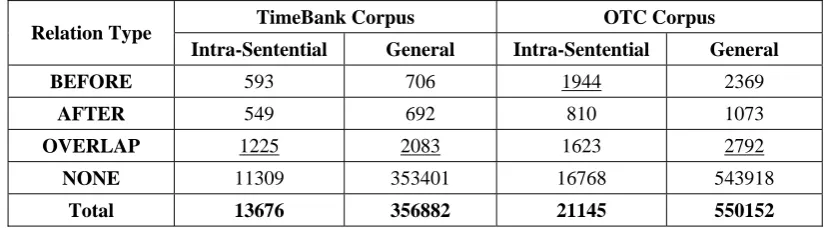
In our experiments, like several previous works, we merged Opinion and TimeBank to generate a single corpus, which is called OTC. Table 2 shows the converted TLink class distribution over TimeBank and OTC corpora for intra-sentential and general (intra- and inter-intra-sentential) event pairs which are situated in the same document.
TimeBank Corpus OTC Corpus
Relation Type
Intra-Sentential General Intra-Sentential General
BEFORE 593 706 1944 2369
AFTER 549 692 810 1073
OVERLAP 1225 2083 1623 2792
NONE 11309 353401 16768 543918
Total 13676 356882 21145 550152
Table 2: The converted TLink class distribution in TimeBank and OTC for intra-sentential and general event pairs.
5
Evaluation
5.1 Experimental Setup
We applied our algorithm to both TimeBank and OTC corpora, using the five-fold cross validation method. The results were evaluated by measuring accuracy. One important point that we should mention is the parameter initialization of EM.
As it was mentioned in section 3.3, we used three different initializations: first, a uniform distribution over all temporal clustering was used; therefore, all temporal clustering in the first step had equal probability. Second, we used a small part of labeled corpora (10% of each
relation type) for setting P(TC | Corpus). Relations were selected randomly. Third, we used some rules for initial estimation of temporal relation types and used this initial estimation for computing P(TC | Corpus). The rules were the combination of GTag rules (Mani et al., 2006),
VerbOcean (Chklovski and Pantel, 2005), and
some rules derived from certain signal words (e.g., “on”, “during”, “when”, and “if”) of the text.
5.2 Results and Discussions
As it is shown in table 2 (in General columns),
very hard (even useless). Regarding this problem, we set up two different types of experiments:
1) Algorithms were applied only for intra-sentential event pairs, considering all relation types (including NONE). The results of these experiments are shown in table 3.
2) The NONE relations were removed, and algorithms were applied to both intra-sentential and general (intra- and inter-sentential) event pairs. Table 4 shows the results of experiments without considering NONE relations.
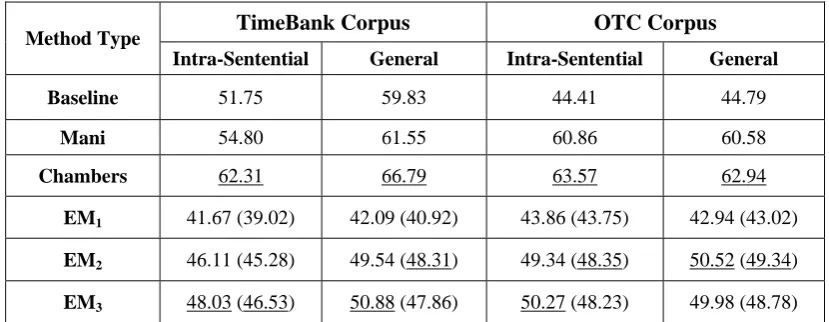
One important issue in the results of table 3 is that in our experiments, all four mentioned relation types (BEFORE, AFTER, OVERLAP, and NONE) have been considered, but in reporting the results, we have reported the aggregated accuracy of only BEFORE, AFTER,
and OVERLAP relations, and excluded the
accuracy results of NONE relations. That is because by considering NONE, one could design a simple system which tags all relations to
NONE, and would get a very high accuracy. But, in that case the comparison would be inappropriate.
In our evaluations, both table 3 and 4, the baselines have been the majority classes for event pair relations ignoring NONE relations of the evaluated corpora (i.e., BEFORE and
OVERLAP relations as it is depicted in table 2).
The Mani's method is in fact a supervised method which exclusively uses gold-standard features (Mani et al., 2007). The Chambers' method is similar to Mani's, except that it uses some external resources such as WordNet (Chambers et al., 2007). The Mani and Chambers results are different from (or even lower than) their reported results, because of two differences: first, we considered only three temporal relation types while in their experiments, there were six relation types. Second, the results of table 3 are reported by considering NONE relations, but in their original works, there was not any NONE relation.
Method Type TimeBank OTC Corpus
Baseline 51.75 44.41
Mani 31.77 47.24
Chambers 36.03 48.86
EM1 23.76 (22.10) 32.48 (32.21)
EM2 28.65 (26.31) 38.68 (36.45)
EM3 29.81 (27.13) 39.92 (39.28)
Table 3: The results of proposed method for intra-sentential event pairs on all mentioned relation types
including NONE relations
TimeBank Corpus OTC Corpus
Method Type
Intra-Sentential General Intra-Sentential General
Baseline 51.75 59.83 44.41 44.79
Mani 54.80 61.55 60.86 60.58
Chambers 62.31 66.79 63.57 62.94
EM1 41.67 (39.02) 42.09 (40.92) 43.86 (43.75) 42.94 (43.02)
EM2 46.11 (45.28) 49.54 (48.31) 49.34 (48.35) 50.52 (49.34)
EM3 48.03 (46.53) 50.88 (47.86) 50.27 (48.23) 49.98 (48.78)
Table 4: The results of different methods for intra-sentential and general event pairs by ignoring NONE relations.
EM1, EM2, and EM3 are the results of our
proposed method with three different initializations. The initializations of EM1, EM2,
and EM3 were random, with little supervision
(10%), and by using a number of rules, respectively. For EM1, one question is how this
method can determine the label of different classes. In our experiments, EM1, depending on
the type of experiment, only determines three or four different classes (Class1, Class2, Class3,
and/or Class4). To label these unlabeled classes, using annotated data, we assigned the labels in such a way that resulted in maximum similarity between predicted and annotated temporal relation types for each event pair.
In tables 3 and 4, the numbers inside parentheses show the results of our proposed algorithm without applying temporal reasoning.
performance. That is due to the problem's nature. As distribution of different columns of table 2 shows, the number of NONE relations, even in the intra-sentential case, is about 7 to 10 times greater than other relations. Therefore, it is very hard for a learning algorithm to precisely determine the relation types. On the other hand, results of table 4, which ignores NONE relations, are satisfactory. Comparing proposed method with the baseline, shows that in the cases that supervised methods can beat the baseline method, our weakly supervised method can also work better than the baseline or close to it.
It should be noted that the Chambers' method, which is the most successful method of tables 3 and 4, is in fact the state of the art supervised method, while our proposed method is, based on the initialization approaches, unsupervised or weakly supervised. Among different settings of the proposed method, EM3 achieved the best
results except for the general case of OTC in table 4, where EM2 achieved better results.
The results show that EM1 is not very efficient
in either first or second type of experiments. It seems that randomized initialization in this hard problem, may cause some divergence in the probability distribution. On the other hand, both EM2 and EM3 showed satisfactory results in
these problems. Therefore, initialization is a critical factor in our EM method, and some little source of supervision seems crucial for achieving better results.
Comparison of the results of proposed EM algorithm with and without utilization of temporal reasoning shows that using temporal reasoning can be effective on the accuracy of the algorithm. By using temporal reasoning, some inconsistencies are removed in step E of the algorithm and the predicted relations will be more reliable. Then in step M, the update of parameters will be performed more accurately and thus the accuracy of the algorithm iteratively will increase.
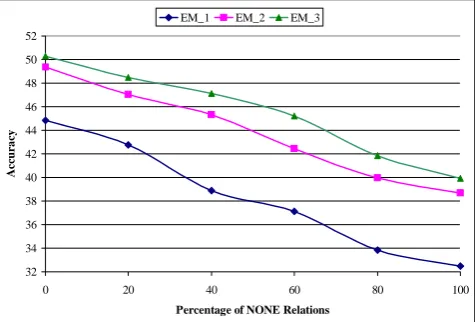
Another important point in the comparison of accuracy results is the existence of NONE relations. As it is shown in tables 3 and 4, the accuracies in table 3 is much lower than that of in table 4. These differences are all due to the existence of NONE relations, which makes problem hard. Figure 2 demonstrates the effects of NONE relations on the accuracy of our proposed algorithm. All the experiments have been performed using OTC. We repeated our experiments for different percentage of NONE relations. As it is shown, NONE relations have
had a great impact on the accuracy of the system. The larger gap between the accuracy of ignoring and consideration of NONE relations on TimeBank (in contrast that of OTC) implies that
NONE relations would have an even greater impact on the accuracy of the algorithm if applied to TimeBank.
32 34 36 38 40 42 44 46 48 50 52
0 20 40 60 80 100
Percentage of NONE Relations
Ac
cu
ra
cy
EM_1 EM_2 EM_3
Figure 2: The effect of NONE relations on the accuracy
Figure 2 shows the impact of NONE relations on the accuracy (or recall) of the algorithm. Our experiments showed that this impact is even more substantial on the precision of the proposed algorithm. That is because although the algorithm can determine BEFORE, AFTER, and
OVERLAP relations with an acceptable rate, but
a lot of NONE relations will also be recognized. As a result, the precision will substantially decrease. Due to lack of space, we have not reported the precision of the algorithm.
6
Conclusion
In this paper, we have addressed the problem of learning temporal relations between event pairs, which is an interesting topic in natural language processing. Building a suitable corpus is a hard, expensive, and time consuming task. Therefore, we focused on unsupervised and weakly supervised types of learning. We proposed a novel generative model that uses the EM algorithm with some interval algebra reasoning for temporal relation learning. We compared our work with some of successful supervised methods. Our experiments showed that the result of the proposed algorithm, considering its little supervision, is satisfactory.
further improve the accuracy of the new algorithm.
References
James Allen. 1984. Towards a General Theory of
Action and Time. Artificial Intelligence, 23, 2,
123-154.
Steven Bethard, James H. Martin, and Sara
Klingenstein. 2007a. Finding Temporal
Structure in Text: Machine Learning of
Syntactic Temporal Relations. Journal of
Semantic Computing, 1, 4.
Steven Bethard, James H. Martin, and Sara
Klingenstein. 2007b. Timelines from Text:
Identification of Syntactic Temporal Relations. Proceeding of ICSC, 11-18.
Steven Bethard and James H. Martin. 2007.
CU-TMP: Temporal Relation Classification Using
Syntactic and Semantic Features. Proceeding of
SemEval-2007, 129-132.
Steven Bethard. 2007. Finding Event, Temporal
and Causal Structure in Text: A Machine
Learning Approach. PhD thesis, University of
Colorado at Boulder.
Steven Bethard and James H. Martin. 2008. Learning Semantic Links from a Corpus of Parallel
Temporal and Causal Relations. Proceeding of
ACL-2008, 177-180.
Nathanael Chambers, Shan Wang, and Dan Jurafsky.
2007. Classifying Temporal Relations between
Events. Proceeding of ACL-2007, 173-176.
Nathanael Chambers and Dan Jurafsky. 2008. Jointly Combining Implicit Constraints Improves
Temporal Ordering. Proceeding of
EMNLP-2008, 698-706.
Eugene Charniak and Micha Elsner. 2009. EM
Works for Pronoun Anaphora Resolution. Proceedings of EACL-2009, 148-154.
Colin Cherry and Shane Bergsma. 2005. An
Expectation Maximization Approach to
Pronoun Resolution. Proceeding of CoNLL
2005. 88-95.
Timothy Chklovski and Patrick Pantel. 2005. Global Path-based Refinement of Noisy Graphs
Applied to Verb Semantics. Proceeding of
IJCNLP-05, 792-803.
Zellig Harris. 1968. Mathematical Structure of
Language. John Wiley Sons, New York, 1968.
Dan Klein. 2005. The Unsupervised Learning of
Natural Language Structure. Ph.D. Thesis,
Department of Computer Science, Stanford University.
Mirella Lapata and Alex Lascarides. 2006. Learning
Sentence-Internal Temporal Relations. Journal
of Artificial Intelligence Research, 27, 85-117.
Dekang Lin and Patrick Pantel. 2001.
Dirt-Discovery of Inference Rules From Text.
Proceeding of ACM SIGKDD-2001, 323-328. Inderjeet Mani, Marc Verhagen, Ben Wellner, Chong
M. Lee, and James Pustejovsky. 2006. Machine
Learning of Temporal Relations. Proceedings of
ACL-2006, 753-760.
Inderjeet Mani, Ben Wellner, Marc Verhagen, and
James Pustejovsky. 2007. Three Approaches to
Learning Tlinks in TimeML. Technical Report
CS-07-268. Brandeis University, Waltham, USA.
Seyed Abolghasem Mirroshandel, Gholamreza Ghassem-Sani, and Mahdy Khayyamian. 2009. Using Tree Kernels for Classifying Temporal
Relations between Events. Proceedings of
PACLIC-2009, 355-364.
Seyed Abolghasem Mirroshandel and Gholamreza
Ghassem-Sani. 2010. Temporal Relations
Learning with a Bootstrapped
Cross-document Classifier. Proceedings of ECAI-2010,
829-834.
Vincent Ng, 2008. Unsupervised Models for
Coreference Resolution. Proceedings of
EMNLP-2008, 640-649.
Victor Pekar. 2006. Acquisition of Verb Entailment
from Text. Proceeding of NAACL/HLT-2006,
49-56.
James Pustejovsky, Patrick Hanks, Roser Saurí, Andrew See, Robert Gaizauskas, Andrea Setzer, Dragomir Radev, Beth Sundheim, David Day, Lisa
Ferro and Marcia Lazo. 2003. The TimeBank
Corpus. Corpus Linguistics, 647-656.
Idan Szpektor, Hristo Tanev, Ido Dagan, and
Bonaventura Coppola. 2004. Scaling Web-based
Acquisition of Entailment Relations. Proceeding of EMNLP-2004, 41-48.
Marta Tatu and Munirathnam Srikanth. 2008. Experiments with Reasoning for Temporal
Relations between Events. Proceeding of
Coling-2008, 857-864.
Kentaro Torisawa. 2006. Acquiring Inference Rules with Temporal Constraints by Using Japanese Coordinated Sentences and Noun-Verb
Co-Occurrences. Proceedings of NAACL-2006,
57-64.
Puscasu G. Wvali. 2007. Temporal Relation
Identification by Syntactico-Semantic