Supervised Morphology Generation Using Parallel Corpus
Alireza Mahmoudi, Mohsen Arabsorkhi† and Heshaam Faili
School of Electrical and Computer Engineering College of Engineering
University of Tehran, Tehran, Iran
{ali.mahmoudi,hfaili}@ut.ac.ir
Abstract
Translating from English, a morphologi-cally poor language, into morphologimorphologi-cally rich languages such as Persian comes with many challenges. In this paper, we present an approach to rich morphology predic-tion using a parallel corpus. We focus on the verb conjugation as the most important and problematic phenomenon in the con-text of morphology in Persian. We define a set of linguistic features using both En-glish and Persian linguistic information, and use an English-Persian parallel cor-pus to train our model. Then, we pre-dict six morphological features of the verb and generate inflected verb form using its lemma. In our experiments, we generate verb form with the most common feature values as a baseline. The results of our experiments show an improvement of al-most 2.1% absolute BLEU score on a test set containing 16K sentences.
1 Introduction
One of the main limitations of statistical machine translation (SMT) is the sensitivity to data sparse-ness, due to the word-based or phrased-based ap-proach incorporated in SMT (Koehn et al., 2003). This problem becomes severe in the translation from or into a morphologically rich language, where a word stem appears in many completely different surface forms. Therefore, morphological analysis is an important phase in the translation from or into such languages, because it reduces the sparseness of model. So, modeling rich morphol-ogy in machine translations (MT) has received a lot of research interest in several studies.
In this paper, we present a novel approach to rich morphology prediction for Persian as target language. We focus on the verb conjugation as a
highly inflecting class of words and an important part of morphological processing in Persian. Our model incorporates decision tree classifier (DTC) (Quinlan, 1986), which is an approach to multi-stage decision making. In order to train DTC, we use both English and Persian linguistic informa-tion such as syntactic parse tree and dependency relations obtained from an English-Persian paral-lel corpus. Morphological features which we pre-dict and use to generate the inflected form of verb are voice (VOC), mood (MOD), number (NUM), tense (TEN), negation (NEG) and person (PER). Our proposed model can be used as a component to generate rich morphology for any kind of lan-guages and MTs.
The reminder of the paper is organized as fol-lows: Section 2 briefly reviews some challenges in Persian verb conjugation, Section 3 presents our proposed approach to generate rich morphology, in Section 4 our experiments and results are pre-sented, in Section 5 we cover conclusions and fu-ture work, and finally, in Section 6 we describe related works.
2 Morphology Challenges of the Persian Verbs
Verbs in Persian have a complex inflectional sys-tem (Megerdoomian, 2004). This complexity ap-pears in the following aspects:
• Different verb forms
• Different verb stems
• Affixes marking inflections
• Auxiliaries used in certain tenses
Simpleform andcompoundform are two forms used in Persian verbal system. Simple form is bro-ken into two categories according to the stem used in its formation. Compound form refers to those that require an auxiliary to form a correct verb.
Figure 1: General schema of the verb generation process.
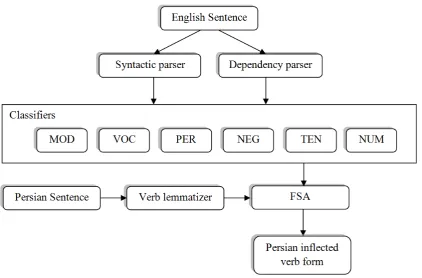
phemes. Unlike these approaches, we predict morphological features like El Kholy and Habash (2012a and b). Using our training data set, we build six language specific DTCs to predict each of the morphological features. Each DTC uses a subset of our feature set and predicts correspond-ing morphology feature independently. Then, we use a FSA to generate an inflected verb form using these six morphological features. Figure 1, shows the general schema of verb generation process.
Table 3 shows Correct Classification Ratio (CCR) of each DTC learned on our train data con-taining 178782 entries and evaluated on a test set containing more than 20k verbs. The most com-mon feature value is used as our baseline for each classifier. The most improvement is achieved in the prediction of MOD and NUM. Others have high CCR but they also have very high baselines.
4 Experiments
In this section, we present the results of our ex-periments on a test set containing 16K sentences selected from an English-Persian parallel corpus. As the main goals of our experiments, we are inter-ested in knowing the effectiveness of our approach to rich morphology prediction and the contribu-tion each feature has. To do so, like Minkov et
Predicted Feature
Baseline CCR %
Prediction CCR %
Improv-ement
MOD 61.12 79.63 18.51
NUM 68.58 83.60 15.02 VOC 85.32 87.98 2.66 TEN 85.06 88.10 3.4 PER 93.66 96.00 2.44
NEG 95.91 97.13 1.22
Table 3: CCR (%) of six DTCs and corresponding improvements.
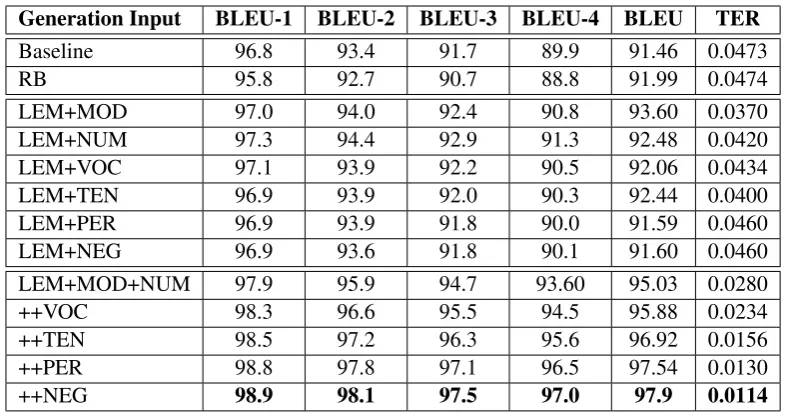
al. (2007) and El Kholy and Habash (2012), who use aligned sentence pair of reference translations (reference experiments) instead of the output of an MT system as input, we also perform reference experiments because they are golden in terms of word order, lemma choice and morphological fea-tures. Table 4 shows detailed n-gram BLEU (Pap-ineni et al., 2002) precision (forn=1,2,3,4), BLEU and TER (Snover et al., 2006) scores for morphol-ogy generation using gold lemma with the most common feature values (LEM) as a baseline and other gold morphological features and their com-binations as our reference experiments.
Generation Input BLEU-1 BLEU-2 BLEU-3 BLEU-4 BLEU TER
Baseline 96.8 93.4 91.7 89.9 91.46 0.0473
RB 95.8 92.7 90.7 88.8 91.99 0.0474
LEM+MOD 97.0 94.0 92.4 90.8 93.60 0.0370 LEM+NUM 97.3 94.4 92.9 91.3 92.48 0.0420 LEM+VOC 97.1 93.9 92.2 90.5 92.06 0.0434 LEM+TEN 96.9 93.9 92.0 90.3 92.44 0.0400 LEM+PER 96.9 93.9 91.8 90.0 91.59 0.0460 LEM+NEG 96.9 93.6 91.8 90.1 91.60 0.0460 LEM+MOD+NUM 97.9 95.9 94.7 93.60 95.03 0.0280 ++VOC 98.3 96.6 95.5 94.5 95.88 0.0234 ++TEN 98.5 97.2 96.3 95.6 96.92 0.0156 ++PER 98.8 97.8 97.1 96.5 97.54 0.0130 ++NEG 98.9 98.1 97.5 97.0 97.9 0.0114
Table 4: Morphology generation results using gold Persian lemma plus different set of gold morpholog-ical features. When we add a feature to the previous feature set we use “++” notation. RB refers to the results of verb generation using rule-based approach.
verb with predicted verb generated by FSA using gold lemma plus the most common feature val-ues as a baseline. In comparison with the base-line used by El Kholy and Habash (2012), this baseline is more stringent. As another baseline we have used a rule-based morphological analyzer which determines morphological features of the verb grammatically and generates inflected verb form (this rule-based morphological analyzer uses syntactic parse, POS tags and dependency rela-tionships of English sentence). We use each gold feature separately to investigate the contribution each feature has. Finally, we combine gold fea-tures incrementally based on their CCR. Adding more features improve BLEU and TER scores. Since, there are some cases in which with the same morphological features it is possible to gen-erate different but correct verb forms, the maxi-mum BLEU score of 100 is hard to be reached even if we are given the gold features. So, the best result (97.90 of BLEU and 0.0114 of TER) could be considered as an upper bound for proposed ap-proach. Note that, these results are obtained from our reference experiments in which a reference is duplicated and modified by our approach. In fact, there is no translation task here and a reference is evaluated by its modified version.
We perform the same reference experiments on the same data using predicted features instead of the gold features. Table 5 reports the results of detailed n-gram BLEU precision, BLUE and TER
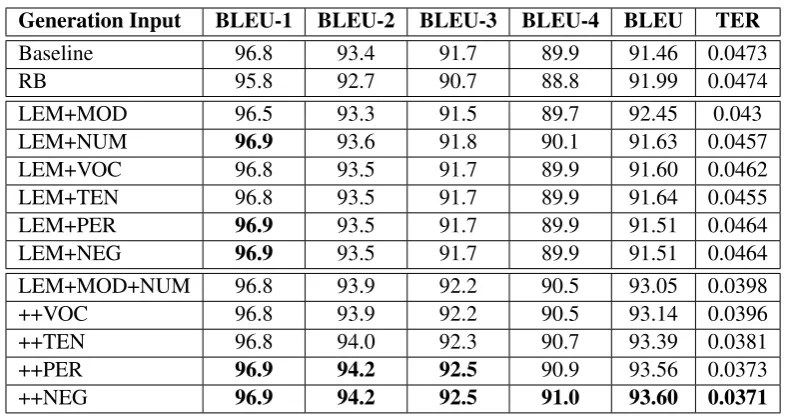
scores. According to the results, our approach out-performs the baselines in all configurations. The best configuration uses all predicted features and shows an improvement of about 2.1% absolute BLEU score and 0.102% absolute TER against our first baseline. Also, in comparison with our sec-ond baseline, rule-based approach, we achieve im-provements of about 1.6% absolute BLEU score and 0.103% absolute TER.
5 Conclusions and Future Work
In this paper we present a supervised approach to rich morphology prediction. We focus on verb in-flections as a highly inflecting class of words in Persian, a morphologically rich language. Using different combination of morphological features to generate inflected verb form, we evaluate our approach on a test set containing 16K sentences and obtain better BLEU and TER scores com-pared with our baseline, morphology generation with lemma plus the most common feature values.
Generation Input BLEU-1 BLEU-2 BLEU-3 BLEU-4 BLEU TER
Baseline 96.8 93.4 91.7 89.9 91.46 0.0473
RB 95.8 92.7 90.7 88.8 91.99 0.0474
LEM+MOD 96.5 93.3 91.5 89.7 92.45 0.043 LEM+NUM 96.9 93.6 91.8 90.1 91.63 0.0457 LEM+VOC 96.8 93.5 91.7 89.9 91.60 0.0462 LEM+TEN 96.8 93.5 91.7 89.9 91.64 0.0455 LEM+PER 96.9 93.5 91.7 89.9 91.51 0.0464 LEM+NEG 96.9 93.5 91.7 89.9 91.51 0.0464 LEM+MOD+NUM 96.8 93.9 92.2 90.5 93.05 0.0398 ++VOC 96.8 93.9 92.2 90.5 93.14 0.0396 ++TEN 96.8 94.0 92.3 90.7 93.39 0.0381 ++PER 96.9 94.2 92.5 90.9 93.56 0.0373 ++NEG 96.9 94.2 92.5 91.0 93.60 0.0371
Table 5: Morphology generation results using gold Persian lemma plus different set of predicted mor-phological features. When we add a feature to the previous feature set we use “++” notation. RB refers to the results of verb generation using rule-based approach.
6 Related Work
In this section we introduce the main approaches to morphology generation. The first approach is based on factored models, an extension of phrased-based SMT model (Koehn and Hoang, 2007). In this approach each word is annotated using morphology tags on morphologically rich side. Then, morphology generation is done based on the word level instead of phrase level, which is also the limitation of this approach. A sim-ilar approach is used by Avramidis and Koehn (2008) to translate from English into Greek and Czech. They especially focus on noun cases and verb persons. Mapping from syntax to morphol-ogy in factored model is used by Yeniterzi and Oflazer (2010) to improve English-Turkish SMT. Hierarchical phrase-based translation, an exten-sion of factored translation model, proposed by Subotin (2011) to generate complex morphology using a discriminative model for Czech as the tar-get laguage.
Maximum entropy model is another approach used by Minkov et al. (2007) for English-Arabic and English-Russian MT. They proposed a post-processing probabilistic framework for morphol-ogy generation utilizing a rich set of morpholog-ical knowledge sources. There are some similar approaches used by Toutanova et al. (2008) for Arabic and Russian as the target languages and by Clifton and Sarkar (2011) for English-Finnish SMT. In these approaches, the model of
morphol-ogy prediction is an independent process of the SMT system.
Segmentation is another approach that improves MT by reducing the data sparseness of translation model and increasing the similarity between two sides (Goldwater and McClosky, 2005; Luong et al., 2010; Oflazer, 2008). This method analyzes morphologically rich side and unpacks inflected word forms into simpler components. Goldwa-ter and McClosky (2005) showed that modifying Czech as the input language using ‘pseudowords’ improves the Czech-English machine translation system. Similar approaches are used by Oflazer (2008) for English to Turkish SMT, Luong et al. (2010) for translating from English into Finnish and Namdar et al. (2013) to improve Persian-English SMT.
Mohammad Sadegh Rasooli, Heshaam Faili, and Behrouz Minaei-Bidgoli. 2011. Unsupervised iden-tification of persian compound verbs. InAdvances in Artificial Intelligence, pages 394–406. Springer.
Matthew Snover, Bonnie Dorr, Richard Schwartz, Lin-nea Micciulla, and John Makhoul. 2006. A study of translation edit rate with targeted human annotation.
In Proceedings of association for machine
transla-tion in the Americas, pages 223–231.
Michael Subotin. 2011. An exponential translation model for target language morphology. In Proc. ACL.
Kristina Toutanova, Hisami Suzuki, and Achim Ruopp. 2008. Applying morphology generation models to machine translation. pages 514–522.