Norwegian Native Language Identification
Shervin Malmasi♦ Mark Dras♦ Irina Temnikova♥
♦Macquarie University, Sydney, NSW, Australia ♥Qatar Computing Research Institute, HBKU, Qatar
[email protected], [email protected] [email protected]
Abstract
We present a study of Native Language Identification (NLI) using data from learn-ers of Norwegian, a language not yet used for this task. NLI is the task of predicting a writer’s first language using only their writings in a learned language. We find that three feature types, function words, part-of-speechn-grams and a hy-brid part-of-speech/function word mixture n-gram model are useful here. Our sys-tem achieves an accuracy of79%against a baseline of13%for predicting an author’s L1. The same features can distinguish non-native writing with99%accuracy. We also find that part-of-speech n-gram per-formance on this data deviates from previ-ous NLI results, possibly due to the use of manually post-corrected tags.
1 Introduction
Native Language Identification (NLI) is the task of identifying a writer’s native language (L1) based only on their writings in a second language (the L2). NLI works by identifying language use pat-terns that are common to groups of speakers of the same native language. This process is underpinned by the presupposition that an author’s L1 disposes them towards certain language production patterns in their L2, as influenced by their mother tongue. This relates to cross-linguistic influence (CLI), a key topic in the field of Second Language Acqui-sition (SLA) that analyzes transfer effects from the L1 on later learned languages (Ortega, 2009).
It has been noted in the linguistics litera-ture since the 1950s that speakers of particular languages have characteristic production patterns when writing in a second language. This lan-guage transfer phenomenon has been investigated independently in various fields from different per-spectives, including qualitative research in SLA
and more recently though predictive computa-tional models in NLP (Jarvis and Crossley, 2012). Recently this has motivated studies in Native Language Identification (NLI), a subtype of text classification where the goal is to determine the native language (L1) of an author using texts they have written in a second language or L2 (Tetreault et al., 2013).
The motivations for NLI are manifold. The use of such techniques can help SLA researchers iden-tify important L1-specific learning and teaching issues. In turn, the identification of such issues can enable researchers to develop pedagogical ma-terial that takes into consideration a learner’s L1 and addresses them. It can also be applied in a forensic context, for example, to glean informa-tion about the discriminant L1 cues in an anony-mous text. In fact, recent NLI research such as that related to the work presented by Perkins (2014) has already attracted interest and funding from in-telligence agencies (Perkins, 2014, p. 17).
While most NLI research to date has focused on English L2 data, there is a growing trend to ap-ply the techniques to other languages in order to assess their cross-language applicability (Malmasi and Dras, 2014c).
The current work presents the first NLI exper-iments on Norwegian data using a corpus of ex-amination essays collected from learners of Nor-wegian, as described in section 3. Given the dif-ferences between English and Norwegian (which we outline in section 2.1), the main objective of the present study is to determine if NLI techniques previously applied to L2 English can be effective for detecting L1 transfer effects in L2 Norwegian. Another unique aspect of this data is the availability of manually corrected part-of-speech (POS) tag annotations. This is something that has not been generally considered in previous NLI re-search and we aim to analyze how these results compare to previous studies in this regard.
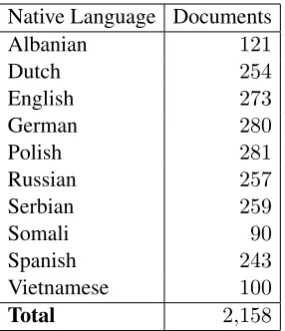
Native Language Documents
Albanian 121
Dutch 254
English 273
German 280
Polish 281
Russian 257
Serbian 259
Somali 90
Spanish 243
Vietnamese 100
Total 2,158
Table 1: The10L1 classes included in this exper-iment and the number of texts we generated for each class.
Given its many morphosyntactic markers and detailed categories, the ASK dataset has a rich tagset with over300unique tags.
4 Experimental Methodology
In this study we employ a supervised multi-class classification approach. The learner texts are or-ganized into classes according to the author’s L1 and these documents are used for training and test-ing in our experiments. A diagram conceptualiz-ing our NLI system is shown in Figure 2.
4.1 Classifier
We use a linear Support Vector Machine to per-form multi-class classification in our experiments. In particular, we use the LIBLINEAR3 package (Fan et al., 2008) which has been shown to be efficient for text classification problems such as this. More specifically, it has been demonstrated to be the most effective classifier for this task in the 2013 NLI Shared Task (Tetreault et al., 2013).
4.2 Evaluation
In the same manner as many previous NLI stud-ies and also the NLI 2013 shared task, we report our results as classification accuracy underk-fold cross-validation, withk= 10. In recent years this has become ade factostandard for reporting NLI results.
3http://www.csie.ntu.edu.tw/%7Ecjlin/liblinear/
5 L1 Identification Experiment
We experiment using three syntactic feature types described in this section. As the ASK corpus is not balanced for topic, we do not consider the use of lexical features such as word n-grams in this study. Topic bias can occur as a result of the sub-ject matters or topics of the texts to be classified not evenly distributed across the classes (Koppel et al., 2009). For example, if in our training data all the texts written by English L1 speakers are on topic A, while all the French L1 authors write about topic B, then we have implicitly trained our classifier on the topics as well. In this case the classifier learns to distinguish our target variable through another confounding variable.
Norwegian Function Words As opposed
to content words, function words are topic-independent grammatical words that indicate the relations between other words. They include determiners, conjunctions and auxiliary verbs. Distributions of English function words have been found to be useful in studies of authorship attribution and NLI. Unlike POS tags, this model analyzes the author’s specific word choices.
In this work we used a list of176function words obtained from the distribution of the Apache Lucene search engine software.4This list includes stop words for the Bokm˚al variant of the language and contains entries such as hvis (whose), ikke
(not),jeg (I), s˚a(so) and hj˚a(at). We also make this list available on our website.5
In addition to single function words, we also ex-tract function word bigrams, as described by Mal-masi et al. (2013). Function word bigrams are a type of word n-gram where content words are skipped: they are thus a specific subtype of skip-gram discussed by Guthrie et al. (2006). For ex-ample, the sentenceWe should all start taking the bus would be reduced towe should all the, from which we would extract then-grams.
Part-of-Speechn-grams In this model POSn -grams of order1–3were extracted. Thesen-grams capture small and very local syntactic patterns of language production and were used as classifica-tion features. Previous work and our experiments showed that sequences of size4or greater achieve
4https://github.com/apache/lucene-solr
Norwegian Text Russian L1
NLI
Norwegian Text
Norwegian Text
Norwegian Text
Polish L1
English L1
German L1
Figure 2: Illustration of our NLI system that identifies the L1 of Norwegian learners from their writing.
lower accuracy, possibly due to data sparsity, so we do not include them.
We observe328different tags in the data result-ing in9k unique bigrams and61k trigram features.
Mixed POS-Function Word n-grams Previ-ously Wong et al. (2012) proposed the use of POS n-grams which retained the surface form of func-tion words instead of using their POS tag. Exam-ple mixed trigrams include “the NN that” or “NN that VBZ”. They demonstrated that such features can outperform their pure POS counter-parts. Here we also use our above-described func-tion word list to generate such mixedn-grams.
5.1 Results
The results for all of our features are shown in Table 2. We compare against a majority class baseline of 13%which is calculated by using the largest class, in this case Polish, as the default clas-sification label chosen for all texts.
The distribution of function word unigrams and bigrams is highly discriminative, yielding accu-racies of 51.1% and50.0%, respectively. These are well-above the baseline and suggest the pres-ence of L1-specific grammatical and lexical choice patterns that can help distinguish the L1, poten-tially due to cross-linguistic transfer. Such lexical transfer effects have been previously noted by re-searchers and linguists (Odlin, 1989). These ef-fects are mediated not only by cognates and simi-larities in word forms, but also word semantics.
Feature Accuracy (%)
Majority Baseline 13.0
Function Words 51.1
Function Word bigrams 50.0
Part-of-Speech unigrams 61.2
Part-of-Speech bigrams 66.5
Part-of-Speech trigrams 62.7
POS/Function Word trigrams 78.1
All features combined 78.6
Table 2: Norwegian Native Language Identifica-tion accuracy for the features used in this study.
GER SPA ENG RUS POL ALB SER VIE SOM DUT
Predicted label GER
SPA ENG RUS POL ALB SER VIE SOM DUT
True label
Confusion Matrix
0.0 0.1 0.2 0.3 0.4 0.5 0.6 0.7 0.8 0.9
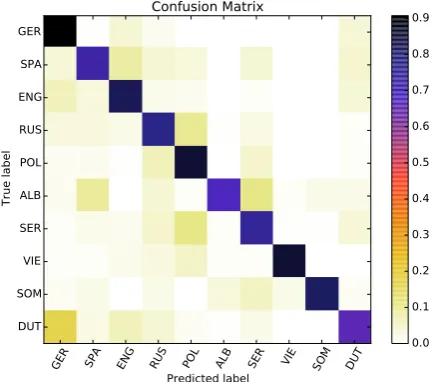
Figure 3: Confusion matrix for our10classes.
The mixture of POS and function wordn-grams provides the best result for a single feature with
78.1%accuracy. This is consistent with previous findings about this feature type.
Finally, combining all of the models into a sin-gle feature vector provides the highest accuracy of
78.6%, which is only slightly better than the best single feature type.
Figure 3 shows the normalized confusion ma-trix for our results. German and Polish are the most correctly classified L1s, while the highest confusion is between Dutch–German followed by Serbian–Polish and Russian-Polish. This is not surprising given that these pairs are from the same families: Germanic and Slavic. We were however surprised by the substantial confusion between Al-banian and Spanish, even though the languages are not typologically related.
We also analyze the rate of learning for our clas-sifier. A learning curve for a classifier trained on all features is shown in Figure 4. We observe that while there is a rapid initial increase in accuracy, performance begins to level off after around1,500
training documents.
6 Identifying Non-Native Writing
Our second experiment involves using the above-described features to classify Norwegian texts as either Native or Non-Native. To achieve this we use250control texts we generated from the ASK Corpus that were written by native Norwegian speakers; these texts represent the Native class. This is contrasted against the Non-Native class
0 500 1000 1500 2000
Training examples 0.0
0.2 0.4 0.6 0.8 1.0
Accuracy
Learning Curve
Cross-validation score
Figure 4: A learning curve for our Norwegian NLI system trained on all features.
Feature Accuracy (%)
Random Baseline 50.0
Function Words 90.0
Function Word bigrams 94.2
Part-of-Speech unigrams 95.0
Part-of-Speech bigrams 98.4
Part-of-Speech trigrams 98.5
POS/Function Word trigrams 98.6
All features combined 98.8
Table 3: Accuracy for classifying Norwegian texts as either Native or Non-Native.
which includes250texts sampled from each lan-guage6listed in Table 1.
6.1 Results
The results of our final experiment for distinguish-ing non-native writdistinguish-ing are listed in Table 3. They demonstrate that these feature types are highly useful for discriminating between Native and non-Native writings, achieving98.8%accuracy by us-ing all feature types. POS/Function Word mixture trigrams are the best single feature in this experi-ment.
These results show that the language produc-tions of native speakers are very different to those of learners, enabling our models to distinguish them with almost perfect accuracy.
Kristina Toutanova, Dan Klein, Christopher D. Man-ning, and Yoram Singer. 2003. Feature-rich part-of-speech tagging with a cyclic dependency network. InIN PROCEEDINGS OF HLT-NAACL, pages 252– 259.
Bertus Van Rooy and Lande Sch¨afer. 2002. The effect of learner errors on POS tag errors during automatic POS tagging. Southern African Linguistics and Ap-plied Language Studies, 20(4):325–335.
Maolin Wang, Shervin Malmasi, and Mingxuan Huang. 2015. The Jinan Chinese Learner Corpus. InProceedings of the Tenth Workshop on Innovative Use of NLP for Building Educational Applications, pages 118–123, Denver, Colorado, June. Associa-tion for ComputaAssocia-tional Linguistics.
Sze-Meng Jojo Wong and Mark Dras. 2011. Exploit-ing Parse Structures for Native Language Identifi-cation. InProceedings of the 2011 Conference on Empirical Methods in Natural Language Process-ing, pages 1600–1610, Edinburgh, Scotland, UK., July. Association for Computational Linguistics. Sze-Meng Jojo Wong, Mark Dras, and Mark