Automatic titling of Articles Using Position and Statistical Information
C´edric Lopez, Violaine Prince, and Mathieu Roche
LIRMM - CNRS - University of Montpellier 2, France {lopez, prince, mroche}@lirmm.fr
Abstract
This paper describes a system facilitating information retrieval in a set of textual documents by tackling the automatic tling and subtitling issue. Automatic ti-tling here consists in extracting relevant noun phrases from texts as candidate titles. An original approach combining statisti-cal criteria and noun phrases positions in the text helps collecting relevant titles and subtitles. So, the user may benefit from an outline of all the subjects evoked in a mass of documents, and easily find the informa-tion he/she is looking for. An evaluainforma-tion on real data shows that the solutions given by this automatic titling approach are rele-vant.
1 Introduction
Web pages contain a multitude of information concerning many domains. Very often, the user has to supply heavy cognitive efforts to find the information he/she is looking for. For handi-capped persons, while the access to Internet is a tremendous vector of integration in society, the localization of information remains complex. One of the key domains of web pages accessibility, such as defined by a standard proposed by hand-icap associations (W3C standard), concerns the titling (and subtitling) of web pages. The main goal is to increase the legibility of pages obtained from a search engine, where the relevance of results is often weak, disheartening readers, or to improve pages indexing, in order to obtain a better search. Besides, automatic titling can be integrated into diverse applications. For instance, it might help the editorial staff, proposing to the author of a given text, a segmented version, according to the issue tackled by (Akrifed, 2000; Prince and Labadi´e, 2007) and automatically
titled. So, a new industrial application, based on automatic titling, would include the automatic generation of contents, saving time.
One of the major benefits of the system de-scribed in this paper, is to help the user in assimi-lating the semantic contents of a set of textual doc-ument. Another is to allow him/her to quickly find the relevant information. Applied to textual re-sources, the proposed approach consists in provid-ing texts subjects by usprovid-ing the automatically gen-erated titles, and so to facilitate information com-munication and localization. Titles determination requires to know titles morphosyntactic structure, as well as their associated subtitles. From some statistical studies, performed on data described in section 3, concerning morphosyntactic character-istics, we propose a two-stages process. The main idea is to extract, from a given text, the most rele-vant noun phrase and use it as title. The first stage consists in extracting all noun phrases existing in the text (section 4.1). The second stage determines the most relevant phrase among those previously extracted (section 4.2). An evaluation, performed by human judgment on real data, is presented (sec-tion 5) and discussed. Experiments have been run on French data, but could be easily transposed to several Western languages, which share with French a rather common set of linguistic features (i.e., most Indo-European languages).
2 Previous Works
It seems that no scientific study leading to an au-tomatic titling application was published. How-ever, the title issue is studied in numerous works. Titling is a process aiming at relevantly repre-senting the contents of documents. It might use metaphors, humor or emphasis, thus separating a titling task from a summarization process, proving the importance of rhetorical status in both tasks (Teufel and Moens, 1998). Titles have been
col-Newspapers Le Monde Le Figaro Les Echos Average Length of titles (avg.) 6.3 4.5 5.5 5.3 Verbs (%) 55 52 68 58 Common Nouns (%) 99 98 99 99 Nammed Entities (%) 75 70 72 72 Covery Rate (%) 66 65 68 66
Table 1: Features of journalistic titles
Newspapers Le Monde Le Figaro Les Echos Average Length of titles (avg.) 2.7 2.5 2.4 2.5
Verbs (%) 5 7 10 8
Common Nouns (%) 99 98 100 99 Nammed Entities (%) 7 16 12 12 Covering Rate (%) 55 82 74 70
Table 2: Features of journalistic subtitles
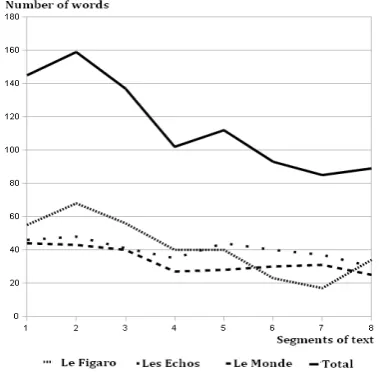
Figure 1: Curves presenting the distribution of title words in the text.
Figure 2: Curves presenting the distribution of subtitle words in the text.
the following subsections: Extracting of the candi-date noun phrases; Determining the most relevant title.
4.1 Extracting Noun Phrases (NP)
Extracting all noun phrases (NP) of the text is mo-tivated by the assumption that each noun phrase potentially represents a title. TreeTagger is used, producing a POS (part-of-speech) text tagging. (Daille, 1996) has deeply focused on noun phrase (NP) syntactic patterns, and her patterns have inspired the chosen extraction patterns, which mostly rely on the following POS tags: Common noun, Adjective, Proper Noun, Determiner, Punc-tuation, Preposition ... NP patterns combine those tags and the filtered NP constitute a list of candi-dates for the titling process.
4.2 Determining (best) Title(s)
Since a title has to be representative and informa-tive of the text contents, a basic intuiinforma-tive line leads to select the most ”frequent” NP in the text, with a sensible definition of frequency. For that, using TF-IDF (Salton and Buckley, 1988) to compute the score of every extracted noun phrase from the text, and then ranking NPs according to this score, has seemed to be a reasonable way of implement-ing the representativity requirement. However, if a new article is inserted into the corpus, TF-IDF has to be computed again. A first score,N PT F−IDF
is computed for each NP. It is the sum of each term TF-IDF, present in the NP (except functional words) [1].
N PT F−IDF = n
X
term=1
(T F ∗IDF)term (1)
The main inconvenience of this score is that it does not take into account the NP position in the text, thus neglecting a precious information provided by literature as well as the data statis-tical analysis (sections 2 and 3). So, if two noun phrases,N P1, found at the beginning of a text and
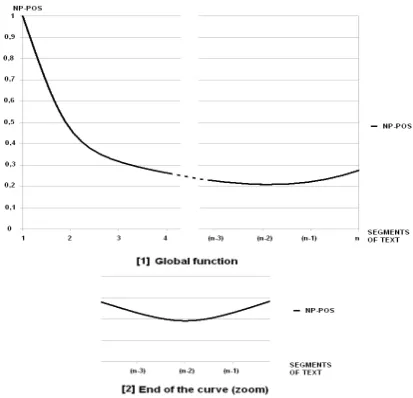
Figure 3: FunctionN PP OS(P)
presence of the words of human-defined titles de-creases the further the text is processed (Zajic et al., 2002), except for the end of the text where it regains some of its previous importance. So the method incorporates aposition scoreN PP OS. It
takes into account the position of the NP in the text. Computing it goes as following: The text is divided into several segments of equal sizes (con-sidering the number of words).nis the number of segments of the text and P is the part of the text where appear the noun phrases (P ∈[1, n]). Since the same study showed that the maximal coverage rate (CR) is obtained at the beginning of the text, then the score needs to decrease in the same pro-portion. Furthermore, CR decreases abruptly in the first two parts of the text, then moderately un-til last but one part. This phenomenon is well for-malized with an exponential function (see Figure 3)[2]
N PP OS(P) =
e1−P if P ∈[1, n−2]
e2−n if P =n−1
e3−n if P =n
(2) Finally, N PP OS [2] formula faithfully
trans-lates the global aspect of the coverage rate, which weakens untiln−2and modestly grows fromn−2 on. Locally, this function offers a hyperbolic curve centered around n−21. The information about
the NP position is translated by the scoreN PP OS
that enables to correct the score computed by the
1for which N PP OS(n −3) = N P
P OS(n −1) and N PP OS(n−4) =N PP OS(n)
TF-IDF (N PT F−IDF). The coefficientλvariation
balances the position score as well as the T-F.IDF score -[3]. The optimal value ofλ∈[0,1]for our corpus is discussed in the section 5.1.
N Pscore(P) =λ×N PP OS+ (1−λ)×N PT F−IDF
(3)
5 Evaluation
The purpose of the evaluation presented in this section, is double. First, the ’on-surface evalua-tion’ consists in estimating the automatically de-termined candidate titles relevance on a set of var-ious texts. It can be associated with a ’deep evalua-tion’ tackling the choice of the ’best’ NP(s) among all the extracted NPs. The conclusion of these evaluations points at an optimal value for λ. In this study, we definen = 8, i.e.,each text is seg-mented in8parts of identical size. This figure has been empirically obtained from corpora features (manual) observation.
5.1 On-surface Evaluation
The first evaluation is performed on 90 French journalistic articles extracted from our corpus (30 articles of each of the three presented newspa-pers). Articles retained for this evaluation are the thirty first ones published (from September 11th to September 15th 2010) in Le Monde, Les Echos, and Le Figaro, with the requirement that they present at least one subtitle. The variation of
λbetween0 and 1determines the value adapted to the corpus. All in all, 270 titles were man-ually estimated (30 articles, so 30 titles accord-ing to 9 values for λ). For each title, an expert attributed one of the two following labels, ”rele-vant title” or ”irrele”rele-vant title”. Many candidates for representing a title are acceptable. Arelevant title is a well formed word group giving a rele-vant outline of the text contents. The results in-dicate that for λ = 0, 25 articles were titled in a relevant way, against only 8 for λ = 1. The best results of automatic titling are obtained with 0.4 ≤ λ ≤ 0.6. It thus seems that, for the given corpus,relevance(i.e. N PT F−IDF) andposition
(i.e.N PP OS) are equally important. So, by
B. Daille. 1996. Study and implementation of com-bined techniques for automatic extraction of
termi-nology. The Balancing Act : Combining Symbolic
and Statistical Approaches to language., pages 29– 36.
J. Goldsteiny, M. Kantrowitz, V. Mittal, and J. Car-bonelly. 1999. Summarizing text documents: Sen-tence selection and evaluation metrics. pages 121– 128.
L-M. Ho-Dac, M-P. Jacques, and J. Rebeyrolle. 2004. Sur la fonction discursive des titres. S. Porhiel and D. Klingler (Eds). L’unit´e texte, Pleyben, Perspec-tives., pages 125–152.
MP. Jacques and J. Rebeyrolle. 2004. Titres et
struc-turation des documents. Actes International
Sympo-sium: Discourse and Document., pages 125–152.
M. Mitra, C. Buckley, A. Singhal, and C. Cardi. 1997. An analysis of statistical and syntactic phrases. In
RIAO’1997.
V. Prince and A. Labadi´e. 2007. Text segmentation based on document understanding for information
retrieval. Natural Language Processing and
Infor-mation Systems, pages 295–304.
G. Salton and C. Buckley. 1988. Term-weighting
ap-proaches in automatic text retrieval. Information
Processing and Management 24, page 513 523.
H. Schmid. 1994. Probabilistic part-of-speech tagging using decision trees. InInternational Conference on
New Methods in Language Processing, pages 44–49.
S. Teufel and M. Moens. 1998. Sentence extraction and rhetorical classification for flexible abstracts. In AAAI Spring Symposium on Intelligent Text Sum-marisation, pages 16–25.
M.T. Vinet. 1993. L’aspet et la copule vide dans la grammaire des titres.Persee, 100:83–101.
D. Wang, S. Zhu, T. Li, and Y. Gong. 2009.
Multi-document summarization using
sentence-based topic models. InACL-IJCNLP ’09: Joint
con-ference of the 47th Annual Meeting of the Associa-tion for ComputaAssocia-tional Linguistics and the 4th In-ternational Joint Conference on Natural Language Processing of the Asian Federation of Natural
Lan-guage Processing, pages 297–300.
M. Yousfi-Monod and V. Prince. 2008. Sentence com-pression as a step in summarization or an alternative path in text shortening. InColing’08: International Conference on Computational Linguistics, Manch-ester, UK., pages 139–142.
D. Zajic, B. Door, and R. Schwarz. 2002. Automatic
headline generation for newspaper stories.
Work-shop on Text Summarization (ACL 2002 and DUC 2002 meeting on Text Summarization). Philadelphia.
L. Zhou and E. Hovy. 2003. Headline
summariza-tion at isi. InDocument Understanding Conference