Automatically Selected Skip Edges in Conditional Random Fields for
Named Entity Recognition
Roman Klinger
Department of Bioinformatics
Fraunhofer Institute for Algorithms and Scientific Computing Schloss Birlinghoven
53754 Sankt Augustin, Germany
Abstract
Incorporating distant information via manu-ally selected skip chain templates has been shown to be beneficial for the performance of conditional random field models in con-trast to a simple linear chain based structure (Sutton and McCallum, 2007; Galley, 2006; Liu et al., 2010). The set of properties to be captured by a template is typically man-ually chosen with respect to the application domain.
In this paper, a search strategy to find mean-ingful skip chains independent from the application domain is proposed. From a huge set of potentially beneficial templates, some can be shown to have a positive im-pact on the performance. The search for a meaningful graphical structure demon-strates the usefulness of the approach with an increase of nearly 2 %F1 measure on a
publicly available data set (Klinger et al., 2008).
1 Introduction
Many applications in the field of text segmenta-tion, especially named entity recognisegmenta-tion, have been addressed with linear chain conditional ran-dom fields. Using a linear chain of variables to represent the labeling of text is straight forward, as processing text in a sequential manner suggests itself due to the way it is written and firstly per-ceived.
While language suggests this linear structure to represent written text, it does not necessarily model all dependencies: Co-referencing a prior entity is an example (while it could be seen as higher order linearity typically pointing back but not forward). Especially in non-scientific texts, in-formation may as well be left out and filled in later to keep a story exciting. Another example is the
10-6
10-5
10-4 10-3
10-2
10-1
0 10 20 30 40 50 60 70 80
Ter
ms with length in %
Length of term BioCreative 2
IUPAC CoNLL
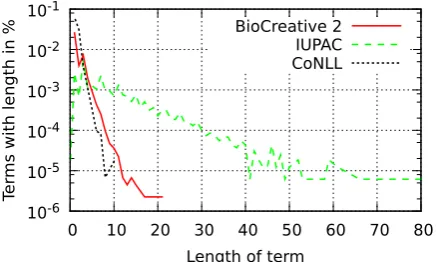
Figure 1: Distribution of the length of three entity classes.
use of filler words as a trivial case where the mean-ing of words can be determined by distant tokens. In named entity recognition, typically linear chain structures of conditional random fields are used. The capabilities of a linear chain such struc-ture may be limited in at least two cases: Firstly, relations between distant tokens can have an im-pact on their meaning. This is a motivation which lead to the previous work presented in the follow-ing Section 2. Secondly, long entity classes can-not be captured as a whole, which is especially interesting because a characteristic of named enti-ties in biology and chemistry is their high length with inter-dependencies between tokens of an en-tity. The distribution of the length of terms in the classes of gene names (BioCreative 2, Smith et al. (2008)), IUPAC names (Klinger et al., 2008) and person names, organizations and places (CoNLL 2005, Sang and De Meulder (2003)) is shown in Figure 1. Gene names and especially IUPAC names are much longer than entities like names, organizations and places. This is the motivation to investigate if a linear-chain structure can be supported by other structures to capture this com-plexity. The work presented in this paper aims towards an automatic detection of beneficial
xt−1 xt xt+1 xt+10 xt+11 xt+12
yt−1 yt yt+1 yt+10 yt+11 yt+12
Senator John Green . Green ran
· · ·
· · ·
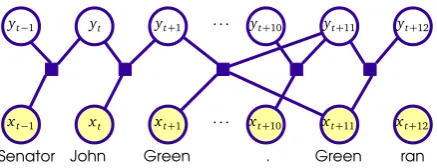
Figure 2: Example of a skip chain CRF structure as used by Sutton and McCallum (2007) (as factor graph depiction). Subsequent labels are connected as well as tokens representing the same string.
tures. The IUPAC domain with its notable long en-tities is used as an evaluation domain in this paper, presuming that a pure linear chain structure has specific difficulties here (using the training corpus presented by Klinger et al. (2008)).
In the following, the challenge is approached as a search for meaningful skip chain templates (Sutton and McCallum, 2007).
2 Previous Work
The class of CRFs including skip chain edges (un-rolled from skip chain templates) has been de-scribed by Sutton and McCallum (2007) and Gal-ley (2006) in a named entity recognition scenario. In addition to the linear chain, a template is used to measure the dependencies between same capi-talized tokens. This is motivated by the assump-tion that same words in a sentence or document are likely to have the same label, despite their to-ken distance. An example for such skip chain CRF is shown in Figure 2. As stated by Sutton and McCallum (2007), each pair of nodes can be connected by a skip chain which the developer be-lieves to be similar. They point out that the num-ber of edges unrolled from a template may not be too high as the runtime and memory consumption increases prohibitively. Connecting only capital-ized words allows to match most proper names (which is an entity class of interest in their test domain) while they are sparsely distributed.
The work by Liu et al. (2010) enhances that ap-proach by different classes of variables (as special keywords) to be connected. To adapt Sutton’s and McCallum’s approach to gene and protein names, they introduce three skip chain templates: Firstly, connecting the main parts of gene names (referred to as “keyword” in their work) defined by regu-lar expressions, secondly connecting only simiregu-lar keywords, only differing to a certain extent, and
thirdly connecting typed dependencies like prepo-sitional modifiers or noun compound modifiers. On the BioCreative 2 NER data set (Smith et al., 2008) they show an increase inF1 measure from
71.73 % with a linear chain to 73.14 % with the best skip chain configuration for a strict evalua-tion not using the allowed alternatives in the gold data test set. Using the official evaluation with alternatives, they show an increase from 83.29 % to 84.67 %F1. They argue that the quality of the
skip chains is essential for the improvement of the result compared to simple linear chain structures.
In contrast to previous work, this paper addresses the question how to select meaningful skip edges automatically from a set of possibilities. This does not make the domain specific development unnecessary (as the application of feature selec-tion still needs the development of features for a domain), but helps to find templates to improve the results. It can select a specific subset of au-tomatically generated clique templates. This task can be understood as a combinatorial optimization problem: Finding a factor graph with a structure maximizing the performance of the model on a test set.
Several approaches have been published about optimizing the structure of Markov networks or more specifically conditional random fields. They can be divided into methods searching for such structure with a measure to judge the quality of a structure and filtering approaches to decide about the quality of an edge. Beside those, regulariza-tion is another way to find a good structure during training.
The work by Schmidt et al. (2008) states to be the first dealing with the structure learning task in discrimatively trained, undirected graphical mod-els. Similarly to Lee et al. (2006) (which is deal-ing with general Markov networks), L1
regular-ization is the incorporated method. While this approach is very elegant due to the joint struc-ture and parameter estimation, it has limitations to deal with large, dynamically generated factor graphs with a lot of features on each factor.
Theanaloguesof 6 -chlor
opur ine,
adenine, andazathiopr
ine hav
ebeenprepared .
y1 y5 y6 y7 y8 y9 y10 y11 y12 y13 y14 y15
match [.*ine]
y2 y3 y4
~x p(xu,xv)holds iffxuandxv
are stop words matches [,]
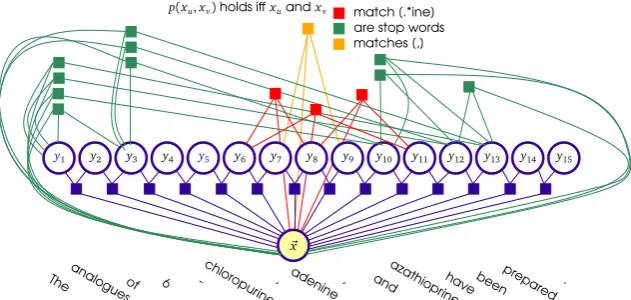
Figure 3: Different skip chain factor templates to choose additionally to the linear chain (example shortened from the abstract by Hasan and Srivastava (1992)).
alternative which limits the performance evalua-tions needed.
Starting with the linear chain, each template is added respectively, the model is trained and eval-uated on a hold-out set. The best template is kept and the prior step is repeated. This process ends if none of the templates can improve the result.
Here, the same inference algorithm is used as for the final model: Loopy belief propagation with tree-based reparameterization for approximate in-ference (Wainwright et al., 2001). During the steps of BFS, the weights for each template to be kept can be adopted for the next search iteration retraining all parameters. Thereby retraining the model can be performed in a much smaller num-ber of iterations than training from scratch.
4 Experiments and Evaluation
In the following, the feasibility of the basic idea of the proposed approach is evaluated on the IU-PAC corpus (Klinger et al. (2008)2, split into 90 % training and 10 % validation randomly). All tem-plates which occur at least 10 times in the train-ing data were taken into account. These are 5096 templates (from 16710 altogether). Training with and without the skip factors (via maximizing
logP(~y|~x) with a Gaussian regularization) leads to a ranked list of templates which forms the first layer of the BFS.
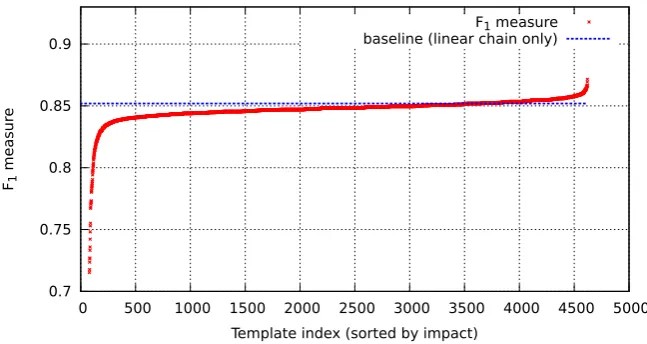
This leads to the results depicted in Figure 4 showing the impact of each template. The infer-ence algorithm did not converge for 474 templates. Most of the templates have no or negative impact
2Statistics of this data set can be found in the original publication and are not cited here due to page limitation.
on the result (3656 templates); 966 have positive impact. The top 10 templates are depicted in Ta-ble 1, together with their contribution. The most important template is to add a skip chain between tokens “alpha” with nearly 2 % improvement in comparison to the linear chain only. This term occurs 319 times in the training data and is fre-quently part of IUPAC names (115) as well as out-side of them (204). In a local, linear chain-based setting a feature based on this token can hardly contribute to a decision, but in a distant labeling setting it can. The second best feature to built skip chain factors is “PREFIX2=tr”: It occurs 698 times, 284 times in IUPAC names and 414 times outside of them.
Most of the features forming the basis for tem-plates with a positive impact are words occurring close to or in chemical names or are typical chem-ical pre- or suffixes. These features measure am-biguous characteristics of tokens where the prob-ability of correctly identifying the surrounding terms can be increased by measuring the distant information of them. The context is taken into account by templates based on features of offset conjunction (likeW=alpha@2 measuring the
to-kenalphatwo tokens left of the skip chain
con-nection). The reason is presumably that their com-mon occurrence in a sentence is not labeled differ-ently.
For instance, the term alpha is occurring
inalpha-ribofuranosyl (which is labeled
as IUPAC) and inalpha1-adrenergic (not labeled as IUPAC). In both examples, alpha
0.7 0.75 0.8 0.85 0.9
0 500 1000 1500 2000 2500 3000 3500 4000 4500 5000
F1
measur
e
Template index (sorted by impact)
F1 measure baseline (linear chain only)
Figure 4: Impact for each proposed templates measured empirically.
treatment(as non-IUPAC), but it is not
prob-able that different labels occur in the same text. The feature W=group@1 is a slightly different case as it does not occur as part of an IUPAC name itself but can occur in the context of chemical names which are difficult to distinguish between IUPAC and not. As an example,formamidino
group would not be labeled as IUPAC, but
p-methoxybenyl group is labeled as such.
Annotation is quite difficult here, but it is likely that the annotator produced consistent data in one text instance.
Notable is the occurrence of very strict fea-tures likeSUFFIX2=31—it is surprising that ob-viously some numbers are occurring frequently in IUPAC names and outside of them such that a dif-ferentiation with distant information is beneficial. This discussion illustrates that the found tem-plates are meaningful in the context of the IUPAC example taken for evaluation here. The impact of the automated approach for the first layer of a search shows similar or better possible improve-ments than the manual approaches by Sutton and McCallum (2007,cf.Table 1.2) (0.4 %) or Liu et al. (2010) (1.2 % on BioCreative II data) (this is remarkable although they tested on different data sets).
5 Conclusion and Future Work
This paper presented the principle idea of build-ing skip chain edges to capture distant informa-tion for named entity recogniinforma-tion in a similar man-ner as features to represent tokens are geman-nerated. Instead of hand-crafting domain- and problem-specific features, they are generated from the
train-ing data; analogously, potentially beneficial skip chain templates are taken into account. It has been shown that this approach is feasible and leads to an improved performance on an example domain. To be able to apply this methodology in prac-tice, the search complexity for meaningful struc-tures needs to be reduced. Nevertheless, the anal-ysis shows that the idea of automatically select-ing distant tokens as a basis for additional factors makes sense. The presented analysis can help in further work and be used as a training set for novel template filtering methods.
Future work includes the analysis how different templates work together for named entity recogni-tion: What is the relation between the linear chain and a skip chain? What characteristics does the linear chain have where skip chains help?
Additionally due to the high complexity of em-pirically testing all templates, the interaction be-tween different skip chains has not been analyzed. Another interesting topic is to investigate the impact of specific factors on different evaluation measures. It can be assumed that some support accuracy, whereas some have a special impact on precision or recall.
References
[Bromberg et al.2009] Facundo Bromberg, Dimitris
Margaritis, and Vasant Honavar. 2009. Efficient markov network structure discovery using
indepen-dence tests. Journal of Artificial Intelligence
Re-search, 35(1):449–484, May.
Template F1 measure to base
1 W=alpha@2 87.15 1.96
2 PREFIX2=tr 86.93 1.74
3 W=liver@1 86.66 1.47
4 W=group@1 86.63 1.44
5 WC=AAA@1 86.59 1.40
6 REFIX2=ox 86.59 1.40
7 PREFIX2=fu@1 86.54 1.35
8 W=rac@1 86.51 1.32
9 W=cis@-1 86.47 1.28
10 SUFFIX2=nt 86.44 1.25
11 SUFFIX2=ro@-2 86.39 1.20
12 W=was@-2 86.39 1.20
13 W=rac@-1 86.39 1.20
14 PREFIX2=hy@1 86.39 1.20
15 PREFIX2=am@1 86.36 1.17
16 SUFFIX2=31 86.32 1.13
17 SUFFIX2=,4 86.32 1.13
18 SUFFIX2=in@2 86.28 1.09
19 SUFFIX2=,4@1 86.28 1.09
20 W=3H@-1 86.28 1.09
Table 1: Top 20 skip chain templates from all pro-posed templates occurring at least 10 times. (“To base” denotes the difference to the baseline, a linear chain CRF.W=denotes exact term match features,
PREFIX2=the use of the string as prefix of length
2, analogously forSUFFIX.@ndenotes the use of the feature characterizing tokens with an offset of
nin the token sequence.)
by importance. In Proceedings of the 2006
Con-ference on Empirical Methods in Natural Language Processing, pages 364–372, Sydney, Australia, July. Association for Computational Linguistics.
[Hasan and Srivastava1992] A. Hasan and P. C. Srivas-tava. 1992. Synthesis and biological studies of un-saturated acyclonucleoside analogues of
s-adenosyl-l-homocysteine hydrolase inhibitors. J Med Chem,
35(8):1435–1439, Apr.
[Klinger et al.2008] Roman Klinger, Corinna Kol´aˇrik,
Juliane Fluck, Martin Hofmann-Apitius, and
Christoph M. Friedrich. 2008. Detection of IUPAC
and IUPAC-like Chemical Names. Bioinformatics,
24(13):i268–i276. Proceedings of the International Conference Intelligent Systems for Molecular Biology (ISMB).
[Kschischang et al.2001] Frank Kschischang,
Bren-dan J. Frey, and Hans-Andrea Loeliger. 2001.
Factor graphs and the sum-product algorithm. IEEE
Transactions on Information Theory, 47(2):498– 519.
[Lee et al.2006] Su-In Lee, Varun Ganapathi, and
Daphne Koller. 2006. Efficient structure learning
of markov networks using l1-regularization. In
Ad-vances in Neural Information Processing Systems.
[Liu et al.2010] Jingchen Liu, Minlie Huang, and Xi-aozan Zhu. 2010. Recognizing biomedical named entitities using skip-chain conditional random fields. InProceedings of the Workshop on Biomedical Nat-ural Language Processing.
[Parise and Welling2006] Sridevi Parise and Max
Welling. 2006. Structure learning in markov
random fields. InAdvances in Neural Information
Processing Systems.
[Russell and Norvig2003] Stuart Russell and Peter
Norvig. 2003. Articifial Intelligence – A Modern
Approach. Prentice Hall.
[Sang and De Meulder2003] Erik F. Tjong Kim Sang
and Fien De Meulder. 2003. Introduction to
the conll-2003 shared task: Language-independent named entity recognition. In Walter Daelemans and
Miles Osborne, editors, Proceedings of
Computa-tional Natural Language Learning (CoNLL), pages 142–147. Edmonton, Canada.
[Schmidt et al.2008] Mark Schmidt, Kevin Murphy, Glenn Fung, and R’omer Rosales. 2008. Structure learning in random fields for heart motion
abnor-mality detection. In Computer Vision and Pattern
Recognition, Anchorage, AK, USA, June. IEEE.
[Smith et al.2008] Larry Smith, Lorraine K. Tanabe, Rie Johnson nee Ando, Cheng-Ju Juo, I-Fang Chung, Chun-Nan Hsu, Yu-Shi Lin, Roman Klinger, Christoph M. Friedrich, Kuzman Ganchev, Man-abu Torii, Hongfang Liu, Barry Haddow, Craig A. Struble, Richard J. Povinelli, Andreas Vlachos, William A. Baumgartner Jr., Lawrence Hunter, Bob Carpenter, Richard Tzong-Han Tsai, Hong jie Dai, Feng Liu, Yifei Chen, Chengjie Sun, Sophia Katrenko, Pieter Adriaans, Christian Blaschke, Rafel Torres Perez, Mariana Neves, Preslav Nakov, Anna Divoli, Manuel Mana, Jacinto Mata-Vazquez, and W. John Wilbur. 2008. Overview of
biocre-ative ii gene mention recognition. Genome Biology,
9(Suppl 2):S2.2–S2.18, September.
[Sutton and McCallum2007] Charles Sutton and An-drew McCallum. 2007. An introduction to condi-tional random fields for relacondi-tional learning. In Lise
Getoor and Benjamin Taskar, editors, Introduction
to Statistical Relational Learning, chapter 4, pages 93–127. MIT Press, November.
[Wainwright et al.2001] Martin J. Wainwright, Tommi
Jaakkola, and Alan S. Willsky. 2001.
Tree-based reparameterization for approximate inference
on loopy graphs. InProccedings of the Conference