Improvement of Cluster Based Approach for Secure
Loadbalancing over Cloud
Sumit Katiyar 1, Mr. Raj Kumar Paul 2
1Computer Science and Engineering, Vedica Institute of Technology, Bhopal, Madhya Pradesh ,India
2Assistant Professor, Computer Science and Engineering, Vedica Institute of Technology, Bhopal, Madhya
Pradesh ,India
ABSTRACT
It is a process of distributing the total load among the system to improve system performance when there is a condition arrive Cloud Computing is the technique of dynamic virtual provisioning of computing resources like processing power, storage, networking and Information Technology infrastructure through the Internet on pay per use basis from service providers. Customers can request for resources on the cloud from anywhere on the planet, by sending request through Internet to cloud service provider. Cloud Computing uses the concept of the virtual machines and store data on virtual machines, instead of physical machines. Load balancing is the major aspect of cloud computing atmosphere. where several nodes are heavily loaded and the others are idle. This paper will present several techniques of load balancing in different cloud environment, existing load balancing technique and also discuss various parameters like scalability, performance, resource utilization, fault tolerance, associative overhead.
Keywords : Cloud Computing, Load Balancing, Resource Utilization, Static load balancing, Dynamic load balancing.
I.
INTRODUCTIONCloud computing is made up of two basic terms in the latest telecommunication technology field. First term is “Cloud”. It is a pool of the heterogeneous resources which provide services as per requirement. “Computing” is done by the criteria provided by service level agreement specified in SLA. Cloud computing is the technique of dynamic virtual provisioning of computing resources like processing, power storage, networking and information. It is also commoditized which means the outcome is a utility registering model, similar to power in which you pay for what you would need. There are some basic characteristics of cloud computing such as on demand self services, broad network
access, rapid elasticity, resource pooling,
measured service, virtualization, service
orientation, geographic distribution, resilient computing. However, by using any kind of method, the complete potential of the cloud cannot be get without understanding its vulnerabilities, capabilities, trade-offs and advantages.
Cloud computing has characteristics of all these technologies which share certain aspects of cloud computing
a. Grid Computing
b. Utility Computing
c. Virtualization
d. Autonomic Computing
A quick review of these technologies is defined here:
Grid Computing is a type of distributed computing that coordinate network resources to achieve their objectives. Here server, storage and network are combined to form computing nodes that can be dynamically provisioned as needed.
b. Utility Computing:
The utility computing ensures the utility based pricing schemes for economic reasons
which also help to maximize resource
utilization and minimizing the operating cost. c. Virtualization:
Virtualization is an abstraction in which a physical machine is converted into a virtual machine and that virtual machine is provided to customer& customer feels that he is actually using the physical machine
d. Autonomic Computing:
Autonomic Computing ensures that the
computer has complex and critical functions present without using any major interventions through a user.
II.
TYPES OF CLOUDSA. Public cloud
The infrastructure of cloud is solely operated for an organization. It may be managed through the organization or another party and may exists on premise and off premise [1].
B. Private Cloud
The infrastructure cloud is shared through various organizations and also through a particular community that has shared concerns. It may be managed by the organization or a third party and may exist on premise or off premise.
C. Community Cloud
The infrastructure of cloud is made presentable to a large industry group or common public and
is owned through an organization selling cloud features.
D. Hybrid Cloud
The infrastructure of cloud is a composition of two or more clouds (community, public, private) that remain unique entities but are bound together through proprietary or standardized methodology that enables information and application portability.
III.
TYPES OF SERVICE MODELSA. Infrastructure as a service (IaaS):
Cloud provider offers computers as virtual machines and other resources as per user’s request. Virtual machines run as hypervisors such as xen, kvm. Infrastructure as a service cloud providers supply these resources as per demand for their data centers. Cloud provides a hosting environment that does not restrict an application to Specific resources. [2]
B. Platform as a Service (PaaS)
Cloud suppliers give a processing stage normally including working framework, programming dialect execution environment such as java, python, database, web servers. NIST describes PaaS as follows:
C. Software as services (Saas)
Software as services is a model of software development where an application is hosted as services provided to customer across the internet. NIST describes SaaS as follows “The provided capability to the client is to use provider’s applications running on infrastructure of cloud. The applications are accessible from several customer devices by a thin client interface such as a web browser (e.g., web-based e- mail)”.
IV.
LOAD BALANCINGLoad Balancing-Load Balancing is a mechanism for distributing a larger processing node to smaller
processing nodes for enhancing the full
performance of a system, without disturbing the other running task. Load Balancing is mainly used for performing two basic tasks one is resource allocation and other is scheduling. An ideal load balancing technique should avoid overloading and under loading of a individual node, but in cloud computing environment case the right selection of the load balancing algorithm is not easy
because it involves various factors like
reliability, throughput, security etc. Some other factors are also described
a. Resource is easily presentable on demand
b. Performance will
substantially improved c. cost of using resource is less
d. Resources are effectively used
e. Ensures system stability
For measuring the adequacy of load balancing algorithms re-enactment environment are needed and Cloudsim [3] is the efficient tool that can be used for measuring the efficiency and effectiveness of cloud. Cloudsim [3] contains four basic entities which are Datacenter, Virtual Machine, Hosts and Software (Application and System software)
Datacenter entity provide the infrastructure level services to the cloud users. Virtual Machine allows development and deployment of application service models. Software is executed on a virtual machine on- demand [4].
V.
TECHNIQUES FOR LOAD BALANCING IN CLOUD COMPUTINGA. Decentralized content aware
Define abbreviations and acronyms the first time they are used in the text, even after they have been defined in the abstract. Abbreviations such as IEEE, SI, MKS, CGS, sc, dc, and rms do not have to be defined. Do not use abbreviations in the title or heads unless they are unavoidable.
B.CARTON
According to this mechanism, it uses two parameters named as LB and DRL. With the help of LB (Load Balancing) equal jobs are
distributed to different server and DRL
(Distribute Rate lining) is used to improve the performance level of the server as it is used in the capacities of dynamic workload.
C.Compare and Balance
This algorithm is based on sampling, unlike
traditional server optimization strategies
which consider load balancing and scheduling of resources for RAM,
BW and CPU usage in physical servers. Dynamic Compare and Balance minimizes the number of host machines, thus reduces cost of cloud services.
D. Event-driven
This algorithm based on the concept of
Massively Multiplayer’s Online Games
it will analyzes its entire component in the context of the resources and its capacity.
E. Task scheduling based on Load Balancing Task scheduling based on LB is a two level scheduling, which is used to meet the dynamic requirement of the users and will also achieve high resource utilization, by mapping task to virtual machine and then virtual machine to host resource
F. Load Balancing Virtual Storage Strategy (LBVS): Load Balan cin g V ir tu al S tor age Strategy provides storage on a cloud as a service model of cloud storage. In this algorithm Load Balancing is achieved by using two modules of load balancing and provides better storage rate and robustness of the system.
G.Central Load Balancing Virtual Machine:
CLBVM i s u s e d to improve t h e major drawback of fault tolerance in the system as the whole selection policy is based on the central node.
H.Honeybee Foraging Behavior:
Honeybee F o r a g i n g Behavior is a self organizing and natured inspired algorithm. In this algorithm performance is achieved by increasing the system size but the overall throughput will not increase with a system size increase.
I.. Biased Random Sampling:
It is a distributed and also scalable method that uses system domain random sampling to achieve the self organization for balancing the load across complete system.
J. Active Clustering:
It is a self aggregation load balancing algorithm to optimize job assignments by connecting s i m i l a r service using local re-wiring.
K. Ant Colony and Complex Network Theory (ACCLB):
ACCLB (Ant Colony and Complex Network Theory) uses fully distributed approach in which information is dynamically updated at each ant movement. The benefit of this algorithm is that it is better fault tolerant and improves the overall performance of the system.
L. Opportunistic Load Balancing and Load Balancing Min- Min (OLB+LBMM):
Opportunistic Load Balancing and Load Balancing Min- Min (LBMM) scheduling algorithm keeps the updated working status of the overall system and minimizes the execution time for the better performance.
Cloud is made up of several resources and to Manage these resources it require systematic planning and layout while designing algorithm on cloud for resource provisioning. The developer must be aware of the issues and scenarios of the atmosphere of cloud therefore various algorithms were made to match up those entire requirements and it is being classified in to various categories. On the basis of cloud environment- Depending upon the load balancing system present state algorithms can either be dynamic or static. Static Environment
heterogeneous cloud environment . C o m m u n i c a t i o n delay can be easily minimized and system execution time is also reduced by using static load balancing algorithm.
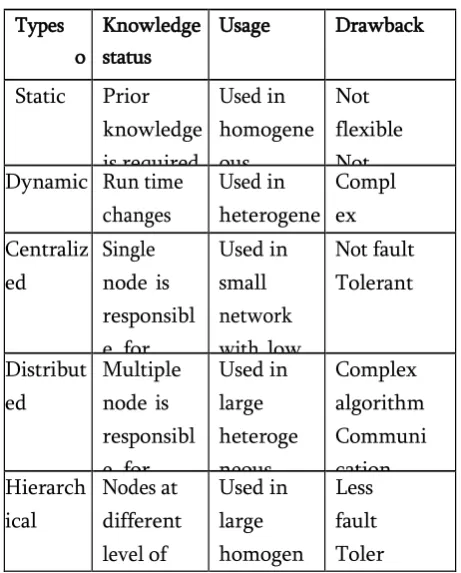
Table 1. Comparison of Various types of Load Balancing Techniques in Cloud Computing
Environment
A. Round Robin and Randomized Algorithms
In this algorithm, resources are assigned to the task on FCFS basics i.e. the job that arrived first will be first allocated the resources. It is one of the configuration and performance of each node is not same. Thus there is slight change in Round Robin algorithm which is called Round Robin based on load degree evaluation. Randomized schemes work well when the process is more and processor is
less. This algorithm attains the best performance as compared to other load balancing algorithms for particular special purpose applications.
B. Central Manager Algorithm
In this algorithm, a central processor or channel agent selects the new process. The minimum loaded processor is selected from all the processors, when a process is created. Then the load manager selects the host for new processor and then central load manager calculates the overall load.
C. Threshold Algorithm
In the threshold algorithm the host is selected locally without sending remote message and each processor must contain the private copy of the system load. In the threshold algorithm the level of the load can be defined as
Under loaded-load<Tunder Medium-Tunder ≤ load Tupper Overloaded-load > Tupper
Initially the process is assumed as under loaded but when the processor exceeds the load limit then it start sending messages at remote level. It contain copy of all the messages and keep updating the entire load of the processor to get the actual status of the load on the processor.
Dynamic Environment
on weight and the capability of node, task is assigned to a node.
Load Balancing Based On Spatial Distribution of Nodes
There can be three basic kind of algorithm that distinguishes which node is responsible for cloud computing atmosphere load balancing.
A.Centralized Load Balancing
In the Centralized Load Balancing technique the central load is the main factor which is responsible for storing knowledge of overall cloud network and then makes decision to apply static or dynamic approach for load balancing. Hence all the decisions are made by the central node. This load balancing reduces the overall time and is free from analyzing whole cloud resources, but it is not fault tolerant for longer time and also creates overhead for centralized node. In this technique the chances of failure for the centralized node is very high and the recovery is also not easy in case of node failure.
B.Distributed Load Balancing
In the Distributed Load Balancing technique there is no single node responsible for monitoring the cloud network instead multiple nodes monitors the network to make accurate load balancing decisions. Every node in the network is equally responsible for maintaining the knowledge table to ensure efficient distribution of task in static environment and re-distribution in dynamic environment. In distributed scenario, failure intensity of a node is less. Hence the system is reliable and fault tolerant and none of the particular node is overloaded. [6]
C.Hierarchical Load Balancing
Hierarchical Load Balancing involves different levels of the cloud in load balancing decisions. This type of balancing is done by master slave model
and it can be modeled as a tree data structure where every node is managed or balanced by its parent node[7]. Based on the information collected by the parent node, allocation and scheduling can be done. In this algorithm the root node is responsible for distributing the load to all its sub nodes.
VI.
LITERATURE REVIEWVII.
OBJECTIVESThe main goal of this work is:-
i. Study of existing VM consolidation algorithms.
ii. Develop the concept of new energy efficient VM Consolidation algorithm using Inter quartile Range (IQR) based on VM migration and maintaining low level of SLA.
iii. Compare the newly developed algorithm with the standard algorithm and performance analysis.
VIII.
PROPOSED METHDOLOGYCloudsim is the most appropriate tool that can be used for m o d e l i n g c l o u d . Cloudsim a l l o w s VM to be managed by the hosts, which in turn are managed by data centers. To measure the efficiency and effectiveness of simulation balancing algorithms load environment are required. In this work, we have used eclipse tool for simulation. We are using energy efficient VM Consolidation algorithm in cloud environment.
We are using inter quartile range (IQR) method for finding dynamic threshold. The proposed algorithm will find the over loaded host first and then choose the virtual machine for migration from overloaded hosts and place this VM using VM placement algorithm for Overloaded Host. After load balancing, finds an under loaded host and select all the virtual machines from that host. Place these VMs over least loaded host by using VM placement algorithm for under loaded Host. For performance evaluation and simulations we are using Cloudsim in our work. Thus an Energy Efficient Dynamic VM Consolidation algorithm for reducing energy consumption and minimizes number of VM
migration while keeping SLA violation at low level is proposed.
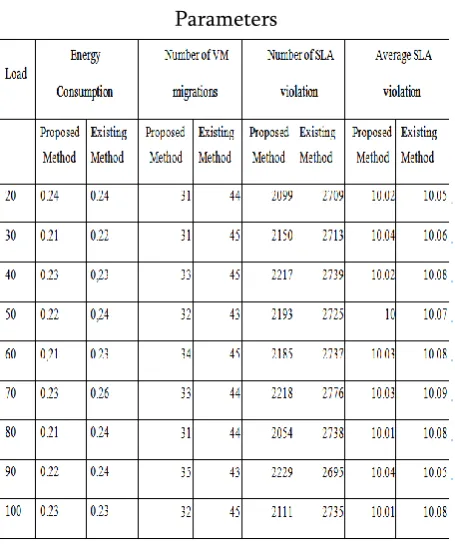
We have analyzed different scenarios by taking 10 hosts, 20 virtual machines and various numbers of tasks (cloudlets) i.e. load to evaluate the performance of proposed algorithm. It is essential to use workload traces from real system. In this simulation we have taken different work load. We have plotted different graphs based on different work load between two strategies, proposed method and the existing method (Static threshold based VM provisioning). The performance of the proposed approach is evaluated for various parameters (i.e. Energy Consumption, Number of VM migrations, Number of SLA violation and Average SLA violation). These results can vary according to the different environment setups.
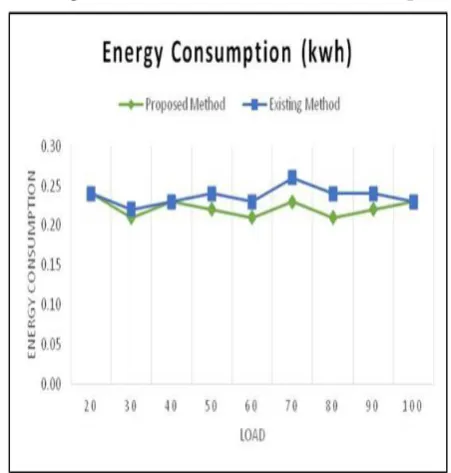
Figure 1. Energy Consumption comparisons between Proposed and Existing method
Table 2. Experimental Results For Various Parameters
Energy consumption is compared for proposed method and existing method as shown in figure 1.
From graph we have analyzed that proposed method; consumes less energy than existing method.Number of VM migrations is compared for proposed method and existing method in figure 2. From graph we have analyzed that proposed method; incurs less number of VM migrations than existing method.
Figure 2. Number of VM Migration comparisons between Proposed and Existing method
Figure 3. SLA Violation comparison between Proposed and Existing method
Figure 4. Average SLA Violation comparisons between Proposed and Existing method
IX.
CONCLUSIONLoad Balancing is a very major issue in cloud computing environment and with the rapid growth of cloud users it has been noticed that the demand of load balancing has increased. In this paper, numerous load balancing techniques have been discussed all having few advantages and disadvantages. Basically there are two basic kinds of load balancing techniques static and dynamic. Static load balancing has an advantage of monitoring and simulation with a drawback that it fails to model heterogeneous nature of the cloud. effectiveness. Unlike centralized and distributed algorithm nature, it provides better fault tolerance but it requires high degree of replication. On the other hand, different hierarchical algorithms divide load at various level with upper level node in a balanced manner. The study also compares various distributed algorithms with their parameters having some pros and cons. As it is known that cloud computing is a very enormous area but it is now understood that the above algorithm will satisfy the criteria with some conditions. However, cloud computing environment performance can be improved if dependencies between tasks are modeled by information.
X.
REFERENCES
[1]. Prof. R.Buyya, J.Broberg, A.Goscinski, "Cloud Computing Principles and Paradigms", Published by: A John Wiley & Sons, INC., Publication, Hoboken, New Jersey, 2011. [2]. Meenakshi Sharma, Pankaj Sharma, Sandeep
Sharma,"Efficient Load Balancing Algorithm in
VM Cloud Environment", IJCST Vol.3, Issue 1, pp.439-441, Jan.March 2012
[3]. A.Khiyaita and M.Zbakh, "Load Balancing Cloud Computing"State of Art IEEE, pp. 106-109, May 2012.
[4]. Sotomayor, B., Montero, R. S., Llorente, I. M. & Foster, I."Virtual infrastructure management in private and hybrid clouds", Internet Computing, IEEE Volume: 13, Issue:5, 14-22, 2009.
[5]. Radojevic, B. & Zagar, M "Analysis of issues with load balancing algorithms in hosted (cloud) environments" In proceedings of 34th International Convention on MIPRO, IEEE, pp.23-27 May 2011.
[6]. Lee, R. & Jeng, B. "Load-balancing tactics in cloud. In proc. International Conference on Cyber- Enabled Distributed Computing and Knowledge Discovery ", IEEE, pp. 447-454, 2011.
[7]. Wang, S. C., Yan, K. Q., Liao, W. P. & Wang, S.S " Towards load balancing in a three- level cloud computing network", Proceedings of 3rdInternational Conference on Computer Science and Information Technology (ICCSIT), IEEE, pp. 108-113, July 1, 2010.
[8]. Martin Randles, A. Taleb-Bendiab, David Lamb" Cross layer dynamics in self-organizing service oriented architectures" IWSOS, Lecture Notes in Computer Science, pp. 293- 298, Springer. December 10-12, 2008.
[9]. Komal Singh Patel and A. K. Sarje, "VM Provisioning Method to Improve the Profit and SLA Violation of Cloud Service Providers", IEEE International Conference, Cloud Computing in Emerging Markets (CCEM) 11-12 Oct. 2011-12.
International Conference on Computational Intelligence and Communication Networks© IEEE.
[11]. R. Buyya, A. Beloglazov, and J. Abawajy, "Energy-Efficient Management of Data Center Resources for Cloud Computing: A Vision, Architectural Elements, and Open Challenges", in proceedings of the 2010 International Conference on Parallel an d Distributed Processing Techniques and Application s (PDPTA 2010), Las Vegas, USA, July 12- 15, 2010.
[12]. Jing Huang, Kai Wu, and Melody Moh, "Dynamic virtual migration algorithms using enhanced energy consumption model for green cloud data centers," IEEE ©2014.
[13]. Mohammad alaul haque monil, Romasa qasim, and Rashedur M rahman, "Energy-aware VM consolidation approach using combination of heuristics and migration control", IEEE ©2013. [14]. K. Yang, J. Gu,T. Zhao and G. Sun , " An