E-Mail Security System using for Phishing Attack- Using Link
Gaurd Algorithm
Kalpana1, Naveen Kuma2, Parul Saharavat3
1M. Tech Scholer, Computer Sci. JPIET, Polytechnique, Meerut, Uttar Pradesh, India
2Department of Computer Sci. JPIET, Meerut , Uttar Pradesh, India
3D.N. Meerut, Uttar Pradesh, India
ABSTRACT
Phishing is type of cybercrime in which phisher attacker make web pages in order to trick the peoples. Phishing is a form theft in order to steal the confidential information e.g. their password, their account no. Phishing mostly uses spoofed e-mail messages that seem to come from legitimate and legal source. Trojans, malware and other malicious software are also used for phishing attacks. In this work, we proposed a new end-host based anti-phishing algorithm, which we call Link Guard plus, by utilizing the characteristics of the hyperlinks in phishing attacks. This Link Guard algorithm Plus includes one step forward with the detection of phishing measures, we introduces the part in which phishing websites is captured using the text reading to find out the malicious and threatening word to be filtered and move in the spam.
Keywords : Domain, Phishing Hyperlinks Lack List, White List, Security.
I. INTRODUCTION
E-Mail is one of the most widely and commonly used internet services. We not only use it every day for official communication but also to be in touch with our friends and relatives. Although E-Mail make our communication so easy and comfortable. Phishing was a term originally used to describe email attacks that were designed to steal our username and password. Phishing is a technique where cyber attackers attempt to fool us into taking an action provided by them.
These attacks often begin with a cyber criminal sending you an email pretending to be from someone or something you know or trust, such as a friend, your bank or your favorite online store. These emails then entrusted you into taking an action, such as clicking on a link, opening an attachment or responding to a message. As E-Mail plays an
important role in communication globally for communication and sharing of data.
Phishing itself is not a new concept, but it's increasingly used by phishers to steal user information and perform business crime in recent years.
II. RELATED WORK
1. Detect and block the phishing Web sites in time: If we can detect the phishing Web sites in time, we then can block the sites and prevent phishing attacks. It is easy to determine whether a site is a phishing site or not, but it's difficult to find those phishing sites out in time. Here we list two methods for phishing site detection [4].
2. The Web master of a legal Web site periodically scans the root DNS for suspicious Since the phisher must duplicate the content of the target site, he must use tools to (automatically) download the Web pages from the target site. 3. Enhance the security of the web sites: The
business Websites such as the Web sites of banks can take new methods to guarantee the security of users' personal information. One method to enhance the security is to use hardware devices.
Block the phishing e-mails by various spam filters: Phishers generally use e-mails as 'bait' to allure potential victims. SMTP (Simple Mail Transfer Protocol) is the protocol to deliver e-mails in the Internet. It is a very simple protocol which lacks necessary authentication mechanisms.
Information related to sender, such as the name and email address of the sender, route of the message, etc., can be counterfeited in SMTP. Thus, the attackers can send out large amounts of spoofed e-mails which are seemed from legitimate organizations. The phishers hide their identities when sending the spoofed e-mails, therefore, if anti-spam systems can determine whether an e-mail is sent by the announced sender, the phishing attacks will be decreased dramatically [4].
Install online anti-phishing software in user’s computers:
Despite all the above efforts, it is still possible for the users to visit the spoofed Web sites. As a last defense, users can install anti-phishing tools in their computers [4].The Anti-phishing tools in use today can be divided into two categories:
Category I: When a user visits a Web site, the anti-phishing tool searches the address of that site in a blacklist stored in the database. If the visited site is on the list, the anti-phishing tool then warns the users. Tools in this category include Scam Blocker from the EarthLink Company, Phish Guard, and Net craft, etc. Though the developers of these tools all announced site according to these rules. Examples of this type of tools include Spoof Guard developed by Stanford, Trust Watch of the Geo Trust, etc. Spoof Guard checks the domain name, URL (includes the port number) of Web site, it also checks whether the browser is directed to the current URL via the links in the contents of e-mails. If it finds that the domain name of the visited Web site is similar to a well-known domain name, or if they are not using the standard port, Spoof Guard will warn the users.
III. PROBLEM ASSOCIATED WITH PHISHING
order to make money transfer, or to get someone users id and password and modify the data or dteal the data ( for e.g. Face book Phishing page is demand to trick the people). There are 3 types of phishing by which we can create the legitimate web page[31]:
A. Spear Phishing
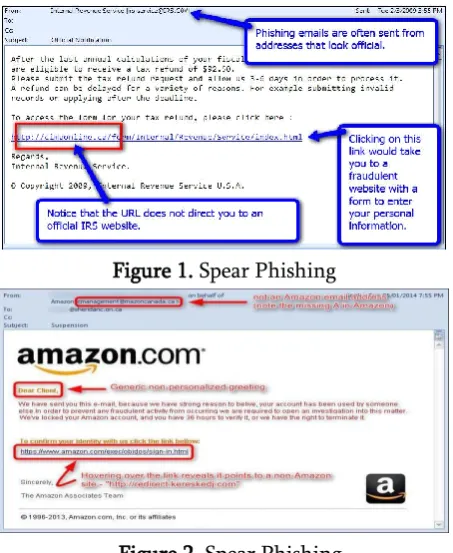
Spear phishing is an e-mail spoofing fraud attempt that targets a specific organization, seeking unauthorized access to confidential data. Spear phishing attempts are not typically initiated by "random hackers" but are more likely to be conducted by perpetrators out for financial gain, trade secrets or military information.Spear phishing targets at a specific group. So instead of casting out thousands of emails randomly, spear phishers target selected groups of people with something in common, for example people from the same organization.
Figure 1. Spear Phishing
Figure 2. Spear Phishing
B. Clone Phishing
In this type phisher creates a cloned email. He does this by getting information such as content and recipient addresses from a legitimate email which
was delivered previously, and then he sends the same email with links replaced by malicious ones. He also employs address spoofing so that the email appears to be from the original sender. The email can claim to be a re-send of the original or an updated version as a trapping strategy
Figure 3. Clone Phishing
C. Phone Phishing
This type of phishing refers to messages that claim to be from a bank asking users to dial a phone number regarding problems with their bank accounts. Traditional phone equipment has dedicated lines, so Voice over IP, being easy to manipulate, becomes a good choice for the phisher. Once the phone number, owned by the phisher and provided by a VoIP service, is dialed, voice prompts tell the caller to enter her account numbers and PIN. Caller ID spoofing, which is not prohibited by law, can be used along with this so that the call appears to be from a trusted source
IV. MECHANISM OF PHISHING
Figure 4. Mechanics of phishing
The steps followed are:
Step 1: first of all, phisher set up a counterfeited website which looks exactly like the legitimate website.
Step 2: Then a large amount of spoofed emails are sent to the targeted users in the name of legitimate banks or organization trying to convince the users to visit their website.
Step 3: User then opens the email and unaware of phishing, clicks the spoofed hyperlink in the email and enters the required information like credit card information.
Step 4: Then phisher steals the personal information from the users and perform their fraud like transferring money from the victims account.
Approaches to prevent Phishing attacks:
There are several (technical or non-technical) ways to prevent phishing attacks:
1) Educate users to understand how phishing attacks work and be alert when phishing-alike e-mails are received;
2) Use legal methods to punish phishing attackers;
3) Use technical methods to stop phishing attackers. In this paper, we only focus on the third one. It is most common and efficient method that is: using phishing
V. ALGORITHM OF PROPOSED SYSTEM
This Link Guard work is to examine the differences between the actual link and visual link. The following terms are used in the algorithm.
In this efficient link guard algorithm firstly, we have to find out the DNS names from visual link and actual link.Secondly,it compares both visual and actual DNS names, if these names are not similar then it is phishing attack for line 3 and5(Group1).We are having ip address which is said to be dotted decimal ip address, it directly used in actual_dns, then it ispossible of phishing attack in lines 6 and 7(Group2).In this algorithm it checks character wise so that it can be easily find phishing attack.
VI. CONCLUSION
An end-host based anti-phishing algorithm which we call LinkGaurd, based on the characteristics of the phishing hyperlink. Since LinkGaurd is character-based, it can detect and prevent not only known phishing attacks but also unknown ones. We have implemented LinkGaurd in Windows XP, and our experiments indicate that LinkGaurd is light-weighted in that it consumes very little memory and CPU circles, and most importantly, it is very effective in detecting phishing attacks with minimal false negatives. Link Guard detects 195 attacks out of the 203 phishing archives provided by APWG without knowing any signatures of the attack.
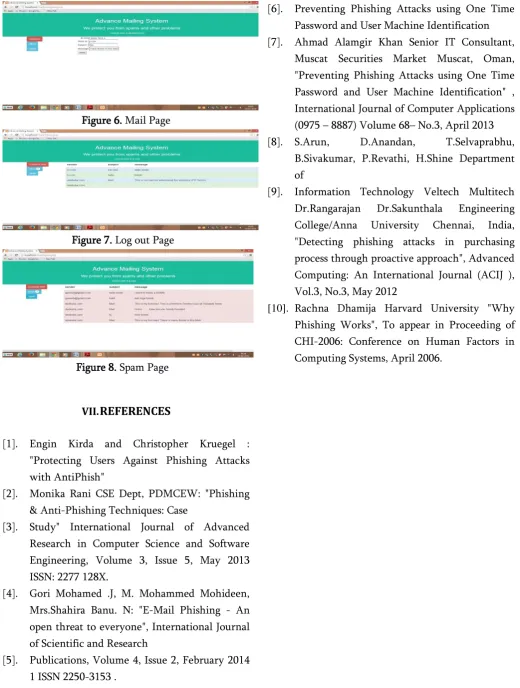
Figure 6. Mail Page
Figure 7. Log out Page
Figure 8. Spam Page
VII.
REFERENCES
[1]. Engin Kirda and Christopher Kruegel : "Protecting Users Against Phishing Attacks with AntiPhish"
[2]. Monika Rani CSE Dept, PDMCEW: "Phishing & Anti-Phishing Techniques: Case
[3]. Study" International Journal of Advanced Research in Computer Science and Software Engineering, Volume 3, Issue 5, May 2013 ISSN: 2277 128X.
[4]. Gori Mohamed .J, M. Mohammed Mohideen, Mrs.Shahira Banu. N: "E-Mail Phishing - An open threat to everyone", International Journal of Scientific and Research
[5]. Publications, Volume 4, Issue 2, February 2014 1 ISSN 2250-3153 .
[6]. Preventing Phishing Attacks using One Time Password and User Machine Identification [7]. Ahmad Alamgir Khan Senior IT Consultant,
Muscat Securities Market Muscat, Oman, "Preventing Phishing Attacks using One Time Password and User Machine Identification" , International Journal of Computer Applications (0975 – 8887) Volume 68– No.3, April 2013 [8]. S.Arun, D.Anandan, T.Selvaprabhu,
B.Sivakumar, P.Revathi, H.Shine Department of
[9]. Information Technology Veltech Multitech Dr.Rangarajan Dr.Sakunthala Engineering College/Anna University Chennai, India, "Detecting phishing attacks in purchasing process through proactive approach", Advanced Computing: An International Journal (ACIJ ), Vol.3, No.3, May 2012