Controlling Mouse Pointer Using Eye for PWDs
Sunidhi S. Sahu1, Prof. Jayant Adhikari2, Prof. Rajesh Babu3
1M.Tech Scholar, Department of Computer Science & Engineering, Tulsiram-Gaikwad Patil College of
Engineering & Technology, Nagpur, Maharashtra, India
2-3Assistant Professor, Department of Computer Science & Engineering, Tulsiram-Gaikwad Patil College of
Engineering & Technology, Nagpur, Maharashtra, India
ABSTRACT
This specialized research work proposes a use of the generally actualized eye tracking methods. Customarily, HCI utilizes mouse, console as an info gadgets however this paper presents hand free interface amongst PC and human. Here giving a clever plan to control PC mouse cursor utilizing human eyes development. It controls mouse moving via consequently influencing the position where eyesight centered. The task involves three segments to be specific Image Capture, Image Processing, and Cursor Control. Subsequent to catching image from webcam, the state of understudy is perceived utilizing Hough Transform and the inside arrange help to decide the correct point on the screen where the client is looking additionally facilitate will educate the PC mouse to move particular area. This framework is exceptionally useful for taking care of the HMI issues of the crippled so it can give an approach to them to speak with the outside world.
Keywords: Eye tracking, Eye-Blinking Detection, Image Processing, Human-Computer Interface, Eye Gaze
I.
INTRODUCTIONAssistive innovation (AT) advances more prominent autonomy for individuals with inabilities by empowering them to perform assignments that they were some time ago unfit to achieve. Nonetheless, the correspondence with patients having neuro-Iocomotor incapacities is an incredible test even today [1]. Typically, the correspondence with these patients requires persistent nearness of a parental figure who should figure patient's essential needs. There is a class of individuals with serious discourse and engine weakness or with neuro-Iocomotor inabilities who cannot talk and cannot utilize communication through signing. In the event that these patients have a decent level of comprehension and observation, they should utilize their eyes for Human-Computer Interaction (HCI).
Eye tracking (ET) methods measure the individual's eye developments with the goal that the look point whenever and the eyes moving are built up precisely. Diverse intrusive or non-invasive techniques for eye development estimation were examined. Today, a few merchants (e.g. Tobii or MyGaze) give business remote camera-based eye-tracker frameworks for which the light source and camera are permanently attached to a screen. These frameworks require the patient's essence before the screen and adjustment technique for any new exchange session and do not fit with the points of AT activity. Moreover, these business frameworks are costly, surpassing 10 000 USD.
organizations and analysts engaged with eye tracking advancements and feature new equipment and programming arrangements.
In one of our past research venture, a correspondence framework for individuals with handicaps, named ASISTSYS, was composed and actualized in concordance with the global rules and principles in regards to assistive innovation (AT). ASISTSYS, displayed in detail in [3], depends on a cell phone for patient's look estimation and furthermore an enhanced calculation for video eye tracking actualized on installed framework. The eye-tracking framework was made from a webcam mounted on a glasses outline, a cell phone with BeagleBoard xM for image securing and processing, a screen for showing words associated with patient's needs and programming application written in C++ and Qt. The model of the proposed framework has been tried in a neurologic recuperation center and was appraised by patients with 210 focuses from 225 most extreme conceivable. The therapeutic staff assessment uncovered a general score was of 18 from a most extreme of25. In spite of great general appraisal, a couple of downsides were uncovered: the nature of the obtained images, the utilization of a screen for showing the client realistic interface, the affectability of ET calculation to light power and the choice of an image or word by taking a gander at it and blinking.
Our ongoing examination was centered around new equipment and programming answers for enhance the dependability, portability and convenience of the correspondence framework. The proposed eye tracking technique was situated towards the likelihood to be utilized by patients for email, courier and social destinations. In this paper, we propose an eye tracking mouse (ETM) framework utilizing video glasses and another hearty eye tracking calculation in view of the versatile double division edge of the obtained images. The proposed framework enables the patient to convey his needs, to peruse a graphical
UI and to choose an image or a word, utilizing just his eyes.
II.
EYE TRACKING TECHNICESAn eye tracker is a gadget for estimating eye positions and eye development. In any investigation, the choice of the strategy rests with the real requests of the application. Amid the examination period of this exploration, three procedures were dissected; the Limbus tracking, Pupil tracking, and third tech is Electrooculography. Every strategy has its own Strong focuses and disadvantages.
A. Limbus
Limbus Tracking clarifies a technique for tracking the eye utilizing the limbus. The limbus is the limit between the white sclera of the eye and the darker iris. As the sclera is white and the iris is darker, this limit can without much of a stretch be optically recognized and followed.
Figure 1. Diagram of an Eye
tracking. For the most part this technique does not include the utilization of infra red light [3].
B. Pupile
Student tracking is a strategy for look detection that is generally utilized frequently in conjunction with different types of tracking. There are a few explanations behind this, yet the primary preferred standpoint is the idea of the "splendid spot". Like the instance of red eye when taking glimmer photos around evening time, infrared can be utilized as a part of understudy detection to make a high power splendid recognize that is anything but difficult to discover with image processing. This splendid spot happens when infrared is reflected off the back of the student and amplified by the focal point. The fundamental preferred standpoint of understudy tracking is that as the outskirt of the student is more keen than the limbus, a higher determination is achievable. Additionally, as the student is never extremely secured by the eyelid, x-y tracking is more doable when contrasted with Limbus tracking. The detriment is that the distinction conversely is bring down between the understudy and iris than between the iris and sclera-along these lines making the fringe detection more troublesome [4].
C. Electro-oculography
The third classification utilizes electric possibilities estimated with anodes put around the eyes. The eyes are the cause of a relentless electric potential field, which can likewise be identified in complete dimness and if the eyes are shut. It can be demonstrated to be created by a dipole with its positive shaft at the cornea and its negative post at the retina. The electric flag that can be determined utilizing two sets of contact cathodes set on the skin around one eye is called Electro-oculogram. On the off chance that the eyes move from the middle position towards the outskirts, the retina approaches one terminal while
the cornea approaches the restricting one. This adjustment in the introduction of the dipole and thusly the electric potential field brings about an adjustment in the deliberate EOG flag. Contrarily, by investigating these adjustments in eye development can be followed. Because of the discretisation given by the regular terminal setup two separate development segments – a level and a vertical – can be distinguished. A third EOG segment is the spiral EOG channel, which is the normal of the EOG channels referenced to some back scalp anode. This outspread EOG channel is touchy to the saccadic spike possibilities originating from the additional visual muscles at the beginning of saccades.
Because of potential floats and variable relations between the EOG flag amplitudes and the saccade sizes make it trying to utilize EOG for estimating moderate eye development and distinguishing look bearing. EOG is, be that as it may, an exceptionally hearty strategy for estimating saccadic eye development related with look moves and recognizing flickers. As opposed to video-based eye-trackers, EOG permits recording of eye developments even with eyes shut, and would thus be able to be utilized as a part of rest look into. It is a light-weight approach that, as opposed to current videobased eye trackers, just requires low computational power, works under various lighting conditions and can be actualized as an implanted, independent wearable framework. It is consequently the technique for decision for estimating eye development in versatile every day life circumstances and REM stages amid rest. The real impediment of EOG is its moderately poor look heading precision contrasted with a video tracker.
III.
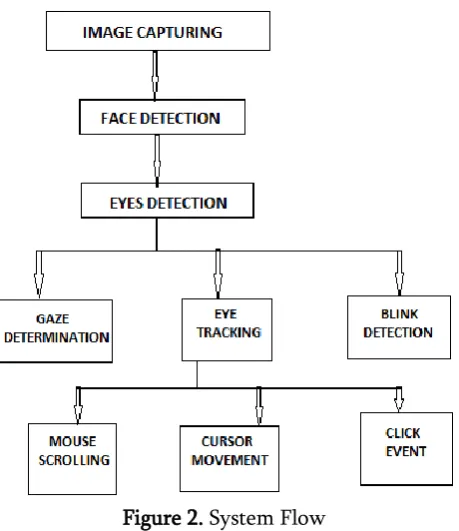
IMPLEMENTATION DETAILSAn entire system is introduced that moves the mouse starting with one place then onto the next on work area through client's eyes development. Prior to the processing for the development of mouse starts, definite processing is exhibited underneath:
Figure 2. System Flow
The client needs to sits before the screen of PC or workstation, a particular camcorder mounted over the screen to watch the client's eyes. The PC consistently breaks down the video image of the eye and finds where the client is looking on the screen. Nothing is appended to the client's head or body. To "select" any key, the client takes a gander at the key for a predefined timeframe and to "press" any key, the client simply flicker the eye. In this framework, adjustment technique isn't required. For this framework input is just eye. No outside equipment is joined or required.
B. Mathematical Formulation
The proposed system can be mathematically represented as following sets and corresponding set operations:
Set S = {s1, s2, s3, s4}
Where,
s1= Initializing camera for capturing images.
s2= selecting the portion from the captured image to be tracked.
s3 = initializing the operations criteria. s4 = start capturing images for tracking. Set R = {r1, r2, r3, r4, s4, s1}
Where,
r1= Determine the position of object to be tracked. r2= Check for the eye status whether it’s blinked or open.
r3 = Perform the operation as per eye blinked status. Set C = {c1, c2, s4, r3}
Where,
c1= Move mouse cursor position based on eye status. c2= perform mouse clicks based on left or right eye blink.
C. Algorithm
Input – Eye video input in RGB format. Output – Detect eye, Cursor move.
Step 1: Get video in RGB format by using function video input.
Step 2: Get snapshot from camera in rgb format by using function getsnapshot.
Step 3: Convert image rgb to gray using function egb2gray.
Step 4: Find size of image using function size( ) after getting row and colume, for finding center pt use function round(row/2)
Step 5: Convert gray image to BW using canny edge method.
Step 6: Hough transform are use for detect lines.
Step 7: Plot x axis and y axis using subplot() function.
Step 8: Convert image to binary using function im2bw.
Step 9: Use bwareaopen function for remove small objects from binary image.
Step 11: Use java package for cursor move according to x and y axis value.
Step 12: Assign the title of eye movement i.e top left, top right, bottom left, bottom right.
Step 13: Stop video using function stop()
Step 14: Flushdata use to remove buffered frames from memory.
IV.
CONCLUSIONThis paper focused on the analysis of the development of the mechanism where an human eye gets interfaced with mouse cursor to control its movement and interact with computer. Advantage of this system is providing computer access for people with server disabilities. In this paper we describe Eye tracking technology. The most unique aspect of this system is that it does not require any complicated wearable attachments. This makes the interaction more efficient and enjoyable. This system also used in industrial control, robotics, medical, advertising, Psychology and so on.
V.
REFERENCES[1] Z. W. Zhu and Q. Ji.: Novel eye gaze tracking techniques under natural head movement. IEEE Trans. Biomed. Eng., vol. 54, no. 12, pp. 2246– 2260, Dec. 2007)
[2] Jianbin Xiong, Weichao Xu, Wei Liao, Qinruo Wang, Jianqi Liu, and Qiong Liang.: Eye Control System Base on Ameliorated Hough Transform Algorithm. IEEE Trans. Vol. 13, no. 9, pp. 3421-3429, September (2013)
[3] K. Abe, Shoich Ohi, M.Ohyama.: Eye – Gaze detection by image analysis under natural light. Springer – verlag Berlin Heidelberg, pp. 176-184, (2011)
[4] Kumar N, Kohlbechers, Schneider E.: A Novel Approach to video – based Pupil Tracking.
IEEE Int. Conf. on San Antonic, pp. 1255-1262, 14 oct 2009.
[5] Yingxi Chen.: Design and evaluation of a human-computer interface based on electro-oculography. (2003)
[6] C. H. Morimoto, A. Amir, and M. Flickner.: Detecting eye position and gaze from a single camera and 2 light sources. in Proc. 16th Int. Conf. Pattern Recognit., pp. 314–317, (2002) [7] J. Daugman.: How iris recognition works. IEEE
Trans. circuits syst. video Techno 1, Vol. 14, no.1, pp. 21-30, Jan (2004)
[8] Al-Rahayfeh, Faezipour. M.: Enhanced Frame rate for real–time eye tracking using circle Hough Transform. LISAT, IEEE, pp. 1-6, 3 May (2013)
[9] http://www.mathworks.in/help/images/edge-detection.html
[10] Kashani, Arani, Fini.: Eye detection and tracking in image with using bag of pixel ”,Communication software and network (ICCSN). IEEE 3rd Int. Conf., pp 64-68,May (2011)
[11] Fini. MRR, Kashani. MAA, Rahmati, M.: Eye detection and tracking in image with complex background. Electronic computer tech, 3rd Int. Conf. IEEE, pp 57-61, 10 April (2011)
[12] Junghoon park, Taeyoung jung, Kangbin yim.: Implementation of an eye gaze tracking system for the disabled people. AINA, IEEE 29th Int. Conf., pp 904-908, 27 March (2015)
[13] Khairos Faizal, Noraini. A. J.: Eyes detection in facial image using circular Hough Transform. SPIA, IEEE, pp. 238-242, 8 March (2009) [14] J. H. Yim, Jeong Min Hwang, Jang. Moseo.:
Wearable video-based eye tracking system with a webcam. Springer, pp. 267-270, (2009)