Comparative Sentiment Analysis on Product Reviews using Deep Learning
Techniques
P. Sumathy1, R. Nishaa2
1Assistant Professor, BDU Trichy, Tamil Nadu, India 2M.Phil Scholar, BDU Trichy, Tamil Nadu, India
ABSTRACT
Micro blogging websites are nothing but social media site to which user makes short and frequent posts. Twitter is one of the famous micro blogging services where user can read and post messages which are 148 characters in length. Twitter messages are also called as Tweets. We will use these tweets as raw data. We will use a method that automatically extracts tweets into positive, negative or neutral sentiments. By using the sentiment analysis the customer can know the feedback about the product or services before making a purchase. The company can use sentiment analysis to know the opinion of customers about their products, so that they can analyze customer satisfaction and according to that they can improve their product. Now-a-days social networking sites are at the boom, so large amount of data is generated. Millions of people are sharing their views daily on micro blogging sites, since it contains short and simple expressions. In this paper, we will discuss about a paradigm to extract the sentiment from a famous micro blogging service, Twitter, where users post their opinions for everything. We can use the deep learning algorithm to classify the twitters which includes Convolutional Neural Networks. The experimental result is presented to illustrate the use and effectiveness of the proposed system.
Keywords : Deep Learning, Micro Blogging, Neural Network, Sentiment Analysis, Tweets.
I.
INTRODUCTIONNowadays, the age of Internet has changed the way people to express their views and opinions. It is now mainly done through blog posts, online forums, product review websites, social media. Millions of people are now using social network sites like Facebook, Twitter, Google Plus, etc. to express their emotions opinions and share views about their daily lives. Through the online communities, we get an interactive media where consumers inform and influence others through forums. Social media is generating a large volume of sentiment rich data in the form of tweets, status updates, blog posts, comments, reviews, etc. Moreover, social media provides an opportunity for businesses by giving a platform to connect with their customers for
objective component but, there are some other textual contents which express subjective characteristics. These contents are mainly opinions, sentiments, appraisals, attitudes, and emotions, which form the core of Sentiment Analysis. It offers many challenging opportunities to develop new applications, mainly due to the huge growth of available information on online sources like blogs and social networks. For example, recommendations of items proposed by a recommendation system can be predicted by taking into account considerations such as positive or negative opinions about those items by making use of SA. Most of the research work of SA is done through deep learning approaches.
The main concept in deep leaning algorithms is automating the extraction of representations (abstractions) from the data. Deep learning algorithms use a huge amount of unsupervised data to automatically extract complex representation. These algorithms are largely motivated by the field of artificial intelligence, which has the general goal of emulating the human brain‟s ability to observe, analyze learn and make decisions, especially for extremely complex problems. Work pertaining to these complex challenges has been a key motivation behind Deep Learning algorithms which strive to emulate the hierarchical learning approach of the human brain. Models based on shallow learning architectures such as decision trees, support vector machines, and case-based reasoning may fall short when attempting to extract useful information from complex structures and relationships in the input corpus. In contrast, Deep Learning architectures have the capability to generalize in non-local and global ways, generating learning patterns and relationships beyond immediate neighbors in the data. Deep learning is in fact an important step toward artificial intelligence and provides complex representations of data which are suitable for AI tasks but also makes the machines independent of human knowledge which is the ultimate goal of AI. It extracts
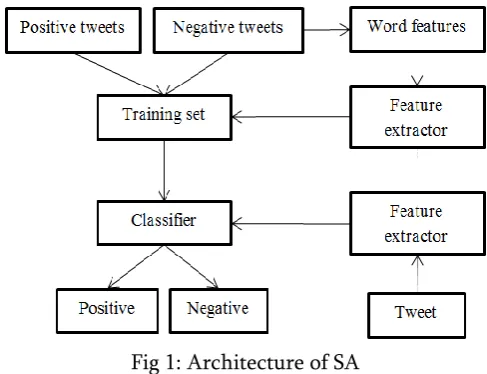
representations directly from unsupervised data without human interference. A key concept underlying Deep Learning methods is distributed representations of the data, in which a large number of possible configurations of the abstract features of the input data are feasible, allowing for a compact representation of each sample and leading to a richer generalization. The number of possible configurations is exponentially related to the number of extracted abstract features. Noting that the observed data was generated through interactions of several known/unknown factors, and thus when a data pattern is obtained through some configurations of learnt factors, additional (unseen) data patterns can likely be described through new configurations of the learnt factors and patterns. Figure 1 provides basic structure of sentiment analysis.
Fig 1: Architecture of SA
related work
and sex. Twitter users are all over the world so it contains data for different language. We have collected a corpus of positive, negative and neutral tweets with the help of Twitter4j java API from Twitter. The size of our corpus can be enormously large. We then remove the stop words from the collected corpus to make the content free from commas, full stops etc. We then apply machine learning algorithms to our training set first and then test set and compare the results. First we extracted the data from twitter using twitter API. Then in pre-processing, we clean the data and make the data available to train using classifiers. We have collected 15000 tweets for training set and 2000 tweets for testing set. SVM using hybrid feature outperforms all other classifiers and selection feature with accuracy of 84% .Max Ent surpass Naïve bayes with bigram feature. Max Ent, on some data sets gives better results than Naïve Bayes. It is concluded that SVM gives better results than other classifiers. In future we are planning to make automatic sentiment classifier for more than one languages starting from the Hindi language. As now a days multilingual messages are posted in twitter, so we will able to predict the sentiment for any language.
Rif at ahdiramadhani, et.al [2] researched on Twitter, a text-based social media, has a significant amount of user-generated content, with 200 million tweets created daily, covering a variety of topics. With this significant amount of data, it has the potential of research related to text mining. One that can be explored on social media data is opinion and sentiment analysis. Naive Bayes is a method that can be used for classification. In the process of text classification, the lack of features sample in training data will provide an absolute zero probability value, causing errors in the classification process. Smoothing methods are used to minimize the possibility of calculation errors on Naive Bayes if the features of test data did not occur on the training data. The process of data mining in this study involved a
comparison of the three smoothing methods: Laplace, Dirichlet (Dir), and Absolute Discounting (AD). Dirichlet and Absolute Discounting methods have a parameter each which needs tuning to get the best classification performance (Sentiment Analysis). The amount of training data could impact the performance classification. The more training data is used, the better the performance of the classification obtained. The amount of training data in this study was limited to 4845 from 8000 raw datasets after preprocessing had been done. The amount of data obtained in the data collection should be improved so that the amount of the final would be large enough that could improve the performance of classification. In sentiment analysis, the absence of samplefeatures in the training data will lead to misclassification.Smoothing is used to overcome this problem. Previous studiesshow that there are differences in performance obtained by thevarious smoothing techniques against various types of data. Inthis paper, we compare the performance of Naive Bayessmoothing methods in improving the performance of sentimentanalysis of tweets. The results indicated that Laplace smoothingis superior to Dirichlet smoothing and Absolute Discounting withthe micro-average value of F1-Score 0.7234 and macro-averageF1-Score 0.7182.
etc.These sentiments become very beneficial for businesses, governments, and individuals. While thiscontent is meant to be useful, a bulk of this writer generated content require using the text miningtechniques and sentiment analysis. But there are several challenges facing the sentiment analysis andevaluation process. These challenges become obstacles in analyzing the accurate meaning of sentimentsand detecting the suitable sentiment polarity. Sentiment analysis is the practice of applyingnatural language processing and text analysis techniques to identify and extract subjective informationfrom text. This paper presents a survey on the sentiment analysis challenges relevant to theirapproaches and techniques. Structured Sentiments are found in formal sentimentreviews, but it targets the formal issues as books orresearch. Because the writers are professional and writingsentiments or notices about the scientific or factissues.Semi-Structured Sentiments lie on the range between theformal structured sentiments and unstructured sentiments.These require understanding several issues aboutreviews. This type which depends on Pros and Cons islisted separately by the writer and the contents of Prosand Cons are usually short phrases.
Federico Neri, et.al [4] proposed the system about the Web is a huge virtual space where to express and share individual opinions, influencing any aspect of life, with implications for marketing and communication alike. Reviews and ratings on the Internet are increasing their importance in the evaluation of products and services by potential customers. In certain sectors, it is even becoming a fundamental variable in the “purchase” decision. A recent Forrester study showed that more than 30% of Internet users have evaluated products or services online. Consumers tend to trust the opinion of other consumers, especially those with prior experience of a product or service, rather than company marketing. Social Media are influencing consumers‟ preferences
by shaping their attitudes and behaviors. The influence of the internet, especially via social networking, on people‟s purchasing behavior has grown over the years. Retailers, who depended on traditional stores to drive sales, have found that the reach of Social Media extends their visibility dramatically. Besides, a friendly, interactive presence on a social network or chat room can greatly improve brand image and help the company gather extremely useful, unstructured data about demand trends, in a nonintrusive way. Monitoring the Social Media activities is a good way to measure customers‟ loyalty, keeping track of their sentiment towards brands or products, of the impact of campaigns and the success of marketing messages, identifying and engaging the top influencers who are most relevant to the brand, product or campaign. Social Media are the next logical marketing arena. Currently, Facebook dominates the digital marketing space, followed closely by Twitter. Blogs, YouTube and MySpace are less preferred, despite obvious benefits these platforms offer. Thisstudy takes also in account the data provided byAuditel regarding newscast audience, correlating theanalysis of Social Media, of Facebook in particular,with measurable data, available to public domain.
in another situation. A second challenge is that people don't always express opinions in a same way.
The user‟s hunger is on for and dependence upon online advice and recommendations the data reveals is merely one reason behind the emerge of interest in new systems that deal directly with opinions as a first-class object. Sentiment analysis concentrates on attitudes, whereas traditional text mining focuses on the analysis of facts. There are few main fields of research predominate in Sentiment analysis: sentiment classification, feature based Sentiment classification and opinion summarization. Sentiment classification deals with classifying entire documents according to the opinions towards certain objects. Feature-based Sentiment classification on the other hand considers the opinions on features of certain objects. Opinion summarization task is different from traditional text summarization because only the features of the product are mined on which the customers have expressed their opinions. Opinion summarization does not summarize the reviews by selecting a subset or rewrite some of the original sentences from the reviews to capture the main points as in the classic text summarization. From the above work it is evident that neither classification model consistently outperforms the other, different types of features have distinct distributions. It is also found that different types of features and classification algorithms are combined in an efficient way in order to overcome their individual drawbacks and benefit from each other‟s merits, and finally enhance the sentiment classification performance.
Mouthami. K, et.al [6] used to determine the attitude/opinion/emotion expressed by a person about a particular topic. Sentiment analysis or opinion mining uses natural language processing and text analytics to identify and extract subjective information in source materials. The rise of social media such as blogs and social networks has fuelled interest in sentiment analysis. In order to identify the
new opportunities and to manage the reputations, business people usually view the reviews/ ratings/ recommendations and other forms of online opinion. This allows to not only find the words that are indicative of sentiment, but also to find the relationships between words so that both words that modify the sentiment and what the sentiment is about can be accurately identified. Scaling system is used to determine sentiment for the words having a positive, negative and neutral sentiment. It also analyzes the subsequent concepts to understand the words and how they relate to the concept. Classification is a supervised procedure that learns to classify new instances based on learning from a training set of instances that have been properly labeled with the correct classes. An algorithm that implements classification, especially in a concrete execution is classifier. The piece of input data is formally termed an instance, and the categories are termed classes.
Sang-Hyun, et.al [7] analyzed tweets or texts related with consumer products is a key marketing strategy. The sentiment behind the tweet is usually determined by the semantics. Thus, to classify the emotions of the tweet correctly, it is essential to build an appropriate dictionary covering various sentiments. Some words such as emoticons and newly coined words were not recognized as words by the automatic indexing system because the embedded morpheme dictionary used for the indexing did not include informal vocabulary. In addition, to extracting the feature vector for sentiment analysis, each vocabulary should be associated with the sentiment weight. Sometimes, the same vocabulary may have a different meaning according to the context. For example, „cold‟ is positive in „food‟ domain but it is negative in the „person‟ domain. For this reason, we constructed the independent sentiment-based domain dictionary for accurate text sentiment classification. However, most of traditional sentiment analysis methods are performed by only using the formal dictionary. This strategy is not effective for this type of classification because tweets usually contain informal vocabulary such as emoticons and newly coined words. Emoticons are widely used to express the emotion of the internet users. It is difficult to classify the emotions behind the emoticons because the structure in emoticons is irregular. Newly coined words are also popular in the SNS[Social Network Service]. In addition, the same word may have different meanings depending on the context. Therefore, it is necessary to build sentiment-based domain dictionaries. In this paper, we propose a new approach of text sentiment classification using sentiment-based domain dictionaries covering formal and informal vocabulary. The tweet is decomposed into morphemes by the morpheme analyzer. From each morpheme, a feature vector is constructed by accessing the sentiment-based domain dictionary. Finally, the sentiment of a tweet is classified by Support Vector Machine (SVM) classifier into positive, negative or neutral.
II.
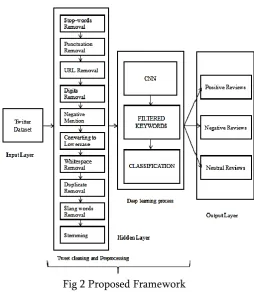
PROPOSED WORKSentiment analysis has been a popular topic in the field of machine learning. It is largely applied to data that comes with self-labeled information such as smart phone reviews from Twitter API. A scalar score comes along with the review text a user writes, which provides a good and reliable labeling of the text polarity. This ability to identify the positive or negative sentiment behind a piece of text is even more interesting when it comes to social data. Twitter gets new user data literally every second. If our model can predict sentiment labels for incoming live tweets, we‟d be able to understand the most recent user attitude towards a variety of topics. Convolutional Neural Networks are very similar to ordinary Neural Networks from the previous chapter: they are made up of neurons that have learnable weights and biases. Each neuron receives some inputs, performs a dot product and optionally follows it with a non-linearity. The whole network still expresses a single differentiable score function: from the raw image pixels on one end to class scores at the other. And they still have a loss function (e.g. SVM/Softmax) on the last (fully-connected) layer and all the tips/tricks we developed for learning regular Neural Networks still apply. We use three main types of layers to build ConvNet architectures: Convolutional Layer, Pooling Layer, and Fully-Connected Layer (exactly as seen in regular Neural Networks). Based on CNN, tweets are classified and labeled as “Positive”, “Negative” and “Neutral” with improved accuracy. Fig 2 provides the proposed framework.
Fig 2 Proposed Framework
3.1 DATA COLLECTION
3.2 TWEET CLEANING AND PREPROCESSING
Data cleansing or data cleaning is the processof detecting and correcting (or removing) corrupt or inaccurate records from a record set, table, or database and refers to identifying incomplete, incorrect, inaccurate or irrelevant parts of the data and then replacing, modifying, or deleting the dirty or coarse data. In computing, stop words are words which are filtered out before or after processing of natural language data (text).Though "stop words" usually refers to the most common words in a language, there is no single universal list of stop words used by all natural language processing tools, and indeed not all tools even use such a list. Some tools specifically avoid removing these stop words to support phrase search. The basic preprocessing steps are:
Removal of Stop-words
Removal of Punctuations
Removal of Expressions
Removal of Digits
Split Attached Words
Standardizing Words
Removal of URLs
Removal of Spaces
Clean the twitter RT,@ from the sentences
Expand acronyms to original words by acronym dictionary
Replace negative mentions
Stemming
3.3 DEEP LEARNING PROCESS
Deep Learning algorithms have great potential for research into the automated extraction of complex data representations. Deep Learning algorithms can develop a layered, and hierarchical architecture of learning and representing data. Deep Learning Big Data allows extraction of high-level, complex
abstractions as data representations through a hierarchical learning process. A key benefit of Deep Learning is Big Data analysis that it can learn from massive amounts of unsupervised data. This makes it a valuable tool for Big Data Analytics where huge amounts of raw data are uncategorized. The preprocessed dataset has many distinctive properties. In the feature extraction method, we extract the aspects from the processed dataset. Later this aspect are used to compute the positive and negative polarity in a sentence which is useful for determining the opinion of the individuals using models like unigram, bigram, N-gram. In this phase, implement n-grammer stemmer to detect the key terms. And also implement convolutional neural network algorithm to construct the layers.
is followed by a computing layer which is used to calculate the local average and the second extract, this unique two feature extraction structure reduces the resolution. CNN is mainly used to identify displacement, zoom and other forms of distorting invariance of two-dimensional graphics. Since the feature detection layer of CNN learns by training data, it avoids explicit feature extraction and implicitly learns from the training data when we use CNN. The basic algorithm framework is listed as follows:
CONSTRUCTING THE CNN MODEL
Step 1: Variable Declaration
function INITCNNMODEL (𝜃, [𝑛1–5]) Step 2 : Layer Construction
layerType = [convolution, max-pooling, fully- connected, fully-connected];
Step 3 : Vector Matching
layerActivation = [tanh(2), max(),softmax()] model = new Model();
for𝑖=1 to 4 do layer = new Layer(); layer.type = layerType[𝑖]; layer.inputSize = 𝑛𝑖
layer.neurons = new Neuron [𝑛𝑖+1]; layer.params = 𝜃𝑖;
model.addLayer(layer); Step 4: Frequency of polarity
end for return model; end function
3.4 SENTIMENT ANALYSIS
Using NLP, statistics, or machine learning methods to extract, identify, or otherwise characterize the sentiment content of a text unit. Sometimes referred to as opinion mining, although the emphasis in this case is on extraction.Sentiment Analysis is the process of determining whether a piece of writing is
positive, negative or neutral. It‟s also known as opinion mining, deriving the opinion or attitude of a speaker. A common use case for this technology is to discover how people feel about a particular topic. And classify the tweets with feature vector. Label as Positive, Negative and Neutral Tweets. Features vectors are classified in fully connected layers.
III.
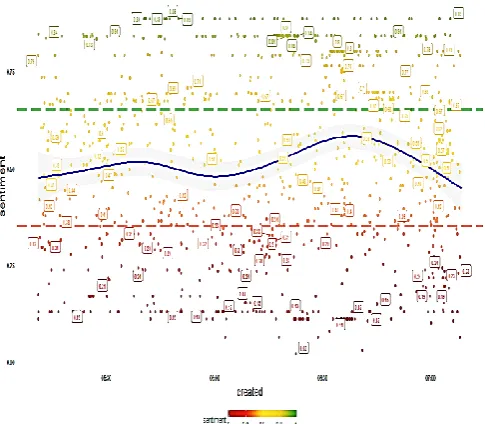
EXPERIMENTAL RESULTSWe used the product review twitter dataset by twitter API link as https://twitter.com. We used the framework where the preprocessor is applied to the raw sentences which make it more appropriate to understand. Further, the different machine learning techniques trains the dataset with feature vectors and then the semantic analysis offers a large set of synonyms and similarity which provides the polarity of the content. The CNN layout is shown in figure 3.
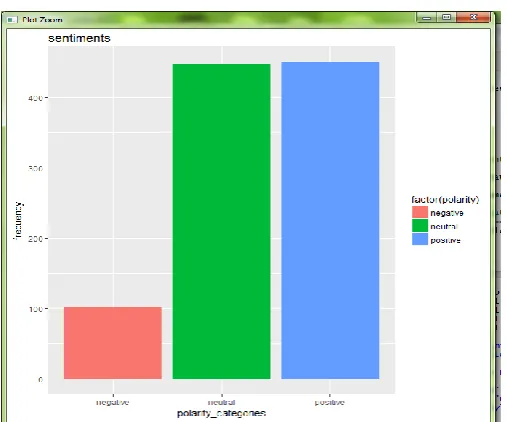
The analyzed result is shown in fig 4.
Fig 4: Sentiment analysis result
We can evaluate the performance using accuracy metrics. The accuracy metric is evaluated as
*100 --- Eq (1)
The proposed algorithm provide improved accuracy rate than the machine learning algorithms.
Algorithm True positiv e
True negativ e
False positiv e
False negativ e Naivesbaye
s
5 10 20 30
SVM 10 8 15 20
CNN 20 5 10 10
Table (1) Performance measurement Accuracy table shown in table 2.
Algorithm Accuracy (%) Naivesbayes 23
SVM 34
CNN 55
Table (2) Accuracy table
Fig 5: Performance chart
IV.
CONCLUSIONThus we conclude that the deep learning technique is very easier and efficient than symbolic techniques. These techniques are easily applied to twitter sentiment analysis. Twitter sentiment analysis is difficult because it is very tough to identify emotional words form tweets and also due to the presence of the repeated characters, slang words, white spaces, misspellings etc. To handle these problems the feature vector is created. Before creating feature vector pre-processing is done on each tweet. Then features are extracted in two phases: First phase is the extraction of the twitter specific word. Then they are removed from the text. Now extracted feature vector is transformed into normal text. After that, features are extracted from tweet which is normal text without any hash tags or slang words. And these extracted features are then added to form feature vector. There are different machine learning classifiers to classify the tweet. It is proposed to stream real time live tweets from twitter using Twitter API, and the large volume of data makes the application suitable for Big Data Analytics. A method to predict or deduct the location of a tweet based on the tweet‟s information and the user‟s information should be found in the future.
0 10 20 30 40 50 60
Naives bayes
SVM CNN
Accuracy (%)
V.
REFERENCES[1]. Joshi, Rohit, and RajkumarTekchandani. "Comparative analysis of Twitter data using supervised classifiers." Inventive Computation Technologies (ICICT), International Conference on.Vol. 3.IEEE, 2016.
[2]. Indriani, Fatma, and Dodon T. Nugrahadi. "Comparison of Naive Bayes smoothing methods for Twitter sentiment analysis." Advanced Computer Science and Information Systems (ICACSIS), 2016 International Conference on.IEEE, 2016.
[3]. Hussein, DoaaMohey El-Din Mohamed. "A survey on sentiment analysis challenges." Journal of King Saud University-Engineering Sciences (2016).
[4]. Neri, Federico, et al. "Sentiment analysis on social media." Advances in Social Networks Analysis and Mining (ASONAM), 2012 IEEE/ACM International Conference on. IEEE, 2012.
[5]. Vinodhini, G., and R. M. Chandrasekaran. "Sentiment analysis and opinion mining: a survey." International Journal 2.6 (2012): 282-292.
[6]. Mouthami, K., K. Nirmala Devi, and V. MuraliBhaskaran. "Sentiment analysis and classification based on textual reviews." Information communication and embedded systems (ICICES), 2013 international conference on.IEEE, 2013.
[7]. Cho, Sang-Hyun, and Hang-Bong Kang. "Text sentiment classification for SNS-based marketing using domain sentiment dictionary." Consumer Electronics (ICCE), 2012 IEEE International Conference on.IEEE, 2012. [8]. Khan, Aurangzeb, and BaharumBaharudin.
"Sentiment classification using sentence-level semantic orientation of opinion terms from blogs." National Postgraduate Conference (NPC), 2011.IEEE, 2011.
[9]. Pan, SinnoJialin, et al. "Cross-domain sentiment classification via spectral feature alignment." Proceedings of the 19th international conference on World wide web. ACM, 2010 [10]. Wu, Fangzhao, and Yongfeng Huang.
"Sentiment domain adaptation with multiple sources." Proceedings of the 54th Annual Meeting of the Association for Computational Linguistics (Volume 1: Long Papers). Vol. 1. 2016.
[11]. B. Pang, L. Lillian, and V. Shivakumar, "Thumbs up?: Sentiment classification using machine learning techniques," in Proc. ACL-02 Conf.Empirical Methods Natural Lang. Process., vol. 10, pp. 79_86, Jul. 2002.
[12]. M. Boia, B. Faltings, C.-C.Musat, and P. Pu, "A :) Is worth a thousand words: How people attach sentiment to emoticons and words in tweets," in Proc. Int. Conf. Social Comput., Sep. 2013, pp. 345_350.
[13]. K. Manuel, K. V. Indukuri, and P. R. Krishna, "Analyzing Internet slang for sentiment mining," in Proc. 2nd Vaagdevi Int. Conf. Inform. Technol.Real World Problems, Dec. 2010, pp. 9_11.
[14]. W. Gao and F. Sebastiani, "Tweet sentiment: From classification to quantification," in Proc. IEEE/ACM Int. Conf. Adv. Social Netw. Anal.Mining (ASONAM), Aug. 2015, pp. 97_104.