Three Prime RSA Algorithm Using Randomly Generated Prime
Sequence Cryptosystem
Pooja Devi1, Naveen Tyagi2, Parul Saharavat3
1M.Tech Scholer J.P.I.E.T, Meerut, Uttar Pradesh, India
2Department of computer science J.P.I.E.T, Meerut, Uttar Pradesh, India 3Department of computer science D.N. Polytechnique, Meerut, Uttar Pradesh, India
ABSTRACT
Existing RSA cryptosystem is not in used due to the fact that it is very slow in process and also having the problem of Brute force and factorization attack. Hence these factors can degrade the performance of the RSA cryptosystem. Therefore a concept is needed which can overcome these entire factor. Hence we proposed algorithm we use the hybrid combination of the subset sum problem and modified RSA cryptosystem. In this work, we are going to enhance the security of the RSA algorithm. Here we are using three prime numbers in place of two and also adding super increasing sequence for the key generation process. If Attacker wants to break proposed systems then one has to factor the modulus into its primes as well as find the secret set A. If modified RSA, which is based on single module is broken in time x and subset sum algorithm is broken in time y then the time required to break this proposed algorithm is x*y. Therefore the security of our proposed system is increased as compared to RSA algorithm.
Keywords: Asymmetric key Cryptography Sub-set Sum cryptography, RSA cryptosystem, Security.
I.
INTRODUCTIONCryptography, a word with Greek origins, means “secret writing. “ However, we use the term to refer to the science and art of transforming messages to make them secure and immune to attacks. There are two types of cryptography techniques:
a. Symmetric key cryptography b. Asymmetric key cryptography
There are few problems with asymmetric key cryptography because it is very slow in process and in terms of security like brute force and factorization attack. At this time asymmetric key cryptography is used only for encrypt and decrypt the keys not the entire message. On the other hand symmetric key cryptography is very fast (i.e.1000 times) as compared to asymmetric key cryptography. Hence symmetric
key cryptography is used for encrypt and decrypt the entire message.
RSA is an algorithm for public-key cryptography that is based on the presumed difficulty of factoring large integers, the factoring problem. RSA stands for Ron Rivest, Adi Shamir and Leonard, who first publicly described it in 1978. A user of RSA creates and then publishes the product of two large prime numbers, along with an auxiliary value, as their public key. The prime factors must be kept secret.
a. Security of RSA algorithm:
b. Sub-Set- Sum cryptography:
The subset sum problem is an important problem in complexity theory and cryptography. The problem is this: given a set of integers, does the sum of some subset of a list of integers has a given sum, which is an integer relation problem. The second subset sum problem is the problem of finding a set of n distinct positive real numbers with as large collection as possible of subsets with the same sum [4]. The subset sum problem is a good introduction to the NP-complete class of problems.
The Subset-Sum cryptosystem (Knapsack Cryptosystem) is also an asymmetric cryptographic technique. This system is based on the subset sum problem (a special case of the knapsack problem): An instance of the Subset Sum problem is a pair (S, t), where S = {x1, x2... xn} is a set of positive integers and t (the target) is a positive integer.
The decision problem asks for a subset of S whose sum is as large as possible, but not larger than t. This problem is NP complete. However, if the set of numbers (called the knapsack) is super increasing, that is, each element of the set is greater than the sum of all the numbers before it; the problem is easy and solvable in polynomial time with a simple greedy algorithm. A knapsack cipher algorithm is based on the NP-complete knapsack-packing problem. This cipher encodes a plain text message as a solution to a series of knapsack problems. A block of plain text equal in length to the number of items in the collection selects the items in the knapsack.
II.
RELATED WORKThe objective of this proposed work is to produce an algorithm to enhance the security of the RSA algorithm. For enhancement of the RSA algorithm, here three prime numbers are used to provide the edge to the security to the RSA cryptosystem. After the problem statement of the RSA cryptosystem, there are two factors comes: Slow speed, Problem of factorization and brute force attack. This work is done in the direction of security i.e. cryptanalysis to overcome the problem of brute force and factorization. We are not working in the direction of speed up the system. In the proposed algorithm we are using the hybrid combination of subset sum cryptosystem and RSA cryptosystem.
In RSA algorithm only encryption key “e “ is used to encrypt and decryption key “d “ is used to decrypt the message. In this proposed work we are using encryption key with secret set A for the encryption and decryption key with the secret set A for decryption. The concept of three prime numbers has been introduced to provide edge to the security of the RSA cryptosystem. We are implementing this work using MatLab programming language.
III.
RSA ALGORITHM5. Calculate d, d = ℮-1 (mod (n)) 6. Public key: PU = {e, n}
7. Private key: PR = {d, n} Encryption Process
Plain text : M < n
Cipher text: C = M℮ mod n Decryption Process Cipher text: C
Plain text: M = Cd mod n.
IV.
PROPOSED TRIPLE PRIME RSA ALGORITHM USING SUBSET SUM CRYPTOGRAPHYAlgorithm 1: Key Generation Process
Input: Three prime numbers and Super increasing sequence
K= key
A = Super Increasing Set
Output: Public Key (B, n, e) , Private Key (A, M, W, n, d )
Begin
Step1. Input the value of three prime p, q and z. Step2. Compute the product of two prime p, q and z. Step3. Compute Φ = (p-1) x (q-1) x (z-1).
Step4. Choose an integer e, satisfying 1 < e < Φ, such that gcd (e, Φ) = 1.
Step5 Compute the secret exponent d, 1 < d < Φ, such that e x d ≡ 1 (mod Φ).
Step6 Choose a super increasing set A = (a1, ..., an). Step7 Choose an integer M with M > SUMi=1...n (ai). M is called the modulus.
Step8 Choose a multiplier W such that gcd (M, W) = 1 and 1 <= W < M This choice of W
guarantees an inverse element U: UW = 1 (mod M). Step9 To get the components bi of the public key B, perform bi = ai*W mod M, I = 1 ... n.
End
Algorithm 2 Encryption
Input: input file to be encrypted K= key Output: Encrypted file
Begin
Step1. Input the message that is to be encrypted. Step2. Generate the ASCII code of the message. Step3. Apply the public key B to the original message and generate the intermediate cipher text C i.e. C = b1 p1 + b2 p2 + ... + bn pn.
Step4. Compute the cipher Text C1 = Ce mod n. Step5. After finding the cipher text C1 we send it to the transmission channel. End
Algorithm 2 Decryption
Input: input file to be decrypted (Cipher text) K= key
Output: Original Message Begin
Step1. Apply the private key “d “ on the cipher text and take the modulo “n “.
m1 = C1d mod n.
Step2. Compute c’ = Um1 mod M = W-1C mod M. Step3. Solve the (A, c) by the following algorithm.
For i = n downto 1
If c ≥ ai then xi = 1 and c = c – ai Else xi = 0
If s ≠ 0 then return (no solution) Else return (x1, x2, ……. , xn )
Because A is super increasing, (A, c’) is easily solvable. Let X = (x1, x2, ……., xn) be the resulting vector and pi = xi and p = (p1, p2, ... , pn) is the plaintext End
VI.
SIMULATION RESULTSAll the implementation work is done on the MatLab platform:
Results:
Table 1.1 Input message with their execution time S.
No.
Input message Execution Time (in sec.)
1. Vishal 0.061682
2. vishal ja 0.087501
3. vishal jayaswal 0.130932
4. vishal jayaswal mtech 0.181511 5. vishal jayaswal mtech
student
0.232388
VII.
CONCLUSIONThis modification improves the security of RSA. If Attackers wants to break our proposed systems then he has to factor the modulus into its primes as well as find the secret set A. If RSA which is based on single module, is broken in time x and subset sum algorithm is broken in time y then the time required to break this proposed algorithm is x*y. Hence the security of our proposed system is increased as compare to RSA algorithm.
Figure1.1. Graph between input message and execution time in second
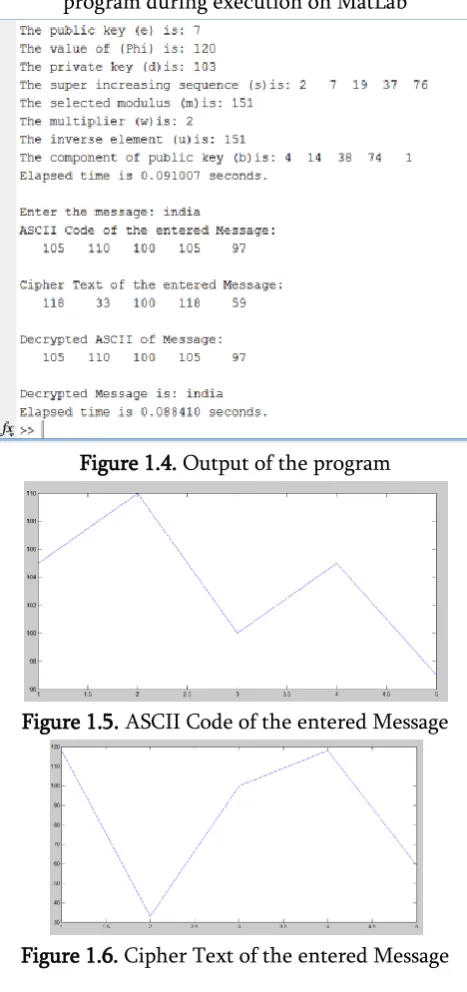
Figure 1.2. Passing input value in the program during execution on MatLab
Figure 1.3. Display intermediate value by the program during execution on MatLab
Figure 1.4. Output of the program
Figure 1.5. ASCII Code of the entered Message
Figure 1.6. Cipher Text of the entered Message
0 0.2 0.4 0.6
T
im
e
(Seco
nd
)
Exeution time3
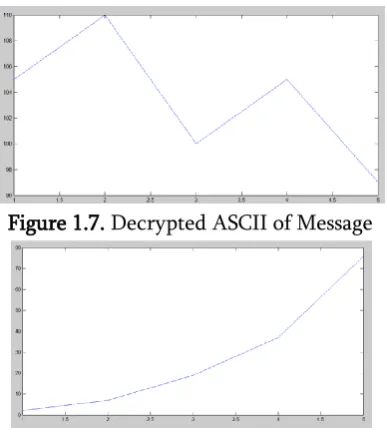
Figure 1.7. Decrypted ASCII of Message
Figure 1.8. super increasing sequence
VIII.
REFERENCES
[1]. Digital signature scheme with message recovery using knapsack-based ECC International journal of network security, Vol.12, No.1, jan 2011. R. Rajaram Ramasamy and M. Amutha prabakar.
[2]. Knapsack based ECC Encrytion and Decryption. International journal of network security, Vol.12, No.1, jan 2011.R.Rajaram Ramasamy and M. Amutha prabakar.
[3]. An Efficient Signature System Using Optimized RSA Algorithm IJCSNS International Journal of Computer Science and Network Security, VOL.8 No.12, December 2008 Prof.
MOUSTAFA ABD EL-AZIEM, Dr.
MOHAMMAD ALI GOMAA.
[4]. IJCSNS International Journal of Computer Science and Network Security, VOL.8 No.12, December 2008, "An Efficient Signature System Using Optimized RSA Algorithm ".
[5]. T. ElGamal. A public key cryptosystem and a signature scheme based on discrete logarithms. IEEE Transactions on Information Theory, July 1985.W.Diffie and M. Hellman. "New Directions in Cryptography ". IEEE transactions on Information Theory. IT-22(1978).472-492.
[6]. R. C. Merkle and M. E. Hellman, "Hiding information and signatures in trapdoor knapsacks, "IEEE Trans. Inf. Theory, IT- 24(5), pp.525-530, 1978.
[7]. Shamir, A. 1984. A polynomial-time algorithm for breaking the basic Merkle - Hellman cryptosystem; Information Theory, IEEE Transactions on , Volume: 30 Issue: 5 , Sep 1984 Page(s): 699 –704
[8]. Diffie, W.; Hellman, M.1976. New directions in cryptography; Information Theory, IEEE Transactions on , Volume: 22 Issue: 6 , Nov 1976 Page(s): 644 –654
[9]. M. E. Hellman and E.D. Karnin, 1983 "The Largest Super-Increasing Subset of a Random Set, "IEEE Trans. on Info. Theory, Vol. IT-29, January 1983, pp.
[10]. R. Rajaram Ramasamy and M. Amutha Prabakar 2011. Digital Signature Scheme with Message Recovery Using Knapsack-based ECC, International Journal of Network Security, Vol.12, No.1, PP.7 - 12, Jan. 2011
[11]. M. E. Hellman, "An Overview of Public Key Cryptography, "IEEE Communications Society Magazine, Vol. 16, Nov. 1978, pp.24-32 (Invited Paper).
[12]. W. Diffie and M. E. Hellman, "Privacy and