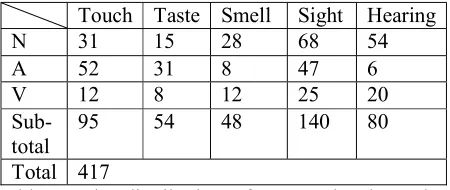
31st Pacific Asia Conference on Language, Information and Computation (PACLIC 31), pages 249–254
A corpus-based study on synesthesia in Korean ordinary language
Charmhun Jo
Faculty of Humanities, The Hong Kong Polytechnic
University, Hong Kong
Abstract
Synesthesia means an involuntary neurologi-cal phenomenon where “sensory events in one modality take on qualities usually considered appropriate to another” (Marks, 1982, p. 15). More generally, it indicates an experiential mapping of one sense domain with another, such as “sweet sound”. The study reported in this paper is to test Ullmann’s (1963) theoreti-cal framework of “hierarchitheoreti-cal distribution” through the synesthetic data coming out of Korean National Corpus (KNC), focusing on modern daily Korean. The research questions here are (a) what are the routes for Korean synesthetic transfers like?, (b) what are the predominant source and target domain for the transfers?, and (c) what are the universal and/or culture-specific aspects in the associa-tion? Based on Strik Lievers et al.’s (2013) methodology, the study extracts synesthetic data from KNC. As a result, the data analysis shows that (a) Korean synesthesia conforms to Ullmann’s (1963) general scheme in the met-aphoric mappings, (b) the predominant source domain is touch while the predominant target is hearing, which matches with Ullmann’s (1963) study as well, and (c) there could be a delicate cultural dependency, which means “taste” occupies a significant position together with “touch” in Korean synesthetic metaphors.
1 Introduction
Synesthesia (also spelled synæsthesia or synaes-thesia) has been an interesting research topic in diverse academic fields. The term synesthesia
comes from the Ancient Greek σύν syn, “together”, and αἴσθησις aisthēsis, “sensation”. Basically, syn-esthesia refers to an involuntary neurological phe-nomenon where “sensory events in one modality take on qualities usually considered appropriate to another” (Marks, 1982, p. 15). To be more general, it means an experiential association of one sense domain with another, such as “sweet sound” and “cold color”. In linguistics, synesthesia is under-stood in terms of metaphor (Williams, 1976; Geeraerts, 2010), which means that a perceptual experience of one sense is described by lexical ex-pressions associated with another. For example, “sweet sound” is linguistically synesthetic because the speaker expresses a perception of sound (“sound”) using a word related to taste (“sweet”), where “sound” becomes the target domain of the transfer and “sweet” is the source. The synesthetic metaphors were introduced by S. Ullmann (1963), where he proposed his theoretical framework of “hierarchical distribution” as a probable universal principle in the process of synesthetic mapping. In this light, the objective of the study is to test Ullmann’s (1963) theoretical framework using the synesthetic data from Korean National Corpus (KNC). Therefore, the research questions here are (a) what are the routes for Korean synesthetic transfers like?, (b) what are the predominant source and target domain for the transfers?, and (c) what are the universal and/or culture-specific aspects in the association?
2 Brief literature review
As the seminal work of synesthetic metaphors, Ullmann (1963), analyzing poetic writings of the nineteenth century in English, French, and
ian, proposed his theoretical framework of “hierar-chical distribution”, where he concluded three overall tendencies in synesthetic mappings. First of all, the majority of synesthetic transfers show the following direction: touch heat taste smell
sound sight. This transfers tend to move from the “lower” to the “higher” sensory domains, which is called “hierarchical distribution”. Second, based on the first tendency, the most frequent source domain of transfers is touch, the lowest lev-el of sensation. Third, the most frequent target do-main for synesthetic transfers is sound rather than sight.
Based on Ullmann’s (1963) study on data from poetry, Williams (1976) investigated the syn-esthetic transfer in daily language, namely, the his-torical change of meaning of synesthetic adjectives in daily English (together with some evidence from other Indo-European languages and Japanese as well). In sum, his results support Ullmann’s (1963) framework of “hierarchical distribution”, general-ized as follows:
Figure 1. Synesthetic transfer route of Williams (1976)
Following Ullmann (1963) and Williams (1976), Yu (1992) applied their approaches to the data collected from Chinese literary and daily lan-guage. The conclusion of the research shows that Chinese synesthetic metaphors basically conform to their general schemes in metaphoric mappings. Yu (2003) also found almost the same results from the analysis of synesthetic data extracted from lit-erary works written by current eminent Chinese novelist Mo Yan, examining synesthesia based on a cognitive perspective.
From the perspective of cognitive poetics, following Ullmann’s (1963) approach, Shen (1997) explored the directionality of transfer for synes-thetic metaphors in Hebrew on the basis of the lit-erary analysis of modern poetry and two experimental data. His findings reinforce Ullmann’s (1963) observation about the mapping in linguistic synesthesia. That is to say, the synes-thetic expressions in the Hebrew language tend to map lower senses on to higher ones in their hierar-chy. By way of the notion of “accessibility”, Shen
(1997) claims that the “low to high” transfer comes from the general cognitive constraints, where “a mapping from more ‘accessible’ or ‘basic’ con-cepts onto ‘less accessible’ or ‘less basic’ ones seems more natural and is preferred over the oppo-site mapping” (p. 51). Also, he points out that sight and sound are less accessible because they do not involve any direct contact with the perceived entity.
Recently, Strik Lievers (2015) reported a no-ticeable study about linguistic synesthesia by mak-ing use of corpora to investigate synesthetic transfers of English and Italian. Via a semi-automatic method for extracting synesthesiae from corpora, developed in Strik Lievers et al. (2013), she found large-scale data results and more clearly presented that the so-called principle of direction-ality just reflects the “frequency” of synesthetic connection types, adding a few interesting interpre-tations about the motivation of English and Italian synesthetic mappings.
3 Methodology
Sensory domains
Prior to the examination into synesthetic mappings in the linguistic text, sensory domains, or sensory modalities, are first to be designated. As a matter of fact, there is no agreement among scholars over how many sensory modalities there exist, and they can vary depending on researchers’ viewpoints and classificatory criteria (Strik Lievers et al., 2013; Strik Lievers, 2015). Most of synesthetic studies now follow the Aristotelian five-sense system of touch, taste, smell, hearing, and sight (cf. Cytowic, 1989; Shen, 1997; Strik Lievers 2015). Some of the studies, on the other hand, makes an adjustment to the above system. For instance, Ullmann (1963) separated “heat” from “touch”1, and Williams (1976) divided sight into two categories of “di-mension” and “color”. Day (1996) is based on Ullmann’s (1963) taxonomy, while Yu (1992, 2003) follows Williams’s (1976). Lin and Hsien (2011) add “emotion” on the six senses of touch, temperature, taste, smell, hearing, and vision, and Zhao and Huang (2015) also take “emotion” into consideration along with the traditional five senses.
1 However, Ullmann (1963) mentioned: “There is of course no
Yu, N. (1992). A possible semantic law in synesthetic transfer. SECOL Review, 16(1), 20-40.
Yu, N. (2002). Body and emotion: Body parts in Chi-nese expression of emotion. Pragmatics & cognition, 10(1), 341-367.
Yu, N. (2003). Synesthetic metaphor: A cognitive per-spective. Journal of Literary Semantics, 32(1), 19-34. Zhao, Q. & Huang, C. R. (2015). A corpus-based study
on synaesthetic adjectives in modern Chinese. Zhao, Q., Huang, C. R., & Xu, H. (2015). Auditory