“
Hi-speed flight operations”
An evaluation of selected e-enabled
applications
Master Thesis
by
Seth van Straten
University of Twente, Enschede,
the Netherlands
Internal supervisory board:
External supervisory board:
Dr. J.M.G. Heerkens
Mr. M. Rademaker
Dr. ir. C.P. Katsma
Ir. E.J.A. Haubrich
I hereby present the public version of my masters thesis and final graduation project. I would like to thank Mr. P.F.Hartman, Mr. E.Haubrich and Mr. M.Rademaker for providing me with the incredible opportunity to put theory into practice, learn and develop myself at KLM. I have had a fantastic and superb internship!
Secondly, I would also like to express my gratitude to all KLM employees that have proven their willingness to help me and provide me with all required information; in particular the flight technical department of the 747-unit where I was located during my internship.
Finally I am very grateful for the efforts and willingness of Mr. J.M.G. Heerkens and Mr. C.P. Katsma to support, supervise and assess me.
Seth van Straten
© 2008 S. van Straten
Management summary
Motive
The e-enabled vision document, accredited and acknowledged by the board in 2006, specifies the infrastructure as currently onboard the Boeing 777-300ER aircraft. However, e-enabled operation on two aircraft still requires conventional operations on all other aircraft. This research helps in addressing the question of what elements should be retrofitted on the remainder of the fleet, to reap the benefits of an e-enabled operation by evaluating the following applications:
! Currently operational applications: e-docs and e-reporting
! Currently non-operational applications: e-charts, e-weather and e-briefing
Recommendations
Recommendations that follow from this research report, taking into account scope, limitations and assumptions, are as follows:
! Retrofit the entire existing fleet with a class II EFB hardware system, a graphical printer and a Gatelink unit, and;
o Retrofit all wide body aircraft with a SATCOM broadband unit
! Set up the e-enabled project throughout the different business divisions, to be able to justify all e-enabled investments
Main findings
! The investment for an e-enabled aircraft environment, within the flight operations’ domain, is viable
! The e-weather application is the most attractive; based on financial and non-financial criteria
! Process benefits from the e-briefing operation (on the 737) and other process benefits represent a substantial part of all benefits
Motivation
First of all, this research has identified the main values and goals that are important to KLM. Relating them to e-enabled applications and means resulted in a comprehensive framework that identified the main criteria: financial, workload, satisfaction/commitment to work, safety in the air, safety on the ground and errors within processes. Next a thorough investigation of conventional and e-enabled operations of selected applications resulted in:
! Technological- and organization requirements and associated costs and;
! Financial and non-financial benefits
Consequences
Table of contents
Management summary ... 3
1.0 The research project; an introduction... 5
1.1 Complete overview of this report ...5
1.2 KLM: a brief introduction...6
1.3 The problem context: the e-enabled aircraft ...7
1.4 Research objectives...9
1.5 Research objects...10
2.0 Research foundation... 11
2.1 Building blocks of this report and their mutual relation...11
2.2 The attractiveness of selected e-enabled applications ...13
2.3 Evaluation criteria...15
2.3.1 KLM and e-enabled goals...15
2.3.2 KLM and e-enabled means ...17
2.3.3 Goals, sub-goals, means and applications; a framework ...19
2.4 The STOF framework...23
2.5 Technological- and organizational requirements...25
2.6 Financial and non-financial benefits...27
3.0 E-enabled; the infrastructure... 29
3.1 Infrastructural elements ...29
3.2 The electronic flight bag (EFB) ...31
3.2.1 EFB hardware systems; different classes...31
3.2.2 EFB software applications; different types...32
3.2.3 EFB hardware and software; combined systems ...33
3.3 The e-enabled infrastructure; scenarios and costs ...34
8.0 E-weather; an evaluation ... 37
8.1 Scope and assumptions ...37
8.7 Summary of financial and non-financial benefits...55
9.0 Overall financial and non-financial analysis ... 56
9.1 Net present value (NPV); theoretical justification...56
9.2 NPV calculations; standard cash flow timings ...58
9.3 NPV calculations; a marginal costing approach ...59
1.0 The research project; an introduction
This introductory chapter provides an overview of this report, a brief introduction to KLM and the problem context. The research objectives and research objects are introduced as well.
1.1 Complete overview of this report
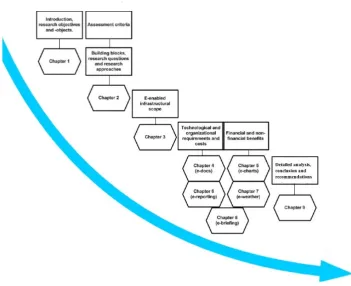
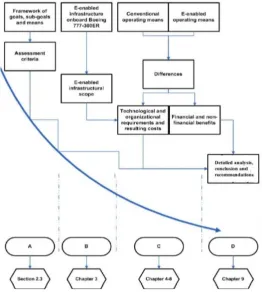
Figure 1 below, provides a complete overview of this research report, indicating what will be addresses and where. Readers who are only interested in specific parts of this report can address this figure to find the chapter that addresses their interest.
1.2 KLM: a brief introduction
KLM, established October 7th 1919, today is the oldest and one of the most renowned international airlines in the world. Starting her operations on the route Amsterdam-London (1920), which is still operated today. KLM started its first intercontinental operating route between Amsterdam and Batavia in 1924, her first Atlantic operating route to Curacao in 1934 and its first flight with a jet plane in 1960. The introduction of the first Boeing 747 (1971) marked the beginning of the ‘wide-body’ era.
In the strategic context, the joint-venture with Northwest Airlines (September 1993) and the entry of KLM in the AIR FRANCE-KLM Group (May 2004) are both recognized to be the most significant occurrences.
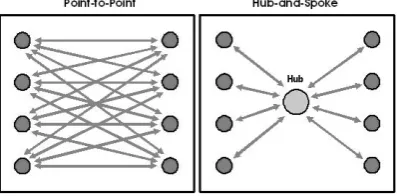
With a fleet of over 170 airplanes1, flying both within Europe (EUR) and intercontinental (ICA), KLM was able to lock-in a distinctive position as ‘the reliable airline’, clearly referring to the KLM operations as a transit airline using a so called hub- and spoke system. (Figure 2)
Figure 2: graphical interpretation point-to-point and hub-and-spoke systems
Whereas in a point-to-point system passengers travel directly from their origin to their destination (assuming airlines operate between the two cities), in a hub- and spoke system passengers from all over the world are transported to relatively few central hubs, where they transfer to a connecting flight.
It is believed that KLM adopted the latter operations, at least partly, because the Dutch market is too small to be viable on its own, KLM maintains Schiphol airport as its central hub.
KLM has divided its business in three main divisions; Passengers business, Cargo business and Engineering & Maintenance business.
1.3 The problem context: the e-enabled aircraft
The industry considers the introduction of the electronic flight bag (EFB2) as the predecessor of the e-enabled aircraft. (Joint Aviation Authorities [JAA], 2004)
FedEx introduced the earliest version of an electronic flight bag around 1990, using laptops to perform weight & balance calculations and to fill out operational forms. (Jensen, 2006) Literature indicates that there is a movement towards a paperless cockpit, or at least towards a cockpit with less paperwork ever since. (Boeing, 2006) (JAA, 2004)
A parallel development concerns the evolvement of information technology changing the environment of almost every organization. (Laudon & Laudon, 2003) Specifically, within the airline industry significant changes have also materialized because of IT influences; online ticketing, digitalization of back offices, digital in-flight-systems and digitalization of avionics are common in today’s environment. Some airlines are even using IT as a core competence to ensure an organization without any paper, tickets or whatsoever; especially low cost-carriers have contributed to this development.
The next step in this development evolved around 2003, when the airline industry introduced the concept of an e-enabled environment. “e-enabling is the strategic connection and integration of business processes, people, airplanes, information, assets, and knowledge into a single focused business system” (Boeing, 2006) (The e-enabled airline, airplane, flight deck, cabin, 2006)
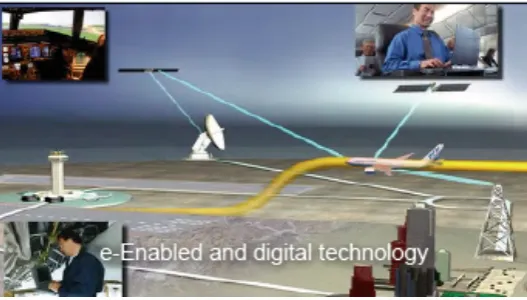
The e-enabled aircraft is only a part of the complete e-enabled environment, enabling more efficient operations, by supplying more accurate data, more quickly, to the people that need it, improved decision-making and enhanced service to passengers. Figure 3 provides a graphical impression. (737 e-Enabling Features – FAQ’s, 2007)
Figure 3: e-enabled impression (Boeing e-enabled environment)
2 An electronic display system intended primarily for flight deck or cabin use. EFB
Operation of e-enabled applications in an (complete) e-enabled infrastructure, both onboard and on the ground, creates opportunities for airlines to operate under new circumstances to improve operations, offer new services and reap the benefits of more efficient processes.
KLMs’ executive committee has endorsed the concept of the e-enabled aircraft in December 2006. (F-fwrd; ‘E-enabled Aircraft’, 2006) The accompanying vision document describes an array of e-enabled applications, reaching from the digitalization of paperwork to enhanced possibilities for predictive maintenance and passenger services.
Fifteen Boeing 777-200ERs were delivered with an EFB class III3 onboard and in February and March 2008 KLM took delivery of two 777-300ERs, both equipped with a complete e-enabled infrastructure as presented in Figure 4, where the EFB is only one of the elements. Interestingly, the class III EFB systems were installed before the e-enabled vision was put on paper. A complete description of the infrastructure is provided in chapter 3.
-Confidential-
Figure 4: Infrastructure e-enabled aircraft
At this moment, the airport moving map and e-docs e-enabled applications are running on the 777-200ERs. The 777-300ERs also operate the e-ATL and e-reporting applications.
Operation of e-enabled applications on sixteen aircraft with an EFB and on two aircraft with a complete infrastructure still requires conventional operations on all other aircraft. Hence, KLM is not yet able to reap the (full) benefits of an e-enabled environment, which constitutes the problem. Explicitly, this research addresses the following problem:
For this research, the e-enabled infrastructure is defined by the infrastructure currently onboard the 777-300ER, as presented in Figure 4 and in accordance with the vision document. (F-fwrd; ‘E-enabled Aircraft’, 2006) The infrastructure is extensively discussed in chapter 4. By focusing on already identified infrastructure the scope is limited; this was done on purpose. However, while the current infrastructure comprises an EFB class III system, this research also addresses the possibility of an EFB class II system, completely in line with a trend where class II EFB systems are capable of ever increasing functionalities. Class I EFB systems are not considered in this report because of the limitation that does not allow usage of class 1 EFB systems during all phases of flight, prohibiting the use of e-charts for example, a requirement from the flight operations department.
The e-enabled operation for this research is bounded by the infrastructure on the one hand, and by identified e-enabled applications on the other hand. For example, a Gatelink unit implies airline operational communication (AOC) while the aircraft is on the ground. This implies that AOC by other means (e.g. USB-sticks Southwest) are not within the scope, hence not investigated.
Selected applications are discussed in section 1.5; it was decided to make a selection of e-enabled applications that have already been identified and acknowledged in KLM e-enabled vision documentation. Other applications that might exist are not considered.
By evaluating the operation of selected e-enabled applications this research helps addressing the question of what elements of the already identified e-enabled infrastructure should be retrofitted on the remainder of the fleet, to reap the benefits of an e-enabled operation. It should be noted that this research only addresses part of the entire problem, by focusing on selected applications only.
1.4 Research objectives
The following objectives have been identified for this research report:
! Determine the attractiveness of selected e-enabled applications
o By determining the technological and organizational requirements and associated costs that are required by operations of selected e-enabled applications and;
o By determining both financial and non-financial benefits that result from the operation of selected e-enabled applications
The attractiveness of selected e-enabled applications is determined by scoring the applications on identified criteria; profitability, employees’ quality of work life and operational performance. The identification and operationalization of criteria is described in section 3.3.
1.5 Research objects
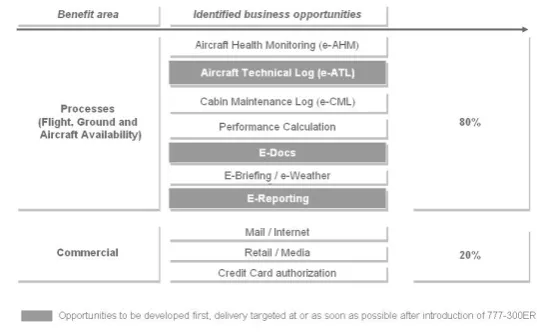
The objects of analysis, the research objects, consist of specific e-enabled applications. It was decided to limit the selection to applications presented in the e-enabled vision document5. (F-fwrd; ‘E-enabled Aircraft’, 2006)
Figure 5: Business opportunities e-enabled
KLM has divided its operations into three processes, namely; ground, flight and aircraft availability. As this research is performed in support of the flight operations department6, business opportunities supporting the processes ground and aircraft availability as well as commercially identified business opportunities are outside the scope of this research.
Five applications have been selected for this research. The e-docs and e-reporting applications, currently operative on the 777-300ERs, are evaluated in the light of expanding operations on the remainder of the fleet. These applications have been selected because of their expected impact on the operations.
The charts application was chosen because it could easily be combined with the e-docs application as a result of its great similarity.
E-briefing and e-weather applications are selected because these applications were envisioned to be of importance, yet no clear ideas exist concerning the operation of the applications, while it is believed that significant benefits are to be expected.
To conclude, the research objectives are realized by means of an investigation of the following research objects:
! Currently operational applications: e-docs and e-reporting
2.0 Research foundation
This chapter presents an overview of the entire report. Research questions for the objectives of this report and accompanying research approaches are described. The delineation of KLM’ strategic goals in relation with the e-enabled applications are presented which leads to the evaluation criteria that are used to determine the attractiveness of selected applications.
Furthermore a modified version of the STOF model is introduced, which is used to guarantee a complete and consistent manner of analysis.
2.1 Building blocks of this report and their mutual relation
The mutual relationship between the building blocks of this report is graphically presented in Figure 6 below.
(A) The first building block determines the assessment criteria that will be used to evaluate the selected e-enabled applications. Assessment criteria are derived from a framework of goals, sub-goals and means, discussed in section 2.3, the core of the main objective. Weights of selected criteria are also determined within section 2.3.
(B) The second building block is concerned with the e-enabled infrastructure. Infrastructural elements are explained, relevant impacts from legislation on the determination of the required class of EFB are discussed and an overview of costs and current fleet status is presented. The e-enabled onboard infrastructure is to be used by all applications and is therefore of a generic character. All costs associated with these generic elements are presented here and de-coupled from the applications because other applications, not within the scope of this research, will also use the e-enabled infrastructure. These generic cost elements consist of both one-time capital expenditures as well as recurring costs related to these investments.
(C) The third building block regards the analysis of selected e-enabled applications. A structural and comprehensive analysis of both the conventional operations and the e-enabled operations results in an overview of technological and organizational requirements and associated costs on the one side, and an overview of financial and non-financial benefits on the other side. These requirements, costs and benefits are presented for each individual application. Recurring costs and benefits that result from the operation of selected applications are described within this building block, as opposed to the one-time investment expenditures related to the infrastructure that are described in building block B.
(D) The fourth building block provides a detailed overview of costs and benefits of both applications and required infrastructural elements. By means of a rough order NPV calculation for all identified scenarios a selection is made and a detailed analysis based on a marginal costing approach is provided for sensible scenarios. Additional financial insights are presented and a final overall picture of the attractiveness of selected application is presented, taking into account both financial and non-financial benefits. Finally, this building block finishes off by presenting conclusions and recommendations that follow directly from the earlier building blocks.
2.2 The attractiveness of selected e-enabled applications
To determine the attractiveness of selected e-enabled applications, the main objective, an evaluation type of research is required. (Verschuuren & Doorewaard, 2005) Evaluation of research objects is performed by applying a multi criteria decision analysis.
The first important step is to determine the assessment criteria that form the core of the evaluation. Investigating KLMs’ overall strategy and KLMs’ e-enabled vision identifies the criteria, experts’ views are incorporated and relevant literature from vendors and magazines have been consulted as well.
By identifying goals, sub-goals, means and their interrelation a comprehensive framework is formed that translates to the main criteria. This framework is described in the next section. It is necessary to operationalize criteria before being able to use them. To build the framework and identify relevant criteria the following guiding central- and sub questions were formulated:
What criteria can be identified for evaluating the selected e-enabled applications (i.e. research objects)?
! What goals can be derived from KLMs’ (e-enabled) vision?
! What goals and means can be derived from views of experts?
! What means can be derived from vendor information?
! What means can be derived from literature research on e-enabled?
How are these goals, means and criteria operationalized?
Answers to these questions result in the first building block of this research report (A). In a later stage of the report the actual attractiveness of applications is determined by scoring the applications on identified criteria, hence the following research questions:
What is the attractiveness of selected e-enabled applications?
! How do the e-enabled applications score on the assessment criteria?
! What are the weights of the different criteria?
Addressing all research questions as stated above yields an overview of the attractiveness of selected applications, the fourth building block (D).
The research procedure
The criteria on which the evaluation is founded are identified by investigating KLMs’ (e-enabled) vision and goals. Furthermore, internal views and opinions from experts are obtained through several series of interview sessions.
The first series of interviews are characterized by a relatively open style with limited pre-structuring. The second series of interviews are characterized by a more closed style, combining dedicated and pre-structured questions. Therefore more focused on the actual intent of gathering insight of the envisioned relations between the goals and means. After each interview session, the results from the other interviews were discussed building a crosscheck in terms of validation. Although open interviews have the tendency to be affected by the so-called anchoring bias, asking several experts on different time periods may overcome this problem. (Verschuuren & Doorewaard, 2005) (Cooper & Schindler, 2006) The annex on page Error! Bookmark not defined. provides a summary overview.
Weights of selected criteria have been determined by asking several business managers and controllers to divide 100 points between the selected criteria. Controllers have been asked because of their direct involvement and experience with new investment decisions.
Actual scoring on selected criteria is based on direct rating, a SMART methodology; section 2.3.3 describes this operation is further detail. (Goodwin & Wright, 1991) However, the identification of both the conventional and e-enabled operations and the resulting differences, the sub-objectives of this report as defined in section 1.4 (Building block 3), are first to be investigated.
2.3 Evaluation criteria
The core of every evaluation consists of the evaluation criteria. (Keeney, 1992) The evaluation criteria for this research are determined by identifying both goals and sub-goals of KLM and the e-enabled project. The structure that is created takes the means to achieve these goals into account as well. The goals, sub-goals and means were identified by reviewing internal vision documentation, interviewing KLM experts and by reviewing (suppliers’) literature.
2.3.1 KLM and e-enabled goals
On the highest level the ambition is set to form Europe’s leading airline group, within the framework of operational safety and corporate social responsibility (CSR). Focusing on customers, operational issues and employees should lead to profitable growth.
Figure 7: KLM' new horizon strategy proposition (New Horizon; ‘KLM Strategie en Speerpunten’ Flight Operations, n.d.)
This publication fails in separating goals and values from means. Furthermore there seems to be a causal ambiguity between identified means. While profitable growth is a goal, operational excellence should be considered a means, for instance to reduce costs. Reducing costs on the other hand should be considered a sub goal of profitable growth, the same goes for increasing revenues.
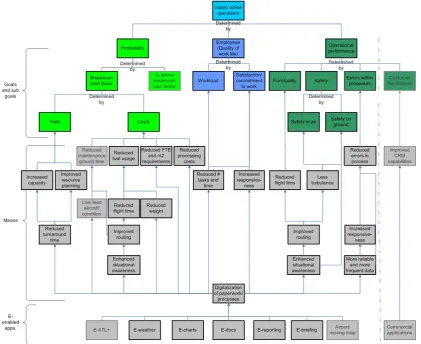
Furthermore, realizing growth should never be considered as a goal, but always as a means to achieve a higher-level goal; gaining market share or increasing revenues for example. The same goes for synergies, usually a means to lower costs. Figure 8 takes these considerations into account and defines a viable airline operation for KLM to be determined by:
! Profitability
! Employees’ quality of work life
A specific e-enabled vision has been constructed as well, endorsed by the KLM executive committee in 2006 (F-fwrd; ‘E-enabled Aircraft’, 2006):
“Increase flight safety, increase operational integrity, optimize the economy of operations and enhance service to passengers by implementing an e-enabled environment through aircraft and ground based infrastructure and broadband connectivity”
Although this vision complies with the overall KLM vision as well as with the basic operating philosophy (BOP) some means and goals, or values perhaps, are again interrelated and hence not correctly stated in this vision document. Operational integrity is considered as a goal or value, while it should be considered a means to achieve a higher-level goal like safety or performance.
The goals and means identified from the vision documentation and described above are summarized below in Table 1.
Table 1: goals/values, sub-goals and means derived from KLM- and e-enabled vision documentation
Taking the presented critical remarks into account, an overview of the relationships between the identified goals and sub goals (a value tree) of KLM is presented below by Figure 8.
Figure 8: overview of goals and sub goals (value tree)
The overview presented in Figure 8 complies with requirements that can be found in literature concerning ‘value trees’. (Goodwin & Wright, 1991) All relevant values are incorporated, therefore satisfying the completeness requirement. Sub goals on the lowest level can be measured (operationalization) and all sub goals can be measured independently from the other (decomposability). Finally, sub goals are non-redundant and the overview or ‘value trees’’ size is kept to a minimum.
Goals or values: Sub-goals: Abstract means:
Profit (able) growth Reduce costs Operational excellence
Increasing revenue Growth
Flight safety Synergies
Service to passengers Operational integrity
E-enabled environment through aircraft and ground based infrastructure and broadband connectivity
2.3.2 KLM and e-enabled means
The primary interview sessions held with approximately 20 experts yielded, already identified, goals and sub-goals; fully aware of goals and sub-goals spread by corporate vision documents. The second round of interview sessions assisted in defining the perceived means by asking structured questions dedicated at the relationship between applications, functionalities and goals. The direct question was asked how a specific application would contribute to identified goals and sub-goals. Furthermore, vendor information contributed to the understanding of applications, functionalities and goals7. Expected relations between individual applications, goals and sub-goals are described below.
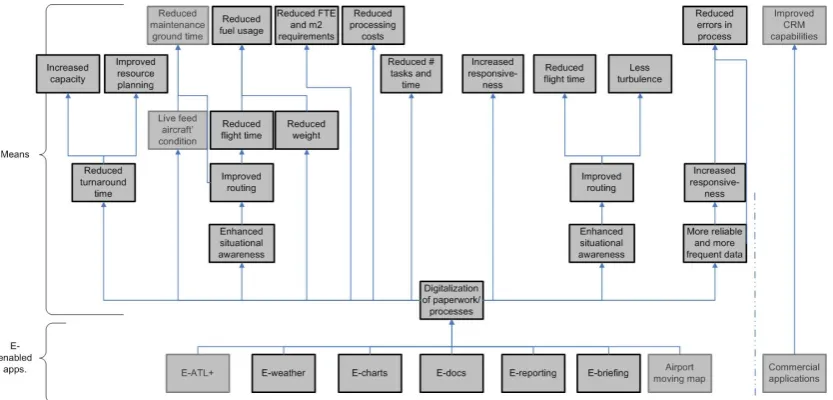
E-docs and e-charts applications are both anticipated as a trigger to digitalize paperwork and surrounding processes. Reducing paperwork by digitalization yields a reduction of reproduction costs. Less paper onboard and thus less weight onboard, results in reduced fuel usage. Digitalization of both operating manuals and aeronautical charts with the possibility to zoom and pan eliminates the effect of un-readability for pilots. Furthermore a ‘portable’ EFB (class II) allows the display to be held in many positions, similar to paper charts. Eliminating paper charts on the flight deck finally reduces the risk of having to search for paper that has fallen down. (FAA, 2007) Furthermore, digitalization influences both the reliability and update frequency of data, reducing the number of errors made throughout the process, possibly enhancing safety. By changing the accompanying processes on the ground, throughput time and personnel requirements are reduced, directly affecting costs.
E-reporting enables a further digitalization of processes, therefore possibly attributing to a reduction of paperwork and required organizational resources. By enabling a digital data link, time-benefits should be considered as well. Simplifying reporting is anticipated to facilitate KLM to take better corrective actions, by reducing the time between the occurrence of an event and the processing in the back offices. Simplifying the reporting procedures is anticipated to (partly) remove a barrier and therefore result in additional reporting.
E-briefing is also expected to result in a further digitalization of processes, serving as a means to reduce organizational requirements and paperwork. A reduced throughput time might result in a reduced turnaround time, possibly influencing resource planning and capacity. Simplifying the process affects the required time for registration before departure as well, which might have an impact on the aircraft planning and rotation schedules.
E-weather, bringing the functionality of ‘live weather’ into the cockpit is regarded as a means to create additional awareness while flying. This could result in a reduced flight time and less turbulence, therefore possibly improving punctuality, capacity, safety and customer service.
7 This research focuses on the operational perspective. The commercial perspective
Although outside the scope of this research the e-ATL application is considered a means for live information about the aircraft condition. This in turn assists in predictive-maintenance analyses reducing the maintenance time while on the ground, therefore yielding substantial cost benefits.
The airport moving map application (AMM) currently operating on all 777 aircraft directly enhances situational awareness on the ground, therefore reducing the risk of runway incursions and improving the safety situation on the ground; this has been brought forward by KLM cockpit crew as well as by the FAA. (FAA, 2006)
Enhanced performance calculations in the cockpit using an electronic performance tool yields substantial benefits by optimizing calculations in terms of ‘derating engines’ and maximizing payload.
Finally, albeit outside the scope of this research, it cannot be stressed enough that commercial applications are foreseen to provide enhanced service offerings to passengers. These offers range from internet-access to the possibility of printing boarding passes of connecting passengers. At this moment these commercial offerings are still regarded a means of differentiation, however in today’s fast moving environment these commercial offerings are rapidly expected to become a prerequisite demanded by customers.
Figure 9 depicts the relationships between the e-enabled applications and resulting means.
Figure 9: overview of relations between applications and means
2.3.3 Goals, sub-goals, means and applications; a framework
The following framework is constructed relating KLM goals, sub-goals, means and e-enabled applications, identified in previous sections, to each other. As described previously, the three partite between profitability, employees’ quality of work and operational performance is taken into account.
Figure 10: evaluation framework, relating goals, sub-goals, means and e-enabled applications
Operationalization of the framework
Operationalization of the framework is essential to create measurable criteria against which the e-enabled applications are to be evaluated. This operationalization was pursued by investigating relevant literature, but is mainly based on interview sessions with KLM experts. (AEA, 2007)
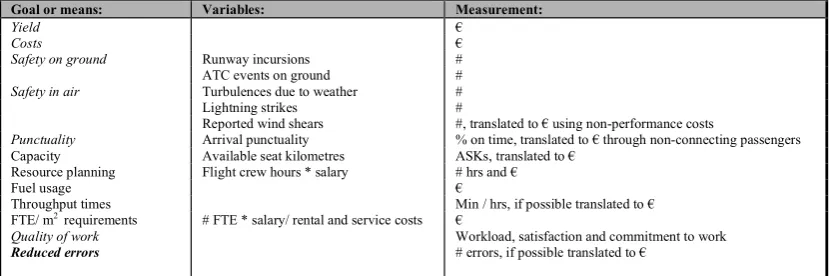
Yield and costs are measured in euros (!). Variables measuring safety while on the ground are the number of runway incursions and ATC events. These variables were assigned after interview sessions with a flight safety manager. For this research particularly, safety while in the air is measured by the number of turbulences recorded due to weather impacts, as well as by the number of lightning strikes and the number of reported wind shears.
Punctuality can be operationalized by the percentage of on time arrivals, important for network carriers, like KLM, because of the relatively large number of transfer passengers. The financial impact of punctuality is determined by the non-performance costs. Capacity is measured by the number of available seat kilometres (ASKs), an industry wide known measure for capacity. (EASA) To determine the financial impact of capacity yield and costs measurements are applied.
The affect on resource planning is mainly attributed to the number of flight crew (hours) that can be reduced, related to production day tariffs and therefore measured in euros (!). Reduced fuel usage, as a result of weight reduction or time advances, is measured in euros (!). Reduced throughput time of processes is measured in hours or minutes. The impact of FTE requirements is calculated in their monetary equivalent denoted in euros (!). The impact on required squared meters (m2) is determined by the rental and service costs (!). Errors are represented in terms of the actual numbers, when possible translated to a financial impact measured in euros (!).
Within this research, employees’ quality of work life (QWL) is bounded by workload, satisfaction and commitment to work. These factors are also described by relevant literature, but are certainly not exclusive. (Igbaria, Parasuraman & Badawy, 1994) Enhanced cockpit operations are mainly described qualitatively, often lacking the ability to measure them. Reduced errors are related to monetary implications hence measured in euros (!), when possible. Finally, enhanced situation awareness is described qualitatively and related to safety impact accordingly. A complete overview is presented in Table 2; goals are in italic.
Goal or means: Variables: Measurement:
Yield !
Costs !
Safety on ground Runway incursions #
ATC events on ground #
Safety in air Turbulences due to weather #
Lightning strikes #
Reported wind shears #, translated to ! using non-performance costs
Punctuality Arrival punctuality % on time, translated to ! through non-connecting passengers
Capacity Available seat kilometres ASKs, translated to !
Resource planning Flight crew hours * salary # hrs and !
Fuel usage !
Throughput times Min / hrs, if possible translated to !
FTE/ m2 requirements # FTE * salary/ rental and service costs !
Quality of work Workload, satisfaction and commitment to work
Reduced errors # errors, if possible translated to !
Evaluation criteria
To derive relevant evaluation criteria all goals are considered in terms of their variables and respective measurement scales.
Yield, and costs (operationalizing profitability) as well as punctuality are all measured in monetary terms (!) and will be combined into one financial criterion. The financial attractiveness is determined by calculating the net present value, internal rate of return and or payback period combining all relevant costs and benefits into yearly cash flows. These measures are directly related to the discounted cash flow method (DCF), allows for the time-value of money to be incorporated. Literature shows that these measures are indeed the most common and applicable used to evaluate business cases. (Wouters, 2005) Specifically, dealing with investment decisions, which are characterized by time-zero capital expenditures and yearly costs and benefits, literature indicates the required match with the DCF method; because it takes into account the time value of money and allows for time zero capital expenditures, therefore creating an honest comparison of relevant cash flows. Furthermore, KLM controllers have also indicated that these measures are indeed used within KLM.
Employees’ quality of work, operationalized by workload and satisfaction and commitment to work, will be described qualitatively. To determine the attractiveness of selected applications on these criteria, the direct rating method is used; according to the SMART theory to be used for attributes that cannot be represented easily by quantifiable variables. (Goodwin & Wright, 1991) This implies that the benefits of the selected applications are ranked from the most preferred to the least preferred. Based on an interval scale the rankings are then attributed to values between 0 and 100, where the best alternative gets the latter value and the worst alternative the former.
Operational performance is operationalized by punctuality (included within the financial criterion), safety, both on the ground and in the air, and errors within the process. To determine the attractiveness of selected e-enabled applications on the safety and error criteria the direct rating methodology is applied. The financial criterion is therefore not financially translated. An overview of direct rating results on the above criteria is to be found in the annex, on page Error! Bookmark not defined.. Chapters 4-8 present the scores of the respective applications on selected criteria.
Figure 11 below presents an overview of relevant evaluation criteria that are used in this research report.
Figure 11: overview of evaluation criteria
Having established the evaluation criteria, their operationalization and the scoring methodology, the final step is to determine the weights of the selected criteria.
To determine the weights of these criteria, the following questions were asked to four business managers and four controllers:
! When an investment decision must be taken, what are the primary criteria of concern?
o What are required scores on these criteria, if any?
! Are there any conjunctive criteria? (Criteria that must, no matter what, be satisfied?)
! When you consider the criteria presented in this report, is there anything lacking in terms of decision criteria?
! How would you distribute 100 points over the presented criteria, indicating their relative importance?
o Within the QWL criterion, how would you distribute the importance of workload versus satisfaction/commitment to work?
2.4 The STOF framework
To be able to present the findings in a consistent manner, this research embraces the STOF business model as defined by (BOUWMAN, VOS & HAAKER, 2008) albeit modified and specified according to this research’ specifics.
The original STOF model as introduced by (BOUWMAN, VOS & HAAKER, 2008) distinguishes four domains; the service domain, the organization domain, the technology domain and the finance domain. The original interpretation presents the model as interactive and mutual dependent in a reciprocal manner; reciprocal relations are further defined in a dynamic ensemble, where no beginning or end is described.
Within the elaboration of the original work it is mentioned that the service domain could be considered a logical starting point. When the service domain is considered as a reference for the other domains, describing the value proposition to ‘the customer’, the STOF framework is actually considered to be a static model instead of dynamic. Requirements defined in the service domain specify the requirements for the technological and operational domains, which in turn determine the impact on the financial domain. When the model is interpreted as such, the dynamic characteristic is changed to a static view, where the mutual dependencies are no longer reciprocal but sequential.
This latter interpretation is used to present a somewhat modified STOF framework where additional literature is consulted to determine the elements (operationalization) of distinct domains. For this research specifically, the value proposition is considered to consist of the selected e-enabled applications while the customer is KLM, more specifically the flight operations department.
The operationalization for the technological domain is provided by a differentiation between initial- and recurring requirements, taking into account acquisition costs, installation costs, maintenance costs, updates, licenses and service level agreements. (Dugan, 2002) (Shin & Jemella, 2002) (Shang, 1996)
Organizational requirements within this research are limited to additional required FTEs, training and responsibilities, in accordance with both the original delineation of the STOF model as well as additional literature.
The financial domain is where costs and revenues (benefits) are determined. Technological requirements, organizational requirements and the operation of selected e-enabled applications directly result in financial impacts. Analogous to theory considering the discounted cash flow evaluation, the financial domain is operationalized by distinguishing between initial investments and recurring -costs and benefits. This distinction allows for an easy financial evaluation by means of a discounted cash flow method, a standard instrument in business case analyses. (Drury, 2004) (Wouters, 2005)
Non-financial impacts regard safety aspects, time benefits and employees’ quality of work, analogous to the framework presented in section 2.3.3.
Figure 12 below provides a graphical interpretation of the modified and extended STOF model (STONFF).
Figure 12: modified interpretation of the STOF model
Table 3 below provides an overview of the operationalization of the amended STOF domains, applicable for this research report.
Table 3: overview of technological, organizational and financial elements
This section has introduced a modified and extended version of the original STOF framework as presented by (BOUWMAN, VOS & HAAKER, 2008). The reciprocal and dynamic interpretation has been replaced by a static and sequential interpretation that starts with the service offering. This service offering, in this case the e-enabled applications, translate into technological and organizational requirements that can be translated into resulting financial impacts. A non-financial impact domain has been added to account for benefits that are not translated into financial terms. As described in section 2.3.3 the benefits are scored against identified criteria. Using the operationalization as presented in Table 3 guarantees a uniformity of analysis.
Technological requirements
(initial): Technological requirements (recurring): Organizational requirements: Financial impacts:
Acquisition costs hardware8 Maintenance costs FTE’s Initial costs
Acquisition costs software Updating content (usage) Responsibilities Recurring costs
Installations costs Licenses Training costs Recurring benefits
2.5 Technological- and organizational requirements
Organizational and technological requirements form the core of the first sub-objective. The requirements have to be quantified by assigning costs when possible. Investigation is based on knowledge acquired from the aircraft data communications department (ADC), the engineering & maintenance department (E&M), vendor information, fleet services, legislation and available literature. The outcome of this investigation results in both the second as well as part of the third research building block (B and C), described in section 2.1 on page 13.
A distinction is made between an explanation of the overall e-enabled infrastructure, including a detailed reasoning of the required class of EFB on the one side (chapter 3), and technological and organizational requirements that result from operations of specific e-enabled applications on the other side (chapters 4-8).
The second building block, the infrastructural scope, is entirely determined by investigating the currently installed infrastructure onboard the Boeing 777-300ER. This serves as a boundary in terms of infrastructure, while also defining operations. The following research questions are formulated to provide this understanding:
What comprises the current e-enabled infrastructure present on the 777-300ER?
! What elements can be identified in the e-enabled infrastructure currently onboard the 777-300ER?
! What functionalities can be identified?
! How do functionalities and elements relate to each other?
! What determines the required class of EFB?
! What elements are currently present onboard the different aircraft? What are the costs of the e-enabled infrastructural elements?
The third major research building block is an overview of technological- and organizational requirements and their associated costs, which result from the operations of selected e-enabled applications. Infrastructural costs haven already been accounted for in chapter 3, therefore only (recurring) costs resulting from the operation are accounted for. These are presented in the respective chapters 4-8. The following research questions have been formulated:
What technological and organizational requirements result from the operations of selected e-enabled applications and what are the associated costs?
! What technological requirements can be identified?
! What organizational requirements can be identified?
The research procedure
Chapter 3 presents an overview of the e-enabled infrastructure as defined by KLM, and currently onboard the 777-300ER. Interview sessions with expert from the aircraft data communications department (ADC) as well as interview sessions with experts from the Engineering & Maintenance department (E&M) have led to an understanding of the e-enabled infrastructure. Costs associated with the elements of this infrastructure were acquired through a request of material (ROM), delivered by fleet services.
An overview of infrastructure onboard the current fleet was acquired through the ‘technology watch’, delivered by the E&M department.
Relevant legislation, both from the US as from Europe, is consulted to create an overview of distinct EFB classes that perform a central role within the e-enabled infrastructure.
Since the e-enabled infrastructure exceeds the level of the individual e-enabled applications, it was decided to present the elucidation and costs associated with the elements of the infrastructure separately in chapter 3.
The infrastructural requirements in terms of hard- and software, for the e-enabled applications, have been identified by dedicated and pre-structured interview sessions with experts from the ADC department. The same interview sessions were held with experts from the E&M department. This was done to ensure verification of the results, creating enhanced validation of data.
Organizational requirements were identified on the basis of comparison between the conventional and e-enabled operations per application as is also depicted in Figure 6. These issues are therefore presented for each individual application in their respective chapter (chapters 4-8). The necessary identification of conventional and e-enabled operations is extensively discussed in section 2.6. A summary of the above is provided in the annex on page Error! Bookmark not defined..
2.6 Financial and non-financial benefits
The third major building block requires the identification of financial and non-financial benefits that are identified by comparing the conventional operations with the e-enabled operations. The identification of both operations is based on interview sessions with experts from various departments that are somehow related to the operational process. Available flowcharts have been used, when applicable, as a starter. The following guiding central- and sub questions are formulated:
What financial and non-financial benefits can be identified from the operation of e-enabled applications?
! What does the conventional operations entails?
! What does the e-enabled operations entails?
! What are the differences? conventional and e-enabled operations. Both operations are identified in terms of process flow charts, creating a clear overview of involved actors (parties), data, and documents, while also providing a sequential impression.
Two distinct kinds of flowcharts are used; to provide a quick overview of the situation at hand a physical goods flowchart is created. Physical goods flowcharts provide an understanding of parties involved, sequence and physical goods that are relevant for each process.
A more detailed overview, also providing insights into the actual activities at hand and (non-physical) information flows is provided by the informational flowcharts. Both types of flowcharts are created according to the schedule and explanation described in literature. (Katsma, 2005)
Understanding operations of both situations is guaranteed by reviewing available documentation, observing the actual real-time process and by conducting interview sessions with relevant parties.
Interviews are characterized by a limited open style, specifically dealing with dedicated and pre-structured questions, therefore focused on the actual intent of gathering insight of the process. After each interview session, the results from the other interviews were discussed building a crosscheck in terms of validation. Process descriptions from currently non-operative applications, e-weather and e-briefing, are based on possible scenarios within the scope of the e-enabled hardware currently onboard the 777-300ER. Interviewees have validated all flowcharts. A summary of the above is presented in Error! Reference source not found..
Section 2.3.3 already described the methodology concerned with scoring the alternatives on selected criteria. Financials are combined into a single net present value calculation. Non-financial benefits are scored using the direct rating methodology. (Goodwin & Wright, 1991) As explained in section 2.3.3 scores are relative against each other, however because there is no aggregation of scores on financial- and non-financial criteria into an overall score the potential problem of interference on the overall score is avoided.
Chapter 9 combines the financial and non-financial benefits of selected applications together with the financial requirements that result from the installation of the e-enabled infrastructure. By combining both initial and recurring costs and benefits, using the discounted cash flow methodology, a complete and comprehensive overview is provided for (financial) decision-making.
3.0 E-enabled; the infrastructure
This chapter introduces the e-enabled infrastructure as is currently onboard the 777-300ER. The elements are briefly discussed and related to functionalities. One of the key elements of the e-enabled infrastructure, the EFB, is addressed more comprehensively because of restrictive legislation. An overview of accompanying costs is presented and at last an overview of the current fleet in terms of e-enabled infrastructure is presented.
3.1 Infrastructural elements
For this research it is assumed that the ground infrastructure will consist of the Boeing enterprise ground support system (BEGSS) and the data distribution management system (CAT/DDM); both are currently already present. Figure 13 presents an overview of the current e-enabled infrastructure onboard the777-300ER. This research does only consider the presented infrastructure, more specifically this research only addresses the cockpit part, part of flight operations, not imparting with the cabin (part of in-flight services). These items will be discussed separately, grouped by functionality (737 e-Enabling Features – FAQ’s, 2007) (The e-enabled airline, airplane, flight deck, cabin, 2006):
-Confidential-
Figure 13: e-enabled infrastructure (present on 777-300ER)
Interface functionality
The EFB, consisting of an electronic or processing unit and a display unit, intended primarily for flight deck use, can display a variety of aviation data or perform basic calculations. (JAA, 2004) The EFB is extensively discussed in this chapter because three distinct classes of EFB systems can be distinguished according to legislation. Defined classes of EFB systems determine operation means, therefore making the selection and distinction important and inevitable.
The graphical printer is merely used to print necessary data and requests; also serving as an additional backup in case of a single EFB failure.
Communication functionality
A distinction can be made between outbound and internal communications. Outbound communication is considered all communication directed at ground-based systems, internal communications are concerned with communication onboard to/from various elements of the complete infrastructure.
The aircraft communication addressing and reporting system (ACARS) is a digital data link system using very high frequency (VHF) communication for transmission of small messages between aircraft and ground stations via radio or satellite.
A SATCOM antenna unit, when integrated into a communications system, can provide an off board link for an onboard network. Utilizing satellites, such an antenna provides a link with terrestrial networks wherever an airplane operates. SATCOM is seen as the successor of ACARS.
A terminal wireless LAN unit (TWLU) is a receiver/transmitter unit that communicates with a ground-based network via an (external) aircraft antenna; enabling data transmission between an aircraft-based network and a ground-based airport- or airline-provided network. Utilizing 802.11 protocols implies operation only when the aircraft is on the ground within the coverage area of a ground-based network.
Within the aircraft, communication between different elements of the infrastructure occurs through a cockpit local area network (LAN). The EFBs, the aircraft condition monitoring system (ACMS), the vertical quick access recorder (VQAR), the printer and the network file server (NFS) are connected to each other through this network. The NFS is a device capable of connecting the various airplane system components and/or user interfaces with an IP network on board an airplane and control them. The NFS serves as a switch connecting cockpit and cabin networks to each other; such functionality is required when cabin and cockpit networks are to be using the same connection (SATCOM). The NFS stores an additional hard-drive as well, therefore serving as an additional storage depository for redundancy issues.
Data depository functionality
The ACMS uses the connectivity on board to receive data from several installed sensors and send data to the ground-based information systems.
The VQAR is an optical drive that records aircraft specific data; the drive can be pulled out and replaced.
As mentioned earlier, the NFS stores an additional hard-drive as well, therefore serving as an additional storage depository for redundancy issues.
Table 4 provides an overview of elements and functions within the scope of this research:
Function/ element: Data depository: Communication: Interface:
ACMS ACARS EFB
VQAR SATCOM Printer
NFS TWLU E&M workstation
LAN NFS
3.2 The electronic flight bag (EFB)
This section provides an overview of the main discriminators between distinct types of hardware and software related to the EFB and the relationship between them. Stressed by legislation hardware and software issues should be addressed separately, together forming an integrated system. Interpretations are based on European legislation extended with American legislation. (U.S. Department of Transportation [FAA], 2003) (JAA, 2004)
3.2.1 EFB hardware systems; different classes
Three classes of EFB systems can be differentiated. Class I EFB systems are considered commercially-off-the-shelf-based (COTS) computer systems used for aircraft operations, portable, connecting to aircraft power through a certified power source, not attached to an aircraft mounting device, considered a controlled portable electronic device (PED), normally without aircraft data connectivity except under specific conditions and not requiring an airworthiness approval.
Class II EFB systems are considered COTS computer systems used for aircraft operations, portable, connected to aircraft power through a certified power source, connected to an aircraft mounting device during normal operations, considered a controlled PED, with a limited possibility to connect to avionics and requiring an airworthiness approval. Class III EFB systems are installed equipment requiring an airworthiness approval.
For practical purposes, the following derived specific implications and discriminators are explicitly denoted:
! Class I EFB systems are not allowed for usage during take-off, landing and taxiing. (FAA, 2003) (FAA, 2007)
! Class I data connectivity to other systems is only allowed when completely isolated from the avionics/aircraft systems (e.g. for airline administration control (AAC) purposes), any other type of data connectivity requires an airworthiness approval. (JAA, 2004)
! Class II EFB systems require airworthiness approval, limited to the mounting device, crashworthiness, data connectivity and EFB power connection. Data connectivity should be verified to ensure non-interference and isolation from aircraft systems during transmission and reception. The advisory circular limits non-AAC communication to receiving information from any aircraft system. (FAA, 2003)
! Class III EFB systems may form part of a host platform (network server) supporting other functions such as central maintenance. (JAA, 2004)
3.2.2 EFB software applications; different types
Legislation has also classified EFB software applications into distinct categories. Where the advisory circular (AC) acknowledges type A, B and C, the temporary guidance leaflet (TGL) denotes type A, type B and non-A/B software applications. (FAA, 2003) (JAA, 2004)
Type A software applications include pre-composed, fixed presentation of data currently presented in paper format. Type A applications may be hosted on any of the hardware classes, require operational approval and do not require airworthiness approval. “Pre-composed information is considered information previously composed into a static composed state (non-interactive). The composed displays have consistent, defined and verifiable content, and formats that are fixed in composition. Applications based on pre-composed information may support “contextual access” like hyperlinks and bookmarks”. (JAA, 2004)
Type B software applications include dynamic, interactive applications that can manipulate data and presentation. Type B applications may be hosted on any of the hardware classes, require operational approval and do not require airworthiness approval. Information presented on the EFB that, via software applications, could be selected and rendered in a number of dynamic ways, is considered interactive information. “This includes variables in the information presented based on data oriented software algorithms, concepts of de-cluttering, and “on-the-fly” composition as opposed to pre-composed information”. (JAA, 2004)
All applications that do not fall into these categories require an airworthiness approval and are denoted as type C or non-A/B software applications. Roughly speaking, applications similar to primary flight displays and applications that replace primary flight displays are classified to belong to this category. Both the TGL as well as the AC provide typical examples of software applications from various types.
3.2.3 EFB hardware and software; combined systems
Based on the previous elucidation of EFB hard- and software, the following decision aid has been created:
Figure 14: decision aid EFB hard- and software
To start with, the purpose and functionality of the software application should be determined. Both the temporary guidance leaflet of the FAA and the advisory circular of the JAA provide typical examples of all software types. In any case, the findings should be propounded to the regulator. When software applications are not classified as type C, classification against type A and type B should be checked. Neither A nor B still implies a classification as type C.
Both type A and B software applications require an operational approval and are allowed on EFB class I, II and III hardware systems.
3.3 The e-enabled infrastructure; scenarios and costs
This section presents an overview of the different scenarios that have been investigated within this research report. Accompanying costs are presented, taking into account the current situation of the existing fleet. Figure 15 below, presents an overview of the different scenarios that have been investigated.
Figure 15: overview of different scenarios
The odd-numbered scenarios contain EFB class II hardware systems, whereas all even-numbered scenarios contain EFB class III hardware systems. The minimum set of elements required for operation consists of an EFB, a printer and a Gatelink unit; reflected by the first two scenarios.
Scenarios 3 and 4 also include a SATCOM broadband unit, albeit on the wide body (non-737) aircraft only.
The different scenarios also take into account the availability of elements on the existing fleet; EFBs are not included in any scenario for the 777, because they are already installed. The “technology watch” has been consulted to provide the information for all aircraft series. (Technology watch, 2008) A total of 108 aircraft are within the scope of this research. Table 5 presents the costs associated with the different scenarios:
-Confidential-
Table 5: costs of different scenarios
These costs are based on the rough order of magnitude, provided by the E&M department (SPL/TQ). (KLM engineering & maintenance, 2006/1) (KLM engineering & maintenance, 2006/2) Although these documents are considered to be the best available information sources, a great deal of uncertainty is still to be applied. According to the ROM itself, a deviation in prices of +/- 50 % should be acknowledged. According to one of the authors of this respective ROM, the great uncertainty is mainly because of the omission of a detailed specification of requirements from KLM, the uncertainty within KLM E&M about required man-hours, downtime and uncertainty related to certification issues. A recommendation addressing this issue is presented in section 9.6. In general, a class III system will require more downtime and additional costs. The ROM omits material costs for a class III EFB on the Airbus A330; it is assumed that these costs are equal to the costs of the EFB class III on a Boeing 737. Furthermore, it is assumed that downtime is kept to a minimum when the installation is planned to take place during conventional aircraft maintenance line-checks. In-line with the original ROM, additional downtime costs are therefore not included.
-Confidential-
Figure 16 displays the relation between the different costs element that sum to the total
initial costs, for each scenario. -Confidential-
Figure 16: relation between cost elements and scenarios
8.0 E-weather; an evaluation
This chapter presents an analysis of the e-weather application. The STOF framework described in section 2.4 is used to describe the technological and organizational requirements. Financial and non-financial benefits are discussed according to the overview presented in section 2.3.3. A critical remark concerns the limited availability of information and therefore a relatively high number of assumptions. All assumptions are explicitly stated.
8.1 Scope and assumptions
The phase of flight serves as the first criterion to determine the scope. The analysis of the e-weather application of both conventional and e-enabled operations will focus on the cruise phase of flight specifically, also addressed within this report as the ‘en-route’ phase. This phase of flight is defined as after the climb phase and until descend. Figure 17 below depicts a graphical interpretation.
Figure 17: overview of flight phases
The cruise phase of flight is considered to be a logical focus because of its distinct position in terms of (lacking) available information relative to the other phases of flight. Section 8.2 discusses the conventional operation and describes available information during all phases in more detail. Weather related information that is currently provided before takoff is considered to be within the scope of the e-briefing process (application).
The following assumptions have been made:
! The e-weather application will only affect tactical and operational planning during the cruise phase of flight
! ATIS, METAR and TAFS that are requested while on the ground and in the air are assumed to be remained sending through conventional channels
! Required data is already present to feed the FLTwinds tool
! Data send to the aircraft is assumed to be encrypted and the application is assumed to save all possible data onboard requiring minimum data feeds
! The e-weather application is assumed only to be operational on intercontinental flights because of airspace congestion and ATC restrictions and limitations in Europe
! Benefits stated are based on a partial routes investigation only (because of time issues of KLM experts), therefore the actual benefits are expected to be substantially higher
8.2 Conventional operations
A summary of the conventional operations is presented in the physical goods flowchart below, Figure 18.
Figure 18: e-weather physical goods flowchart; conventional operations
Physical goods flowchart conventional operations e-weather
Several external parties deliver various weather related information to the dispatch department; from forecasts in data format and satellite and radar images to complete weather charts from meteorologists from Northwest airlines. Terminal aerodrome forecasts (TAFs), meteorological aerodrome reports (METARs), significant weather charts, upper wind and upper-air temperature charts at different flight levels and significant weather information (SIGMETs) are combined for specific routes and are disclosed with the briefing package. These briefing packages are then collected at the cockpit flight support centre, as described in the previous chapter (e-briefing), and taken by the crew to the aircraft. Within the aircraft, aerodrome information can be received through ACARS. TAFs, METARs and ATIS messages; all apply to aerodromes. A complete overview of available weather information is provided in the annex on page Error! Bookmark not defined..
In the en-route phase of flight, the cockpit crew has access to en-route weather information from the ATC and dispatch (upon request). Through ACARS; TAFs, ATIS and METARs can be requested and printed onboard. However, en-route weather is limited to the aircraft’s weather radar.
During the descent phase of the flight, aerodrome information is retrieved through ACARS requesting ATIS messages. Furthermore, during the entire flight, dispatch functions as the single point of contact for all communications to and from the aircraft, this also applies to technical questions and network effects.