Master Thesis
Ing. Bart AA Monnink
Second Supervisor
Dr.Ir. J. Kraaijenbrink
First Supervisor
Dr. D.L.M. Faems
Public Version
Integration in Technological Firms
Creating Value by Integration in High-Tech
Keywords:
(post)acquisition, technology, integration, value creation,
synergy, management
Alles zelf doen is optellen. Samenwerken is vermenigvuldigen.
Patterns of Post-Acquisition Integration in Technological Firms
Creating Value by Integration in High-Tech
Medium-Sized Manufacturing Firms
Master Thesis Business Administration
Ing. Bart AA Monnink
Hengelo (O)
February
August, 2008
First Supervisor
Dr. D.L.M. Faems
Master Business Administration
Track Innovation & Entrepreneurship
University of Twente
Preface
For succeeding a Master of Science in Business Administration at the University of Twente, the master assignment of Norma on how to succeed post-acquisition integration of their acquisition of tooling operations of Philips IMS has been conducted. The purpose of this research was to explore the post-acquisition integration process of acquiring a larger or even-sized company within a high-tech context.
Considering the acquisition of tooling operations of Philips IMS by Norma in spring 2007, Norma executed a preservation strategy in the first year after acquisition. However, they developed the need for a post-acquisition integration strategy in order to succeed this post-acquisition, which resulted in this master assignment. By this, the master thesis focuses on the development of patterns for succeeding post-acquisition integration.
I would like to thank all respondents and employees of both Norma and Norma IMS for providing a positive and open working climate, and by making considerable contributions to this thesis by means of participating in semi-structured interviews. Overall, respondents became interested in this master assignment. Without them, it would have been impossible to succeed this master thesis research. Also, I would like to thank Mr. Vlaskamp and Mr. Oude Mulders, general managers of Norma, for giving me the opportunity for conducting this challenging research within an inspiring organization and culture. This provided me all opportunities for fulfilling this master thesis. Further, I would like to thank Dr.Ir. Kraaijenbrink and especially Dr. Faems for their scientific contributions, valuable advices and critical opinions.
Lastly, I would like to thank Mr. Mollema for his time and energy into how to progress this master assignment. Due to his shared thoughts and advices, it became clear what was expected from Norma within this research and how to fill-out these perspectives and insights.
Ing. Bart AA Monnink
Table of Contents
Summary ... VII Samenvatting (DUTCH)... IX
1. General Introduction ...1
1.1. Introduction ... 1
1.2. Literature Gap... 1
1.3. Purpose ... 2
1.4. Contributions ... 2
1.5. Setting ... 2
1.6. Central Question ... 3
1.7. Research Approach ... 4
1.8. Thesis Outline ... 4
2. Theoretical Framework An Overview of Post-Acquisition Integration ...5
2.1. Introduction ... 5
2.2. Definitions & Typologies ... 5
2.3. Situating the Post-Acquisition Integration Process ... 7
2.4. Challenges in Post-Acquisition Integration... 9
2.5. Post-Acquisition Integration Strategies... 14
2.6. Conclusion ... 21
2.7. Research Questions ... 21
3. Research Methodology ... 23
3.1. Research Strategy... 23
3.2. Research Design... 23
3.3. Data Collection... 26
3.4. Research Analyses ... 29
4. Norma IMS Case Acquisition of an Even-Sized High-Tech Entity... 31
6. Discussion
Conditions for Succeeding Post-Acquisition Integration... 32
6.1. Introduction ... 32
6.2. Post-Acquisition Integration of Philips IMS... 32
6.3. Differences in Post-Acquisition Integration... 32
6.4. Conclusion ... 32
7. Managerial Implications Succeeding Post-Acquisition Integration ... 33
Epilogue ... 34
Concluding Post-Acquisition Integration ... 34
Limitations & Implications for Future Research ... 34
Executive Summary
Introduction
The purpose of this research was to explore the post-acquisition integration process of acquiring a larger or even-sized company within a high-tech context. However, a large majority of existing scientific literature only analyzes the acquisition of smaller high-tech companies, and only focuses on preventing post-acquisition integration failure. This master thesis should make a contribution of filling up this literature gap by providing patterns for succeeding post-acquisition integration, which are applicable to this described unique high-tech post-acquisition integration context. Within this context, the post-acquisition integration process after the take-over of tooling operations of Philips IMS in 2007 by Norma has been explored. After preserving and investing in the newly acquired entity (from then on called Norma IMS), Normas general management needed a post-acquisition integration strategy to extract value from the acquisition. For investigation, two within cases have been analyzed; (1) the acquisition of tooling operations of Philips IMS and (2) the prior acquisition of production of Crown Gear. Afterwards, a cross-case analysis has been conducted in order to provide patterns for Norma to succeed post-acquisition integration. Data in both cases has been gathered by making use of semi-structured interviews and available documentation.
Research Outcomes
The acquisition of production of Crown Gear by Norma (2003) provided Norma a complementary technology in producing patented crown gearwheels. Together with their Swiss partner ASS AG, these crown gearwheels are marketed.
Confidential content was removed
Norma Cylkro developed to a self-regulating team within the Norma organization, in which both Norma and Norma Cylkro learned from each other by implementing each others strengths.
Confidential content was removed
Nowadays (four years after the acquisition) Norma Cylkro holds high growing rates. Normas acquisition of tooling operations of Philips IMS (2007), however, covers another driver for acquisition. Before the acquisition, Philips IMS was part of Philips DAP, but top management decided to outsource non-core competences. Consequently, Philips IMS has been outsourced because it produced tools and machinery in order to make the production of shavers suitable for mass production. This was not considered a core competence, and tooling operations has been acquired by Norma while this was a core competence for Norma.
Consequently, post-acquisition integration covers mainly two objectives; (1) cost savings or (2) value creation. In addition, on a lower level, every acquisition covers some drivers for value creation, which can be established by (2a) preservation or (2b) synergy.
Conclusion & Implications
Samenvatting
(
DUTCH
)
Introductie
De doelstelling van dit onderzoek was om te onderzoeken hoe het integratieproces na de overname verloopt, wanneer een groter of even groot bedrijf in een hightech omgeving, wordt overgenomen. Een beweegreden hiervoor is dat het merendeel van bestaande wetenschappelijke literatuur zich bezighoudt met de analyse van overnames van kleinere hightech bedrijven, en zich focust op het voorkomen van het mislukken van het integratieproces na de overname. Dit onderzoek onderscheidt zich door een bijdrage te leveren aan het opvullen van dit onderbelichtte wetenschappelijke gebied door patronen te ontwikkelen welke toepasbaar zijn binnen deze unieke hightech context. Hiervoor is het integratieproces na de overname van de gereedschapsmakerij van Philips IMS door Norma onderzocht. De aanleiding voor dit onderzoek is de behoefte van de directie van Norma om, na een periode van investeringen in de overgenomen organisatie (Norma IMS) waarin de autonomie van Norma IMS behouden is gebleven, een integratiestrategie te ontwikkelen om waarde te kunnen creëren. Voor deze analyse is gebruik gemaakt van twee within-cases; (1) de overname van de gereedschapsmakerij van Philips IMS en (2) een eerdere overname van de productie van Crown Gear. Nadien is een cross-case analyse uitgevoerd om beide cases analyserend te vergelijken, en om patronen te definiëren die moeten leiden tot een succesvolle integratie. Onderzoeksinformatie is verzameld door gebruik te maken van semigestructureerde interviews en beschikbare documentatie.
Onderzoeksresultaten
De overname van de productie van Crown Gear door Norma (2003) heeft Norma aanvullende technologie geboden in het produceren van gepatenteerde tandwieloplossingen. Samen met haar Zwitserse partner ASS AG worden deze tandwielen op de markt gebracht.
Confidential content was removed
Norma Cylkro heeft zich ontwikkeld tot een zelfsturend team binnen Normas organisatie, waarin zowel Norma Cylkro als Norma van elkaar leren door elkaars sterkten over te nemen.
Confidential content was removed
Op dit moment groeit Norma Cylkro snel. Wanneer naar de overname van de gereedschapsmakerij van Philips IMS gekeken wordt, dan heeft deze overname een andere oorzaak. Als interne afdeling van Philips DAP wordt Philips IMS niet als kernactiviteit beschouwd. Het produceren van gereedschappen en machines om de productie van scheerapparaten geschikt te maken voor massaproductie wordt door Philips niet als kernactiviteit gezien. Norma beschouwt het maken van gereedschappen (dat binnen de gereedschapsmakerij van Philips IMS plaatsvond) echter wel als kernactiviteit.
Uiteindelijk vertegenwoordigt het integratieproces uit twee hoofddoelen, te weten (1) kostenbesparingen en (2) waardecreatie. Het creëren van waarde kan hierbij worden gecreëerd door (2a) het behouden van factoren of (2b) het creëren van synergie.
Conclusie en Implicaties
1.
General Introduction
In this chapter, a general introduction will be provided in which the drivers for research, an overview of scientific literature on the subject, and an overview of the research question and purpose will be provided. Also, the expected contributions and thesis outline will be given.
1.1.
Introduction
Several emerging and continuing trends point to a variety of fundamental changes central to manufacturing strategy. Many of these changes are technologically driven, and in some cases todays firms are struggling with their effects. Realized or not, however, these developments likely will result in order-of-magnitude increases in the uncertainty and complexity of manufacturing strategy formulation and implementation (St. John et al., 2001: 143). However, one of the most consistent patterns in business is the failure of leading companies to stay at the top of their industries when technologies or markets change (Bower & Christensen, 1995: 43).
1.1.1. Acquiring External Technology
According to Chesbrough (2003a: 35), companies are increasingly rethinking fundamental ways in which they generate ideas and bring them to market. Indeed, many companies have been defining new strategies for exploiting the principles of open innovation, exploring ways in which external technologies can fill gaps in their current businesses and looking at how their internal technologies can spawn the seeds of new businesses outside the current organization. As stated by Chesbrough (2003b), there is a change in the innovation paradigm: it is shifting from closed to open innovation. Closed innovation is recognized by a strong internal focus, while open innovation combines external technologies. As a form of open innovation, acquisitions can contribute to improving technological performance in high-tech environments. Further, technological acquisition has been viewed as an important method to achieve higher economic returns and overall performances in an era of intensive competition and increasing technological complexity (Tsai & Wang, 2008).
1.2.
Literature Gap
has been paid to the analysis of the acquisition and integration process of relatively small or medium-sized organizations as acquirer taking-over even-sized1 or larger companies. In addition, most of the academic research on acquisitions focuses on the financial impact or the effect of acquisitions on the people or communities involved. While these issues are clearly complex, many acquisitions fail to accomplish their purpose (Haspeslagh & Jemison, 1991: 5). But the factors associated with these disappointing experiences are not addressed. Considering this literature gap, it can be stated that successfully integrating a technological acquisition is a formidable task (Ranft & Lord, 2002), especially when a high-tech company is taking-over an even-sized or larger company within a high-tech context.
1.3.
Purpose
This research investigates the post-acquisition integration process in which a company (Norma Hengelo) acquires an even-sized company. Norma Hengelo recently (2007) took-over tooling operations of Philips IMS, an internal department of Philips DAP. The overall purpose of this research is to make a considerable contribution in solving the literature gap by exploring the (post)acquisition integration process within this described high-tech context. The research should provide patterns for value creation as a result of succeeding post-acquisition integration when even-sized or larger entities have been acquired within a high-tech context. As a result, these patterns should present positive value creating mechanisms by integration in high-tech manufacturing firms.
1.4.
Contributions
By providing patterns of succeeding post-acquisition integration in a field not (fully) covered by literature, this research should provide a considerable contribution to this literature gap and body of knowledge on post-acquisition integration.
1.4.1. Scientific Contribution
The main contribution of this research is to make a considerable contribution for filling up the described literature gap on post-acquisition integration. By conducting a multiple case study, a considerable contribution to the literature gap will be made. However, this multiple case study will not be fully valid for providing the total solution to the literature gap. As a consequence, existing literature on post-acquisition integration will be used as a basis for this particular research. This existing literature will be analyzed and applied to a multiple case study, in which the applicability of existing post-acquisition integration will be analyzed. When not fully applicable, a solution has to be found in order to create successful post-acquisition integration in these cases. These research outcomes should have a considerable contribution in solving the challenge of post-acquisition integration of acquiring even-sized or larger companies within a high-tech context by eventually providing applicable patterns for succeeding post-acquisition integration within these unique contexts by creating value.
1.4.2. Managerial Contribution
Confidential content was removed
1.5.
Setting
Norma Hengelo is an innovative manufacturer and specialized in high-tech engineering and production of sophisticated fine mechanic precisions parts and integrated modules for prominent and leading worldwide
industrial OEMers (e.g. ASML and Carl Zeiss). Its strategy (resulting in a sustainable firm foundation) can be named innovative and progressive, and is considered Normas key to success. It currently consists of three separated plants; (1) Norma Hengelo, (2) Norma IMS, and (3) Norma Asia. Further, Norma is processing the acquisition of Thales MPM, which provides Norma access to the defense- and aerospace industry. When this acquisition is confirmed, Norma employs approximately 400 FTE, which should be further forced up by autonomous growth. Norma holds one of the most state-of-the-art machinery workshops in Europe and is regularly selected as manufacturer for pilot projects. Through acquisitions and longstanding relationships with their partners, Norma will be able to provide a total solution for their clients.
Confidential content was removed
The acquisition of tooling operations of Philips IMS2 Drachten in 2007, now processing in the stage-setting phase3, provides Norma a sustainable fundament in serving clients needs and high demands.
Confidential content was removed
However, not all growth is generated by acquisition, because also autonomous growth is pushed. By starting-up operations in Indonesia (2005), Norma is able to combine high-tech manufacturing with the advantages of cost reduction and operational effectiveness.
1.6.
Central Question
As already cited, Puranam et al. (2006: 267) define technology acquisitions as the acquisition of small, technology-based firms by large firms. Again, within this definition, no attention has been paid to the role of acquiring a larger or even-sized company in post-acquisition integration. As a fundamental framework to explore differences between these two acquisition integration contexts, it is expected that differences in the integration process occur within these different contextual environments. Further, it is expected that the acquisition process of an even-sized or larger company and the technological context these companies are acting in, are influencing the post-acquisition integration approach and eventually the acquisition success. Consequently, following central question will be answered:
How is the post-acquisition integration process of acquired entities functioning at Norma, and
how can this process be further optimized in terms of realizing value creating advantages?
The research question provides insights into the way how companies acquiring even-sized or larger companies, are performing post-acquisition integration.
2Philips IMS was the tool making division of Philips DAP Drachten. Philips DAP Drachten is producer of Philishave dry shaving devices.
1.7.
Research Approach
As stated above, this research should provide insights into the way how acquisition post-integration processes can be further optimized in terms of realizing value creation. By investigating the phenomenon of a take-over of an even-sized company (tooling operations of Philips IMS) and a prior acquisition (production of Crown Gear) by Norma Hengelo, the central question and additional research questions will be answered. Next, the Theoretical Framework will be based on existing scientific literature on post-acquisition integration. In addition, a multiple case study of these two acquisitions executed by Norma Hengelo will have a sophisticated and more applied character to the context of the research purpose by making use of a cross-case analysis.
1.7.1. Intended Outcome
Confidential content was removed
1.8.
Thesis Outline
2.
Theoretical Framework
An Overview of Post-Acquisition Integration
In this chapter, the outcome of a study on scientific literature is provided, resulting in a Theoretical Framework. At first, an introduction of the external technological context will be presented. In addition, definitions and typologies will be helpful for understanding the post-acquisition integration process which will be handled afterwards. Then, the application of scientific literature will be provided, which consists of three main pillars; (1) the post-acquisition integration process, (2) challenges in post-post-acquisition, and (3) post-post-acquisition integration strategies. Lastly, a conclusion and linkage with provided research questions will be made.
2.1.
Introduction
Over time, managerial motivations for acquisitions have included horizontal and vertical integration, market power gains, geographic expansion, efficiency gains, empire building, resource sharing, and diversification (Schweizer, 2005). Moreover, rapid technological change, growing technological complexity and shortening product life cycles has been functioning as a driver, and increasingly force companies to source technologies externally. Due to the companies limited resources in terms of time and skills, they cannot develop their competences fully on their own (Bannert & Tschirky, 2004: 481). According to Cloodt (2005), companies source externally to obtain value creating advantages from technological complexity and an improvement of the flexibility of both organizations, rather than relying on internal development or other mechanisms such as alliances (Ranft & Lord, 2002: 420) in order to avoid time-consuming, path-dependent, and uncertain processes of internally accumulating capabilities for producing streams of innovation (Puranam et al., 2006). Moreover, Hagedoorn & Duysters (2002) showed that companies prefer acquisitions. This is supported by the increased number of acquisitions in high-tech industries and the growing importance of technologically motivated acquisitions. However, technology driven acquisitions are associated with difficulties in transferring and integrating knowledge (Cloodt, 2005) and are vulnerable to failure (Bannert & Tschirky, 2004: 481). Despite the popularity of acquiring, 60 80 percent of all acquisitions fails to create value (Swaminathan et al., 2008) and is not successful. In addition, management poses an organizational paradox. Acquirers must integrate acquired firms in order to commercialize their technologies in a coordinated manner. At the same time, they must preserve organizational autonomy in order to avoid disrupting their capacity for continued innovation (Puranam et al., 2006: 263). As they continue, acquisitions are at the center of controversy among managers and academics about their purpose, motives and contributions. However, there is very little knowledge about what makes acquisitions succeed or fail in a high-tech context when larger or even-sized companies are acquired. Within this, strategic, technological, financial and organizational considerations in the context of integration will determine the success or failure of post-acquisition integration. In addition, caution is required because performing integration is much more complex (Haspeslagh & Jemison, 1991) and every context is a unique one.
2.2.
Definitions & Typologies
Technology Acquisition
Puranam et al. (2006: 267) define technology acquisitions as the acquisition of small, technology-based firms by large, established firms to gain access to the target firms technologies and capabilities. However, this definition does not cover the context of this research. As a consequence, in this research, technology acquisitions will be described as the acquisition of technology-based firms to gain access to the target firms technologies and capabilities, which corresponds with the more general definition provided by Ahuja & Katila (2001) who state that technological acquisition cover a technology component, not naming an organizational size. Thus, according to Puranam et al. (2006) they potentially expand the acquirer's knowledge base and provide scale, scope, and recombination benefits. However, technological acquisitions can also entail a disruption in organizational routines. This disruption is most likely in the set of routines that are closest to the innovation arena, the technological subsystem of the firm. Thus, technological acquisitions can also have negative impacts on the innovation output of the acquired firm. On balance, assessing whether technological acquisitions will have a positive or negative impact on post-acquisition innovation output is likely to depend upon the quantity and nature of knowledge elements that they bring to the acquiring firm (Ahuja & Katila, 2001: 199).
Value Creation
As stated by Haspeslagh & Jemison (1991), integration is a source of value creation. However, according to Cloodt (2005), a substantial part of scientific literature argues that value creation only can be established in acquisitions of a related business, because economies of scale will result in higher synergies than within unrelated businesses. In addition, Meyer (2008: 197) argues that the potential to create value in acquisitions rests on the premise that a firm can supplement or complement its core competences through synergistic or value-creating combinations with other firms. Cloodt (2005) argues that there is a positive relationship between the relatedness of the acquisition and the level of innovation of the acquirer after the acquisition. However, if companies fail to create value, acquisitions force negative impacts on both employees and managers of acquired firms (Pablo, 1994). Further, it is not enough for an acquirer to simply buy a technology, because, to create value, this technology must be nurtured and integrated throughout the post-acquisition integration process (Larsson & Finkelstein, 1999). Thus, it is necessary to handle such a complex integration process carefully and to respect the local context of the acquired company in order to make such an acquisition successful (Schweizer, 1999: 1054).
Synergy
complementary competences or replacing incompetent managers and (4) financial synergies from risk diversification and coinsurance leading to reductions in the cost of capital. These various sources define a combinations potential, affecting the extent to which value creating advantages could be realized. According to Chatterjee (1986: 125), any synergy that is generated is limited by the size of the target firm. For example, any operational synergy is limited by the economies of scale / scope that the target firm is capable of generating. The various sources of synergy define a combination's potential which, in turn, is expected to affect the extent to which synergies will be realized. That expectation reflects that acquisitions with very low value creation are not likely to realize much significant efficiencies, whereas high-potential value creation provides greater opportunity for synergy realization (Larsson & Finkelstein, 1999).
2.3.
Situating the Post-Acquisition Integration Process
The first main pillar will describe the post-acquisition process, which is divided into several important stages, of which the post-acquisition integration phase is considered most important. After analyzing the acquisition process as a whole, the post-acquisition integration process and its importance will be described and declared.
2.3.1. The Acquisition Process
Acquisitions are a form of hybrid in which integration is the challenge by which inter-firm coordination and control are achieved (Pablo, 1994: 805). Before the start of the post-acquisition integration phase, the acquisition process already processed. The role of the acquisition process itself should not be underestimated; the decision-making and integration processes have a substantial impact on the source of ideas, the quality of justification, the integration approach, and the results. Subsequently, Figure I makes clear that post-acquisition integration only is one part of a broader system of phases. Adopting a process perspective shifts the focus from an acquisitions results to the drivers that cause these results: the post-acquisition integration process that will lead to competitive advantage.
Figure I: The Acquisition Process (Haspeslagh & Jemison, 1991: 12)
Within the acquisition process, the problems firms experience with acquisitions are not always due to individuals or due to a lack of insight into what should be done. Instead, they are embedded in the organizational processes by which managers tackle those issues. Acquisitions are a severe test of a companys organizational capabilities, one of which many firms do not achieve a passing grade (Haspeslagh & Jemison, 1991: 13-14). However, post-acquisition integration is considered most important when value has to be created. In addition, integration is influenced by the other stages of the acquisition process, as there are (1) idea, (2) acquisition justification, (3) acquisition integration and (4) results. Eventually, successful post-acquisition integration should lead to positive and profit increasing results.
2.3.2. The Post-Acquisition Integration Process
The post-acquisition integration process is the key to making acquisitions successful (Haspeslagh & Jemison, 1991). Subsequently, Figure II visualizes the process of post-acquisition integration. An important part within this process is the integration design decision of whether changes should be made in one or both organizations. Integration may involve a complex and interactive mutual adjustment process between both organizations, however change is primarily occurring within the acquired organization (Pablo, 1994: 806). Although managers acknowledge the importance of the integration process, negotiators often bypass detailed discussion of
integration because of its uncertainty, its complexity, and because of other pressures during the decision process. Subsequently, all phases of the post-acquisition integration process will be presented in Figure II, except the challenges within the post-acquisition integration process. These challenges in post-acquisition integration will be presented in Paragraph 2.4, while this is considered the most important phase.
Figure II: The Post-Acquisition Integration Process (Haspeslagh & Jemison, 1991: 107)
Difficulties in managing the post-acquisition integration process, however, are not just difficulties in bringing about the capability itself. Creating an atmosphere that can support this is the real challenge. Shaping such an atmosphere is especially difficult because problems in the post-acquisition integration process itself tend to subvert its creation. To minimize this and to integrate two organizations successfully, the acquiring company must give attention to interactions between the firms that create an atmosphere needed for capability transfer and successful integration (Haspeslagh & Jemison, 1991: 106-107).
Interactions
Ultimately, the atmosphere necessary for capability transfer results from the stream of interactions between employees and managers of the two firms. Haspeslagh & Jemison (1991: 117-118) mention three types of interactions; (1) substantive, (2) administrative and (3) symbolic. Substantive interactions involve efforts to transfer capabilities, administrative interactions focus on developing information and control systems to bring the acquired firm into the overall corporate condition, and symbolic interactions are attempts to promote or influence certain beliefs.
Atmosphere
Before any capabilities can be transferred between firms, regardless of the method of capability transfer, the right atmosphere must be created. Haspeslagh & Jemison (1991) describe this atmosphere in terms of five key ingredients; (1) a reciprocal understanding of each firms organization and culture, (2) the willingness of people in both firms to work together after the acquisition, (3) the capacity to transfer and receive the capability, (4) discretionary resources to help foster the atmosphere needed to support the transfer and (5) a cause-effect understanding of the benefits expected from the acquisition. Following, an overview of all types of strategic capability transfers will be provided.
Transfer of Strategic Capabilities
The main pillar of the integration process is the transfer and application of strategic capabilities, which may be transferred in several ways; (1) they may be given to the acquired firm, (2) they may be shared for common
use or (3) they may be taught to people in the acquiring firm. Three types of capability transfer can be named; (1) operational resource sharing, (2) functional skill transfer and (3) general management skill transfer, which all involve different organizational challenges and often are combined to force a combination of benefits.
Combining Phases of Post-Acquisition Integration
Size-related benefits, such as market power, transfer of financial resources and purchasing power require little coordination to put in practice (Haspeslagh & Jemison, 1991). In summary, each type of capability transfer involves different challenges. The process of capability transfer is complex because beyond simply giving or sharing resources or assets, it necessitates complex learning by both the acquiring as the acquired firm. Because of the complexity of learning, the context and atmosphere in which this strategic capability transfer is to take place becomes so important.
2.3.3. The Importance of Post-Acquisition Integration
Literature on post-acquisition integration clearly indicates that integration is one of the most important and difficult aspects of acquisition management in general, and particularly in technology-based acquisitions (Bannert & Tschirky, 2004). According to Shrivastava (1986), integration serves as a condition to coordinate and control the activities of the acquired and acquiring organization, allowing the realization of potential interdependencies that motivated the acquisition. Within this, integration is an interactive and continuous process in which individuals from two organizations learn to work together and cooperate in the transfer of strategic capabilities (Haspeslagh & Jemison, 1991: 106). Based on the multidimensional integration strategy, integration projects and their value drivers can be defined in the following fields: sales and marketing, technology, manufacturing, supply chain management, organizations and structures, human resources, communications, IT, finance, legal, etc. Integration projects implement the integration strategy and thus allow the achievement of the acquisition strategy (Bannert & Tschirky, 2004: 488).
Further, the task of post-acquisition integration is to focus on the bought business, to internalize the external knowledge and to reap synergies. This is done by means of value driven projects. Value driven projects cover all measures necessary to realize synergies and to manage the acquired business. Whereas acquirers usually focus quickly on value capitalization in terms of financial or value capturing in terms of market synergies, value creation measures, such as the internalization or development of competences, are not always addressed during integration. This leads to an incorrect assessment of post-acquisition integration success. Furthermore, acquirers often jump on the expected synergies, absorbing resources from the target and neglecting the investment in the natural growth of the acquired unit. This might lead to a loss of the whole technology base and thus the business itself (Haspeslagh & Jemison, 1991).
According to Meyer (2008), the degree of integration is one of the most important strategic decisions in post-acquisition integration, and resource configuration may be necessary to realize synergies between the acquiring and acquired organizations. Further, acquisitions often fail to achieve their objectives and instead result in organizational difficulties and poor performance (Ranft & Lord, 2002). The post-acquisition integration relevance is without question, but its specific role in technology intensive acquisitions remains unclear. However, researchers regard post-acquisition integration in general and in particular in technology intensive acquisition as the decisive factor and challenge determining success or failure (Bannert & Tschirky, 2004: 482).
2.4.
Challenges in Post-Acquisition Integration
these both challenges. Overall, the balancing process should be considered of major importance, while this process determines the success of post-acquisition integration. Subsequently, these three major challenges will be presented, while, within the field of organizational dynamics of acquisitions, acquisition failure is often attributed to the many difficulties of post-acquisition integration.
Many of these difficulties stem from organizational issues such as cultural clashes and human resource conflicts. Post-acquisition integration, then, is likely to be problematic when valuable knowledge-based resources reside in human and social capital that is difficult to measure, manage, and extract value from (Ranft & Lord, 2002). While there are some commonalities in integration, the precise post-acquisition integration context involved differs substantially. This is what makes post-acquisition integration a huge challenge. High potential acquisitions are most challenging because they require effective interaction and coordination to realize their potential. When an acquisition affords fewer potential synergies, the problem of realizing them is reduced because cooperation is less important and coordination costs are less severe. Although not unimportant when value creation is low, the potential value added is somewhat muted when acquisitions have little synergy potential (Larsson & Finkelstein, 1999). Therefore, in addition, a trade-off between (1) preservation and (2) synergy creation has to be made in order to extract value from acquisition.
Every acquisition, after the agreement, involves a transition period before the actual integration of the two companies begins. Haspeslagh & Jemison (1991: 169-171) call this the stage-setting phase. This phase should be used to underpin integration dynamics and facilitate upcoming capability transfer in which one theme runs through all of them; communicate and then communicate again. In practice, fulfilling the stage-setting phase is complex because each dimension is important and interactive. Solutions in one might create problems in another. In some situations, the need to strengthen the acquired firm before starting integration is critical. It should be clear that each stage-setting task is dependable on the type of integration applied. According to Haspeslagh & Jemison (1991), the stage-setting phase duration and importance also vary with the acquired companys condition.
2.4.1. Challenge I:
The Need for Preservation
The need for preservation of knowledge, competences and specialism requires a certain organizational condition to manage these preserved competences within both entities. Within this, (1) the quality of the acquired company and its management capability and (2) the acquisition size is of major importance.
Quality of the Acquired Company & Management Capability
The quality of the acquired company is an important challenge, especially with respect to the quality of its general management team. Haspeslagh & Jemison (1991: 150) define quality in relative terms as the ability of the acquired companys management to bring about the strategic purpose of the acquisition. The real difficulty with a lack of quality in the acquired firm is that it makes it difficult to preserve the autonomy that the integration may strategically require. It is considered that if the management quality and capability is sufficient or strengthened, a preservation of organizational autonomy can be established. Consequently, one major challenge then is tackled, namely the preservation of organizational autonomy. Eventually, preservation of critical knowledge, competences and specialism can be established and preserved. However, also other conditions for preservation have to be considered and fulfilled.
Acquisition Size
Pablo (1994), mismatches in size can lead to a lack of management attention within the acquiring company. They have to make use of extra management attention to complete all stages of the integration process (Cloodt, 2005) which consequently will extract attention on other (internal) managerial and organizational issues. Ranft & Lord (2002: 433) state that the relative size and performance of the acquired firm has two apparently conflicting effects; a greater relative size and performance of the acquired firm appeared to (1) enhance its post-acquisition autonomy as well as (2) the retention of key employees. However, greater relative size and performance at the same time appeared to (1) impair communications across organizational boundaries between the both organizations and (2) differences in the organizational maturity and the business development stages of development or complexity of both companies also can cause integration problems.
As stated by Hagedoorn & Duysters (2002), there is a positive relationship between the degree of size similarity of companies involved, and the post-acquisition technological performance of companies. In addition, Larsson & Finkelstein (1999) found that organizational integration was not affected by acquisition size, which is due to a certain level of critical mass rather than the amount of managerial attention. The critical mass argument holds that the target must be of sufficient size in relation to the bidder for it to generate substantial value creation by preservation. Eventually, the challenge of preserving critical competences only can be tackled if the acquisition size covers a certain critical mass which makes it possible to establish autonomy in order to preserve critical competences within a (by growth developed) organizational critical mass.
2.4.2. Challenge II:
The Need for Creating Synergies
For creating synergies, co-operation between both entities (acquired and acquiring companies) is needed. Consequently, this will jeopardize the level of preservation. In addition, synergy creation requires other conditions than preservation. A certain level of organizational fit is needed for integration and synergy creation. Further, by creating synergies, value leakages can occur, which makes it difficult to keep control of both entities.
Organizational & Strategic Fit
According to Cassiman et al. (2005: 198), an important factor driving the potential synergies that can be realized within an acquisition is whether or not both entities strategically fit. This is determined by their relatedness. According to Hagedoorn & Duysters (2002: 67), strategic and organizational fit seem to play an important role in improving companies technological performance because of synergetic effects through economies of scale and scope. Cloodt (2005) argues that, from an organizational perspective, a company is better suited to integrate related knowledge than unrelated knowledge in relevant technological disciplines. So, when the body of knowledge of the acquirer insufficiently matches the acquired knowledge, it will be difficult to transfer, combine and integrate these bodies of knowledge. However, it has to be stressed that both organizational and strategic fit of companies involved in high-tech acquisitions are crucial for the technological success of acquisitions. Swaminathan et al. (2008: 44) name that acquisitions with a high degree of strategic similarity have been shown to outperform firms with a low degree of similarity. Developing organizational and strategic fit, then, is the real challenge for creating synergies.
Technological Fit & Innovation
organizations face an important paradox; the tension between strategic- and organizational fit, and the required flexibility. To solve this paradox, organizations need a high level of innovation in order to make a maximal profit out of the contribution of the acquired company. However, acquirers should be aware that highly specific knowledge is harder to transmit because few firms can benefit from its application (Schweizer, 2005: 1069). Finally, Larsson & Finkelstein (1999) conclude that complementary operations increase the probability of success by fostering synergy creating advantages. When applied to organizational and technological fit, this consequently can solve the challenge of creating synergies by combining STFs and CTFs within a high level of organizational relatedness.
Further, the extent to which a technological acquisition results in synergistic benefits is related to the strategic and technological potential, the degree of organizational integration after the deal was completed, and the lack of employee resistance to the integration of the joining firms (Larsson & Finkelstein, 1999).
2.4.3. Challenge III:
Tensions in Balancing both Challenges for Value Creation
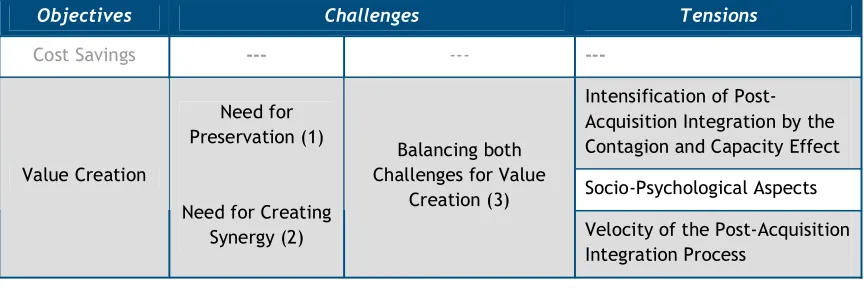
Within the trade-off between preservation and the creation of synergies, tensions are influencing the type and intensification of post-acquisition integration. The primary objective in post-acquisition integration is to make more effective use of competences (Datta, 1991) and covers mainly two objectives; (1) cost savings or (2) value creation. In addition, on a lower level, every acquisition covers some drivers for value creation, which can be established by challenging the need for (2a) preservation and (2b) synergy. Within the process of post-acquisition integration, trade-offs constantly have to be made to solve tensions between preservation and synergy objectives for creating value. Consequently, balancing challenges of post-acquisition integration can be divided into three tensions; (1) the intensification of post-acquisition integration by the contagion and capacity effect, (2) socio-psychological aspects, and (3) the velocity of the post-acquisition integration process. Subsequently, Table I provides a focused overview on value creation, visualizing the linkage between the
Table I: Overview of the Linkage between Objectives, Challenges and Tensions
Subsequently, the tensions within the challenges of preservation and synergy will be discussed.
Intensification
managerial systems or deploying managerial talent to an acquired company that lacks such resources, and (3) cross-selling or umbrella branding products to increase buyer acceptance and sales. It shows how the contagion effect is relevant, whether the basis of synergy is reducing average costs or enhancing revenues. Consequences of the contagion effect4 are a reduced spread of risk by combining both entities into one organization and production plant or the combination of same resources and infrastructure which is considered risk-bearing. Because the negative events would have affected only one entity if the acquisition not occurred (preservation of two autonomous entities) and because contagion causes the negative events to affect the acquired entity, contagion eventually reduces the value of the acquisition, which can be considered a value leakage.
Another way in which opening or strengthening a transfer between both organizations affecting the distribution of potential outcomes is through a capacity constraint, named the capacity effect (Myles Shaver, 2006). The capacity effect5 is occurring when all technology and competences of the acquired entity have been absorbed and leaned in order to accomplish more standardized production. The danger herewith is that organizational flexibility to adapt to changes of the acquired (and the acquiring) entity will decrease dramatically. Depending on the nature of how the synergy is generated, there might not be a capacity constraint in the underlying resource. Nevertheless, under such conditions, there are often organizational capacity constraints that become binding. For example, workload increases to more than what the current set of managers or employees can effectively handle. The capacity effect is not necessarily binding on long term because of the firms ability to increase capacity, but, under certain conditions, increasing capacity is virtually impossible, even on long term (Myles Shaver, 2006: 966).
In implementing synergy-based acquisition strategies, firms share resources across both organizations. However, opening up such a transfer also increases the possibility that negative outcomes can develop, which is the contagion and capacity effect. Further, as already stated, these effects occur if (1) under or (2) over integration takes place. Myles Shaver (2006) argues that if a firm over integrates it has the potential to reap the rewards of integrating both firms. Nevertheless, it also expends effort and resources to integrate activities that do not render any benefits. This reduces the return of integrating both firms. In addition, by integrating additional activities, the firm opens or strengthens additional transfers across the businesses that magnify the contagion and capacity effects. Therefore, relaxing the assumption in this manner strengthens the contagion and capacity effects. On the other hand, if a firm under integrates, it does not build or strengthen the transferring that it should across the integrated businesses. Under this condition, synergies cannot be captured. Moreover, because integration is what drives the contagion and capacity effects, these effects will be dampened. At the extreme, if both organizations do not undertake any integration, it will not realize any benefits and it will not be subject to contagion or capacity effects. However, it will have incurred transactions costs with no corresponding benefits, making the acquisition destroy value (Myles Shaver, 2006: 971). Moreover, synergy-based acquisitions often result in the more intensive use of firm resources with limited capacity. However, this integration can amplify threats and can inhibit the firms ability to respond to favorable conditions in the business environment.
Socio-Psychological Aspects
According to Vaara (2003), many studies have focused on rationalistic explanations for challenges encountered in acquisition integration. There remains little knowledge of how socio-psychological features of post-acquisition decision-making may influence (organizational) integration. Vaaras (2003: 862) sense making
4 An example of the contagion effect is converting two production plants into one, which is risk-bearing when if fires occur at the production plant.
perspective highlights complex socio-psychological processes, in which several socio-psychological factors are considered playing an important role in post-acquisition integration. A focus on socio-psychological processes should be considered important, because acquisitions are likely to create many tensions concerning organizational changes within post-acquisition integration, which can not be solved within a modeled approach. Vaara (2003) considers four characteristics hindering post-acquisition integration; (1) inherent ambiguity surrounding integration issues, (2) cultural confusion in social interaction and communication, (3) organizational hypocrisy in integration decision making and (4) political integration issues (power games). Ambiguity and cultural confusion may produce organizational hypocrisy if and when the integration approach is not consequent with actions in the post-acquisition organization. This is likely to happen in circumstances where there is no pressure for organizational changes in particular parts of the post-acquisition organization as in conditions of (relatively) satisfactory organizational performance. Ambiguity and confusion may also develop into circumstances where changes are seen as politically significant. Consequently, key actors should not be content with superficial signs of success. They must be prepared for tough decisions when their aim is organizational integration (Vaara, 2003: 890). Consequently, neglecting socio-psychological influences certainly can lead to value leakages in post-acquisition integration.
Velocity
As stated by Ranft & Lord (2002: 423), several scholars have stressed the need to rapidly integrate to avoid post-merger drift. Post-merger drift is a decline in organizational and individual productivity during the period following an acquisition. During this time, integration-related tasks may distract management attention away from the firms operations, important decisions and investments may be delayed, and competitors may take advantage of these distractions and delays. As Meyer (2008: 211) noticed, the best time to attack a competitor is when he is in the middle of a complex acquisition process. Further, employees in the acquired firm may be uncertain about their future roles, which may erode their job satisfaction, commitment, and motivation. Therefore, rapid acquisition integration is viewed as a means of minimizing post merger drift.
However, other scholars have stressed that rapid integration may be harmful in its own way for reasons of creating dissatisfaction among the acquired firms employees and blocking the acquiring firms ability to learn about the acquired firms operations and processes. Overall, integrating an acquisition may be problematic because of organizational fit issues. Dissimilarities in organizational cultures, systems, and practices may lead to tensions and conflicts. Employees from both organizations may not work together productively because of different norms, values, and attitudes. These dimensions of organizational culture are deeply ingrained and resistant to change. Integration also may be difficult because of different reward and incentive systems, IT systems, production technologies, distribution channels, and marketing. Issues related to a lack of organizational fit may result in a number of HR and organizational dysfunctions, including diminished individual productivity, reduced organizational efficiency, and a loss of competitive strength (Ranft & Lord, 2002: 423).
According to Grimpe (2007), a higher level of integration of acquirer and target offers greater chances to exploit value creation. However, a lower level of integration and, thus, a higher level of autonomy for the target imply a lower potential for conflicts leading to higher commitment and creativity. The lack of skills in order to learn from the target, high internal resistance, and slower decision-making could furthermore damage the (innovation) potential of the acquisition (Cassiman et al., 2005: 201).
2.5.
Post-Acquisition Integration Strategies
force decisions in post-acquisition integration. These decisions can be forced by providing post-acquisition integration typologies in which the trade-off between preservation and integration is modeled and challenges in post-acquisition integration can be solved. Several scholars stressed different approaches within different contexts to force successful post-acquisition integration in which often a trade-off between preservation and synergy creation has to be established. Next, these different typologies are provided and analyzed.
2.5.1. A Standard Approach
For understanding the integration approach a firm applies, Haspeslagh & Jemison (1991) consider two central dimensions of the acquisition; (1) its relationship to the acquiring firm and (2) the way in which value is expected to be created. The first dimension relates to strategic interdependence that needs to be established between both firms to realize a strategic capability transfer. The other dimension is associated with the need to preserve the acquired strategic capabilities after the acquisition.
The Need for Strategic Interdependence & Organizational Autonomy
The essential task in any acquisition is to create the value that becomes possible when two organizations are combined and which would not exist if the firms operated separately. Haspeslagh & Jemison (1991) and Pablo (1994: 807-808) define the strategic task as the successful transfer of critical skills, strategic capabilities and resources that form the foundation for value creation. Such capability transfer requires creating and managing interdependencies between both organizations. These interdependencies disturb the boundary of the acquired company, and this disturbance is likely to be presented, if not resisted, by managers who want to keep their way of doing things. Therefore interdependence should be carefully managed (Haspeslagh & Jemison, 1991). Yet one of the paradoxes in acquisitions is that the pursuit of capability transfer itself may lead to the destruction of the capability being transferred. The preservation of capabilities requires boundary protection and organizational autonomy. Dealing with the perceived need for autonomy after an acquisition is one of the most important challenges management will face. The organizational task, therefore, is the preservation of any unique characteristics which are a source of key strategic capabilities (Pablo, 1994). However, both strategic and organizational tasks have implications for integration activities. The strategic task requires that the development between the combining firms' value activities and the organizational context is appropriate, while the organizational task reflects a need to maintain some level of structural differentiation between both organizations to protect capabilities that are causally related to a specific organizational context (Haspeslagh & Jemison, 1991). However, there remains a tension in the integration design decision (Pablo, 1994: 808).
Typologies
interdependence and organizational autonomy should be considered in a combined fashion, which resulted into more specific approaches (typologies) to integration, visualized in Figure III.
Figure III: Typologies of Acquisition Integration Approaches (Haspeslagh & Jemison, 1991: 145)
Subsequently, these typologies, with exemption of the holding typology will be described and analyzed.
Absorption Acquisitions
Absorption acquisitions are those in which the strategic task requires a high degree of interdependence to create the value expected, but has a low need for organizational autonomy to achieve that interdependence. The integration implies a full consolidation over time of the operations, organization, and culture of both organizations. To eliminate all differences between both original companies may take a very long time indeed, especially if one is combining two comparable even-sized companies. According to Haspeslagh & Jemison (1991), the distinction that matters is one of intent at the outset. In absorption acquisitions the objective is ultimately to dissolve the boundary between both firms. In absorption acquisitions the acquiring company needs to ensure that its vision for the acquisition is carried out. Wavering because of extreme sensitivity to cultural issues is likely to limit the firms ability to get the value expected, because the management task is to bring about the interdependence of the firms.
Preservation Acquisitions
In preservation acquisitions there is a high need for autonomy and a low need for interdependence among the combining firms. In such situations the primary task of management is to keep the source of the acquired benefits intact, because deterioration in the acquired (and sometimes acquiring) companys ways of managing, practices, or even motivation would endanger a successful acquisition. Despite that the need for interdependence is rather low within the preservation typology, this sort of autonomy and the protection it implies are often difficult to provide. Acquired operations are managed at arms length beyond specific areas in which interdependence is to be pursued. According to Haspeslagh & Jemison (1991), value was created
NEED FOR ORGANIZATIONAL AUTONOMY
LOW
HIGH
SYMBIOSIS
PRESERVATION
through a series of interactions that brought about positive changes in the ambition, risk-taking, and professionalism of the acquired companys management group. The metaphor capturing this value creation in preservation acquisitions is nurturing. Nurturing the acquired firm represents only one part of the value-creation potential that may be realized through preservation. Another important source of value value-creation is the learning that for the acquiring company might derive, both in terms of making further acquisitions in the newly explored area and in terms of learning for its base businesses.
Symbiotic Acquisitions
The third type of an acquisition integration approach presents the most complex managerial challenge, since these two requirements have equal importance (Koenig & Meier, 2001: 26). Symbiotic acquisitions involve high needs for both strategic interdependence (because substantial capability transfer must take place) and organizational autonomy (because acquired capabilities need to be preserved in an organizational context that is different from the acquirers). In addition, in symbiotic acquisitions both organizations first coexist (preservation) and then gradually become increasingly interdependent. Within the period of preservation, members of both firms learn from each other before making strategic changes necessary to gradually amalgamate both firms (Schweizer, 2005: 1068). This coexistence and mutual dependency is slowly achieved, because of the tension arising from conflicting needs for strategic capability transfer and preservation of autonomy and culture. Symbiotic acquisitions need simultaneous boundary preservation and boundary permeability in which the acquired company itself changes its organizational practices to adapt to the new situation. To succeed in amalgamating organizations symbiotically, each firm must take on the original qualities of the other (Haspeslagh & Jemison, 1991). Despite the advantages for a symbiosis approach, Koenig & Meier (2001) argue that a rational approach is unsuitable for managing symbiotic acquisitions. Koenig & Meier (2001) present a more organic model within the symbiosis typology. They state that post-acquisition integration failure is associated with a rational approach, and success with an organic approach. This organic (and less rational) approach considers that organizations are above all human communities that are endeavoring to adapt and survive. This means that they are more actively constructing their future, instead of the distinction and trade-off between strategic interdependency and organizational autonomy. Furthermore, all post-acquisition integration contexts are too different and complex to fit in one rational model of four typologies.
A Technology-Driven Application
that the structural linking exhibits a great impact on technological and economic success but no effect on integration quality (Grimpe, 2007: 625-626).
2.5.2. A Model of Dynamic Integration
Based on the trade-off between the need for strategic interdependence and the need for organizational autonomy, it is previously discussed that Haspeslagh & Jemison (1991) defined four different integration typologies. In addition, Grimpe (2007) pays more attention to the technological context and their consequences on these four different typologies. Subsequently, a more dynamic approach is provided by Birkinshaw et al. (2000) which is not focused on a technological context, which makes this model more dynamic.
Combining Human & Task Integration
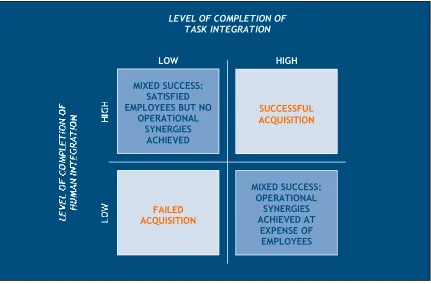
Based on the integration typologies of Haspeslagh & Jemison (1991) and the technology-based approach of Grimpe (2007), Birkinshaw et al. (2000) provide a more dynamic model of integration in which the success of the integration type is analyzed and visualized in Figure IV.
Figure IV: Impact of Task and Human Integration Processes on Acquisition Outcome (Birkinshaw et al. (2000: 399)
Birkinshaw et al. (2000) distinguish two types of integration instead of the four typologies Haspeslagh & Jemison (1991) and Grimpe (2007) applied. According to Birkinshaw et al. (2000), first a post-acquisition strategy has to be developed, which is more or less comparable with the acquisition justification phase (Haspeslagh & Jemison, 12). This strategy provides task- and human integration processes which eventually should result in acquisition success. Applying these two typologies Birkinshaw et al. (2000) suggested ((1) task integration and (2) human integration), should result in successful post-acquisition integration. Within this, task integration is defined as the identification and realization of operational synergies and human integration is defined as the creation of positive attitudes towards the integration among employees on both sides. Overall acquisition success is thus contingent on the effective management of both sub processes (Birkinshaw et al.,
2000: 400). However, the two dimensions of the integration process do not necessarily occur to the same extent, and a relative emphasis on either task or human integration can potentially have a significant negative impact on the outcome of the acquisition (Birkinshaw et al. 2000: 399). In addition, also cultural and political characteristics should be considered because of their suspected importance of how these characters influence the chosen approach to integration (Pablo, 1994: 824). An emphasis on human integration may result in satisfied employees but no operational synergies, while an emphasis on task integration can lead to the achievement of synergies but with a loss of employee motivation. For the process to be entirely successful, both task and human integration have to be effective (Birkinshaw et al., 2000: 399). According to Koenig & Meier (2001), the process can be named successful if the premium paid is lower compared with the advantages that are established.
2.5.3. A Multilayered Hybrid Approach
According to Schweizer (2005), the multileveled and multistage complexity of acquisitions makes it necessary to apply a hybrid post-acquisition integration approach with simultaneous short- and long-term motives and orientations, and segmentation at a different pace across different value chain components and lenses. As already mentioned, Bannert & Tschirky (2004) argue that technology integration needs to be consistent with other integration dimensions and proceeds more slowly than financial and structural integration. Taking a broad perspective, however, makes it possible to integrate multidimensional issues into a comprehensive model that views acquisition performance as a function of post-acquisition integration and value creation (Larsson & Finkelstein, 1999).
Multilayered Insights of Post-Acquisition Integration Challenges
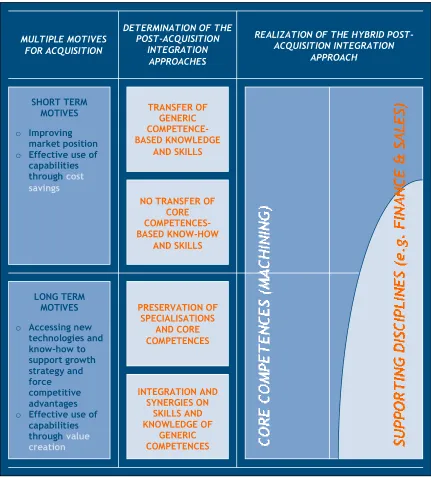
As stated by Schweizer (2005: 1067), the need to treat acquisitions as multidimensional and multifaceted phenomena (Javidan et al., 2004) is driven by different motives, while companies pursue different motives within their desire to acquire specific technological know-how and technologies (Ahuja & Katila, 2001). Schweizer (2005) makes a considerable contribution in the development of a post-acquisition integration pattern that calls for a hybrid integration approach with simultaneous short- and long-term orientations and preservation of specialism across different functions and value chain components.
Applying only one integration approach, then, is not sufficient. Different motives may call for completely different integration approaches. To correctly decide what kind of integration approach to apply, an acquirer needs to compare the core competences of its acquired company with its own core competencies along the value chain (Schweizer, 2005: 1068). Core competences are superior in use, hard to imitate, difficult to substitute for, and more valuable within their original firms than outside them. After the acquisition, a company is no longer a small and dynamic company because it has become part of the structure of a large, multiproduct, integrated, and more hierarchical company. Acquisition initiates a change in culture as well as in the determinants of the rate and direction of firm-level innovation (Schweizer, 2005: 1069). The acquirer tries to set structures in place that grant the company a high degree of autonomy, so that it becomes an independent center of excellence within the structures of the company while at the same time integrating those value chain activities that do not depend on critical culture and know-how. Based on this, one could argue for as much autonomy for acquired organizations as possible because they may otherwise lose the qualities that made them interesting to the acquirer in the first place. Schweizer (2005) also indicates that post-acquisition integration can be a very long process and can be affected by key managerial decisions on the speed and extent of the post-acquisition integration process.
post-acquisition integration, namely (3) successfully balancing these two challenges. The hybrid approach (visualized in Figure V) covers a solution for the fragmentation of several theoretical lenses.
Figure V: Post-Acquisition Integration; a Hybrid Approach (based on: Schweizer, 2005: 1067).
Larsson & Finkelstein (1999) mention that acquisitions have been studied through (1) strategic management, (2) strategic combination, (3) economics, (4) financial performance, (5) organizational integration and (6) HRM. This fragmentation has resulted in several barriers to the development of more integrative research on acquisitions. In addition, Schweizer (2005) mentioned that this multileveled fragmentation is a fundamental problem of acquiring companies searching for optimal integration strategies. Bannert & Tschirky (2004) argue that researchers in the fields of acquisition and integration, technology and knowledge management lack an understanding of the individual aspects determining integration success and subsequently an understanding of success in technology driven acquisitions. That many, if not most, acquisitions do not succeed can be seen as
indicators that the integration