CSEIT172633 | Received : 01 Nov 2017 | Accepted : 13 Nov 2017 | November-December-2017 [(2)6: 95-101]
International Journal of Scientific Research in Computer Science, Engineering and Information Technology
© 2017 IJSRCSEIT | Volume 2 | Issue 6 | ISSN : 2456-3307
95
Digital Image Processing Techniques in Character Recognition -
A Survey
Dr. Marlapalli Krishna1, Gunupusala Satyanarayana2 V. Devi Satya Sri3 1
Associate professor, Sir C. R. Reddy College of Engineering, Eluru, West Godavari Dt, Andhra Pradesh, India 2
Assistant Professor, Sir C. R. Reddy College of Engineering, Eluru, West Godavari Dt, Andhra Pradesh, India 3
M. Tech Student, Sir C. R. Reddy College of Engineering, Eluru, West Godavari Dt, Andhra Pradesh, India
ABSTRACT
The digital image processing (DIP) has been employed in a number of areas, particularly for feature extraction and to obtain patterns of digital images. Recognition of characters is a novel problem, and although, currently there are widely-available digital image processing algorithms and implementations that are able to detect characters from images, selection of an appropriate technique that can straightforwardly acclimatize to diverse types of images, that are very specific or complex is very important. This paper presents a brief overview of digital image processing techniques such as image restoration, image enhancements, and feature extraction, a framework for processing images and aims at presenting an adaptable digital image processing method for recognition of characters in digital images.
Keywords : Processing, Digital Image Processing, Thresholding, Morphological Thinning, Hough Transform,
Character Recognition, Digital Image Processing
I. INTRODUCTION
Imaging has undergone certain developments with the advancement of technology and science. The reason why an image can be digitized is to be transformed into computer memory storable or other forms media storage such as CD-ROM or hard disk. Digital image is a representation of a double-dimensional image as a limited set of digital values known as pixels or picture elements. The digitization procedure can be conducted through a scanner or video camera. Once an image is digitized, it can done using different image processing operations Digital image processing lays emphasis on two main tasks: amelioration of pictorial information for the purposes of human interpretation and processing of data image for storage, representation, and transmission for independent machine perception. The purpose of digital image processing is to find a delegacy of intensity distribution of any image and changing 3D images to 2D image values that is utilizable for quantitative morphology description and representation.
corrections. Radiometric corrections incorporate correcting the data for sensor irregularities and undesirable sensor or atmospheric noise, as well as converting the data such that they precisely represent the emitted or reflected radiation measured by the sensor. Geometric corrections on the contrary, include amending the geometric distortions because of sensor-earth geometry variations, and rebirth of the data to actual world coordinates such as longitude and latitude on the surface of the earth.
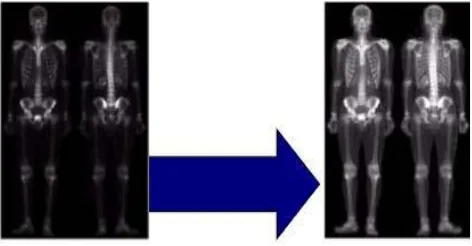
Image Enhancement involves modification of one or more components of the image to increase clarity and details through the visual analysis and interpretation. It looks also to modify the visual impact in a way that enhances the information content of the image as in Figure 1.
Figure 1. Effect of Image Enhancement
There exist several image enhancement techniques that can improve the quality of digital images without causing any harm to it. Some of image enhancement techniques comprise of contrast enhancement, hue, intensity, and saturation transformations, edge enhancement, and gray level slicing. Certain examples of enhancement functions include contrast that stretches to increasing the tonal distinction between varied features within a scene, and spatial filtering to heighten or rather suppresses specific spatial image patterns. The main aim of this method is to alter certain components of an image to turn it into more understandable image for a specific viewer and a given task. There are different techniques within this category and the techniques include contrast enhancement, hue, intensity, and saturation, edge enhancement, and Gray level slicing. The techniques have been discussed as follows:
Contrast enhancement: This ratio has a strong influence on detection of the capability and the power to resolve
digital images. Methods for enhancing contrast of images are among the most popular and broadly employed image enhancement processes. The brightness range of screen is utilized to produce an image with the most favorable contrast ratio.
Hue, intensity, and saturation: Though it has a system of primary colors including RGB (red, green, and blue) is well established, hue, intensity, and saturation is an important alternative method to color as it presents colors more practically as seen by the human observer. Edge enhancement: The method banks on the variety in brightness related to the edges containing some linear features. Nevertheless, the process is not limited to just linear features. For instance, MATLAB offers in-built functions to encourage images.
Gray level slicing: This method changes the constant gray image tone into a series of density intervals, or to a specific digital range. The regions confined by the contour lines represented slices; this method emphasizes elusive gray-scale variations that cannot be seen by the human eye.
Digital image enhancement methods or techniques provide a host of choices for enabling the visual quality as well as appeal of images. The enlisted techniques offer a wide range of means for altering images in order to achieve images that are deemed visually adequate. The selection of the enlisted techniques or methods is a function of the image content, observer features, specific task, and viewing conditions.
Image Transformations are procedures that are similar to those in image enhancement in concept. However, contrary to image enhancement procedures which are often applied to only to one channel of data at a time. Image transformations normally engage concerted processing of data from numerous spectral bands. Arithmetic operations such as division, subtraction, addition, and multiplication are executed to combine and change the novel bands into new images which better highlight or display some features in the scene. Some of the different methods include band or spectral rationing as well as principal components analysis which is often employed to more efficiently represent the information in a multichannel imagery.
data. Classification is often conducted on a multichannel datasets. This process assigns every image and pixel to a particular theme or class and based on statistical features of the brightness values pixel. There are varied approaches taken to conduct digital classification.
Figure 2. Image classification operations exist in a supervised or unsupervised
Supervised classification posits that spectral features of certain areas of known types of land cover are obtained from the image. The areas are referred to as training areas. Each pixel in general image is then classified as being part of one of the classes based on how its spectral features are to those of the training areas.
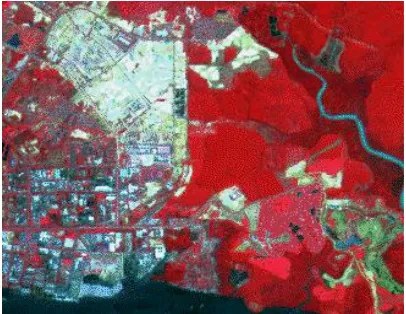
Unsupervised classification, however, the program on the computer automatically collects the pixels in the into different clusters based on their spectral features. Every cluster is assigned to the type of land cover by the analyst. Every class of land cover is referred to as theme and its classification product is referred to as thematic map. This is illustrated by the following map: the map was obtained from the multispectral spot found in the test area image indicated in the previous section which used unsupervised classification algorithm.
Figure 3. SPOT multispectral image of the test area
Figure 4
In image processing as well as pattern recognition, there exists another technique known as feature extraction. It is a special dimensionality reduction form. Feature extraction is an image processing technique also referred as dimensionality reduction. It is definable as a method of transforming input data into a set of some features. When the input data (or digital image) to an algorithm or application is too big to be worked on and it is supposed to be disreputably redundant, then the input is required to be transformed into a simplified or reduced representation set of certain features. The technique helps in extracting the appropriate information from the input data so as to perform desired task by employing this reduced representation rather than the full size input. This method emphasizes on simplifying the number of needed to illustrate a huge set of data correctly. One of the main problems that roots during the analysis of complex data is the amount of variables involved. An appropriate algorithm and a large memory are required to analyze a large number of complex variables. Feature extraction is a method through which a combination of variables can be constructed to solve problems of data insufficiency. Feature extraction is widely applied in the area of optical character recognition (OCR). Feature extraction has several techniques within itself too, and they are described as indicated below:
the image with an operator such as a 2-D filter, while returning zero values in uniform regions of the image. There is a wide variety of edge detection functions and operators available.
Morphological thinning: Thinning is morphological image processing operation which reduces the binary valued image areas to lines that are close to the center skeletons of the areas. Generally, for each single image area, the lines of the result of the thinning operation are required to be connected. This helps in inferring topology and shape in the original image. Morphological thinning is commonly used in the image preprocessing stage to aid higher degree analysis and recognition for applications such as diagram understanding, OCR, feature detection, and fingerprint analysis. Morphological thinning includes two operations: dilation and erosion. Dilation is a morphological operation that uses a structured element (SE) for examining and elaborating the shapes enclosed in the input image i.e. adding pixels to the object boundaries and erosion is an operation used to remove pixels on object boundaries.
Hough Transform: Hough transform is one of the feature extraction methods used in digital image processing. This technique aims at finding imperfect instances of objects enclosed in a specific category of shapes with the help of a voting procedure. Hough transform emphasizes on the recognition of lines in an image and identification of positions of random shapes, usually circles and ellipses (Maji & Malik, 2009, p. 1038). This method of feature extraction provides an approach to deal with the complexity issue of object searching in an image and has been employed in solving many pose estimation problems such as shape detection. Optical Character Recognition (OCR).
The main goal played by OCR is classifying optical patterns (normally engrained in a digital image) related to alphanumeric or other characters. OCR process engages several steps including classification, segmentation, and feature extraction. Each of the steps is in itself a field, and is described within the Matlab OCR implementation. It is that branch of computer science involving reading text from a particular paper and then interpreting the images into a form the the power of computers to obtain printed documents. It is already under extensive use, particularly in the legal profession, where hunts that previously took hours or days are achievable in several seconds. Character Recognition using MATLAB. Recognition of characters is a fresh problem, and although, currently there are widely-available digital image processing algorithms and implementations that are able to detect characters from images, selection of an appropriate technique that can straightforwardly acclimatize to diverse types of images, that are very specific or complex is very important. MATLAB as a software offers a wide range of digital image processing tools, algorithms, and a complete and integrated environment for data visualization, analysis, and algorithm development. It offers functions for analyzing, enhancing, spatially transforming, and de-blurring images. It also allows application of morphological operations such as dilation, erosion, reconstruction, and more.
Dilation and Erosion: Dilation and Erosion are two morphological operations. While dilation operation expands a region X and smooth concavities, the erosion operation reduces the region X and tend to smooth protrusions. Although the exact result depends upon the kernel, these meanings are usually true for all filled convex kernels.
Moments Calculation: The moments of the image are calculated to detect the character. This can further be explained as follows:
According to Sharma, Saini, and Joshi (2012, p. 382), moments of a value-function f(x; y) of an image object can be defined as:
Equation 1.
The integration provides the area of the image object or character. Pixel based feature can also be used instead of the value to calculate the moments of the object in an image. For binary images, the value function f(x; y) is defined as:
This can be neglected in the following formulas.
The order of moments is usually used to classify moments. The order of a moment is dependent on two indices, p and q of the moment mp,q and vice versa. The sum of the two indices p and q, i.e. p+q gives the order of the moment mp, q. Considering this, the following moments are defined:
Zero order moment ((p; q) = (0; 0))
Equation 3.
The zero order moment describes the area X of the image object. First order moments ((p; q) = (1; 0) or (0; 1))
Equation 4.
The information about the center of gravity of the image object is contained by the first order moment:
Equation 5.
II. Methodology of OCR
There are several steps for OCR as a process has several steps that can be summarized by Image Acquisition, Preprocessing and Feature Extraction.
Image Acquisition: In this step, the recognition system gains a scanned image as an input image. The image needs to have a specific format including BMT, JPEG and many others. The image is acquired via a digital camera, scanner, or other desirable digital input device Pre-Processing: This is a sequence of operations undertaken on scanned input image. It basically enhances the image that renders it eligible for segmentation. The function of preprocessing is
segmenting the interesting pattern from the scope. In general, normalization, noise, smoothing, and filtering should be carried out in this step. The step also defines a packed representation of a given pattern. Binarization process changes an image from gray scale to binary image. Edge dilation in the image that has been binarized is done through the sobel technique.
Feature Extraction: In this stage, the characters’ features that are considered important for classifying them at the stage of recognition are obtained. It is an important stage as its optimal functioning ameliorates the recognition rate as well as reducing the misclassification. Diagonal scheme of extracting feature for recognizing off-line characters that are handwritten is often proposed in the work. Each character image is disintegrated into equal zones, with each size being 10x10 pixels. The features are obtained from each zone pixels through moving along the diagonals of the respective 10x10 pixels.
Feature extraction has several techniques and is discussed as follows:
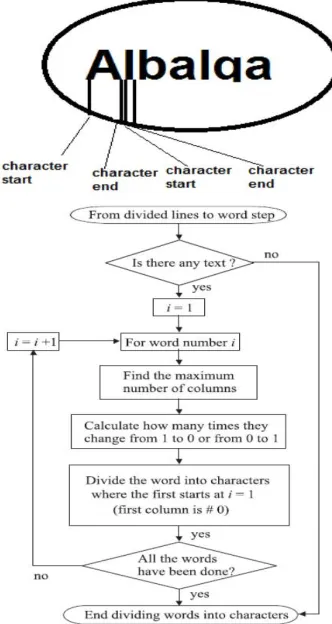
Figure 5. Converting Text into Lines Character
Segmentation: Character segmentation is the other technique of feature extraction which is used to isolate or detect characters from digital images. After going through line segmentation, characters are isolated and detected through scanning every array vertically within every line. The beginning and the black pixels which are vertically detected are the character borders. There is chance of presence of a white region, below, above or both above and below the character, segregating the tallest character because its height is similar to that of the line. Consequently, another scan is performed horizontally to detect the lower and the upper end of the character and sequestrate the region which consists only of character pixels, because the edges of every characger box are needed for recognition purposes. (see Figure 6).
Figure 6. Character segmentation
Character Recognition: After extracting every character individually from the image text, character is recognized and displayed. Though there are several methods disposable for recognition characters including fuzzy or neural network, online recognition and many others, correlation coefficients method is less decomposable and more efficient one because it requires just a database for linking the images. The accuracy or efficiency of this method is pegged on the type of built database.
III.CONCLUSIONS
Volume 2, Issue 6, November-December-2017 | www.ijsrcseit.com | UGC Approved Journal [ Journal No : 64718 ] 101 network. At the prevailing stage of advancement, the
software performs well either in terms of accuracy or speed but not better. It is almost impossible to replace the existing OCR techniques, particularly for English text. A simple-minded approach for optical character recognition using artificial neural networks has been explained. The concept is one of the most important in the modern day photography and most industries have employed the use of digital image processing such as transport. More research is needed though in order to improve the prevailing issues with regard to digital imaging. Recognition of characters helps in capturing the best photographs and images that are visible both closely and from a distance.
IV.REFERENCES
[1] Almohri, H., , J. S., & Alnajjar, H. (2008). A
Real-time DSP-Based Optical Character Recognition System for Isolated Arabic characters using the TI TMS320C6416T. In Proceedings of The 2008 IAJC-IJME International Conference.
[2] Anagnostopoulos, C. N., Anagnostopoulos, I. E.,
Loumos, V., & Kayafas, E. (2006). A license plate-recognition algorithm for intelligent transportation system applications. IEEE Transactions on Intelligent Transportation Systems, 7(3), 377-392.
[3] Basu, J. K., Bhattacharyya, D., & Kim, T.-h.
(2010). Use of Artificial Neural Network in Pattern Recognition. International Journal of Software Engineering and Its Applications, 4(2), 23-34.
[4] Cho, T. S., Zitnick, C. L., Joshi, N., Kang, S. B.,
Szeliski, R., & Freeman, W. T. (2012). Image restoration by matching gradient distributions. IEEE Transactions on Pattern Analysis and Machine Intelligence, 34(4), 683-694.
[5] Dash, T., & Nayak, T. (2012). Non-Correlated
Character Recognition using Artificial Neural Network. In Proceedings of National Conference on Dynamics and Prospects of Data Mining: Theory and Practices (pp. 79-83). India: OITS-BLS.
[6] Deodhare, D., Suri, N. R., & Amit, R. (2005).
Preprocessing and Image Enhancement Algorithms for a Form-based Intelligent Character Recognition System. International Journal of Computer Science and Application, 2(2), 131-144.
[7] Felzenszwalb, P. F., & Huttenlocher, D. P. (2004).
Efficient Graph-Based Image Segmentation.
International Journal of Computer Vision, 59(2), 167-181.
[8] Kaur, K., & Sharma, M. (2013). A Method for
Binary Image Thinning using Gradient and Watershed Algorithm. International Journal of
Advanced Research in Computer Science and Software Engineering, 3(1), 287-290.
[9] Khan, K., Siddique, M., Aamir, M., & Khan, R.
(2012). An Efficient Method for Urdu Language Text Search in Image Based Urdu Text. International Journal of Computer Science Issues, 9(2), 523-527.
[10] Kranthi, S., Pranathi, K., & Srisaila, A. (2011).
Automatic Number Plate Recognition.
International Journal of Advancements in
Technology, 2(3), 408-422.
[11] Maini, R., & Aggarwal, H. (2009). Study and
Comparison of Various Image Edge Detection Techniques. International Journal of Image Processing, 3(1), 1-11.
[12] Maini, R., & Aggarwal, H. (2010). A
Comprehensive Review of Image Enhancement Techniques. Jounal of Computing, 2(3), 8-13.
[13] Maji, S., & Malik, J. (2009). Object detection using
a max-margin hough transform. IEEE Conference on Computer Vision and Pattern Recognition (pp. 1038-1045). Miami, Florida: IEEE.
[14] Mittal, A., & Dubey, S. K. (2013). Analysis of
MRI Images of Rheumatoid Arthritis through Morphological Image Processing Techniques. International Journal of Computer Science Issues, 10(2), 118-122.
[15] Parker, J. R. (2010). Algorithms for image
processing and computer vision. John Wiley & Sons.
[16] Pradeep, J., Srinivasan, E., & Himavathi, S. (2011).
Diagonal based feature extraction for handwritten alphabets recognition system using neural network. International Journal of Computer Science & Information Technology, 3(1), 27-38.
[17] Samantaray, R. K., Panda, S., & Pradhan, D.
(2011). Application of Digital Image Processing and Analysis in Healthcare Based on Medical Palmistry. IJCA Special Issue on Intelligent Systems and Data Processing, 56-59.
[18] Sharma, D. V., Saini, G., & Joshi, M. (2012).
Statistical Feature Extraction Methods for Isolated Handwritten Gurumukhi Script. International Journal of Engineering Research and Application, 2(4), 380-384.
[19] Solomon, C., & Breckon, T. (2011). Fundamentals
of Digital Image Processing: A practical approach with examples in Matlab. John Wiley & Sons.
[20] Trier, O. D., Jain, A. K., & Taxt, T. (1996). Feature
extraction methods for character recognition- A