Automatic Term Recognition Needs Multiple Evidence
Natalia Loukachevitch
Research Computing Center of Lomonosov Moscow State University Russia, Moscow, Leninskie Gory, 1/4
E-mail: [email protected]
Abstract
In this paper we argue that the automatic term extraction procedure is an inherently multifactor process and the term extraction models needs to be based on multiple features including a specific type of a terminological resource under development. We proposed to use three types of features for extraction of two-word terms and showed that all these types of features are useful for term extraction. The set of features includes new features such as features extracted from an existing domain-specific thesaurus and features based on Internet search results. We studied the set of features for term extraction in two different domains and showed that the combination of several types of features considerably enhances the quality of the term extraction procedure. We found that for developing term extraction models in a specific domain, it is important to take into account some properties of the domain.
Keywords:term extraction, domain-specific thesaurus, machine learning
1.
Introduction
Automatic extraction of domain terms from texts is a subject of constant interest in automatic document processing (Zhang et al. 2008; Wong et al. 2008). Contemporary information systems usually contain documents related to broad domains, which requires development of large terminological resources. Term extraction to develop such resources should be based on processing of large amount of documents. In addition, existing terminological resources need periodic updates. It is known that manual term selection is an enough complicated, often subjective procedure (Nazarenko & Zargayouna, 2009). Besides the real practice of term selection may be quite different depending on a specific type of a terminological resource under development. At first, terminologists collect the terminology of a domain to present it in terminological dictionaries. The main principle of term selection in this case is based on the necessity to provide term definitions (Wuster, 1979; Shelov, 2002).
Second, developers of traditional information-retrieval thesauri, maintenance of which is regulated by international and national standards (ISO-2788, Z39.19), usually create a more detailed terminological system of so-called descriptors (or in other words “authorized terms”). The main purpose of the descriptors is to cover main topics of documents in the domain (LIV, 1984). So manuals and standards on information-retrieval thesaurus development provide detailed principles for multiword term selection. For example, American standard on construction of monolingual thesauri Z39.19 considers such principles as:
- frequency in domain-specific texts and importance for the domain community (literary warrant),
- splitting the parts would lead to ambiguity or loss of a meaning,
- one component of a phrase is too vague, - meaning of the compound term as a whole is
not the sum of the meanings of its parts etc. But the traditional information-retrieval thesauri usually do not contain very specific terms, or term variants to decrease the inconsistency of manual indexing (Z39.19, Will, 2004; LIV, 1984).
At last, if terminological resources for natural language processing and automatic indexing are created, they require an even more detailed description of the domain terminology, including ambiguous expressions, specific terms, detailed lists of term synonyms and variants to provide better matching between the pre-described terms and real texts (Spasic et al., 2005; Buitellar et al., 2006). The aforementioned issues lead to the following conclusions:
- terminologists use a range of principles to select terms including the purpose of the resource under development. Therefore term selection in a domain is an inherently multifactor process and automatic term recognition should be based on many different factors. For example, a phrase with the relatively low frequency, mutual information and other statistical measures obtained from a domain text collection can be a term variant for a well-known term, what makes it noteworthy at least for computational terminology applications;
- it is necessary to train multifactor machine-learning models on those resources whose purpose coincides with the purpose of a terminological resource under construction;
- besides, it is important to study the possibility of the transfer of multifactor models developed for the same-type resources among different domains.
In this paper we consider an experiment on development of a multifactor model of term extraction for a specific type of terminological resources – a domain ontology for automatic text processing in information retrieval applications. We have developed a series of such resources including Socio-Political thesaurus (Loukachevitch & Dobrov, 2004), Ontology on Natural Sciences and Technologies (Dobrov & Loukachevitch, 2006), Avia-Ontology (Dobrov et al., 2003), Banking thesaurus for the Central Bank of the Russian Federation and others. To support our terminological work we now try to develop and test term-extraction models adjusted to the type of resources we create.
Extracting terms we utilize a combination of three types of features:
- features based on a domain-specific text collection,
- features obtained from an Internet search engine,
- features obtained from a domain-specific thesaurus.
Including thesaurus-based features, we simulate the situation when the thesaurus partially exists. We want to study its potential to recognise new terms. Besides, this type of features should adjust the term recognition process to a specific type of a terminological resource. An important point of our research is also to study the stability of the term extraction model among different domains.
2. Description of Experiment: Data and
Evaluation
We conduct our study in two domains. The first domain is the very broad domain of natural sciences and technologies. The second one is domain of banking and bank regulation. For both domains we have Russian thesauri, developed manually, which we use as a basis for evaluation of term extraction methods (see section 2.1). Besides, there are Russian domain-specific text collections used for development of these thesauri. From the text collections, we have extracted single words and multiword expressions. Two-word expressions belong to two types of noun groups: Adjective+Noun and Noun+Noun_in_Genitive.
The extracted expressions were initially ordered in descending order of their frequencies. Terminologists usually work with these term candidate lists paying more attention to expressions with high frequencies. However it was noted that the important terms could have medium or
low frequencies because of the unbalance of text collections. So the aim of our new term extraction method is to reorder the extracted expressions to get more approved terms in the top of the candidate list. We experimented with five thousands of the most frequent two-word expressions from these lists.
2.1. Terminological Resources Used for Evaluation
Ontology on Natural Sciences and Technologies comprises Russian terminology in a very broad domain of natural sciences including mathematics, physics, chemistry, geology and elementary biology. It was created for automatic text processing of scientific documents such as automatic conceptual indexing, search results visualization, search query expansion, automatic text categorization, text summarization etc. The wide scope of the ontology is intended to support an interdisciplinary research, to serve as a general source of terminology described in a formalized way. The current volume of Ontology on Natural Sciences is more than 150 thousand terms (Dobrov & Loukachevitch, 2006).
Banking thesaurus was created during a state contract with the Central Bank of the Russian Federation. It comprises the terminology related to activity of the Central Bank, including such issues as banking activity, banking regulation, monetary politics, macroeconomics. Now it includes about 15 thousand terms.
In structure, both terminological resources are similar to classical information-retrieval thesauri (ISO 2788), having descriptors, corresponding to concepts of the domain; synonyms and term variants attached to the descriptors; relations between the descriptors.
At the same time, the resources are intended to be used in automatic text processing (in contrast to classical information-retrieval thesauri for manual indexing) and therefore they have considerable coverage of their domains, in particular, including a lot of term variants, occurred in real texts of the domain. For example, synonyms and term variants of descriptor CURRENCY DEPRECIATIONare presented as follows:
currency devaluation, depreciate the currency, depreciate the money, depreciation of currency, depreciation of money, devaluate,
devaluation,
devaluation of currency, devaluation of money
was a thesaurus term, then it was excluded from the terminological basis for feature generation. We considered the following features obtained from a domain-specific thesaurus.
Synonym to Thesaurus Term (SynTerm). Domain
documents can contain a lot of variants of the same term (Nenadic et. al., 2004). Therefore we can suppose that a phrase similar to a thesaurus term is also a term. Let aand bbe components of phrase ab. We consider phrasecd as a
synonym of phraseab if every component word of phrase cdis either equal to a component word ofab either is a
synonym of a component word of ab. The order of
components in the phrases is unimportant.
Synonym to Non-Term (SynNotTerm).We also fix a feature of similarity to a phrase not included to the thesaurus.
Completeness of Description (Completeness). It is possible that component words aand/or bof phrase ab
have been already described in a domain thesaurus. For example, ais related to thesaurus descriptor Da, andb is
related to thesaurus descriptor Db.Descriptor Dahassa
synonyms and rarelations to other descriptors. Descriptor
Dbhassb synonyms and rbrelations to other descriptors. Completenessfeature is a sum of thesaurus relations of
component terms that is:
Completeness = sa+ sb+ ra+ rb
If a component of a phrase is not included to the thesaurus then its sa andra are equal to 0.
4. Results of Experiments
We experimented in two domains: the banking domain and the domain of natural sciences. In all experiments 5 thousand most frequent two-word expressions extracted from the corresponding text collections were used. For these expressions, all above-mentioned features were calculated. To obtain the best combination of features for term extraction, we used machine learning methods implemented in programming package RapidMiner (www.rapidminer.com). The quality of reordering was evaluated with AvP measure. The training set was three-quarters of the phrase list, the testing set was aremaining part. As basic minimal levels of AvP we used the alphabet order and the decreasing frequency order.
To find the best combination of features for phrase reordering we tested various machine learning methods from RapidMiner package. Every time logistic regression achieved maximal level of AvP. Therefore we took this method as a basic machine learning method for our experiments on term extraction.
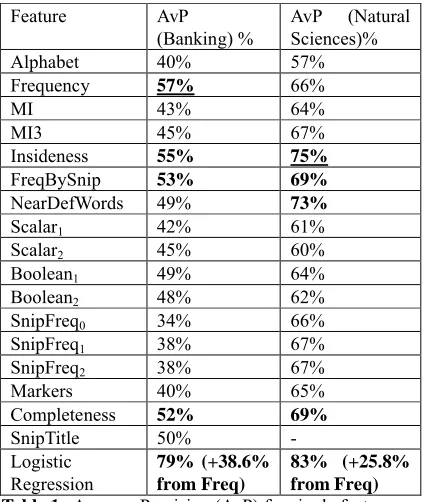
Table 1 shows AvP values for single features and their combination obtained with logistic regression. SynTerm and SynNotTerm features are Boolean and can not be evaluated with AvP. We concluded that SynTerm feature
is highly informative: if SynTerm(ab) =1 then phrase abis
a domain term with probability more than 80%.
From the table we can see that in both cases the same set of features and using of machine learning methods lead to much higher values of average precision. The similarity between models can be revealed because the three features (Insideness, FreqBySnip, Completeness) among four best features coincide.
However there are significant distinctions in ratios between AvP of features between domains. For example, in the banking domain AvP of the frequency feature has the highest value, features with high average precision in the science domain have relatively low values in the banking domain.
Feature AvP
(Banking) %
AvP (Natural Sciences)%
Alphabet 40% 57%
Frequency 57% 66%
MI 43% 64%
MI3 45% 67%
Insideness 55% 75%
FreqBySnip 53% 69%
NearDefWords 49% 73%
Scalar1 42% 61%
Scalar2 45% 60%
Boolean1 49% 64%
Boolean2 48% 62%
SnipFreq0 34% 66%
SnipFreq1 38% 67%
SnipFreq2 38% 67%
Markers 40% 65%
Completeness 52% 69%
SnipTitle 50%
-Logistic Regression
79% (+38.6% from Freq)
83% (+25.8% from Freq) Table 1. Average Precision (AvP) for single features and
logistic regression. Feature SnipTitle was not extracted for phrases in science domain.
We explain this phenomenon with relative narrowness of the banking domain. Banking documents contain a lot of terminology of neighbour domains such as economy or politics. So among extracted expressions, there are many real terms having all specific qualities of “unithood”, but not related to the banking activity. In the scientific text collection the share of terms from other domains is much lower.
Also we can see relative failure of SnipFreqi features in
banking domain. The reason of this phenomenon, in our opinion, is as follows: the banking domain is subject to legal regulation, therefore documents of the domain contain a lot of citations from legal acts which leads to false large values of SnipFreqi.
To evaluate the significance of the proposed features we fulfilled a feature selection procedure. For science domain the selected features were Boolean1, Completeness,
(AvP – 82%). For banking domain the selected features were Completeness, FreqBySnip, MI, NearDefWords,
Scalar1, SnipFreq0, SynTerm (AvP – 78%). The selected
features repeated for both domains are highlighted. We can see that in both cases all three types of features are represented in the short list of features.
5. Related approaches
For many years, researchers tried to find the best statistical feature for term extraction. However the term selection procedure is an inherently multifactor process. Now machine learning methods allow for the combination of many features.
In (Pecina & Schlesinger, 2008) the combination of statistical characteristics of phrases, based on the Czech text collection, is used to extract several types of collocations (such as phrasal verbs, idioms, terms). The authors used over 80 features and obtained 20% improvement compared with the best individual feature. The authors of this paper indicate that efficiency of various features is very variable and depends on a collection, types of expressions and so on.
In (Vivaldi et al., 2001) features for extraction of medical terms are combined using the boosting algorithm. The features include information from EuroWordNet, Greek and Latin word forms, statistical measures. Some of the features are rather domain-dependent. (Aze et al., 2005) apply the genetic algorithm ROGER to combine 13 statistical features for term extraction in two domains (biology and resources). (Foo & Merkel, 2010) study applicability of rule-based machine-learning algorithm Ripper for term extraction from patent texts.
We can see that the question of development of robust machine learning models for term extraction and the possibility of the model transfer among various domains remains open.
6. Conclusion
In this paper we argue that the automatic term extraction procedure is an inherently multifactor process and the term extraction models needs to be based on multiple features including a specific type of a terminological resource under development.
We have proposed to use three types of features for extraction of two-word terms and showed that all these types of features are useful for term extraction. The set of features includes new features such as features extracted from the existing domain-specific thesauri and features based on Internet search results. The use of thesaurus-based features allows adaptation of the term extraction procedure to the type of a created terminological resource.
We showed that the combination of several types of features considerably enhances the quality of the term extraction procedure. The developed system of term
extraction reorders terms in a list of candidates much better than the basic-line ordering by decreasing frequency.
We studied the set of features for term extraction in two different domains. We found that for developing term extraction models in a specific domain, it is important to take into account such properties of the domain as broad scope or narrow scope (science vs. banking) and connection with the socio-political domain, which is regulated with legal acts. We suppose that it is possible to find the main types of domains for term extraction, to select the best feature sets and special machine learning models for every type of domains.
Acknowledgements
This work is partially supported by RFBR grant N11-07-00588-а.
References
Azé, J., Roche, M., Kondratoff, Y., Sebag, M. (2005). Preference Learning in Terminology Extraction: A ROC-based Approach. Applied Stochastoc Models and Analysis: 209-219.
Baroni, M., Bernardini, S. (2004). BootCaT: Bootstrapping Corpora and Terms from the Web. In
Proceedings of LREC- 2004: 1313-1316.
Buitelaar, P., Magnini, B., Strapparava, C., Vossen, P. (2006). Domain-Specific WSD. Word Sense Disambiguation. Text, Speech and Language Technology, V. 33: 275-298.
Daille, B., Gaussier, E., Lang, J. (1998). An evaluation of statistics scores for word association. InProceedings. of Tbilisi Symposium on Logic, Language and Computation. CSLI Publications: 177-188.
Dobrov, B., Loukachevitch, N. and Nevzorova, O. (2003). The Technology of New Domains' Ontologies Development. In Proceedings of X-th Intern. Conf. KDS 2003"Knowledge-Dialogue-Solution". Varna,
Bulgaria: 283-290.
Dobrov, B., Loukachevitch, N. (2006). Development of Linguistic Ontology on Natural Sciences and Technology. In Proceedings of LREC-2006.
Foo, J, Merkel, M. (2010). Using machine learning to perform automatic term recognition. InProceedings of LREC2010 Aquisition Workshop.
ISO-2788. 1986. Documentation -- Guidelines for the establishment and development of monolingual thesauri.
Kageura, K., Umino, B.(1996). Methods of automatic
term recognition: a review. Terminology, 3(2):
259–289.
LIV. (1994). LIV (Legislative Indexing Vocabulary).
Congressional Research Service. The Library of Congress. Twenty-first Edition.
Loukachevitch, N., Dobrov, B. (2004). Sociopolitical Domain as a Bridge from General Words to Terms of Specific Domains. In Proceedings of Second International WordNet Conference GWC:163-168.
Manning, Ch., Raghavan, P., Shutze, H. (2008).
Introduction to Information Retrieval. Cambridge
University Press.
their Family and Friends. In Proceedings. of 18th International Conference on Computational Linguistics COLING-2000.
Nazarenko, A., Zargayouna, H. (2009). Evaluation Term Extraction. InProceedings. of RANLP-2009.
Nenadic, G., Ananiadou, S., McNaught, J. (2004). Enhancing automatic term recognition through recognition of variation. In Proceedings of International Conference on Computational Linguistics COLING-2004: 604-610.
Pecina, P., Schlesinger, P. (2006). Combining association measures for collocation extraction. In Proc. of Annual Meeting of the Association for Computational Linguistics ACL-2006.
Peñas, A., Verdejo, F., Gonzalo, J. (2001). Corpus-Based Terminology Extraction Applied to Information Access. In Proc. of Corpus Linguistics-2001, Lancaster
University.
Sato, S., Sasaki, Y. (2003). Automatic Collection of Related Terms from the Web.The Companion Volume to the Proceedings of 41stAnnual Meeting of the ACL,
Sapporo, Japan, 2003: 121–124.
Shelov, S.D. (2003). On Generic Definitions of Terms: An Attempt of a Linguistic Approach to Term Definition Analysis. Terminology Science & Research. Journal of International Institute for Terminology Research,
Vol.14: 52-58.
Spasic, I., Ananiadou, S., McNaught, J., Kumar A. (2005). Text Mining and Ontologies in Biomedicine: Making Sense of Raw Text. Briefings in Bioinformatics. Vol. 6.,
No. 3: 239-251.
Turney, P. D. (2003). Coherent Keyphrase Extraction via Web Mining. In Proc. the 18th International Joint Conference on Artificial Intelligence IJCAI-03:
434–439.
Vivaldi, J., Marquez, L., and Rodriguez, H. (2001). Improving Term Extraction by System Combination Using Boosting. In Proc. of ICML2001, LNCS, V2167:
515-526.
Will, L. (2004). Thesaurus consultancy. The thesaurus: review, renaissance and revision/ Sandra K. Roe and
Alan R. Thomas, editors. - New York ; London : Haworth,.
Wong, W., Liu, W., and Mennamoun, M. (2008). Determination of Unithood and Termhood for Term Recognition. In M.Song and Y.Wu.(eds) Handbook of Research on Text and Web Mining Technologies, IGI
Global.
Wűster,E. (1979). Einfurung in die Allgemeine Terminologielehre und terminologishe Lexicographie.
-Vien; N.Y..
Zhang, Z., Iria, J., Brewster, Ch., and Ciravegna, F. (2008). A Comparative Evaluation of Term Recognition Algorithms. In Proceedings of Language Resources and Evaluation Conference of LREC-2008.