SUT
IME
: A Library for Recognizing and Normalizing Time Expressions
Angel X. Chang, Christopher D. Manning
Computer Science Department, Stanford University, Stanford, CA, 94305 {angelx,manning}@cs.stanford.edu
Abstract
We describe SUTIME, a temporal tagger for recognizing and normalizing temporal expressions in English text. SUTIMEis available as part of the Stanford CoreNLP pipeline and can be used to annotate documents with temporal information. It is a deterministic rule-based system designed for extensibility. Testing on the TempEval-2 evaluation corpus shows that this system outperforms state-of-the-art techniques.
Keywords:temporal tagger, time normalization, pattern matching
1.
Introduction
The importance of modeling temporal information is in-creasingly apparent in natural language applications, such as information extraction and question answering. For in-stance, in relation extraction, it is not sufficient to just ex-tract simple relations likePresident(U.S.A, George Walker Bush). Rather, one would also need to extract fluents that capture the temporal range over which such relations hold. Given the sentence
George Walker Bush (born July 6, 1946) is an American politician who served as the 43rd Pres-ident of the United States from 2001 to 2009.
we can extract the following temporal information about when George Bush was born and when he was president:
Expression Type Normalized
Birth July 6, 1946 DATE 1946-07-06 Pres. from 2001 to 2009 RANGE 2001/2009
Extracting such temporal information requires the ability to recognize temporal expressions, and to convert them from text to a normalized form that is easy to process. Systems that extract temporal expressions are known as temporal taggers. In this paper, we present SUTIME, a system for extracting and normalizing temporal expressions.
2.
System Description
SUTIME is a rule-based temporal tagger built on regular expression patterns. Temporal expressions are bounded in their complexity, so many of them can be captured us-ing finite automata. As shown by systems such as FAS-TUS (Hobbs et al., 1997), a cascade of finite automata can be very effective at extracting information from text. With SUTIME, we follow a similar staged strategy of (i) building up patterns over individual words to find numerical expres-sions; then (ii) using patterns over words and numerical ex-pressions to find simple temporal exex-pressions; and finally (iii) forming composite patterns over the discovered tem-poral expressions.
In NLP applications, text is usually first tokenized and an-notated, making it convenient to specify regular expres-sions over the tokens. The resulting regular expresexpres-sions
can be more concise and easier to understand, manipu-late and modify than traditional regular expressions over strings. Regular expressions over tokens facilitate access to additional features, such as parts-of-speech and named en-tity tags. With this approach, adding new rules to SUTIME is simple, by design.
We provide SUTIMEas a Java library, implemented as an annotator in the Stanford CoreNLP pipeline;1its main fea-tures are described below:
Extraction of temporal expressions from text: Given to-kenized English text, SUTIME finds temporal expressions and outputs annotations for further manipulation and inter-pretation. Its output includes annotations in the form of TIMEX3 tags. TIMEX3 is part of the TimeML annotation language (Pustejovsky et al., 2003) for markup of events, times and their temporal relations in documents. To better capture temporal information found in natural language, the value attribute of TIMEX3 tags extends the ISO 86012 stan-dard. For temporal expressions not covered by this specifi-cation, we introduce additional attributes.
Representationof temporal objects as Java classes: Natu-ral language uses many kinds of tempoNatu-ral expressions. SU-TIMEprovides tools to map them to logical representations and data structures that are easier to handle programmati-cally. For interoperability, our representations are convert-ible to Joda-Time3classes.
Resolutionof temporal expressions with respect to a refer-ence date: When processing natural language text, one of-ten has to work with expressions that refer to a relative time (e.g., last Friday). Determining the actual date to which such expressions refer requires a reference date, on which the statement was made. SUTIMEuses document dates as references. For example, for a document from 2011-09-19, SUTIMEwould resolve the date referred to bylast Fri-dayas2011-09-16. But there could be confusion about the time point to which expressions refer: e.g., from a date like
1nlp.stanford.edu/software/corenlp.shtml 2www.iso.org/iso/date_and_time_format
3Joda-Time —joda-time.sourceforge.net— is a
2011-09-19, a Monday, it is unclear whetherFridayshould refer to2011-09-16or2011-09-23. In such cases, the verb tense of the clause could help resolve the ambiguity.
2.1. Types of Temporal Expressions
SUTIME supports four basic types of temporal objects:
Time,Duration,Interval, andSet.
Time: A time point indicating a particular instance on a time scale. SUTIME recognizes both relative times, such asnext Monday, as well as absolute times, such asJanuary 12, 1999. SUTIME also handles partially specified times, such asthe nineties. Below, we give examples of some ex-pressions that it can recognize, using the TIMEX3 type and normalized value (with2011-09-19as the reference date):
Expression Type Value
October of 1963 DATE 1963-10 October DATE 2011-10 last Friday DATE 2011-09-16 next weekend DATE 2011-W39-WE the day after tomorrow DATE 2011-09-21
the nineties DATE 199X winter of 2000 DATE 2000-WI 5th century B.C. DATE -05XX
now DATE PRESENT REF Saturday morning TIME 2011-09-24TMO
4 p.m. Tuesday TIME 2011-09-20T16:00
Duration: The amount of intervening time between the two end-points of a time interval. Durations can be specified as a combination of a unit (e.g., day, month, year, etc.) and a numeric value (the quantity associated with the unit). SU-TIMErecognizes three types of durations:
•exactdurations: both value and unit fully specified; •inexactdurations: unit known, but not its value; and •durationranges: the duration is bounded between a min-imum and a maxmin-imum duration. Note that duration ranges are not part of the TIMEX3 standard.
Examples of temporal expressions corresponding to the three different types of durations are given below:
Expression Type Value
Exact 3 days DURATION P3D Inexact a few years DURATION PXY
Range 2 to 3 months DURATION P2M/P3M
Interval: A range of time defined by a start and end time points. Recognizing an interval expression, such as from July to August, involves identifying the individual end-points (July andAugust). While it is useful to recognize the entire expression as a time interval, it can also be help-ful to identify the individual nested time expressions. SU-TIMEoptionally tries to recognize ranges and includes such nested expressions. A time interval is not a separate type in TIMEX3, but can be represented as aDURATIONwith be-gin and end times. For example, SUTIMEcan provide three separate TIMEX tags for the expression17 August 1656 -21 January 1669:
<TIMEX3 tid="t1" value="1656-08-17" type="DATE">17 August 1656</TIMEX3> <TIMEX3 tid="t2" value="1669-01-21"
type="DATE">21 January 1669</TIMEX3>
<TIMEX3 tid="t3" value="PT108960H" type="DURATION" beginPoint="t1" endPoint="t2">
17 August 1656 - 21 January 1669</TIMEX3>
SUTIMEalso provides functions for extracting time inter-vals from temporal objects. For instance, the date 2011-09-19 can be converted to the interval from 2011-09-19T00:00:00to2011-09-19T24:00:00.
Set: A set of temporals. SUTIMEsupports periodic tempo-ral sets representing times that occur with some frequency. For example, it will provide the following TIMEX3 type and value for the expressionEvery third Sunday:
Expression Type Value
Every third Sunday SET XXXX-WXX-7
SUTIMEwill provide additional attributes with more infor-mation about the temporal set:
<TIMEX3 tid="t1" value="XXXX-WXX-7" type="SET" quant="every third" periodicity="P3W"> Every third Sunday</TIMEX3>
2.2. Recognizing and Normalizing Expressions
To recognize temporal expressions, SUTIMEapplies three types of rules, in the following order:
1. text regexrules: mappings from simple regular expres-sions over characters or tokens to temporal representations;
2.compositionalrules: mappings from regular expressions over chunks (both tokens and temporal objects) to temporal representations; compositional rules are iteratively applied after the text regex rules. At each stage, nested time ex-pressions are removed,4 and these rules are applied until
the final list of time expressions stabilizes;
3. filteringrules: the final stage, in which ambiguous ex-pressions that are likely to not be temporal exex-pressions are removed from the list of candidates. For instance, we can specify a rule indicating that if a potential temporal expres-sion is a single wordfalland the part of speech tag is not a noun, then it is likely thatfallrefers to the act of falling and not the season autumn, and so SUTIME will refrain from marking it as a temporal expression.
After all the temporal expressions have been recognized, each temporal expression is associated with a temporal ob-ject. Each temporal object is resolved with respect to the reference date using heuristic rules. At this time, relative times are converted to an absolute time, and composite time objects are simplified as much as possible. Finally, SU-TIMEwill take the internal time representation and produce a TIMEX3 annotation for each temporal expression.
2.3. Temporal Pattern Language
SUTIMEuses a regular expression language for expressing how text should be mapped to temporal objects. SUTIME is built on top of TOKENSREGEX5, a generic framework included in Stanford CoreNLP for definining patterns over text and mapping to semantic objects. Using this framework, rules for how to map text to the temporal objects provided by the SUTime Java library are specified.
4
• Non-whole numbers such as a half are not recog-nized. Due to limitations of the numeric normalizer used by SUTIME, non-whole numbers are not recog-nized. Consequently, SUTIMEcannot correctly inter-pret temporal expressions such asa year and a half ago.
• Patterns are language specific. SUTIMEis limited to extracting temporal expressions from English text. In order to recognize temporal expressions in other lan-guages, separate rules will need to be developed.
3.
Evaluation
We evaluated SUTIME’s performance on TempEval-2 Task A (Verhagen et al., 2010), which consists of two parts: identifying the extents of a temporal expression and then providing the correct TIMEX3 type and value attributes for each recognized expression. For the evaluation of extents, token-based precision, recall, andF1are used. For the eval-uation of attributes, only tokens that are correctly identified as being part of a temporal expression are considered. The official evaluation for TempEval-2 includes the percentage of correct guesses for both the type and the value attributes.
3.1. Other systems
We compare SUTIME’s performance with several other systems for the TempEval-2 Task A in English. Table 1 gives the results for all systems on the evaluation set.
• GUTime (Mani, 2004):6 a Perl temporal tagger
pro-vided by Georgetown University, part of the TARSQI toolkit (Verhagen and Pustejovsky, 2008) for tempo-ral processing. Although GUTime generates TIMEX3 annotations, the format is not the same as that used in TempEval-2. GUTime is an extension of the TempEx tagger (Mani and Wilson, 2000), which is targeted for ACE TIMEX2. Annotations provided by GUTime in-corporate some TimeML TIMEX3 extensions. We use simple rules to map from the output of GUTime to a format that is compatible with the TempEval-2 scorer.
• HeidelTime (Str¨otgen and Gertz, 2010):7 the best-performing system from SemEval-2 — also a rule-based system. HeidelTime1 is optimized for precision, while HeidelTime2 is tuned for recall. HeidelTime* corresponds to results from the publicly available ver-sion of HeidelTime (from December 2011).
• TRIPS/TRIOS (UzZaman and Allen, 2011):8 the
sec-ond best system from SemEval-2, which uses a con-ditional random field (CRF) for recognizing temporal expressions, and a rule-based system for normalizing temporal expressions.
3.2. Discussion
Experimental results show that both the rule-based system (HeidelTime) and the probabilistic system (TRIPS/TRIOS) were as effective (with similar F1 scores) for identifying
6timeml.org/site/tarsqi/toolkit/index.html 7dbs.ifi.uni-heidelberg.de/index.php?id=129 8www.cs.rochester.edu/u/naushad/temporal
Extents Attribute System P R F1 type value
GUTime 0.89 0.79 0.84 0.95 0.68 SUTime 0.88 0.96 0.92 0.96 0.82 TRIPS/TRIOS 0.85 0.85 0.85 0.94 0.76 HeidelTime1 0.90 0.82 0.86 0.96 0.85 HeidelTime2 0.82 0.91 0.86 0.92 0.77 HeidelTime* 0.57 0.89 0.70 0.96 0.85
Table 1: TempEval-2; English evaluation set.
temporal expressions. This validates our intuition that most temporal patterns can be captured effectively with rules.
SUTIME has the highest overallF1and the highest recall in discovering temporal expressions. Compared to Heidel-Time2, the high recall system, SUTIME has both higher precision and higher accuracy for the attribute type and value. However, compared to HeidelTime1, SUTIME has a lower precision and lower accuracy for the attribute type and value. Note that using the attribute scores of the official TempEval-2 scorer to compare the systems can be mislead-ing since the attributes are scored only for tokens correctly identified as belonging to a temporal expression. Because the attribute scores are computed using a total that is dif-ferent for each system, it is inappropriate to compare the attribute scores across systems.
For example, consider a system that only marks one token as belonging to a temporal expression. Assuming that the token had the correct type and attribute, the system would achieve an accuracy of 100% on the type and value at-tributes (although theF1of identified extents would be ex-tremely low). From this example, we see that is it difficult to only compare the attribute scores without considering the scores for identifying extents.
3.3. Revised Scoring of Attributes
To address the attribute scoring problem, we compare the systems using a modified attribute scoring method where we compute the precision, recall, andF1for each attribute based on the number of temporal expressions with the cor-rect attribute, the total number of temporal expressions in the gold, and the total number of temporal expressions in the system response. Table 2 gives the revised attribute scores based on the following formulas:
Pattr=# Correctattr/# Mentionsresp
Rattr=# Correctattr/# Mentionsgold
F1attr= 2PattrRattr/(Pattr+Rattr)
The number correct is determined by matching each re-sponse mention against a gold mention and checking if the attribute matches.
Type Value System P R F1 P R F1
GUTime 0.85 0.79 0.82 0.59 0.55 0.57 SUTime 0.84 0.94 0.89 0.71 0.78 0.74 HeidelTime* 0.87 0.89 0.88 0.76 0.77 0.76
Table 2: Revised attribute scores for English evaluation set.
3.4. Error Analysis
We performed error analysis on the TempEval-2 training set. Performance of SUTIMEon this training set, using the official scorer, is given in Table 3. The revised attribute scores are given in Table 4.
Extents Attribute System P R F1 type value
GUTime 0.88 0.71 0.79 0.92 0.67 SUTime 0.87 0.90 0.89 0.92 0.77 HeidelTime* 0.58 0.82 0.68 0.96 0.85
Table 3: TempEval-2; English training set.
Type Value System P R F1 P R F1
GUTime 0.79 0.71 0.75 0.57 0.51 0.54 SUTime 0.78 0.84 0.81 0.65 0.70 0.67 HeidelTime* 0.84 0.84 0.84 0.73 0.74 0.73
Table 4: Revised attribute scores for English training set.
Below, we give some examples of the types of errors that SUTIMEmakes.
True errors made by SUTIME. Most of the errors are due to the limitations of SUTIME, as noted before. Since SUTIME cannot recognize fractions such asone half, for the phrase a minute and a half, instead of marking the entire phrase as a temporal expression with a normalized value ofPT1M30S, it only recognizesa minuteas a tem-poral expression and gives it a normalized value ofPT1M.
In another case, SUTIME has trouble with ambiguous words. For instance, in the phrase ...where Orangemen march..., SUTIMEincorrectly identifiesmarchas referring to the month March. In addition, SUTIME will always try to resolvetomorrowliterally to the day after the docu-ment date, even in phrases such asthe people of tomorrow. Also, despite its best efforts, SUTIME often makes mis-takes when resolving a relative date. Given a reference date of1990-08-16, SUTIMEhas trouble determining whether
Septembershould refer to1989-09or1990-09. Some other examples of temporal expressions that are difficult for SU-TIMEto resolve correctly are given below:
Expression SUTime Correct
a year ago 1988-10-27 1988-Q3 the full year P1Y 1989 more than two thousand years P2000Y P2L
months ago 1989-09-30 PXM
Despite its high recall, there are still many phrases that SU-TIMEmisses, such asthe latest period, which happened to refer to1989-Q3. This particular case also requires more advanced semantic understanding to be able to recognize and infer that the period being referred to is a Quarter, and the last one that occurred is1989-Q3.
Different normalization. In some cases, the normalization selected by SUTIME was different from that of the gold annotation, but the two could be regarded as equivalent.
Expression SUTime Correct
the last twenty four hours PT24H P1D the late 1970s 197X 197 more than two thousand years P2000Y P2L
In the TempEval-2 annotation,Qis used forQuarters,E
for decades, C for centuries, and Lfor millennia. Since these are non-standard, they are not used by SUTIME.
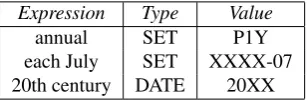
Temporal expression not marked by annotators. In some cases, our system actually recognized many tempo-ral expressions that were not marked by annotators.
Expression Type Value
annual SET P1Y
each July SET XXXX-07 20th century DATE 20XX
Errors in annotations. In a few rare cases, the disagree-ment appears to have been due to errors in annotation.
Expression SUTime Correct
a few minutes PTXM PXM July last year 1997-07 1997-06
We would like to note that documented980111.1130.0089
appears to have an incorrect reference date of2010-03-24
(the actual date should be1998-01-11), causing SUTIME to evaluate incorrect values forYesterdayandtoday.
Imprecise annotation. The week number is often not marked by annotators, whereas SUTIMEwill typically at-tempt to guess a week.
Expression SUTime Correct
this week 1989-W43 1989-WXX
Type Mistakes. SUTIME has difficulty distinguishing when an expression should be marked as aDurationversus aDate. There also appear to be problems with annotators often marking temporal expressions for aDateasTime.
Expression SUTime Correct
[in] five years DURATION DATE
January DATE TIME
4.
Conclusion
We presented SUTIME, a temporal tagger which provides a practical and extensible state-of-the-art system for ex-tracting time expressions. SUTime can be used as a ba-sic component for building temporally aware systems and for investigating problems requiring temporal information, such as event extraction, temporal ordering of events, and question answering. By incorporating SUTIMEin Stanford CoreNLP, we provided easy access to temporal information alongside other levels of NLP annotation. SUTIME can also serve as a strong baseline for comparing future tempo-ral taggers.
5.
Acknowledgements
We gratefully acknowledge the support of Defense Advanced Re-search Projects Agency (DARPA) Machine Reading Program un-der Air Force Research Laboratory (AFRL) prime contract no. FA8750-09-C-0181. Any opinions, findings, and conclusion or recommendations expressed in this material are those of the au-thor(s) and do not necessarily reflect the view of the DARPA, AFRL, or the US government. Angel X. Chang is supported by a SAP Stanford Graduate Fellowship. We thank Valentin I. Spitkovsky, Gabor Angeli, Manolis Savva and the anonymous re-viewers for helpful comments on draft versions of this paper.
6.
References
Jenny Rose Finkel, Trond Grenager, and Christopher Manning. 2005. Incorporating non-local information into information ex-traction systems by Gibbs sampling. In Proceedings of the 43nd Annual Meeting of the Association for Computational Linguistics (ACL), pages 363–370.
Jerry R. Hobbs, Douglas E. Appelt, John Bear, David Israel, Megumi Kameyama, Mark Stickel, and Mabry Tyson. 1997. FASTUS: A cascaded finite-state transducer for extracting in-formation from natural-language text. pages 383–406. Inderjeet Mani and George Wilson. 2000. Robust temporal
pro-cessing of news. InProceedings of the 38th Annual Meeting on Association for Computational Linguistics, ACL ’00, pages 69–76.
Inderjeet Mani. 2004. Recent developments in temporal infor-mation extraction. InProceedings of RANLP03, pages 45–60. John Benjamins.
James Pustejovsky, Jos Castao, Robert Ingria, Roser Saur, Robert Gaizauskas, Andrea Setzer, and Graham Katz. 2003. TimeML: Robust specification of event and temporal expressions in text. Inin Fifth International Workshop on Computational Seman-tics (IWCS-5.
Jannik Str¨otgen and Michael Gertz. 2010. HeidelTime: High quality rule-based extraction and normalization of temporal ex-pressions. InProceedings of the 5th International Workshop on Semantic Evaluation, pages 321–324.
Naushad UzZaman and James F. Allen. 2011. Event and tem-poral expression extraction from raw text: first step towards a temporally aware system. International Journal of Semantic Computing.
Marc Verhagen and James Pustejovsky. 2008. Temporal process-ing with the TARSQI toolkit. Colprocess-ing 2008: Companion vol-ume: Demonstrations.