The Extended DIRNDL Corpus as a Resource
for Automatic Coreference and Bridging Resolution
Anders Bj¨orkelund, Kerstin Eckart, Arndt Riester, Nadja Schauffler and Katrin Schweitzer
University of Stuttgart, Institute for Natural Language Processing (IMS) Pfaffenwaldring 5B, 70569 Stuttgart, Germany
{anders.bjoerkelund,kerstin.eckart,arndt.riester,nadja.schauffler,katrin.schweitzer}@ims.uni-stuttgart.de
Abstract
DIRNDL is a spoken and written corpus based on German radio news, which features coreference and information-status annotation (including bridging anaphora and their antecedents), as well as prosodic information. We have recently extended DIRNDL with a fine-grained two-dimensional information status labeling scheme. We have also applied a state-of-the-art part-of-speech and morphology tagger to the corpus, as well as highly accurate constituency and dependency parsers. In the light of this development we believe that DIRNDL is an interesting resource for NLP researchers working on automatic coreference and bridging resolution. In order to enable and promote usage of the data, we make it available for download in an accessible tabular format, compatible with the formats used in the CoNLL and SemEval shared tasks on automatic coreference resolution.
Keywords:anaphora, prosody, corpus annotation
1.
Introduction
The Discourse Information Radio News Database for Linguistic analysis (DIRNDL) is a spoken corpus resource of German radio news (ca. 50.000 tokens, 3221 sentences). In its first release (Eckart et al., 2012), it was manually annotated for referential information status, i.e. the given-new classification of referring expressions (Riester et al. 2010) as well as prosodic GToBI(S) labels (Mayer, 1995). Constituent-structure annotations originated with the XLE parser (Crouch et al., 2011) and the LFG grammar by Rohrer and Forst (2006).
Aligning spoken language with its written transcript (or text with one of its read realizations) in a single resource is chal-lenging for several reasons. Obviously, speech has a tem-poral determination which written language lacks. Punctu-ation marks (e.g. decimal points/commas) and compound words may receive different tokenisations in the different processing pipelines for written and spoken language,
re-spectively. Moreover, speech, even the one by trained
newsreaders, is seldom flawless and contains disfluencies and slips of the tongue, which are not contained in the writ-ten transcripts. (If they were, this would cause trouble to the parser.) In DIRNDL, these problems are tackled by in-tegrating both sets of data with their different tokenisations in a PostgreSQL database and providing an alignment that uses multiple links (e.g. for accidental repetitions). The database has proven to be a valuable resource for testing linguistic hypotheses at the interface between dis-course, information structure, morpho-syntax and prosody. For instance, Riester and Piontek (submitted) extract all adjective-noun sequences from the corpus, together with their prosodic realization, in order to test whether NPs with accented adjectives necessitate the existence of contrastive alternatives. Augurzky et al. (submitted) investigate the in-fluence of segmental clashes on the frequency of prosodic phrase breaks at the transition between two referring ex-pressions, and between nominal heads and their embedded arguments. Rosenberg et al. (2012) and Soto et al. (2013) use DIRNDL for training an automatic prosodic labeler. We have recently improved DIRNDL by revising existing
annotations, and by adding new annotation layers, e.g. con-stituent trees and dependency trees from Bj¨orkelund et al. (2013), and named entities using Finkel et al. (2005) and Faruqui and Pad´o (2010). Based on this extension, we
ex-tracted DIRNDLanaphoraas a resource for evaluation of
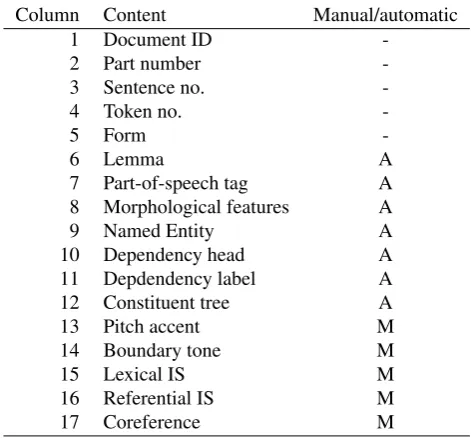
au-tomatic coreference and bridging resolvers. We exported the corpus in three tabular formats, two from recent shared tasks on automatic coreference resolution, i.e. the SemEval 2010 (Recasens et al., 2010) and CoNLL 2012 (Pradhan et al., 2012) shared tasks, and a third tabular format contain-ing additional annotation layers which are not represented in the CoNLL or SemEval format, but might be useful for the resolution task, e.g. information status labels and pitch accents. In this paper we describe the exported annotation layers as well as the formats used. The export is freely
available for download.1
2.
Annotation layers
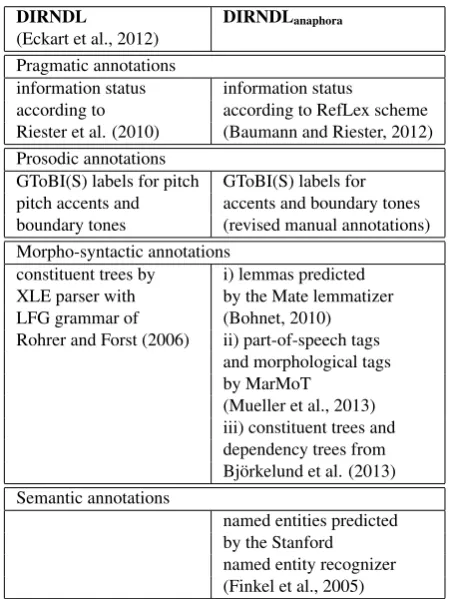
In this section we review the various layers of annotation in the DIRNDL corpus and the new export. Table 1 gives an overview of the annotation layers in the DIRNDL cor-pus as described by Eckart et al. (2012) and in the new
DIRNDLanaphorarelease.
2.1.
Pragmatic annotations
The corpus was previously annotated forreferential
infor-mation status following Riester et al. (2010). These an-notations were replaced by two-dimensional
information-status annotations following theRefLexscheme (Baumann
and Riester, 2012), which distinguishes betweenreferential
andlexicalinformation status. For example, (1) contains a referentially given (coreferential) phrase which comes with
new lexical material (a so-calledepithet). By contrast, in
(2) there is a referentially new phrase which features lexi-cally given material. For the referential as well as for the lexical level, the corpus contains links between the anaphor and its antecedent.
1http://www.ims.uni-stuttgart.de/data/
Referential information status Lexical information status
Units: referring Units: nouns, verbs,
expressions (NP/DP, PP) adjectives, adverbs
Label Description Label Description
R-GIVEN coreferential L-GIVEN word identity /
anaphor synonym / hypernym /
holonym / superset
R-BRIDGING non-coreferential L-ACCESSIBLE hyponym / meronym /
context-dependent subset / otherwise
expression related
R-UNUSED definite L-NEW unrelated expression
discourse-new (within current
context-free news item)
expression
R-NEW specific indefinite
R-GENERIC generic definite or indefinite
OTHER e.g. cataphors
Table 2: Overview basic RefLex scheme
Pitch accents Boundary tones
L*H rise % intonation phrase boundary
H*L fall H% high end of intonation phrase
H* high peak with potential late fall L% low end of intonation phrase
L* low target with potential late rise %H high beginning of intonation phrase
L*HL rise-fall - intermediate phrase boundary
HH*L early peak
H*M stylised contour
! diacritic for tonal declination
*? marker for uncertain accent placement
? diacritic for uncertainty
Table 3: Overview of the GToBI(S) inventory
2.3.
Automatic morpho-syntactic annotations
The DIRNDL corpus was originally parsed with the XLE parser (Crouch et al., 2011) and the LFG grammar by Rohrer and Forst (2006). XLE provides deep LFG
con-stituent structure analyses2 but unfortunately yields
frag-mented parses in a substantial number of cases.
In order to provide additional, more robust syntactic infor-mation, as well as more fine-grained morphological annota-tions, we apply several other automatic tools to the corpus. Specifically, we added the following annotations: (i) au-tomatically predicted part-of-speech tags and morpholog-ical tags, predicted with MarMoT (Mueller et al., 2013), which has been shown to outperform other available part-of-speech and morphology taggers; (ii) predicted lemmas, using the lemmatizer of the Mate tools toolkit (Bohnet, 2010), a state-of-the-art statistical lemmatizer; (iii) auto-matically predicted constituent trees with the constituent parser from Bj¨orkelund et al. (2013); (iv) automatically predicted dependency trees with the dependency parser from Bj¨orkelund et al. (2013). The constituent and de-pendency parsers by Bj¨orkelund et al. (2013) have shown state-of-the-art performance and recently obtained the best
2
LFG F-structures are currently not integrated in the database.
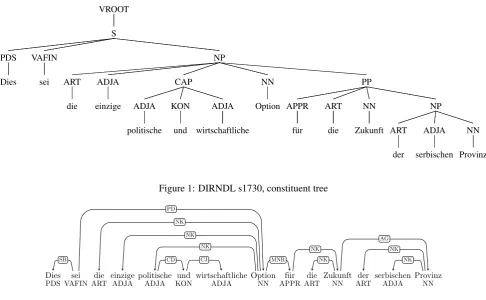
results for German in the recent SPMRL 2013 Shared Task on parsing of morphologically rich languages (Seddah et al., 2013). In contrast to the LFG parser, which is rule-based and driven by a grammar, all these tools are data-driven. They were all trained on the TiGer treebank (Brants et al., 2002; Seeker and Kuhn, 2012) and therefore provide annotations adhering to the TiGer annotation scheme. Ex-ample constituent and dependency analyses of a fragment of (1) is shown in Figures 1 and 2, respectively.
Since we have no gold standard annotations for these layers we are unable to evaluate the accuracy of these tools on the DIRNDL data set, however we refer the reader to the papers of the respective tools for evaluations on other data sets.
2.4.
Automatic named entity annotations
Named entities are closely related to coreferentiality. In
the RefLex scheme, named entities typically receive anR
-UNUSEDlabel3 on their first occurrence, and anR-GIVEN
label on subsequent occurrences. We added named entities using the Stanford named entity recognizer (Finkel et al., 2005). Specifically, we used the German model created by Faruqui and Pad´o (2010), which, in addition to standard
3
Data in Linguistics. Representing and Connecting Language Data and Language Metadata, pages 65–76. Springer, Heidel-berg.
Faruqui, M. and Pad´o, S. (2010). Training and evaluating a ger-man named entity recognizer with seger-mantic generalization. In Proceedings of KONVENS 2010, Saarbr¨ucken, Germany. Finkel, J. R., Grenager, T., and Manning, C. (2005).
Incorporat-ing non-local information into information extraction systems by gibbs sampling. InProceedings of the 43rd Annual Meet-ing of the Association for Computational LMeet-inguistics (ACL’05), pages 363–370, Ann Arbor, Michigan, June. Association for Computational Linguistics.
Halliday, M. (1967). Notes on Transitivity and Theme in English. Part 2.Journal of Linguistics, 3:199–244.
Mayer, J. (1995). Transcription of German Intona-tion. The Stuttgart System. http://www.ims.uni-stuttgart.de/phonetik/joerg/labman/STGTsystem.html. M¨ohler, G. (2001). Improvements of the PaIntE model for F0
parametrization. Technical report, Institute of Natural Lan-guage Processing, University of Stuttgart. Draft version. Mueller, T., Schmid, H., and Sch¨utze, H. (2013). Efficient
higher-order CRFs for morphological tagging. InProceedings of the 2013 Conference on Empirical Methods in Natural Language Processing, pages 322–332, Seattle, Washington, USA, Octo-ber. Association for Computational Linguistics.
Nissim, M., Dingare, S., Carletta, J., and Steedman, M. (2004). An Annotation Scheme for Information Status in Dialogue. In Proceedings of the Fourth International Conference on Lan-guage Resources and Evaluation (LREC), Lisbon.
Pierrehumbert, J. B. (1980).The phonology and phonetics of En-glish intonation. Ph.D. thesis, Massachusetts Institute of Tech-nology, September.
Poesio, M. and Vieira, R. (1998). A Corpus-Based Investiga-tion of Definite DescripInvestiga-tion Use. Computational Linguistics, 24(2):183–216.
Pradhan, S., Ramshaw, L., Marcus, M., Palmer, M., Weischedel, R., and Xue, N. (2011). Conll-2011 shared task: Modeling un-restricted coreference in ontonotes. InProceedings of the Fif-teenth Conference on Computational Natural Language Learn-ing: Shared Task, pages 1–27, Portland, Oregon, USA, June. Association for Computational Linguistics.
Pradhan, S., Moschitti, A., Xue, N., Uryupina, O., and Zhang, Y. (2012). Conll-2012 shared task: Modeling multilingual un-restricted coreference in ontonotes. In Joint Conference on EMNLP and CoNLL - Shared Task, pages 1–40, Jeju Island, Korea, July. Association for Computational Linguistics. Prince, E. F. (1981). Toward a Taxonomy of Given-New
Informa-tion. In Cole, P., editor,Radical Pragmatics, pages 233–255. Academic Press, New York.
Recasens, M., M`arquez, L., Sapena, E., Mart´ı, M. A., Taul´e, M., Hoste, V., Poesio, M., and Versley, Y. (2010). Semeval-2010 task 1: Coreference resolution in multiple languages. In Pro-ceedings of the 5th International Workshop on Semantic Evalu-ation, pages 1–8, Uppsala, Sweden, July. Association for Com-putational Linguistics.
Riester, A. and Baumann, S. (2013). Focus Triggers and Focus Types from a Corpus Perspective.Dialogue & Discourse, 4(2). Riester, A. and Piontek, J. (submitted). Anarchy in the NP. When
new nouns get deaccented and given nouns don’t.
Riester, A., Lorenz, D., and Seemann, N. (2010). A Recursive Annotation Scheme for Referential Information Status. In Pro-ceedings of the Seventh International Conference on Language Resources and Evaluation (LREC), pages 717–722, Valletta, Malta.
Rohrer, C. and Forst, M. (2006). Improving Coverage and
Pars-ing Quality of a Large-Scale LFG for German. InProceedings of the Fifth International Conference on Language Resources and Evaluation (LREC), Genova.
Rosenberg, A., Cooper, E., Levitan, R., and Hirschberg, J. (2012). Cross-Language Prominence Detection. In 6th International Conference on Speech Prosody, Shanghai.
Schwarzschild, R. (1999). GIVENness, AvoidF, and Other Con-straints on the Placement of Accent.Natural Language Seman-tics, 7(2):141–177.
Seddah, D., Tsarfaty, R., K¨ubler, S., Candito, M., Choi, J. D., Farkas, R., Foster, J., Goenaga, I., Gojenola Galletebeitia, K., Goldberg, Y., Green, S., Habash, N., Kuhlmann, M., Maier, W., Marton, Y., Nivre, J., Przepi´orkowski, A., Roth, R., Seeker, W., Versley, Y., Vincze, V., Woli´nski, M., and Wr´oblewska, A. (2013). Overview of the SPMRL 2013 shared task: A cross-framework evaluation of parsing morphologically rich languages. InProceedings of the Fourth Workshop on Statis-tical Parsing of Morphologically-Rich Languages, pages 146– 182, Seattle, Washington, USA, October. Association for Com-putational Linguistics.
Seeker, W. and Kuhn, J. (2012). Making ellipses explicit in dependency conversion for a german treebank. In Calzolari, N., Choukri, K., Declerck, T., Do˘gan, M. U., Maegaard, B., Mariani, J., Odijk, J., and Piperidis, S., editors, Proceed-ings of the Eighth International Conference on Language Re-sources and Evaluation (LREC-2012), pages 3132–3139, Istan-bul, Turkey, May. European Language Resources Association (ELRA). ACL Anthology Identifier: L12-1088.
Soto, V., Cooper, E., Rosenberg, A., and Hirschberg, J. (2013). Cross-Language Phrase Boundary Detection. InProceedings of ICASSP, Vancouver.