Annotation of specialized corpora
using a comprehensive entity and relation scheme
Louise Del´eger
∗Anne-Laure Ligozat
∗ ∗∗Cyril Grouin
∗Pierre Zweigenbaum
∗Aur´elie N´ev´eol
∗∗CNRS, UPR 3251, LIMSI, 91403 Orsay, France ∗∗ENSIIE, 91000 Evry, France
Abstract
Annotated corpora are essential resources for many applications in Natural Language Processing. They provide insight on the linguistic and semantic characteristics of the genre and domain covered, and can be used for the training and evaluation of automatic tools. In the biomedical domain, annotated corpora of English texts have become available for several genres and subfields. However, very few similar resources are available for languages other than English. In this paper we present an effort to produce a high-quality corpus of clinical documents in French, annotated with a comprehensive scheme of entities and relations. We present the annotation scheme as well as the results of a pilot annotation study covering 35 clinical documents in a variety of subfields and genres. We show that high inter-annotator agreement can be achieved using a complex annotation scheme.
Keywords:Annotation; Clinical Texts; Natural Language Processing
1.
Introduction
Annotated corpora are essential resources for many appli-cations in Natural Language Processing. They provide in-sight on the linguistic and semantic characteristics of the genre and domain covered, and can be used for the training and evaluation of automatic tools. In the biomedical do-main, annotated corpora have become available for several genres and subfields. Several efforts addressed the devel-opment of annotated corpora for English free-text, covering both the biomedical literature (Kim et al., 2003; Bada et al., 2012; Do˘gan and Lu, 2012; Ohta et al., 2012) and clinical narrative (South et al., 2009; Uzuner et al., 2010; Del´eger et al., 2012). Annotation tasks sought to cover grammati-cal characteristics (Smith et al., 2004), complex linguistic phenomena (Chapman et al., 2012) as well as biological or clinical phenomena (Do˘gan and Lu, 2012; Ohta et al., 2012) that may be described in domain knowledge bases (Bada et al., 2012) as they occurred in natural language text. However, very few similar resources are available for lan-guages other than English. Furthermore, annotation efforts are often focused on one particular linguistic phenomenon or biological entity of interest.
In this paper we present an effort to produce a high-quality corpus of clinical documents in French, annotated with a comprehensive scheme of entities and relations. We present the annotation scheme as well as the results of a pilot an-notation study covering 35 clinical documents in a variety of subfields. We show that high inter-annotator agreement can be achieved using a complex annotation scheme.
2.
Material and Methods
2.1.
Two clinical corpora
Presentation. The clinical documents used in this study were drawn from two sources: foetopathology case reports (referred to as Foetopath thereafter) from a large French city hospital and electronic health records from a differ-ent set of French hospitals (referred to asEHRthereafter).
While documents in the first corpus are similar in terms of structure and medical content, documents in the second corpus exhibit a large variety of documents types and cover several medical specialties.
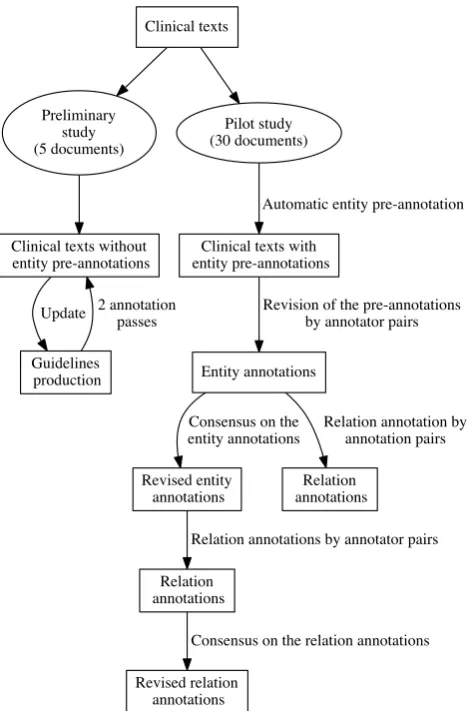
Preprocessing. All documents have been de-identified and manually reviewed to ensure that all protected infor-mation was removed. Surrogate inforinfor-mation was gener-ated to replace the de-identified elements. The annotation strategy built on previous findings that pre-annotations can increase inter-annotator agreement and reduce annotation time (N´ev´eol et al., 2011). Therefore, we produced a pre-annotated version of the corpora for entities only. Auto-matic entity pre-annotations were supplied to the annota-tors using an exact match strategy based on a French UMLS dictionary and a lexicon derived from a small set of docu-ments annotated in the preliminary stage of the project (5 documents, selected from both corpora).
2.2.
Methods
2.2.1. Annotation Protocol
The annotation scheme used in this work was designed to provide a broad coverage of the clinical domain, in order to allow for the annotation of medical events of interest mentioned in the clinical documents. We used the open source Brat Rapid Annotation Tool (BRAT) (Stenetorp et al., 2012), which supports complex annotation schemes for entities and relations and allows the use of pre-annotations. Four annotators—the authors of this paper (ALL, AN, CG, LD)—participated in the annotation task. All of them had previous annotation experience.
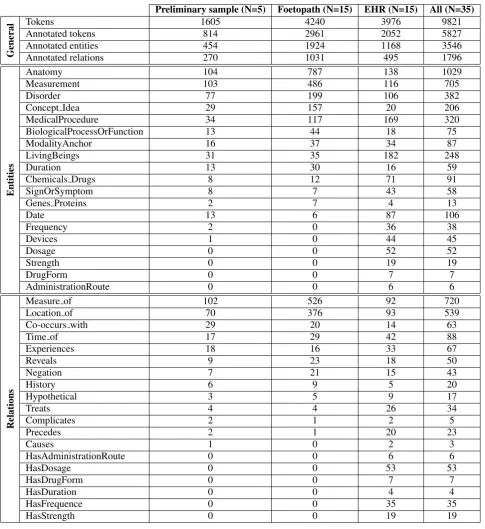
Preliminary sample (N=5) Foetopath (N=15) EHR (N=15) All (N=35)
General
Tokens 1605 4240 3976 9821
Annotated tokens 814 2961 2052 5827
Annotated entities 454 1924 1168 3546
Annotated relations 270 1031 495 1796
Entities
Anatomy 104 787 138 1029
Measurement 103 486 116 705
Disorder 77 199 106 382
Concept Idea 29 157 20 206
MedicalProcedure 34 117 169 320
BiologicalProcessOrFunction 13 44 18 75
ModalityAnchor 16 37 34 87
LivingBeings 31 35 182 248
Duration 13 30 16 59
Chemicals Drugs 8 12 71 91
SignOrSymptom 8 7 43 58
Genes Proteins 2 7 4 13
Date 13 6 87 106
Frequency 2 0 36 38
Devices 1 0 44 45
Dosage 0 0 52 52
Strength 0 0 19 19
DrugForm 0 0 7 7
AdministrationRoute 0 0 6 6
Relations
Measure of 102 526 92 720
Location of 70 376 93 539
Co-occurs with 29 20 14 63
Time of 17 29 42 88
Experiences 18 16 33 67
Reveals 9 23 18 50
Negation 7 21 15 43
History 6 9 5 20
Hypothetical 3 5 9 17
Treats 4 4 26 34
Complicates 2 1 2 5
Precedes 2 1 20 23
Causes 1 0 2 3
HasAdministrationRoute 0 0 6 6
HasDosage 0 0 53 53
HasDrugForm 0 0 7 7
HasDuration 0 0 4 4
HasFrequence 0 0 35 35
HasStrength 0 0 19 19
Table 1: Descriptive statistics (count of tokens and consensus annotations (overall and per type) in each corpus
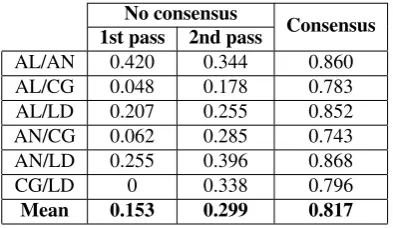
(revision according to improved guidelines), but can be im-proved. Agreement on relations after revising the guide-lines and reaching a consensus on entities is very good (mean of 0.817).
Table 4 and Table 5 show IAA on the Foetopath and EHR corpora during the pilot phase after a stable version of the guidelines had been produced. On the Foetopath corpus, agreement is very good for entities (mean of 0.817) and substantially higher than on the preliminary corpus (at most 0.604, see Table 2). Agreement on relations is also higher than on the preliminary corpus (0.599 vs. at most 0.299 be-fore entity consensus, see Table 3 and 0.890 vs. 0.817 after
entity consensus). On the EHR corpus, agreement on enti-ties is fair (mean of 0.679) and also higher than during the preliminary phase. It is good on relations after entity con-sensus (mean of 0.773) but slightly lower than during the preliminary phase, unlike on the Foetopath corpus. How-ever, agreement remains low when relations are annotated before reaching a consensus on entities (mean of 0.599 and 0.413). Agreement is high when relations are annotated af-ter resolving disagreements (0.890 and 0.779).
Figure 2: Snippet of annotated text (Foetopath)
1st pass 2nd pass
AL/AN 0.546 0.670
AL/CG 0.376 0.574
AL/LD 0.496 0.589
AN/CG 0.496 0.589
AN/LD 0.627 0.657
CG/LD 0.468 0.545
Mean 0.502 0.604
Table 2: Overall inter-annotator agreement for entities dur-ing the preliminary phase (1st/2nd annotation passes)
No consensus
Consensus 1st pass 2nd pass
AL/AN 0.420 0.344 0.860
AL/CG 0.048 0.178 0.783
AL/LD 0.207 0.255 0.852
AN/CG 0.062 0.285 0.743
AN/LD 0.255 0.396 0.868
CG/LD 0 0.338 0.796
Mean 0.153 0.299 0.817
Table 3: Overall inter-annotator agreement for relations during the preliminary phase (1st and 2nd annotation passes, and after the consensus on entities)
Anatomy, Procedure, Duration and Chemicals Drugs enti-ties in the Foetopath corpus. Annotators had more trou-ble with Disorder and BiologicalProcessOrFunction enti-ties (agreement around 0.65, the lowest for this corpus). We do not take into account the zero agreement values for the SignOrSymptom and Devices entities. Because of the
Foetopath EHR
AL/LD 0.840 0.697
AN/LD 0.833 0.700
CG/LD 0.777 0.631
Mean 0.817 0.676
Table 4: Overall inter-annotator agreement for entities dur-ing the pilot annotation phase
Foetopath EHR
No consens. Consensus No consens. Consensus
AL/LD 0.632 0.931 0.384 0.843
AN/LD 0.577 0.917 0.590 0.830
CG/LD 0.589 0.822 0.266 0.645
Mean 0.599 0.890 0.413 0.773
Table 5: Overall inter-annotator agreement for relations during the pilot annotation phase, annotated without ing disagreements on entities (no consensus) or after resolv-ing disagreements (consensus)
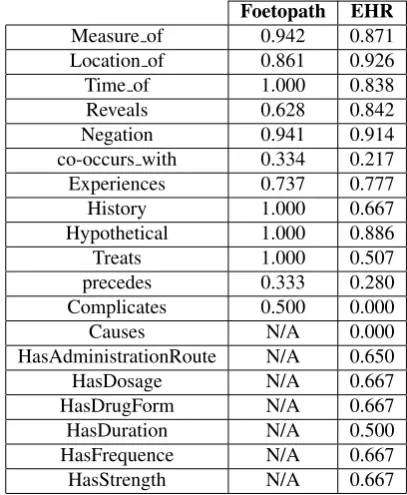
very small number of these entities (respectively 7 and 0), we cannot draw any significant conclusion for these two entity types. As mentioned before, agreement is generally lower on the EHR corpus. The highest agreement values (above 0.75) were on Chemicals Drugs, Date and Medical-Procedure entities. The lowest values (below 0.45) were on Concept Idea, BiologicalProcessOrFunction, Duration, Frequency, and Strength entities (although most of these have less than 20 occurrences). Similarly to the Foetopath corpus, agreement is only fairly good on Disorder (0.68). Table 7 details inter-annotator agreement (mean) results for each relation type for the Foetopath and EHR corpora (pi-lot annotation phase, after entity consensus). Agreement is high (above 0.85) on the three most common relations (Measure of, Location of, Time of), but very low on the co-occurs with and precedes relations, in both corpora.
3.3.
Pre-annotation performance
We evaluated the performance of the automatic pre-annotation against the consensus pre-annotations. Results (Ta-ble 8) show good precision (0.844 overall), but rather low recall (0.567) for the Foetopath corpus, and average preci-sion (0.678) and low recall (0.406) for the EHR corpus.
4.
Discussion
Tables 2 to 5 show that the agreement can vary significantly between annotator pairs. This was also observed for an opinion categorization task (Osman et al., 2010).
Foetopath EHR
Precision Recall F-measure Precision Recall F-measure
Anatomy 0.936 0.750 0.833 0.724 0.399 0.514
Measurement 0.833 0.440 0.576 0.652 0.259 0.370
Disorder 0.560 0.283 0.376 0.551 0.462 0.503
Concept Idea 0.943 0.529 0.678 0.500 0.050 0.091
MedicalProcedure 0.835 0.650 0.731 0.660 0.379 0.481
BiologicalProcess 0.317 0.296 0.306 0.625 0.556 0.588
ModalityAnchor 1 0.189 0.318 0.875 0.412 0.560
LivingBeings 0.750 0.257 0.383 0.556 0.517 0.536
Duration 0.727 0.800 0.762 0.429 0.188 0.261
Chemicals Drugs 0.833 0.833 0.833 0.905 0.803 0.851
Genes Proteins 0.667 0.571 0.615 0.167 0.250 0.200
SignOrSymptom 0.357 0.714 0.476 0.567 0.395 0.466
Date 0 0 0 0.973 0.828 0.894
Devices 0 0 0 0.539 0.159 0.246
AdministrationRoute N/A N/A N/A 0 0 0
Dosage N/A N/A N/A 0 0 0
DrugForm N/A N/A N/A 0 0 0
Frequency N/A N/A N/A 0 0 0
Strength N/A N/A N/A 0 0 0
Overall 0.844 0.567 0.678 0.673 0.406 0.506
Table 8: Pre-annotation performance
Foetopath EHR
Anatomy 0.899 0.646
Measurement 0.779 0.680
Disorder 0.664 0.686
Concept Idea 0.767 0.350
MedicalProcedure 0.862 0.762
BiologicalProcessOrFunction 0.631 0.321
ModalityAnchor 0.767 0.671
LivingBeings 0.712 0.727
Duration 0.867 0.429
Chemicals Drugs 0.952 0.884
SignOrSymptom 0 0.582
Genes Proteins 0.667 0.333
Date 0.778 0.935
Frequency N/A 0.353
Devices 0 0.544
Dosage N/A 0.532
Strength N/A 0.256
DrugForm N/A 0.333
AdministrationRoute N/A 0.667
Table 6: Mean inter-annotator agreement for each entity type during the pilot annotation phase
due to the fact that the Foetopath corpus is composed of documents from a specific domain with very similar struc-ture and content. The EHR corpus on the other hand in-cludes several medical specialties and document types, and thus documents from this corpus exhibit more variation. The level of agreement on relations varies according to the annotation strategy. Agreement is lower when relation
an-Foetopath EHR
Measure of 0.942 0.871
Location of 0.861 0.926
Time of 1.000 0.838
Reveals 0.628 0.842
Negation 0.941 0.914
co-occurs with 0.334 0.217
Experiences 0.737 0.777
History 1.000 0.667
Hypothetical 1.000 0.886
Treats 1.000 0.507
precedes 0.333 0.280
Complicates 0.500 0.000
Causes N/A 0.000
HasAdministrationRoute N/A 0.650
HasDosage N/A 0.667
HasDrugForm N/A 0.667
HasDuration N/A 0.500
HasFrequence N/A 0.667
HasStrength N/A 0.667
Table 7: Mean inter-annotator agreement for each relation type during the pilot annotation phase
Entity type UMLS Semantic Type (or definition if none) Examples
Anatomy Anatomical Structure, Body Location or Region, Body
Part Organ or Organ Component, Body Space or Junc-tion, Body Substance, Body System, Cell, Cell Com-ponent, Embryonic Structure, Fully Formed Anatomical Structure, Tissue
foot; right femoral artery
Disorder Acquired Abnormality; Anatomical Abnormality; Cell or
Molecular Dysfunction; Congenital Abnormality; Dis-ease or Syndrome; Experimental Model of DisDis-ease; In-jury or Poisoning; Mental or Behavioral Dysfunction; Pathologic Function; Neoplastic Process
diabetes; myocardial infarction
SignOrSymptom Sign or Symptom pain; cough
Devices Devices insulin pomp; pacemaker
Concept Idea Classification, Conceptual Entity, Functional Concept,
Group Attribute, Idea or Concept, Intellectual Product, Language, Qualitative Concept, Quantitative Concept, Regulation or Law, Spatial Concept, Temporal Concept
weight; length
MedicalProcedure Diagnostic Procedures; Health Care Activity; Laboratory
Procedure; Therapeutic or Preventive Procedure
angiography, psychiatric consult
BiologicalProcessOrFunction Biologic Function; Cell Function; Genetic Function; Molecular Function; Natural Phenomenon or Process; Organ or Tissue Function; Organism Function; Physio-logic Function
transit
LivingBeings Alga; Amphibian; Animal; Archeon; Bacterium; Bird;
Family Group; Fish; Fungus; Human; Invertebrate; Mammal; Organism; Patient or Disabled Group; Plant; Population Group; Professional or Occupation Group; Reptile; Rickettsia or Chlamydia;Vertebrate; Virus
patient; salmonella
Chemicals Drugs Antibiotic; Biomedical or Dental Material;
Carbohy-drates; Chemical; Chemical Viewed Functionally; Chem-ical Viewed Structurally; ClinChem-ical Drug; Hazardous or Poisonous Substance; Inorganic Chemical; Pharmaco-logical Substance; Vitamin
insulin; steroids; Percocet
Genes Proteins Amino Acid, Peptide or Protein; Enzyme, Lipid;
Im-munologic Factor; Indicator, Reagent, or Diagnostic Aid; Gene or Genome; Nucleic Acid, Nucleoside or Nu-cleotide; Receptor
PTX1; fibrin
Measurement A figure, extent, or amount obtained by measuring or
ob-serving. Measurement also include subjective qualifica-tions of the shape, color, or other attributes of measured entities
3 cm; normal
Date The time at which an event occurs in 1981; 02/01/2013; today
Duration The time during which something exists or lasts for two weeks
Frequency The number of repetitions of a periodic process in a unit
of time
twice a day, every morning
AdministrationRoute Route or method of administering the medication oral; IV
Dosage How many of each drug the patient is taking 3 tablets; two puffs
DrugForm Form of the medication tablet; cream
Strength Strength number and unit of the prescribed drug 10 mg; 5 mg/ml
ModalityAnchor A phrase or text span that provides motivation for
as-signing a given modality (either negation, hypothetical, or history) to an entity
no; suspected; history of
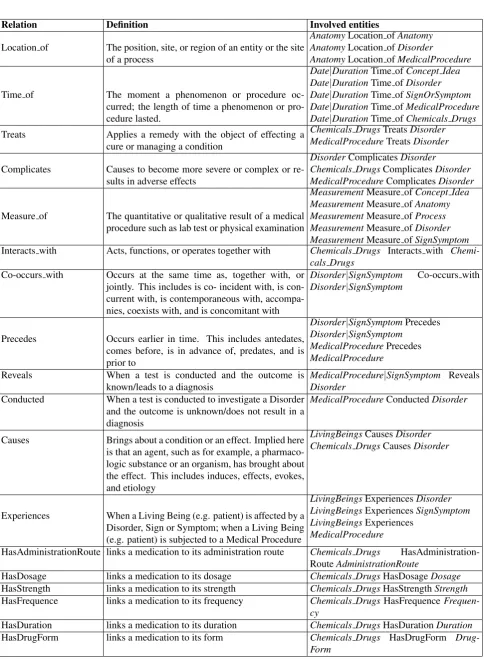
Relation Definition Involved entities
Location of The position, site, or region of an entity or the site of a process
AnatomyLocation ofAnatomy AnatomyLocation ofDisorder
AnatomyLocation ofMedicalProcedure
Time of The moment a phenomenon or procedure
oc-curred; the length of time a phenomenon or pro-cedure lasted.
Date|DurationTime ofConcept Idea Date|DurationTime ofDisorder Date|DurationTime ofSignOrSymptom Date|DurationTime ofMedicalProcedure Date|DurationTime ofChemicals Drugs
Treats Applies a remedy with the object of effecting a
cure or managing a condition
Chemicals DrugsTreatsDisorder MedicalProcedureTreatsDisorder
Complicates Causes to become more severe or complex or
re-sults in adverse effects
DisorderComplicatesDisorder
Chemicals DrugsComplicatesDisorder MedicalProcedureComplicatesDisorder
Measure of The quantitative or qualitative result of a medical procedure such as lab test or physical examination
MeasurementMeasure ofConcept Idea MeasurementMeasure ofAnatomy MeasurementMeasure ofProcess MeasurementMeasure ofDisorder MeasurementMeasure ofSignSymptom
Interacts with Acts, functions, or operates together with Chemicals Drugs Interacts with
Chemi-cals Drugs
Co-occurs with Occurs at the same time as, together with, or
jointly. This includes is co- incident with, is con-current with, is contemporaneous with, accompa-nies, coexists with, and is concomitant with
Disorder|SignSymptom Co-occurs with
Disorder|SignSymptom
Precedes Occurs earlier in time. This includes antedates,
comes before, is in advance of, predates, and is prior to
Disorder|SignSymptomPrecedes
Disorder|SignSymptom MedicalProcedurePrecedes
MedicalProcedure
Reveals When a test is conducted and the outcome is
known/leads to a diagnosis
MedicalProcedure|SignSymptom Reveals
Disorder
Conducted When a test is conducted to investigate a Disorder
and the outcome is unknown/does not result in a diagnosis
MedicalProcedureConductedDisorder
Causes Brings about a condition or an effect. Implied here
is that an agent, such as for example, a pharmaco-logic substance or an organism, has brought about the effect. This includes induces, effects, evokes, and etiology
LivingBeingsCausesDisorder Chemicals DrugsCausesDisorder
Experiences When a Living Being (e.g. patient) is affected by a Disorder, Sign or Symptom; when a Living Being (e.g. patient) is subjected to a Medical Procedure
LivingBeingsExperiencesDisorder LivingBeingsExperiencesSignSymptom LivingBeingsExperiences
MedicalProcedure
HasAdministrationRoute links a medication to its administration route Chemicals Drugs HasAdministration-RouteAdministrationRoute
HasDosage links a medication to its dosage Chemicals DrugsHasDosageDosage
HasStrength links a medication to its strength Chemicals DrugsHasStrengthStrength
HasFrequence links a medication to its frequency Chemicals DrugsHasFrequence
Frequen-cy
HasDuration links a medication to its duration Chemicals DrugsHasDurationDuration
HasDrugForm links a medication to its form Chemicals Drugs HasDrugForm
Drug-Form