problematic language pairs that can be easily confused. Language identification already has techniques for identifying such pairs of languages such as confusion matrices. However, such approaches require a large amount of documents for each language. Word list based methods manage to do so with very little text.
There are few works using parallel text for language comparison. Mayer (2012) uses word alignment and matrix algebra for this task.
3.
Word list based approaches
3.1 Data
Web corpora of the LCC for 346 languages are used in the following experiments. Text collections from different sources are compiled to test robustness of the approaches in regard to factors such as subject area or text type. We utilize the Universal Declaration of Human Rights (UDHR) containing about 1800 words (English version). Further textual data are added by utilizing Watchtower texts. In addition random web corpora are generated for well resourced languages.
3.2 Methods
In this section languages are compared based on lists of common vocabulary. Different automatic processing steps are necessary to achieve this.
First, we extract profiles from text corpora, which are used for later comparison. These profiles consist of:
the most frequent words or
the most frequent letter trigrams.
We utilize lists of different length in our experiments.
In a next step a similarity value has to be calculated for each pair of languages based on common vocabulary in the sense of identical strings. There is a wide choice of possible measures used in text clustering (Huang, 2007). They are applied to the profiles described before. We utilize rank correlation coefficients or vector space based techniques such as:
Kendall tau distance for ranked lists (Kendall, 1938) with an own extension for lists with unequal sets of elements
Cosine similarity and
Dice coefficient, the number of common elements, as a baseline.
Dependent on the similarity measure used, different weightings of the elements of the extracted profiles are possible. Rank correlation uses the rank of elements while Dice coefficient does not rank them at all. When using cosine similarity different weightings are possible, we use:
(reversed) rank,
frequency and
logarithm of the frequency.
The latter is applied due to the typical distribution of word frequencies in natural languages. The use of the logarithm diminishes the influence of very high frequencies in the top words according to Zipf's Law.
To evaluate our results we compare them to the genealogical classification of languages on levels such as
family or genus. For this purpose we cluster the resulting similarity matrix of all languages using just the number of occurring genealogical classes as further input. We then determine cluster purity of our solution as a measure of correctness of our solution. Since we do not solely aim at rebuilding language families, we also have a manual look some results.
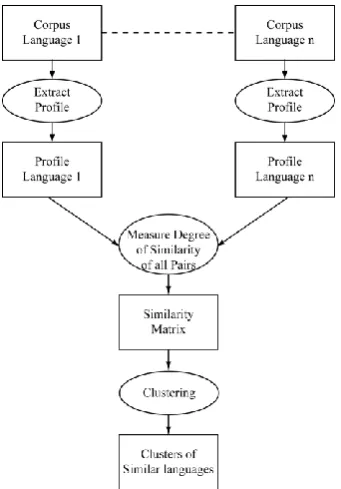
Figure 1 depicts all the steps necessary for computing language similarity.
Figure 1: Stages of computation of language similarity.
3.3 Results
Figure 2: Cluster-Purity for word- and trigram-based language comparison dependent on weighting of the features and measure of similarity. Values are computed with reference to 108 language genera present in the data.
Influences of different methods of comparison and feature weighting can also be seen. Use of logarithmic frequencies is beneficial independent of the profile applied. Utilizing pure frequencies has negative effects when comparing word lists.
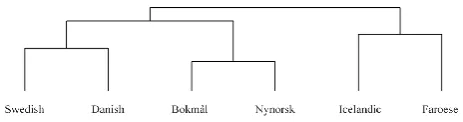
The effect of methods and weighting used is also visible when looking at examples as in figures 3 and 4.
Rank-based comparison leads to a correct solution containing only North Germanic languages. The use of the Dice coefficient leads to a cluster erroneously including English and an English-based Pidgin language as can be seen in figure 4. This is based on many common words with same spelling but different meaning. Such words are often alike by chance. In table 1 the most frequent words of the Swedish corpus, which also appear in the corpus of Nigerian Pidgin, can be found. Among them are many word pairs with different meanings which have identical word forms by coincident. One example is the word far. In Nigerian Pidgin it has the same meaning as in English but in Swedish it means 'father'.
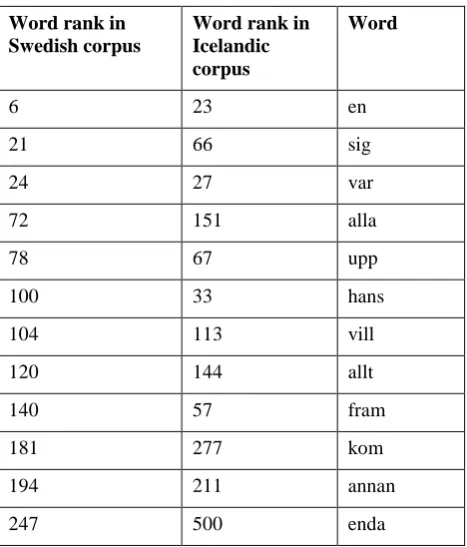
Rank-based approaches help to overcome these problems by penalizing large rank differences as they occur in table 1. Table 2 depicts common words of corpora of Swedish and Icelandic. As opposed to the previous example most identical words have a common meaning in both languages and rank differences are typically low. Thus rank-based techniques will identify these languages to be very similar.
Figure 3: Clustering solution of North Germanic languages based on cosine similarity of word ranks.
Figure 4: Clustering solution of North Germanic languages based on Dice coefficient.
Word rank in Swedish corpus
Word rank in Nigerian Pidgin
Word
23 157 man
39 1 dem
123 197 in
325 43 person
383 324 god
386 14 be
436 22 of
454 24 all
463 201 form
598 98 far
623 318 information
805 55 bad
831 12 and
836 383 december
888 36 ting
Table 1: The most frequent common words of two
Word rank in Swedish corpus
Word rank in Icelandic corpus
Word
6 23 en
21 66 sig
24 27 var
72 151 alla
78 67 upp
100 33 hans
104 113 vill
120 144 allt
140 57 fram
181 277 kom
194 211 annan
247 500 enda
Table 2: The most frequent common words of two
corpora in Swedish and Icelandic.
So far we were only able to detect similar languages within the same writing script. By enhancing our approach with transliteration we can overcome these boundaries. For that we integrated components from ICU1. ICU allows for language-independent transliteration based just on the script used. Thus, extension of analyses to new languages is simple, as long as no new script is involved. In return overall transliteration quality is lower. Figure 5 shows a cluster of our solution containing just Slavic languages. When using transliteration resulting clusters successfully bypass script boundaries.
Figure 5: Clustering solution of Slavic languages in Latin script in comparison to genealogical relations. Results are
based on cosine similarity of transliterated trigrams weighted by rank.
1
International Components for Unicode:
Figure 6 shows the influence of the length of lists used for comparison. Small lists seem to suffice. Once again results are dependent on the weighting of the features.
Figure 6: Cluster-Purity for word-based language comparison dependent on size of the word list and
weighting of the features.
The dependency of our results on general characteristics of the texts can be seen in figure 7. Word-based comparison yields worse cluster purity when corpora from different subject areas are used. Trigrams seem to be less susceptible to such textual properties.
Figure 7: Cluster-Purity for word-based and trigram-based language comparison dependent on subject
areas of the underlying corpora.
4.
Approaches based on parallel text
4.1 Data
There are different sources for parallel text, among them UDHR or religious texts like Watchtower or the Bible2. Due to the availability in many languages and the extent of about 8,000 verses in the New Testament, Bible texts are used in the following studies.
4.2 Methods
Using parallel text such as Bibles it is possible to align corresponding words across languages (Melamed, 1996; Biemann, 2005). This is solely based on the cross-language distribution of words across sentences. This results in a value of accordance for every cross-language word pair.
On the basis of a genealogically stratified sample of 160 languages these values are created for all words of all language pairs and form the starting point for further analyses.
In a first investigation we use the amount of word pairs above a certain threshold to estimate language similarity. This is based on the assumption that similar languages should have similarly distributed words.
In a second approach we examine these word pairs in more detail. We identify cognates (words with similar form because of common etymological origin) among them using orthographic or phonetic comparison. For that we apply Levenshtein distance and phonologically weighted Levenshtein distance with naive transliteration into the International Phonetic Alphabet (Kondrak, 2000, 2006). The amount of cognates is then utilized as a measure of similarity.
4.3 Results
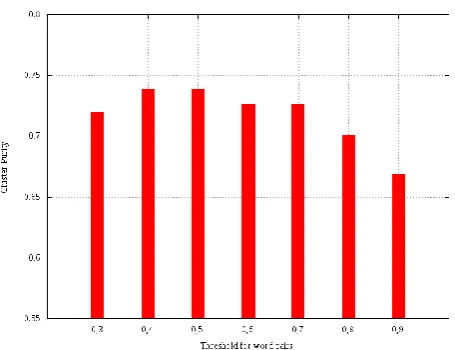
Figure 8 depicts the results of analyzing the count of translation pairs. Once again our results resemble genealogical relations quite well. But some results vary strongly compared to word list based approaches. Using lists of words or trigrams there are no languages similar to Korean. Based on translation pairs we find Altaic languages to be close to Korean (table 3). This is supported by Miller (1971) and Song (2005) who identify grammatical similarities between them, indicating our approach is discovering morphological or syntactical similarities between languages.
2
http://www.bible.is
Figure 8: Cluster-Purity for language comparison based on number of translation pairs. Results are depicted
dependent on a threshold for word similarity.
Rank Language 1 Language 2 Family Script
1 Korean Kazakh Altaic Kyrillic 2 Korean Uzbek Altaic Kyrillic 3 Korean Turkish Altaic Latin
Table 3: Languages most similar to Korean when using language comparison based on translation pairs.
When comparing the cognate-based approach to previous approaches like the word list based ones, we observe a higher quality of results. These analyses reproduce genealogical relations better than other methods. At that phonetic comparison is slightly ahead of the orthographic one (figure 9).
Figure 9: Cluster-Purity for different approaches of language similarity. On the left cognates among translational equivalents are analyzed, while on the right
word-based and trigram-based language comparison (as in section 3) is performed.