The DIRHA simulated corpus
L. Cristoforetti
1, M. Ravanelli
1, M. Omologo
1, A. Sosi
1,
A. Abad
2, M. Hagm ¨uller
3, P. Maragos
41
Fondazione Bruno Kessler (FBK), Via Sommarive 18, 38123 Povo (TN), Italy cristofo,mravanelli,omologo,[email protected]
2
INESC-ID/IST, R. Alves Redol 9, 1000-029 Lisbon, Portugal [email protected]
3
Graz University of Technology, Inffeldgasse 16c, A-8010 Graz, Austria [email protected]
4
Athena Research and Innovation Center, 15125 Maroussi, Greece [email protected]
Abstract
This paper describes a multi-microphone multi-language acoustic corpus being developed under the EC project Distant-speech Interaction for Robust Home Applications (DIRHA). The corpus is composed of several sequences obtained by convolution of dry acoustic events with more than 9000 impulse responses measured in a real apartment equipped with 40 microphones. The acoustic events include in-domain sentences of different typologies uttered by native speakers in four different languages and non-speech events representing typical domestic noises. To increase the realism of the resulting corpus, background noises were recorded in the real home environment and then added to the generated sequences. The purpose of this work is to describe the simulation procedure and the data sets that were created and used to derive the corpus. The corpus contains signals of different characteristics making it suitable for various multi-microphone signal processing and distant speech recognition tasks.
Keywords: data collection, speech contamination, impulse responses
1.
Introduction
Natural spontaneous speech interaction with distant micro-phones is an important step towards the development of easy-to-use voice interfaces in an increasing number of pos-sible applications. With this type of interaction, except for rather controlled real scenarios, present Automatic Speech Recognition (ASR) systems still exhibit lack of robustness and flexibility and, as a result, an unacceptable variability in their performance (M. W ¨olfel and J. McDonough, 2009). In fact, past activities on this topic showed that state-of-the-art speech recognition systems are inadequate for an inter-action at distance from microphones due to several reasons, including the environmental noise, the reverberation effects introduced by the environment and, related to it, the posi-tion and head orientaposi-tion of the speaker.
During the last decade, these topics were investigated un-der different projects as, for instance, CHIL (Waibel and Stiefelhagen, 2009) and DICIT (Omologo, 2010). In the former case, microphone arrays were distributed in space in order to detect, localize and classify acoustic events, as well as to transcribe speech, typical tasks for contexts as lectures and seminars. In the latter case, the application sce-nario was spoken dialogue with a TV and related devices, in a typical living-room environment. In both cases, voice interaction was addressed introducing some constraints as the monitoring of a single room, or the possible position of the subject (in front of a TV in the case of DICIT). The DIRHA project1, which started in January 2012, ad-dresses the challenge of distant-speech recognition and un-derstanding in a home environment, with a very realistic and complex application scenario as reference, which is
1http://dirha.fbk.eu
characterized by a fully flexible interaction in any room and position in space. Exploiting a microphone network distributed over the different rooms of an apartment, the targeted system should react properly when a command is given by the user. Moreover, the system is “always-listening”, and an important challenge is to develop a so-lution that reduces false alarms due to misinterpretation of normal conversations and other generic sounds which do not carry any relevant message to the system.
Related to the above-mentioned functionalities and fea-tures, the main fields on which research is conducted are: multichannel acoustic processing, distant speech recogni-tion and understanding, speaker identificarecogni-tion/verificarecogni-tion, and spoken dialogue management. The final target is to in-tegrate a prototype in real automated homes for an on field evaluation by real users. At this moment, four languages (i.e., Italian, Greek, Portuguese, and Austrian German) are considered, while the English language will be addressed for comparison purposes during the third and last year of the project.
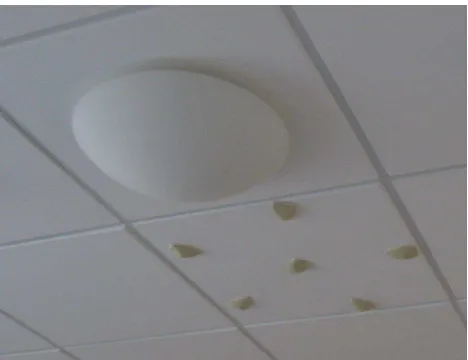
Figure 2: A six-element microphone array installed on the ceiling.
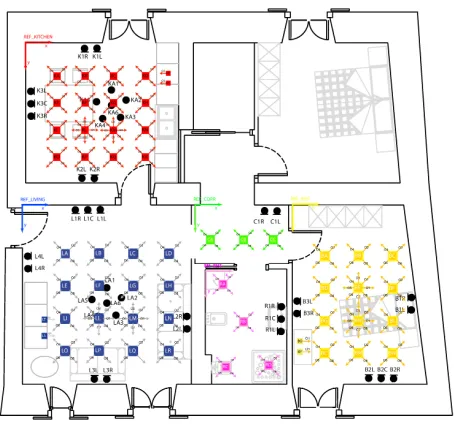
The IRs measurement process explored several different positions and orientations of the loudspeaker over the var-ious rooms of the apartment, in order to generate simu-lated data with a satisfactory level of richness in terms of spatial variability. As shown in Table 1, more than 9000 sample-synchronized IRs have been measured. Cross-room impulse responses are also included in order to simulate sources in other rooms.
The huge number of measured IRs derives from the mul-tiplication of the various orientations and positions by the total number of microphones. As an example, in the bath-room 16 positions/orientations (see Figure 1) were recorded by 40 microphones, leading to a number of 640 different IRs.
The IRs measurements were based on a professional stu-dio monitor (Genelec 8030A) able to excite the target en-vironment with long sequences of Exponential Sine Sweep (ESS) signals (Farina, 2000). As pointed out in (Ravanelli et al., 2012), ESS method ensures IRs measurements with a high Signal to Noise Ratio (SNR) and a remarkable robust-ness against harmonic distortions.
The Time of Flight (TOF) information, crucial to appli-cations such as acoustic event localization, beam-forming, and multi-microphone signal processing in general, has been preserved by means of six sample-synchronized multi-channel audio cards (RME Octamic II). The mea-sured IRs are at 48kHz sampling frequency with 24-bit ac-curacy.
2.2. The multi-language clean speech corpus
A clean-speech data set has been created to derive the sim-ulated corpus outlined in the previous section. For this pur-pose, very high quality close-talking speech signals, lead-ing to at least 40dB of SNR for each sentence, have been recorded at each partner site, in order to avoid any possible artifacts otherwise introduced by convolution with impulse responses. For each language, either 20 or 30 speakers were recorded. These speakers, aged between 25 and 50, have an equal gender distribution. The subjects were sitting in front of a display in the recording room. The recording process
Room Installed Available IRs T60(s)
mics positions
Living-room 15 18 2960 0.74
Kitchen 13 18 2960 0.83
Bedroom 7 14 2160 0.68
Bathroom 3 4 640 0.75
Corridor 2 3 480 0.60
Total 40 57 9200
Table 1: Some details on the microphone network adopted for the DIRHA SimCorpus. The last column reports the estimated reverberation time T60, which indicates that
the room acoustic characteristics are quite challenging for distant-talking ASR studies.
was controlled by an operator outside the room, in order to show on the display each sentence to read.
Recordings were performed using professional micro-phones (Neumann U89i and TLM 103, AKG C 414B-UL, and Studio Projects T3 Dual Triode) with a pop filter. Par-ticular care has been taken to avoid any interferences, both acoustical and electrical.
The subjects read different typologies of data, in order to augment the recorded material also beyond the purposes of the DIRHA project. The Austrian German data collection has been recorded as a part of a bigger corpus (GRASS), described in (Schuppler et al., 2014).
Each speaker read the following material:
• phonetically-rich sentences (i.e., sentences designed to have a large phone coverage and phonetic context);
• read commands (i.e., typical commands to operate in-house devices);
• spontaneous commands (i.e., typical commands to op-erate in-house devices, after visualizing some domes-tic pictures on the display);
• keywords (i.e., open-sesame keywords);
• conversational speech (i.e., free speech on a given topic).
Sentences containing errors in speech pronunciation have been deleted from the clean data set. All the sentences (ex-cept for the conversational speech sentences) were anno-tated in text files, following a standard previously adopted for TIMIT (Garofolo et al., 1993), APASCI (Angelini et al., 1994), and other similar corpora.
2.3. The non-speech events and background noises corpus
In order to generate realistic acoustic sequences, high-quality recordings of typical home noisy events were needed. In the context of these simulations, we chose more than 300 different sounds (appliances, knocks, ringing, creaking, and other similar noises) from the Freesound3and
Apple Logic Pro database. A selection of copyright-free ra-dio shows, music and movies were used to simulate rara-dio and television sounds.
To further increase the realism of the acoustic sequences, a set of 16 common background noise sequences (i.e., shower, washing machine, oven, vacuum, etc.) were di-rectly recorded, in a multi-channel fashion, in the reference apartment and then properly added to the convoluted sig-nals. The resulting multi-channel noise sequences are in this way extremely realistic since they are directly recorded from the target acoustic environment.
2.4. The simulation process
The contamination process adopted to generate the simula-tions is depicted in Figure 3. A set of dry acoustic events (speech or typical home noises) are selected from the avail-able clean corpora. For each source, a random position in space is chosen, and then a convolution between the clean signal (with gain randomly chosen within a specified range) and the proper set of multi-microphone IRs is performed to account for the room acoustics. To increase the realism of the acoustic sequences, real background noise sequences of different dynamics (noise gain) have also been added. The speech sentences might be overlapped in time with any other acoustic source (i.e., a phone ring, a door bell, music, and all the other possible localized noises). The overlap be-tween speech and non-speech acoustic sources is allowed both in the same and between different rooms, while the overlap between speech acoustic sources occurs mostly in different rooms.
Figure 3: Basic scheme of the simulation process adopted for the generation of the DIRHA SimCorpus.
The simulation software is written in MATLAB and it is easily reconfigurable to account for new acquisition setups or different acoustic event distributions.
2.5. Corpus features
Each sequence of each language includes a set of speech events (i.e, a keyword followed by a read command, a spon-taneous command, a phonetically-rich sentence, a segment of conversational speech) and a variable number of local-ized non-speech sources.
For each language, the simulated corpus is divided into two or three chunks (DEV, TEST1, TEST2) containing 75
acoustic sequences each with 10 different speakers involved for each data set. Table 2 shows the exact composition of each data set, while some details on the total size of the cor-pus and an overall statistic in terms of SNR averaged over all the sequences are respectively reported in Table 3 and Table 4.
Language DEV TEST1 TEST2 TOT (seq) (seq) (seq) (seq)
Italian 75 75 75 225
German 75 75 - 150
Greek 75 75 - 150
Portuguese 75 75 - 150
TOT 300 300 75 675
Table 2: Available sequences for the DIRHA SimCor-pus. Since each sequence lasts 60 seconds, the number of available sequences corresponds to the number of minutes. TEST2 is available only for the Italian language, since 30 speakers were recorded only for that language.
Language DEV TEST1 TEST2 TOT
(GB) (GB) (GB) (GB)
Italian 61 58 60 179
German 62 60 - 122
Greek 62 60 - 122
Portuguese 60 58 - 118
TOT 245 236 60 541
Table 3: Total size of the DIRHA SimCorpus in GB. The disk space occupation accounts for all the 675 acoustic se-quences by considering all the 40 channels (48 kHz, 16 bits) in mixed, separated and clean conditions.
Language DEV (dB) TEST1 (dB) TEST2 (dB)
Italian 16.0±11.7 17.2±11.6 16.7±11.6 German 15.2±11.7 16.7±11.8
-Greek 15.6±11.8 16.6±11.6 -Portuguese 15.1±11.6 16.7±11.5
-Table 4: Mean SNR of the acoustic sequences and standard deviation. For each speech source, the SNR is computed and averaged over all the microphone signals related to the same room. In the corpus the standard deviation is rather high, since there is a significant variability in the environ-mental noise conditions, as a typical domestic scenario.
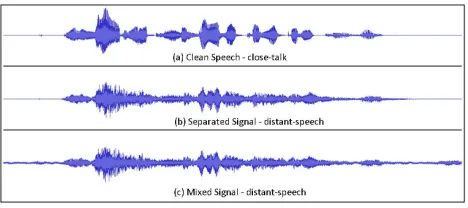
The simulated corpus contains both mixed sources (i.e., the multi-microphone signals containing all the acoustic sources mixed-up) and separated sources (i.e., the single source separated by the other acoustic sources). The clean (or dry) signals of each acoustic source are also included in the corpus. Figure 4 highlights the differences among the three categories of available signals.
Figure 4: Each source of each acoustic sequence is avail-able in three different scenarios of increasing complexity. In (a) is reported a read command uttered in a clean and anechoic environment. The same sentence has been avail-able (for all the sensors of the microphone network) in the reverberated version (b) and in the most challenging sce-nario (c) in which both noises and reverberation degrade the quality of the signal.
living-room. In the example, the name of the source un-der description (<name>), the begin and end samples, and the adopted impulse response, as well as position of the source, are reported. Additional fields describe the rever-beration time (<T60>), the SNR, the gender and ID of the speaker, and the transcription of the uttered sentence. The documentation is completed by additional information that describe the overall geometric configuration, the seg-mentation boundaries related to each acoustic event, and a pictorial representation of the geometry of the acoustic se-quence.
<SOURCE>
<name>sp_ph_rich</name>
<begin_sample>770838</begin_sample> <end_sample>984848</end_sample> <IR>LIVINGROOM/LG/O2/LA1.mat</IR>
<pos>xs=295 ys=188 zs=150 REF=REF_LIVINGROOM</pos> <T60>0.75s</T60>
<SNR>23.61dB</SNR> <gender>Female</gender> <SPK_ID>spk6</SPK_ID> <label=txt>
770838 984848 nel giardino c’ e’ una statua muliebre </label=txt>
</SOURCE>
Figure 5: Excerpt of a XML annotation file describing a phonetically-rich sentence uttered in the living-room by a female speaker.
3.
Possible applications
Several experiments conducted in DIRHA have shown the usefulness of the corpus for testing of source localization, acoustic event detection, speech/non-speech discrimination techniques. Thanks to the presence of clean, mixed, and separated signals, the corpus is also suitable for multi-microphone acoustic echo cancellation. Furthermore, such a database is also adequate for multi-microphone speech enhancement and for distant speech recognition.
Finally, the split of the corpus in three different chunks in-cluding different speakers, helps the user perform parame-ter tuning on the development set while the other sets can be used for test purposes.
In the context of the 4th Joint Workshop on Hands-free
Speech Communication and Microphone Arrays (HSCMA 2014), a special session dedicated to “Speech detection and speaker localization in domestic environments” (Brutti et al., 2014) has been proposed. In particular, a portion of the DIRHA SimCorpus has been delivered (together with some real data sequences extracted from Wizard of Oz ex-periments) to researchers working in the field of multi-microphone signal processing in order to assess their al-gorithms in this domestic scenario.
4.
Conclusions
The DIRHA SimCorpus is a huge collection of simulated acoustic sequences, suitable for various signal processing and speech recognition tasks.
We plan to extend the corpus by including more languages such as English and French. Furthermore, we will explore some other microphone configurations involving, for in-stance, arrays with a different geometric configuration and, possibly, a higher number of microphones.
The corpus will be made available to the research commu-nity under possible future initiatives, such as international challenges and special sessions. At the moment an excerpt of six simulations extracted from the SimCorpus is already available for downloading through the project website.
5.
Acknowledgments
6.
References
B. Angelini, F. Brugnara, D. Falavigna, D. Giuliani, R. Gretter, and M. Omologo. 1994. Speaker indepen-dent continuous speech recognition using an acoustic-phonetic Italian corpus. In Proceedings of ICSLP 1994. A. Brutti, M. Ravanelli, P. Svaizer, and M. Omologo. 2014.
A speech event detection/localization task for multiroom environments. In Proceedings of HSCMA 2014.
A. Farina. 2000. Simultaneous Measurement of Impulse Response and Distortion with a Swept-Sine Technique. In Proceedings of 108th AES Convention.
J. S. Garofolo, L. F. Lamel, W. M. Fisher, J. G. Fiscus, D. S. Pallett, and N. L. Dahlgren. 1993. DARPA TIMIT Acoustic Phonetic Continuous Speech Corpus CDROM. J. Huang, M. Epstein, and M. Matassoni. 2008. Effec-tive Acoustic Adaptation for A Distant-talking Interac-tive TV System. In Proceedings of Interspeech 2008. M. W¨olfel and J. McDonough. 2009. Distant Speech
Recognition. Wiley.
M. Matassoni, M. Omologo, D. Giuliani, and P. Svaizer. 2002. HMM Training with Contaminated Speech Mate-rial for Distant-Talking Speech Recognition. Computer Speech and Language.
M. Omologo. 2010. A prototype of distant-talking inter-face for control of interactive TV. In Proceedings of Asilomar Conference on Signals, Systems and Comput-ers.
M. Ravanelli, A. Sosi, P. Svaizer, and M. Omologo. 2012. Impulse response estimation for robust speech recogni-tion in a reverberant environment. In Proceedings of EU-SIPCO 2012.
B. Schuppler, M. Hagm¨uller, J. A. Morales Cordovilla, and H. Pessentheiner. 2014. GRASS: the Graz corpus of Read And Spontaneous Speech. In Proceedings of LREC 2014.