Proceedings of Recent Advances in Natural Language Processing, pages 686–693,
Word Embeddings as Features for Supervised Coreference Resolution
Iliana Simova
Saarland University Saarbr¨ucken, Germany
Hans Uszkoreit
Language Technology Lab, DFKI Alt-Moabit 91c, Berlin, Germany
Abstract
A common reason for errors in corefer-ence resolution is the lack of semantic information to help determine the com-patibility between mentions referring to the same entity. Distributed representa-tions, which have been shown successful in encoding relatedness between words, could potentially be a good source of such knowledge. Moreover, being obtained in an unsupervised manner, they could help address data sparsity issues in labeled training data at a small cost. In this work we investigate whether and to what extend features derived from word embeddings can be successfully used for supervised coreference resolution. We experiment with several word embedding models, and several different types of embedding-based features, including embedding clus-ter and cosine similarity-based features. Our evaluations show improvements in the performance of a supervised state-of-the-art coreference system.
1 Introduction
Coreference resolution is the task of automatically identifying expressions in a text which refer to the same real-world entity. It is an important interme-diate step for a number of Natural Language Pro-cessing (NLP) applications which depend on text understanding, such as machine translation, rela-tion extracrela-tion, and quesrela-tion answering, to name a few.
There is a wide range of approaches for solv-ing coreference resolution. Some successful sys-tems rely on rules and heuristics (Lee et al.,2011), others employ a variety of machine learning mod-els (Martschat et al.,2015;Bj¨orkelund and Kuhn,
2014). One aspect they have in common is the recognition that the process could benefit from some form of lexical and encyclopedic knowledge. For instance, lexical relations such as synonymy and hyperonymy (e.g., a capitalis a city), world knowledge (e.g., France is a country), and even attributive knowledge (e.g., countrieshave areas and population) could all prove helpful for the task.
Durrett and Klein (2013) have shown that to achieve state-of-the-art performance in corefer-ence resolution, one does not need complicated heuristic-driven features. However, they identify the task of including semantics into the process as an “uphill battle”. Many works explore sources of semantic knowledge for the task. Some include mining unannotated data (Bean and Riloff,2004; Mohit Bansal,2012), structured lexical databases (Daum´e III and Marcu, 2005), and knowledge bases (Rahman and Ng, 2011). In this work we explore a different source of semantic knowledge, namely distributed word representations.
Word embeddings are representations of word meaning taking the perspective that the sense of a word is defined by the company it keeps, or its context words. In some models, these representa-tions are learned as a prediction task using neural networks (Mikolov et al.,2013), other approaches use dimensionality reduction on a co-occurrence matrix (Pennington et al., 2014). The resulting representations have been shown to encode word relatedness and similarity. Depending on the con-text selected to represent a word’s sense, this sim-ilarity can take different forms (Levy and Gold-berg, 2014). Such representations are typically learned from large collections of text in an unsu-pervised manner. If we employ them to a super-vised task, they could also prove useful in address-ing some data sparsity issues in the trainaddress-ing data. Therefore they are an attractive source of semantic
knowledge, which can be obtained at a small cost and be beneficial in multiple ways.
In this work we explore the usefulness of fea-tures derived from word embeddings for the task of coreference resolution. We experiment with several general purpose word embedding models, and several different types of features derived from word embeddings, including embedding cluster and cosine similarity-based features.
2 Related Work
Word embeddings generally serve as input to deep learning architectures. Several works have applied such techniques successfully to the task of coref-erence resolution (Wiseman et al.,2016;Clark and Manning,2016). While such systems reach state-of-the-art performance without the need for elab-orate handcrafted features, complexity is added in terms of the model. In this work we investigate whether word embeddings could also be benefi-cial when used in another simpler way and a stan-dard setting - in the form of features for super-vised learning. To the best of our knowledge this is the first work to apply such features to supervised coreference resolution.
Several works have explored the application of word embedding features to supervised learning systems for other NLP tasks.
Turian et al. (2010) compare several unsuper-vised word representation models for Named En-tity Recognition (NER) and chunking. The au-thors find that each of them improves on state-of-the-art supervised baselines. Yu et al.(2013) fur-ther explore ofur-ther ways of encoding word embed-ding information at a lower computational cost by performing prior clustering of the embeddings and inducing a cluster label feature.
In (Guo et al., 2014), word embedding-based features are studied in relation to the task of NER. The work further explores several different ways of deriving features from word embeddings - 1) by creating a binarized version of the embedding to consider features with strong opinions on each di-mension, 2) by clustering of the embedding via k-means and including the cluster label as a feature, and 3) as a distributional prototype feature. In the latter, a few examples are automatically selected to represent each type of named entity, and then cosine similarity is calculated between the embed-dings of the word in question and these prototypes. All word embedding-based features brought
im-provements to the baseline, and over the direct use of the embedding. Moreover, a combination of the features led to a greater improvement in perfor-mance, indicating that the knowledge represented by them is not overlapping completely.
Similarly to Guo et al. (2014), in this work we experiment with several different word embedding-based features. We employ prior clus-tering of the word embeddings and include the ob-tained cluster label as a feature, with the expec-tation that it would encourage semantic compati-bility between candidate coreferring expressions. One difference here lies in choice of clustering al-gorithm - spherical k-means was selected due to its use of cosine similarity as a distance metric as op-posed to Euclidean distance which is employed in standard k-means. We consider this metric more suitable when comparing word embeddings, and expect that its use would result in more meaningful clusters. In addition to also directly using the orig-inal word embedding as a feature, we experiment with reduced version of it. While a prototype-based feature could also prove useful for this task, we plan to investigate it in future work.
3 Experimental Setup
This section offers more details on the way in which we use word embeddings as features for su-pervised learning, as well as on the word embed-ding models selected for the current experiments. We further present the baseline coreference sys-tem.
3.1 Word Embedding Models
Our aim is not to provide a fair comparison of these models, but rather to see if some of them with their specific characteristics would prove par-ticularly useful for our task. For instance, the first two embedding models have different types of training data. The word2vec model is trained on news data, which coincides with the major-ity of the data in the OntoNotes corpus, and has the largest vocabulary of the three. The GloVe model, in addition to news data present in Giga-word, also incorporates the encyclopedic knowl-edge of Wikipedia. The dependency embedding, on the other hand, takes a different perspective on which words in the context of a word are impor-tant for determining it’s sense, and make use of dependency analysis in order to select meaning-ful contexts. The resulting embeddings have been shown to exhibit more functional similarity (Levy and Goldberg,2014).
3.2 Features Derived from Word Embeddings
3.2.1 Embedding Cluster
We perform a clustering of word embeddings and assign a cluster label to the head words of each mention pair under consideration. The motiva-tion behind this is that this clustering would pro-vide us with a form of a semantic tag which could either ensure semantic compatibility between the mentions directly when two mentions fall into the same cluster, or be used by the supervised system to learn compatible anaphor-antecedent combina-tions from the training data. During clustering, each word embedding vector is treated as a single instance, and the resulting clusters consist of the words with the most similar embeddings accord-ing to a distance metric.
The selection of clustering algorithm is guided by the choice of suitable distance metric. As co-sine similarity is popularly used to compare em-beddings of words, our clustering algorithm of choice is spherical k-means1.
We experiment with several different values for number of clusters in order to determine what granularity is most suitable for the task. The val-ues include 50, 100, 500 for less fine-grained clus-ters, and 1k to 10k in steps of 2.5k for more fine-grained ones.
1https://github.com/clara-labs/spherecluster
3.2.2 Dense Embedding Features
Another way to deliver word embedding informa-tion to the coreference system is by including the embedding vector directly. In this setting each di-mension of the vector of a mention’s head word is a separate numeric feature. This is justified by the fact that different dimensions of each embed-ding can be considered as latent features encoembed-ding different properties of a word (Turian et al.,2010). One consideration here is that by including the whole vector we increase the amount of features substantially. Therefore we also experimented with reduced versions of the original vectors by Principal Component Analysis (PCA)2. PCA
ex-amines the correlation between different dimen-sions in the word embedding vector, and identi-fies a smaller number of variables that best explain the original vector. The vectors were reduced to retain different amounts of variability present in the original data, which addresses over-fitting, and effectively reduces the amount of features to be added. We experiment with variance levels of 10% to 100% in steps of 10%.
3.2.3 Cosine Similarity Features
The third set of word embedding features is based on cosine similarity. Cosine similarity computes the cosine of the angle between two vectors, and in the case of word embeddings, provides a mea-sure of relatedness between words. We estimate the similarity between the head words of each anaphor and antecedent (ANA, ANTE) in a candi-date pair, as well as between their governing words (GOVana, GOVante) in the dependency tree, and the
combinations ANA-GOVanteand ANTE-GOVana.
This feature could prove useful in cases of pro-noun resolution, where the context of the propro-noun referring expression is a deciding factor. Consider the example from (Jespersen,1949), “If thebaby does not thrive on raw milk, boil it.”, where the pronoun it has two candidate antecedents. The cosine similarity between the governing word of the anaphor,boil, and the second antecedent can-didate, milk, is very high, as opposed to between the alternative pairing which leads to an undesir-able interpretation. As GOVana and GOVante are
often verbs, this feature could also prove useful when coreferring mentions carry out related ac-tions (“During an interview hesaid[..] He further reportedthat [..]”).
Feature set F1
baseline 59.19
+ECw2v,2.5k 59.56
+CSglove,pca-20 59.49 +WEglove,pca-50 59.67 +ECglove,2.5k+CSglove,pca-20 59.68 +CSdeps,pca-60+WEglove,pca-50 59.66 +ECglove,2.5k+WEglove,pca-50 59.66 +ECglove,5k+CSdeps,pca-90+WEglove 59.72
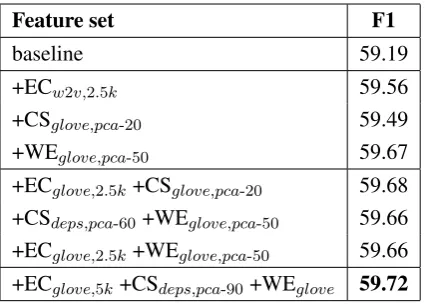
Table 1: Summary of the performance of the coreference system (CoNLL F1) with different sets of features. Individual features include: em-bedding cluster (EC) label, cosine similarity (CS) features, and word embedding (WE) features, as described insubsection 3.2.
When calculating the cosine similarity between two words, we use the vectors of the original word embeddings, as well as PCA-reduced versions of them.
3.3 Coreference Resolution System
The coreference resolution toolkitcort(Martschat et al.,2015;Martschat and Strube,2015) was used to obtain the baseline, and extended in our fur-ther experiments. The system offers several im-plementations of popular coreference resolution approaches, as well as ways of visualizing and comparing the outputs of different models. In this work we employ amention-pair model with best-firstclustering. This model breaks down the task of coreference resolution into pairwise coref-erence decisions. The construction of corefcoref-erence chains is then enabled via clustering.
The baseline employs a standard set of features, including: number, gender, various string match-ing and distance features, semantic class (“per-son”, “object”, “numeric”), fine type (name, defi-nite/indefinite noun phrase, etc.), and others3.
4 Results
4.1 Evaluation
Table 1 contains the best results achieved by the coreference resolution tool per feature and feature combination. All of the models were trained and tested on the CoNLL-2012 training and test data sets with automatic preprocessing. The evaluation
3see https://github.com/smartschat/cort for a complete list
metric is CoNLL-F1 score (average of MUC, B3, and CEAFe). Due to space limitations we do not provide a detailed list of results, but a discussion of the most important ones is included below.
When considering the embedding cluster fea-ture in isolation, we observed that the best per-forming setting is that with the w2v embedding and 2.5K number of clusters. For the other two embedding models, the same amount of clusters was also most successful. We observed a drop in performance for high number of clusters (over 7.5K) with all three models. In 12% of the exper-iments we obtained a small drop in performance below the baseline score.
For the cosine similarity set of features, the best performance was achieved byglovewith ex-plained variance of 20%. Using the whole word embedding vectors to compute this feature lead to worse results for all embedding models, and the performance of the feature across different reduc-tions was unstable, often dropping slightly below the baseline level (results were in the range 58.97-59.49, with 36% worse than the baseline).
The best result with the word embedding fea-ture was achieved withgloveand variance of 50%. Here we also observed that when the original em-beddings were used, the performance was worse compared to the reduced versions. The models’ performance ranged from 59.06 to 59.67, with 25% of them performing worse than the baseline.
The second part ofTable 1shows the best pair-wise combinations of features. We experimented with combinations of some of the best perform-ing individual features. Our goal is to determine if the knowledge they encode is complementary to each other. The most complementary feature com-bination is embedding cluster and cosine similar-ity. For the rest of the combinations we did not observe any gains in performance over the use of the best individual feature.
With a combination of three of the feature types we obtained the highest scoring model of 59.72 F1 score.
4.2 Error Analysis
As the automatic evaluation doesn’t offer a very good insight on where the word embedding feature models differ with respect to the baseline model and each other, we include a more detailed recall and precision error analysis.
Precision Error Analysis
Error Category Feature Set
ANAÕANTE baseline +ECw2v,2.5k +CSglove,pca-20 +WEglove,pca-50 +EC+CS+WEbest
PronÕPron 33% 33% 34%1 35%1 33%
PronÕName 5% 5% 5% 5% 5%
PronÕNoun 7% 7% 7% 6% 7%
NameÕPron 1% 2%1 2%1 1% 1%
NameÕName 21% 21% 21% 22%1 22%1
NameÕNoun 1% 2%1 1% 1% 1%
NounÕPron 1% 1% 1% 1% 1%
NounÕName 2% 1% 2% 2% 2%
NounÕNoun 27% 26% 25% 26% 26%
total num. errors 4758 4712 4638 4500 4565
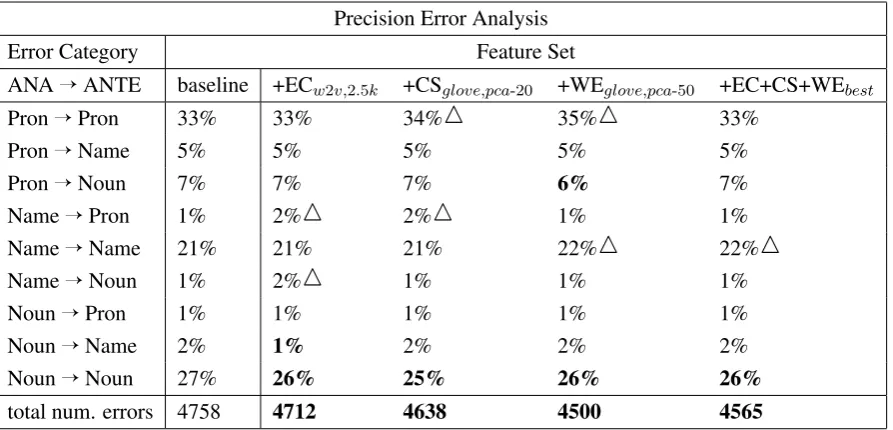
Table 2: Precision error analysis of some of the best models per type of anaphor and antecedent. A decrease in the amount of errors is marked inbold, and an increase: with the symbol1.
(Martschat and Strube, 2014). In this study, coreference chains are viewed as complete one directional graphs, following the order in which mentions occur in the text. Error analysis is then viewed as comparing graphs in terms of edges. A system’s output is transformed into a maximum spanning tree using a notion from accessibility theory to select the most likely missing links needed to reach the reference graph. If an edge in the resulting graph is missing from the reference entity, this is considered a recall error. To extract precision errors, the anaphor and antecedent decisions made by a system are used in a similar manner. This representation allows for the recall and precision errors to be categorized in terms of type of anaphor and antecedent.
4.2.1 Precision Error Analysis
The results of our precision error analysis are pro-vided inTable 2. In bold we mark all cases where a reduction of the amount of errors is visible as com-pared to the baseline system, while an increase in the amount of errors is marked with the symbol 1. The percentages denote the proportion of er-rors per error type from the total number of erer-rors a system made. For instance, in the baseline sys-tem, resolving a link between a pronoun anaphor and a pronoun antecedent (“Pron Õ Pron”) was responsible for 33% of the total number of errors, 4758.
All of the systems manage to achieve a reduc-tion in the total number of precision errors
com-pared to the baseline system (see “total number of errors”). The word embedding model comes first with 258 fewer errors, followed by the best com-bination model with 193 fewer errors.
We observe interesting results for the category “NounÕNoun”, where both the anaphor and an-tecedent are noun phrases. All of the systems man-age to improve over the baseline, showing the in-fluence of the semantic knowledge introduced by the word embedding features. Here surprisingly the most improvement is achieved by the cosine similarity model (25% or 105 fewer errors in raw counts).
Our initial hypothesis that the cosine similar-ity model would be especially useful for pronoun resolution was not supported by the evaluation re-sults. For the category “PronÕPron”, it even lead to more precision errors.
The word embedding model is the one which stands out in terms of overall performance, but it leads to more errors in two of the categories: “Pron
ÕPron” and “NameÕName”. For the first one, it is perhaps to be expected, as the word embed-ding of a pronoun is not particularly informative, given no additional context information. The lat-ter result was surprising, as we anticipated that the model would be able to detect more aliases and name variations.
Recall Error Analysis
Error Category Feature Set
ANAÕANTE baseline +ECw2v,2.5k +CSglove,pca-20 +WEglove,pca-50 +EC+CS+WEbest
PronÕPron 7% 7% 7% 7% 7%
PronÕName 10% 10% 10% 10% 10%
PronÕNoun 17% 17% 17% 17% 17%
NameÕPron 1% 1% 1% 1% 1%
NameÕName 18% 18% 18% 18% 18%
NameÕNoun 3% 3% 3% 4%1 4%1
NounÕPron 1% 1% 1% 1% 1%
NounÕName 9% 9% 9% 9% 9%
NounÕNoun 21% 21% 21% 21% 21%
total num. errors 4844 4800 48531 48611 4835
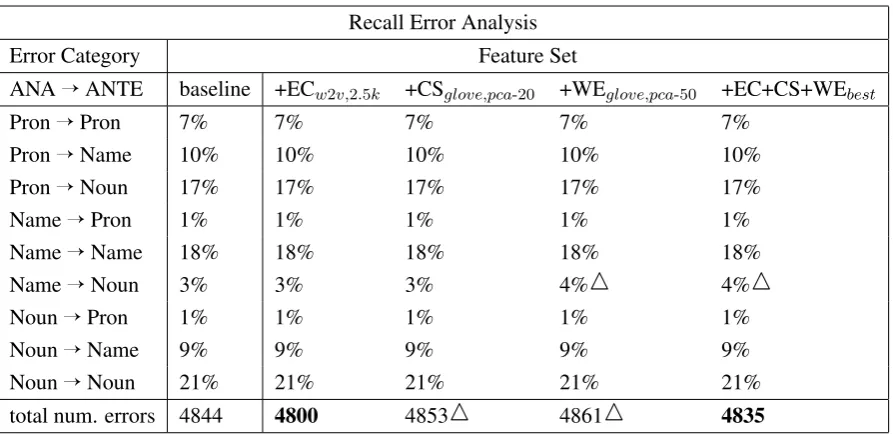
Table 3: Recall Error Analysis of some of the best models per type of anaphor and antecedent. A decrease in the amount of errors is marked inbold, and an increase: with the symbol1.
problematic for the individual feature models.
4.2.2 Recall Error Analysis
The error analysis in terms of recall presented in Table 3 was not as informative as the precision one. Most of the systems perform similarly, with small variations in raw counts per error category.
Only two of the models manage to obtain lower total number of recall errors compared to the base-line: the embedding cluster with 44 fewer errors, and the combination model with 9. The overall good performance of the word embedding model in terms of precision is a result of a Precision-Recall trade-off.
5 Discussion
On the topic of selecting a word embedding model, we made several observations. In the au-tomatic evaluation and error analysis for most of our experiments, including ones not reported here, thegloveword embedding proved to be most use-ful. Thedepsmodel stood out in conjunction with the cosine similarity feature. Given that it has the smallest vocabulary of the three, it would be in-teresting so see how this type of embedding per-forms for the task when trained on a bigger data set. This would also allow us to fairly compare the former model, encoding more topical similar-ity, and the latter with more functional similarity. We believe that both types of knowledge are of im-portance with respect to coreference resolution.
The error analysis presented in subsection 4.2
suggests the need for a task-specific word em-bedding with a special handling of pronouns and names. While all tested feature configurations were beneficial for resolving coreferences involv-ing common nouns, for several other categories in-volving the aforementioned types of expressions, they did not improve and sometimes even lead to a degradation in precision. The exploration of suit-able task-specific models which address these is-sues is left to future work.
We observed a trade-off between performance in terms of F1 measure and computational cost. Our results partially support the findings of Yu et al. (2013) - the embedding cluster feature was the most cost-effective way to provide word em-bedding information to the coreference tool. How-ever, it did not lead to better coreference resolution performance over the direct use of the word em-bedding. The word embedding feature did lead to longer training and testing, but using the PCA re-duction technique improved on both running time and F1 measure.
Additional complexity is added to the corefer-ence model when attempting to combine several of the word embedding features. Moreover, it is not trivial to find a good combination - selecting the features configurations which perform best in isolation did not necessarily lead to a more suc-cessful combination, as can be seen inTable 1.
re-Feature set F1 ∆F1
baseline 59.19
+ECw2v,2.5k 59.56 +0.37 +WEglove,pca-50 59.67 +0.48
-gender 59.10 -0.09
-gender, +ECw2v,2.5k 59.18 -0.01 -gender, +WEglove,pca-50 59.34 +0.15
-number 59.39 +0.20
-number, +ECw2v,2.5k 59.33 +0.14 -number, +WEglove,pca-50 59.43 +0.24
-head 59.19 +0.00
-head, +ECw2v,2.5k 59.28 +0.09 -head, +WEglove,pca-50 59.29 +0.10
-head NE 59.14 -0.05
-head NE, +ECw2v,2.5k 59.34 +0.15 -head NE, +WEglove,pca-50 59.34 +0.15
-semclass 59.23 +0.04
-semclass, +ECw2v,2.5k 59.44 +0.25 -semclass, +WEglove,pca-50 59.46 +0.27
-finetype 55.50 -3.69
-finetype, +ECw2v,2.5k 55.98 -3.21 -finetype, +WEglove,pca-50 55.74 -3.45
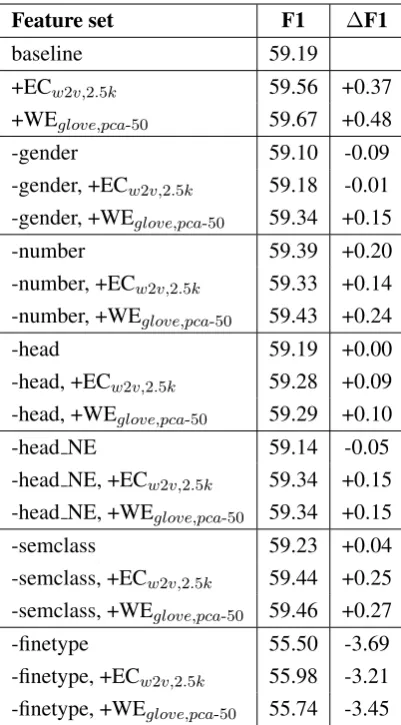
Table 4: Interaction of some of the original and newly introduced features. ∆F1 denotes the dif-ference in the performance of a model compared to the baseline.
moved. The goal of this experiment was to de-termine to what extend the knowledge encoded by these features overlaps with some of the semantic information already present in the original ones, and whether they might be better alternatives to them. These include: gender and number infor-mation, head word and Named Entity (NE) tag of the head word, and semantic class and fine type of the mention. Table 4 presents a summary of the results.
None of the new features seem to completely cover the information encoded by the original ones. Rather, they work best in the setting where they interact with each other. The dense word em-bedding feature includes more of thenumberand gender information, compared to the embedding cluster feature. An explanation for this could be that the different dimensions of an embedding of a word encode some of these properties. Thus the
word embedding feature is a better way of provid-ing them to the coreference system, as each dimen-sion is kept as a separate numeric feature. This in-formation is partially lost when performing clus-tering. For head word, its NE tag, and semantic class, we do not observe a big difference between the performance of the two new features. Both of them seem to successfully encode information on the semantic class of a word. For the fine type fea-ture, the embedding cluster outperforms the word embedding feature, but neither manage to cover much of this information.
6 Conclusion
This work offers some insights on how word em-beddings can be applied to the task of coreference resolution. We present three different features de-rived from word embeddings, and show that they influence the coreference resolution process in dif-ferent ways. These include a setting in which each dimension of the embedding is a separate numeric feature, an embedding cluster which approximates a semantic class, and a set of cosine similarity fea-tures, which incorporate some contextual informa-tion.
Our evaluation results and error analysis show that each of these features helps to improve over the baseline coreference system’s performance. We observed a reduction in the total number of precision errors. Moreover, all features lead to a reduction in the amount of precision errors in re-solving references between common nouns. These results indicate that they successfully incorporate some lexical semantic and world knowledge into the process.
One of the ways in which we would like to ex-tend the current experiments in future work is by creating a task-specific word embedding. Our er-ror analysis shows that the current approach de-graded the precision for the resolution of pronouns and names. For the former, word embeddings do not contribute much without the availability of more contextual information. We will investigate some specific examples to determine the reason for the latter.
References
David L. Bean and Ellen Riloff. 2004. Unsupervised learning of contextual role knowledge for
corefer-ence resolution. In HLT-NAACL. The Association
for Computational Linguistics, pages 297–304.
Anders Bj¨orkelund and Jonas Kuhn. 2014. Learn-ing structured perceptrons for coreference resolution with latent antecedents and non-local features. In
Proceedings of the 52nd Annual Meeting of the As-sociation for Computational Linguistics (Volume 1: Long Papers). Association for Computational Lin-guistics.
Kevin Clark and Christopher D. Manning. 2016. Im-proving coreference resolution by learning entity-level distributed representations. CoRR.
Hal Daum´e III and Daniel Marcu. 2005. A large-scale exploration of effective global features for a joint
en-tity detection and tracking model. InProceedings
of the Conference on Human Language Technology and Empirical Methods in Natural Language Pro-cessing. Association for Computational Linguistics, Stroudsburg, PA, USA, HLT ’05.
Greg Durrett and Dan Klein. 2013. Easy victories and uphill battles in coreference resolution. In Proceed-ings of the 2013 Conference on Empirical Methods in Natural Language Processing.
Jiang Guo, Wanxiang Che, Haifeng Wang, and Ting Liu. 2014. Revisiting embedding features for sim-ple semi-supervised learning. InProceedings of the 2014 Conference on Empirical Methods in Natu-ral Language Processing (EMNLP). Association for Computational Linguistics, Doha, Qatar, pages 110– 120.
Otto Jespersen. 1949. A Modern Grammar On
Histor-ical Principles. Part 7 Syntax. Taylor and Francis Ltd, London, UK.
Heeyoung Lee, Yves Peirsman, Angel Chang, Nathanael Chambers, Mihai Surdeanu, and Dan Ju-rafsky. 2011. Stanford’s multi-pass sieve coref-erence resolution system at the conll-2011 shared task. InProceedings of the Fifteenth Conference on Computational Natural Language Learning: Shared Task. pages 28–34.
Omer Levy and Yoav Goldberg. 2014.
Dependency-based word embeddings. InProceedings of the 52nd
Annual Meeting of the Association for Computa-tional Linguistics.
Sebastian Martschat, Patrick Claus, and Michael Strube. 2015. Plug latent structures and play coref-erence resolution. InACL.
Sebastian Martschat and Michael Strube. 2014. Re-call error analysis for coreference resolution. InIn proceedings of the 2014 Conference on Empirical Methods in Natural Language Processing.
Sebastian Martschat and Michael Strube. 2015. Latent structures for coreference resolution. InACL. Tomas Mikolov, Ilya Sutskever, Kai Chen, Greg
Cor-rado, and Jeffrey Dean. 2013. Distributed represen-tations of words and phrases and their composition-ality. InProceedings of the 26th International Con-ference on Neural Information Processing Systems. Curran Associates Inc., NIPS’13.
Dan Klein Mohit Bansal. 2012. Coreference semantics from web features. The Association for Computa-tional Linguistics.
Jeffrey Pennington, Richard Socher, and Christo-pher D. Manning. 2014. Glove: Global vectors for
word representation. InEmpirical Methods in
Nat-ural Language Processing (EMNLP). pages 1532– 1543.
Altaf Rahman and Vincent Ng. 2011. Coreference
res-olution with world knowledge. In Proceedings of
the 49th Annual Meeting of the Association for Com-putational Linguistics: Human Language Technolo-gies - Volume 1. Association for Computational Lin-guistics, HLT ’11, pages 814–824.
Joseph Turian, Lev Ratinov, and Yoshua Bengio. 2010. Word representations: A simple and general method for semi-supervised learning. InProceedings of the 48th Annual Meeting of the Association for Compu-tational Linguistics. Association for Computational Linguistics, Stroudsburg, PA, USA, ACL ’10, pages 384–394.
Sam Wiseman, Alexander M. Rush, and Stuart M. Shieber. 2016. Learning global features for coref-erence resolution. CoRR.
Mo Yu, Tiejun Zhao, Daxiang Dong, Hao Tian, and Dianhai Yu. 2013. Compound embedding features