Figure 1: Terminological entry conforming GMT
sary resources to identify terms to extract, (ii) the creation of a cascade of transducer each of which has its own role.
In the following, we detail the different re-sources and steps of our approach.
5.1 Necessary Linguistic Resources
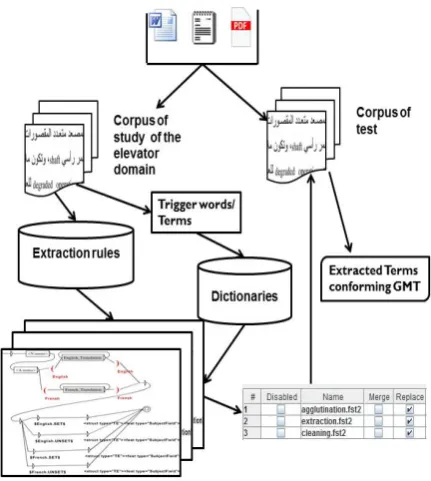
For our approach, we construct linguistic resouces from our study corpus, such as dictionaries, trigger words and extraction rules (syntactic patterns). In the following, we present these resources.
5.1.1 Dictionaries
For the domain of elevator, subject of our study, we identified the following dictionaries: a dictio-nary of inflected nouns and their canonical forms, a dictionary of inflected verbs, a dictionary for ad-jectives, a dictionary for trigger words of the do-main and dictionaries of particles, possessive nouns, demonstrative pronouns and relative pro-nouns. The structure of the various dictionary en-tries is not the same. It can vary from one dic-tionary to another. It must contain the grammati-cal category of the entry (noun, adjective), but, ac-cording to the dictionary, it may contain also: gen-der (masculine, feminine or neutral) and number (singular, dual, plural or broken plural), definition
Figure 2: Proposed approach
(defined or undefined), case (accusative, nomina-tive or geninomina-tive) or mode (indicanomina-tive, subjuncnomina-tive or jussive), person (1st person, 2nd person or 3rd person) and voice (active or passive).
5.1.2 Trigger Words
The extraction rules generally use morphosyntac-tic information such as trigger words for the detec-tion of the beginning of a term. We opted for in-creasing the number of rules and triggers in order to have as efficient as possible extraction system. We identified 162 trigger words, some of them can trigger the recognition of up to 5 terms. For this reason we classified them in classes.
5.1.3 Extraction Rules
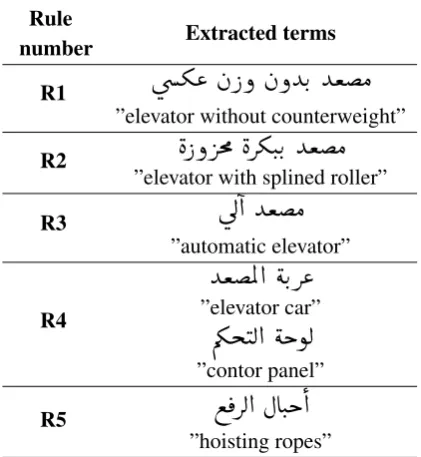
To facilitate the identification of the necessary transducers for the extraction of terms, we have built a set of extraction rules. Indeed, they give the arrangement of the various constituents of terms in a linear manner easily transferable as graphs. We identified 12 extraction rules. Table 1 shows some of them. Four grammatical features are at-tribuated here: gender (masculine (m) or feminine (f)), number (singular (s), dual (d) or plural (p)), definition (defined (r) or undefined (n)) and case (accusative (a), nominative (u) or genitive (i)).
”mainte-Rule Extraction rules number
R1 <Pattern 1>:=<Trigger word>
<N:nums><PREP>(<N:nums>)+
R2 <PREP<Pattern 2><N:nufs>:=><[N:nums<Adj:nufs> >]
R3 <Pattern 3>:=<Trigger word>
<N:nums><Adj:nums>
R4 <Pattern 4>:=<Trigger word>
<N:nufs><N:rums>
R5 <Pattern 5<N:nufp>:=><<Trigger wordN:rums> >
Table 1: Some extraction rules of Arabic patent terms
nance” for the ruleR3and
© ¯P
”lifting” for the rule R4. Table 2 shows some extracted terms due to the precedent extraction rules (here identified by their number in Table 1).Rule Extracted terms number
R1
ú溫 à Pð àðYK. YªÓ
”elevator without counterweight”
R2
è Pð Qm× èQºJ.K. YªÓ
”elevator with splined roller”
R3
úÍ
@ YªÓ
”automatic elevator”
R4
YªÖÏ@ éK.Q«
”elevator car”
ÕºjJË@ ékñË
”contor panel”
R5
© ¯QË@ ÈAJ.k
@
”hoisting ropes”
Table 2: Terms extracted due to extraction rules
5.2 Implementation of Extraction Rules We created three types of transducers. The first one is the transducer of pre-treatment solving Ara-bic prefixes and suffixes agglutination. To rec-ognize the agglutinative character, we should en-ter inside the token. As Unitex works on a to-kenized version of the text, it is not possible to make queries entering within the tokens, except
with morphological filters or the morphological mode which is more appropriate in our case. To do this, we must define the whole portion of grammar using the symbols< and> as presented in Fig-ure. 3). The transducer annotate every part of the agglutinated token with appropriate grammatical category.
Figure 3: Transducer of resolution of agglutina-tion
The second transducer, as shown in Fig-ure. 4, includes all subgraphs of term extraction and annotation under the GMT format (”extrac-tion trasducers” box). In order to improve terms extraction, trigger words are regrouped into the ”trigger words” box.
Figure 4: The main extraction transducer
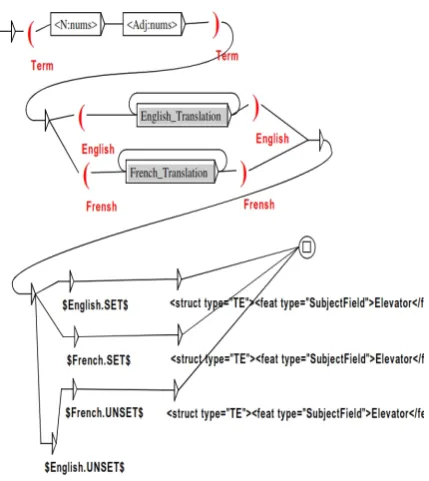
Figure. 5 shows one of the transducers that ex-tract and annotate terms. It also recognizes the French or English translation of terms (if avail-able) thanks to the ”French Translation” and ”En-glish Translation” subgraphs and annotate them in a new Language Section (LS) in the GMT format as shown in Figure. 1.
The final transducer is a post-treatment trans-ducer consisting on document cleaning: its role is to delete all text remains (which is not XML). Fig-ure. 6 is an overview of this transducer. The sub-graph ”XML” recognize all the XML element that could be contained by the <struct type=”TE”>
Figure 5: Example of extraction subgraph
6 Experimentation and Evaluation
Our test corpus contains 160 Arabic documents from multiple resources: 100 patents, 50 scien-tific papers and 10 manuals and installation doc-uments of elevators, with a total number of 1.6m tokens. Our transducers are called in a specific or-der in a transducer cascade which is directly im-plemented in the linguistic platform Unitex5
us-ing the CasSys tool (Friburger and Maurel, 2004). Each graph adds its own annotations due to the mode ”Replace”. This mode provides, as output, a recognized term surrounded by a GMT annotation defined in the transducers.
In order to conduct an evaluation, we applied the cascade implemented on the test corpus. We manually evaluated the quality of our work on the test corpus. The total number of terms is 852. Ta-ble 3 gives an overview of the obtained results.
Terms Extracted terms Erroneous terms
852 827 59
Table 3: Overview of the obtained results The obtained results are satisfactory, the trans-ducers were able to cover the majority of terms with a precision of 0.95 and a recall of 0.97 with a F-score of 0.95. We therefore find that the pro-posed method is effective.
5Unitex: http://www-igm.univ-mlv.fr/ unitex/
Figure 6: Post-treatment transducer
The noise can be caused by the absence of dia-critics in our corpus and dictionaries, which could create ambiguity problem. It may also be caused by the absance of high granularity features of our dictionary entries. For this reason, we will try to add other semantic and grammatical features to our dictionary entries to improve our results. De-spite the good results, we were forced to spend our terminological database to a terminologist to correct erroneous terms and their definitions. We believe that the automatic integration and merging of our database with other existing databases can help us to automatically correct errors.
7 Conclusion
In this paper, we built a set of transducers. Then we generated a cascade allowing extraction of sci-entific and technical terms. Extracted terms were represented in a standardized format (GMT). The generation of this cascade is performed using the CasSys tool, built-in Unitex linguistic platform. The operation of the transducer cascade required the construction of resources such as dictionaries. In the immediate future, we will create a trans-ducer cascade to extract bibliographic data and metadata of citations, tables, formulas and fig-ures from scientific and technical documents and patents. We will also extract terms using a satatis-tic approach. Finally, we will try to combine the two approaches in a hybrid one.
Acknowledgments
References
Cui Binge. 2009. Scientific literature metadata
ex-traction based on HMM. CDVE 2009, pages 64-68.
Luxembourg, Luxembourg.
Didier Bourigault. 1992. Surface Grammatical Anal-ysis for the Extraction of Terminological Noun
Phrases. In Proceedings of the 14th International
Conference on Computational Linguistics COL-ING’92, volume 3, pages 977-981. Nantes, France.
Didier Bourigault. 1994. LEXTER, Un
Logi-ciel d’Extraction de TERminologie. Application `a l’Acquisition de Connaissances `a Partir de Textes.
Doctoral thesis. Ecole des hautes Etudes en Sci-ences Sociales.
Erik Hetzner. 2008. A simple method for citation metadata extraction using hidden markov models.
JCDL 2008, pages 280-284. New York, USA. Huy H.N. Do, Muthu K. Chandrasekaran, Philip S. Cho
and Min Y. Kan. 2013. Extracting and Matching Authors and Affiliations in Scholarly Documents.
JCDL 2013. Indianapolis, Indiana, USA.
Ido Dagan and Ken Church. 1994. Termight:
Identifying and Translating Technical Terminology. In Proceedings of the 4th Applied Natural Lan-guage Processing Conference ANLP’94, pages 34-40. Stuttgart, Germany.
Laurent Romary. 2001. An Abstract Model for the Representation of Multilingual Terminological Data: TMF Terminological Markup Framework.
TAMA 2001. Antwerp, Belgium.
Nathalie Friburger, Denis Maurel. 2004. Finite-state transducer cascades to extract named entities in texts. InTheoretical Computer Science,volume 313, pages 93-104.
Patrice Lopez. 2009. GROBID: Combining Auto-matic Bibliographic Data Recognition and Term
Ex-traction for Scholarship Publications. ECDL 2009.
Corfu, Greece.
Patrice Lopez and Laurent Romary. 2010b. GRISP: A Massive Multilingual Terminological Database for
Scientific and Technical Domains. LREC 2010. La
Valette, Malta.
Pattabhi R.K. Rao, Sobha L. Devi, Paolo Rosso. 2013. Automatic Identification of Concepts and Concep-tual relations from Patents Using Machine Learning
Methods.ICON 2013, pages 18-20. Noida, India.
Sagnik R. Choudhury, Prasenjit Mitra, Andi Kirk, Sil-via Szep, Donald Pellegrino, Sue Jones and C Lee Giles. 2013. Figure Metadata Extraction from
Dig-ital Documents. ICDAR 2013, pages 135 - 139.
Washington, USA.