Domain-specific vs. Uniform Modeling for Coreference Resolution
Olga Uryupina
1, Massimo Poesio
1,21University of Trento, Center for Mind/Brain Sciences,2University of Essex, Language and Computation Group [email protected],[email protected]
Abstract
Several corpora annotated for coreference have been made available in the past decade. These resources differ with respect to their size and the underlying structure: the number of domains and their similarity. Our study compares domain-specific models, learned from small heterogeneous subsets of the investigated corpora, against uniform models, that utilize all the available data. We show that for knowledge-poor baseline systems, domain-specific and uniform modeling yield same results. Systems, relying on large amounts of linguistic knowledge, however, exhibit differences in their performance: with all the designed features in use, domain-specific models suffer from over-fitting, whereas with pre-selected feature sets they tend to outperform union models.
Keywords: coreference, discourse, domain adaptation
1.
Introduction
In many areas of Computational Linguistics it has been shown that domain selection and adaptation methods have the potential to improve the performance of systems. The issue is of particular interest for research in coreference as many of the corpora used for evaluation—e.g., the ACE corpora—consist of several domains, which however are not particularly big in size, so that it’s an often considered question whether one would get a better performance by training and testing separately or putting all data together. And it’s becoming even more of an issue considering that the biggest resource currently available, OntoNotes-3, con-sists of a number of texts from different domains, so that finding homogeneous subsets may be very useful (as well as being practically necessary given the size of the corpus). No systematic study of the effect of diversity on develop-ing coreference methods has been carried out yet, but there has been some preliminary work investigating the effect of corpus composition on the performance of coreference al-gorithms, showing that even apparently similar corpora like MUC and ACE in fact differ in a number of ways (Stoyanov et al., 2009).
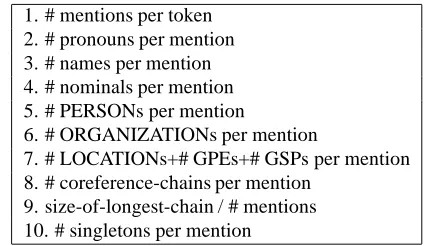
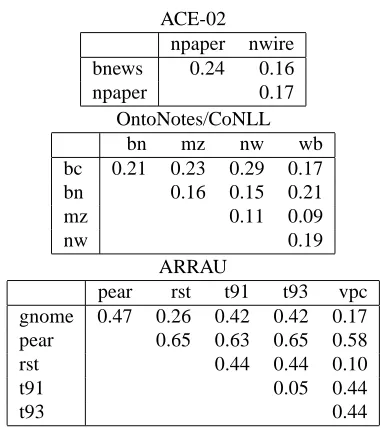
As a first step in this direction, we propose in this paper a measure of corpus homogeneity w.r.t. coreference that can be used to test whether it’s sensible to blend together differ-ent domains at training, or it’s best to keep them separate. We believe that this measure might help us better under-stand the structure of the coreference datasets and find ho-mogeneous clusters within them, ultimately improving the resolution accuracy.
In this work we also remain aware that corpus homogeneity may have different effects on different types of coreference feature sets - in particular, that shallow feature sets, which have been shown to be less affected by the size of the train-ing corpus (Soon et al., 2001; Uryupina, 2006) may also be less sensitive to corpus homogeneity.
In the present paper we investigate possibilities of improv-ing the system’s performance through learnimprov-ing domain-specific models. Our hypothesis is that a classifier, rely-ing on a rich set of lrely-inguistic features, can benefit from capturing domain specific information. We run our experi-ments on three corpora: ACE-02, ARRAU and OntoNotes.
These datasets differ with respect to their size, domain di-versity and annotation guidelines and provide therefore a good testbed for our approach.
2.
Datasets
2.1. Corpora
In the present study, we compare three datasets: ACE-02 (Doddington et al., 2004), ARRAU (Poesio and Artstein, 2008) and OntoNotes (Pradhan et al., 2011). All these cor-pora contain documents from different domains, and the corresponding information has been preserved in the dis-tributions. All the ACE-02 and OntoNotes documents are news, whereas ARRAU contains news, medical texts, fic-tion and dialogues.
In Table 1 we provide some statistics for the training data in the whole datasets and their domains: the average length of a document, total number of tokens and mentions. It is clear that “domains” in the three corpora are composed very differently: thus, thenwOntoNotes domain is larger than the whole ACE-02 set.
The corpora have been annotated according to very differ-ent guidelines. The ACE-02 dataset has been developed mainly from the Information Retrieval perspective, whereas both the ARRAU and OntoNotes annotation schemes rep-resent a more linguistic view of coreference.
The ACE guidelines focus only on specific predefined en-tity types: PERSON, ORGANIZATION and so on. The OntoNotes data, on the contrary, contain annotations of all the entities. ACE mentions contain information on their
minimal spans, that allow for less restrictive alignment of
system vs. gold boundaries. OntoNotes mentions are ex-pected to be recovered in their exact boundaries. The AR-RAU guidelines require all the mention to be annotated, but the minimal spans are provided only for some domains (rst,vpc).
Soon et al all features Selected features domains union domains union domains union
ARRAU
gnome 58.06 56.92 56.12 51.56 56.38 56.11 pear 66.74 67.36 64.35 65.06 66.29 65.24 rst 59.51 59.36 53.61 53.77 56.88 57.97 t91 39.01 36.85 39.59 35.83 37.86 36.67 t93 43.17 42.9 41.07 39.14 47.55 43.31 vpc 57.3 57.58 52.36 54.54∗∗ 54.91 57.73
whole corpus 56.66 56.04 52.92 51.91 54.84 55.29 ACE-02
bnews 69.33 71.33 74.15 75.46 73.17 72.61 npaper 70.92 69.69 70.93 72.37∗∗ 72.53∗∗ 67.61
nwire 69.43 69.08 67.85 72.03∗∗ 76.08∗∗ 72.96
whole corpus 69.91 70.05 70.9 73.29∗∗ 73.97∗∗ 71.12
OntoNotes/CoNLL
bc 55.04 55.62 54.76∗∗ 53.85 60.71 59.52
bn 56.42 56.33 53.71 52.93 58.39∗∗ 58.17
mz 59.56 60.2 52.93 53.35 61.65 62.42 nw 52.03∗∗ 51.53 44.24 44.63∗∗ 55.5 54.47
wb 51.07 53.05 47.39 46.61 53.91 53.36 whole corpus 54.17 54.5 49.55 49.35 57.74∗∗ 57.05
Table 4: Experimental results (MUC F-score) for 3 corpora: ARRAU, ACE-02 and OntoNotes. Significant differences between domain and union modeling shown with ∗∗ (sign test on per-document scores, p < 0.05). NB: sign test not
applicable to the ARRAUt91,t93,gnomeandpeardomains due to the insufficient test set size.
sets, the domain-specific modeling brings a significant ad-vantage over the union one.4
5.
Conclusion
In this paper we have investigated possibilities of domain-specific modeling for coreference resolution. We have shown that for modern knowledge-rich algorithms it might be beneficial to split the training set into different domains to be processed separately, provided the system relies on efficient feature selection techniques to overcome the over-fitting problem. This holds even for corpora containing rel-atively similar documents (ACE-02, OntoNotes). It must be noted that a domain-specific approach is only beneficial when the corresponding domain contains a sufficient num-ber of documents. For very small domains, for example ARRAUvpc, one should consider merging the training set with other similar domains (using the distance between the centroids of indicator vectors as a similarity measure) or simply retract to the union modeling.
In our study we rely on a very naive measure of document similarity with respect to coreference. In the future work, we plan to elaborate on this measure, incorporating more indicators of the discourse structure and combining it with other metrics of document similarity (e.g. topic models). Our analysis shows that some documents might belong to one domain but be more similar to another one (e.g., the ACE-02 domains provide only very poor clusters). This
4An exception is a small ARRAU vpc domain: as our
in-dicators show, it is very similar to a much larger domain, rst, which makes it beneficial to train a linguistically-rich model on the whole corpus.
suggests that, for a given test document, it might be ben-eficial to construct its domain automatically, ignoring the split suggested in the corpus distribution (cf. Plank and van Noord (2011) for a similar approach to parsing). We plan to pursue this line in our future work.
6.
Acknowledgements
The research described in this paper has been partially sup-ported by the European Community’s Seventh Framework Programme (FP7/2007-2013) under the grants #247758:
ETERNALS – Trustworthy Eternal Systems via Evolving
Software, Data and Knowledge, and #288024: LIMOSINE
– Linguistically Motivated Semantic aggregation engiNes.
7.
References
Hal III Daume. 2007. Frustratingly easy domain adapta-tion. In Proc. ACL 2007.
George Doddington, Alexis Mitchell, Mark Przybocki, Lance Ramshaw, Stephanie Strassell, and Ralph Weischedel. 2004. The automatic content extraction (ACE) program–tasks, data, and evaluation. In Proc.
LREC-04.
Veronique Hoste. 2005. Optimization Issues in Ma-chine Learning of Coreference Resolution. Ph.D. thesis,
Antwerp University.
David McClosky, Eugene Charniak, and Mark Johnson. 2010. Automatic domain adaptation for parsing. In
Proc. NAACL 2010.
Vincent Ng and Claire Cardie. 2002. Improving machine learning approaches to coreference resolution. In Proc.
Barbara Plank and Gertjan van Noord. 2011. Effective measures of domain similarity for parsing. In Proc. ACL
2011.
Massimo Poesio and Ron Artstein. 2008. Anaphoric anno-tation in the arrau corpus. In Proc. LREC-08.
Sameer Pradhan, Lance Ramshaw, Mitchell Marcus, Martha Palmer, Ralph Weischedel, and Nianwen Xue. 2011. Conll-2011 shared task: Modeling unrestricted coreference in ontonotes. In Proc. CoNLL 2011, Port-land, Oregon, June.
Wee Meng Soon, Hwee Tou Ng, and Daniel Chung Yong Lim. 2001. A machine learning approach to coreference resolution of noun phrases. Computational Linguistic, 27(4):521–544.
Veselin Stoyanov, Nathan Gilbert, Claire Cardie, and Ellen Riloff. 2009. Conundrums in noun phrase coreference resolution: making sense of the state-of-the-art. In Proc.
ACL 2009.
Olga Uryupina, Sriparna Saha, Asif Ekbal, and Massimo Poesio. 2011. Multi-metric optimization for corefer-ence: The UniTN / IITP / Essex submission to the 2011 CONLL shared task. In Proc. CoNLL-2011.
Olga Uryupina. 2006. Coreference resolution with and without linguistic knowledge. In Proc. LREC-06. Kees van Deemter and Rodger Kibble. 2001. On
core-ferring: Coreference in muc and related annotation schemes. Computational Linguistics.