LIMA: A Multilingual Framework for Linguistic Analysis and Linguistic
Resources Development and Evaluation
Romaric Besançon, Gaël de Chalendar, Olivier Ferret, Faiza Gara,
Meriama Laïb, Olivier Mesnard, Nasredine Semmar
CEA, LIST, Vision and Content Engineering Laboratory, Fontenay-aux-Roses, F-92265, France;
Abstract
The increasing amount of available textual information makes necessary the use of Natural Language Processing (NLP) tools. These tools have to be used on large collections of documents in different languages. But NLP is a complex task that relies on many processes and resources. As a consequence, NLP tools must be both configurable and efficient: specific software architectures must be designed for this purpose. We present in this paper the LIMA multilingual analysis platform, developed at CEA LIST. This configurable platform has been designed to develop NLP based industrial applications while keeping enough flexibility to integrate various processes and resources. This design makes LIMA a linguistic analyzer that can handle languages as different as French, English, German, Arabic or Chinese. Beyond its architecture principles and its capabilities as a linguistic analyzer, LIMA also offers a set of tools dedicated to the test and the evaluation of linguistic modules and to the production and the management of new linguistic resources.
1
Context and objectives
In this article, we present the LIMA (CEA List Multilin-gual Analyzer) platform which is, as GATE (Cunningham et al., 2002), together an architecture, a set of tools and resources and an environment for developing applications based on Natural Language Processing (NLP). This plat-form was developed by the LVIC laboratory of CEA LIST with the following requirements:
• multilingualism, with the objective of dealing with a broad spectrum of languages;
• a large diversity of applications. LIMA aims at be-ing used as a basic component for various applications that can be text-based applications such as automatic summarization or question-answering but can also be applications dealing with multimedia documents;
• extensibility, that is to say the ability to support the addition of new functionalities. As illustrated by Sec-tion 2.2, the current version of LIMA mainly performs analyses up to syntactic analysis but we also aim at ex-tending it to semantic and discourse analyses;
• the need for efficiency. A platform such as LIMA must be able to process very large corpora both because the processing of such corpora is more and more required by work in Computational Linguistics (see (Pantel et al., 2009) for instance) and because it also has to be used in an industrial context.
The first three requirements make necessary to design an ar-chitecture based on modularity and flexibility at a high de-gree. All languages are not characterized by the same set of linguistic phenomena and as a consequence, their process-ing doesn’t rely on the combination of the same elementary analyses. Moreover, even if a linguistic analysis module can be used for two different languages, the linguistic re-sources it relies on are generally specific to each language. The same need for modularity and flexibility comes from
the diversity of applications LIMA has to deal with: using the same system for lemmatizing a set of keywords from a base of images, a newspaper article or the transcription of a phone conversation is not the best means to have good results in each of these three contexts. Finally, the main dif-ficulty LIMA had to face was to fulfill these requirements without sacrificing efficiency.
Several kinds of architectures were already proposed to ad-dress these different issues. Process-oriented architectures focus on the combination and the control of a set of mod-ules together with the communication between them. They generally implement a loosely integration by the means of a “glue” that can be a multi-agent system as in Tal-Lab (Wolinski et al., 1998) or a client-server architecture as in FreeLing (Carreras et al., 2004). Data-oriented archi-tectures also represent a weak type of integration by con-centrating on the normalization of data between modules, as in the MULTEXT project (Ide and Véronis, 1994) or the LT XML Library (Brew et al., 1999). The TIPSTER-like architectures (Grishman, 1997) go a step further by impos-ing both a shared representation of data, often by annota-tion graphs (Bird and Liberman, 1999), and a uniform in-terface for modules. The GATE platform (Cunningham et al., 2002) is the typical representative of this kind of archi-tectures but TEXTRACT (Neff et al., 2004) and its most recent descendant, UIMA (Ferrucci and Lally, 2004), also belong to this category. Finally, the highest degree of in-tegration is reached by formalism-oriented architectures in which both data and processes are represented through a declarative formalism associated to a kind of inference en-gine. This approach was initially dedicated to the develop-ment of grammars as in ALVEY (Grover et al., 1993) but was also applied more widely through platforms such as ALEP (Simkins, 1994), NooJ (Koeva et al., 2007) or Out-ilex (Blanc et al., 2006).
# Pipeline definitions
# Process unit definitions
# Resource definitions limaconf.xml
# Dumper and logger definitions
<cf lang="fre" file="limafre.xml"/> <cf lang="ara" file="limaara.xml"/>
limafre.xml limaara.xml
<pipeline name="general">
<pipeline/>
<pu name="namedentitiesgen"/>
<pipeline name="medicalmedical">
<pipeline/>
<pu name="namedentitiesmednamedentitiesmed"/>
<pu name="namedentitiesgen" type="neTagger">
<pu/>
<res name="namedentitiesgenrules"/> <log name="namedentitieslogger"/> <log name="namedentitieslogger"/>
<pu name="namedentitiesmednamedentitiesmed" type="neTagger">
<pu/>
<res name="namedentitiesmedrulesnamedentitiesmedrules"/>
<res/>
<param key="file" value="namedentitiesgenrules"/>
<res name="namedentitiesmedrulesnamedentitiesmedrules">
<res/>
<param key="file" value="namedentitiesmedrules"/> <res name="namedentitiesgenrules">
<log name="namedentitieslogger">
<log/>
<param key="outputSuffix" value=".se.xml"/>
Figure 1: Configuration of LIMA
• specific entity recognition: the same pattern recogni-tion unit is used with different rules to recognize num-bers, dates and named entities (the treatment is per-formed before POS-tagging because it reduces the am-biguity);
• POS-tagging: default POS-tagging implemented in LIMA uses a Viterbi algorithm on POS trigrams, with a fallback to bigrams, unigrams and lemma a priori probabilities;
• syntactic analysis: it is performed using a dependency grammar implemented as a set of simple rules ex-ecuted by the generic pattern recognition unit (Be-sançon and Chalendar (de), 2005). This step is itself splitted in sub-steps, each able to handle specific kinds of relations, such as local or distant ones.
2.2.2 Adding a specific process unit for Arabic analysis
The Arabic pipeline has a similar skeleton to the French pipeline, but without the special treatment for hyphenated words and with and additional unit dedicated to some speci-ficities of Arabic, namely the fact that Arabic texts are of-ten completely unvowelled or partially vowelled and a large number of proclitics and enclitics can be attached respec-tively to the beginning or the end of a word (Grefenstette et al., 2005). The following treatment is then added:
• clitic stemmer: this unit uses two additional dictionar-ies for clitic (containing 77 proclitics and 65 enclitics) in order to split Arabic agglutinated words into procli-tics, simple forms and enclitics. It proceeds as follows:
– Several vowel form normalizations are per-formed: the vowel symbols
@ @
@ @ @ @
are removed, the characters@ @ @
are replaced by the character@
and the final charactersø ø ð
orè
are replaced by the charactersø Zø Zð
or. è
;– All clitic possibilities are computed by using pro-clitics and enpro-clitics dictionaries;
– A radical, obtained by removing these clitics, is checked against the full form lexicon. If it does not exist in the full form lexicon, re-write rules are applied, and the altered form is checked against the full form dictionary. For example, consider the token "
éKQºK.
" (with its ball) and the included cliticsH.
(with) andè
(its), the com-puted radicalHQ»
does not exist in the full form lexicon but after applying one of the re-write rules, the modified radical "èQ»
" (ball) is found in the dictionary and the input token is segmented into root and clitics as:è + èQ» + H. = éKQºK.
(with + its + ball);– The compatibility of the grammatical tags of the three components (proclitic, radical, enclitic) is then checked. Only valid segmentations are kept and added into the graph of words.
2.2.3 Reusing and combining process units
form composed of agglutinated radical “da” and the enclitic “me”. The Spanish pipeline if hence configured to use the clitic stemmer with an enclitic dictionary.
Similarly, the German pipeline has two additional specific units dedicated to treat compound words. German has the ability to form compound words by combining all possi-ble words together: nouns, adjectives, adverbs, participles, verbs, prefixes, prepositions. Specific elements can be used for coupling the words: -e ; -es ; -s ; -n ; -en. These addi-tional units are:
• before POS-tagging, a processing unit seeks if a word is an agglutination of several lexical units, possibly separated by a delimiter, and assigns a grammatical tag to the compound word. Lexical units are checked against full form lexicon and delimiters are specified in another resource. All grammatical tags of the last unit are assigned to the compound word.
• after POS-tagging, another processing unit is used to separate compound word components, to be treated separately in the rest of the analysis.
For example, the word “Vorlesungsbetrieb” contain “’ Vor-lesung” + (“s”) + “betrieb”. “Vorlesung” and “betrieb” are found in the full form lexicon and ’s’ is a delimiter. “ be-trieb” can be VERB or NOUN. The grammatical tags of the last unit (VERB or NOUN) are assigned to the com-pound word. Separating word components is done after POS-tagging in order to decrease lexical ambiguity. When dealing with new languages, the different process units developed to treat specific linguistic phenomenons can be combined. For instance, Hungarian is a highly agglutinative language: for example, “hazamban” is the equivalent of the English prepositional phrase “in my house”. Hungarian has also the ability to compose words like German. For example, “anyanyelv”=”anya” (“mother”)+”nyelv” (“language”) is a composed word and means “native language”. In order to develop a pipeline for Hungarian text processing, we integrated the clitic stemmer developed for Arabic and the decompounder developed for German. The only additional work needed is the develop-ment of specific resources for these pipeline units for the Hungarian language.
2.3 Performances
2.3.1 Part-of-speech tagging
We present in Table 1 an evaluation of the performances of the Part-Of-Speech tagging of LIMA on different lan-guages. These evaluation measures have been obtained us-ing a ten-fold cross validation on the reference tagged cor-pus that is used as training for the default n-gram model used by LIMA for its POS tagging module. We use in the LIMA POS-tagging a rich tagset with many features, which makes the POS-tagging a more complex task and makes necessary larger corpus for training (which we do not have for all languages). We present the results for the fine-grain tagset, and the results on the main part-of-speech categories, limited to 12 tags.
The performance of LIMA POS tagger is a bit below state-of-the-art taggers for English language (around 96 or 97%),
lang corpus size POS-tagging precision (words) fine-grain 12 tags
eng 30086 91.4% (136 tags) 93.5%
fre 28828 87.7% (168 tags) 94.4%
ara 13257 80.2% (85 tags) 86.1%
spa 30088 80.6% (114 tags) 84.1%
ger 20155 63.5% (423 tags) 89.1%
Table 1: Evaluation of LIMA POS-tagging
but has reasonable performances on the other languages. The modular architecture of LIMA allows to easily change the model of a particular module, and we are currently test-ing other paradigms of POS-taggers for English (SVM and MaxEnt models, which achieve the best performance in the litterature).
2.3.2 Syntactic analysis
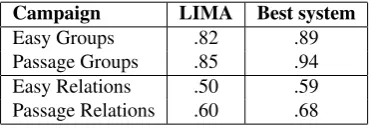
LIMA has been evaluated during two evaluation campaigns of French syntactic analyzers, Easy in 2005 and Passage in 2009. In these two campaigns, analyzers were evalu-ated on non recursive minimal chunks and on relations be-tween these chunks, while LIMA produces a pure depen-dency analysis. Thus, we had to design a converter able to produce Easy/Passage formats from our dependencies. Table 2 shows the F-measures on groups and relations for LIMA and the best system for each campaign. Note that the Passage results are still unofficial and very preliminary as they concern only a small subset of the evaluated material, namely 989 words out of the final 430,000 final reference.
Campaign LIMA Best system
Easy Groups .82 .89
Passage Groups .85 .94
Easy Relations .50 .59
Passage Relations .60 .68
Table 2: Evaluation of LIMA during Easy and Passage (very preliminary results) campaigns ; F-measure on groups and relations
We can see that although LIMA is still not at the level of the best system, it has progressed between the two campaigns, particularly on relations. The progress was obtained thanks to a work on resources eased by the development environ-ment described in section 3.1.
2.3.3 Speed of processing
Since the LIMA framework has been developed with the goals of both configurability and efficiency to treat large amounts of data, the time required to process texts is an im-portant criterion of LIMA evaluation. We present in Table 3 the evaluation of speed processing, in number of words per second (CPU time), for different languages, and for two levels of processing: one for the part-of-speech tag-ging only, and one for the complete syntactic analysis and concept extraction. These measures have been obtained on a standard workstation (Intel Core2 Duo 3Ghz, 4Go RAM).
pro-Language POS tagging Syntactic analysis
eng 12066 w/s 4332 w/s
fre 8646 w/s 6580 w/s
spa 23282 w/s 11819 w/s
ger 4854 w/s 4394 w/s
ara 436 w/s 146 w/s
Table 3: Evaluation of speed of LIMA processing (in num-ber of words per second)
cessors1. However, the figures show that speed perfor-mances are different across languages, which can be ex-plained by the differences of treatments and the complexity of the resources used (morphological analysis, dictionary sizes, grammar sizes). For instance, in German and even more in Arabic, the morphological analysis is costly due to clitic treatments and complex words decompouding.
3
Developing with LIMA
This section describes the three steps involved in making LIMA a useful tool for Natural Language Processing tasks. First of all, one has to be able to develop resources used by the analyzer (section 3.1). Then, LIMA must communicate with the application using it. Section 3.2 shows the various ways in which this communication can be handled. Finally, section 3.3 lists a few applications in which LIMA has been integrated.
3.1 LIMA Integrated linguistic analysis development environment
As other real-size linguistic analyzers, LIMA is a large-scale software, whose development involved many man-years of work, in terms of both coding and resource de-velopment. Given, for example for French, a dictionary of 110k lemmas, a few hundred syntactic analysis rules, 20k ngrams matrices and other resources, it is difficult to predict what will be the impact of adding a new possible category to a given verb or a new syntactic rule. Any modification may imply, besides what was expected, unforeseeable side-effects and the complexity of the system makes it difficult to guess the overall impact of even small changes. Thus, in association with the analyzer, we need tools that allow to easily edit the resources and to iteratively evaluate the quality of the analysis using a reference corpus. We have developed two such tools, a benchmarking tool and a re-sources editor (de Chalendar and Nouvel, 2009). Both have been developed using the Qt 4.5 GUI library.
The benchmarking tool (Figure 2) allows to run an evalua-tion against a reference corpus, to see immediately the per-formance, globally and for each of a set of different evalu-ation dimensions. Its specificity is its genericity. It is not limited to the evaluation of LIMA but can be configured to use a different analyzer, a different evaluation program and a different set of evaluation dimensions. Besides the evaluation results themselves, the tool allows to compare
1It would for instance be in second place behind the
Tree-Tagger in Matthew Wilkens’ evaluation of POS-taggers, on a similar computer: http://workproduct.wordpress.com/2008/11/08/evaluating-pos-taggers-speed/
Figure 2: Benchmarking tool showing the measures panel on all evaluated files and with all groups and relations se-lected
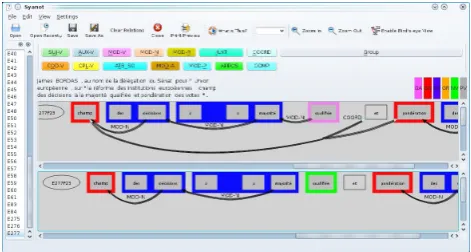
an evaluation run with the previous one or with the refer-ence by displaying the analysis graph for both using the Syanot tool2, a graphical view of the syntactic analysis
re-sults (Figure 3). Note that Syanot is also an editor allowing to graphically annotate texts.
Figure 3: Syanot used to compare changes between two runs in the Benchmarking Tool
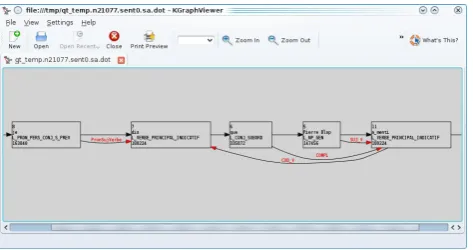
The benchmarking tool allows also to run the analyzer on a given sentence (“One Shot” tab) in order to observe its be-haviour in handling a specific linguistic phenomenon. The results are shown in Syanot but also as raw XML showing the full dump of the data structures and in KgraphViewer (Figure 2) to show the internal representation of the anal-ysis graph. KgraphViewer is available for all in the KDE extragear module3.
The resource development tool is currently tied to LIMA but we plan to make it more generic. It offers a clean and easy to use interface to the dictionary, the part-of-speech tagging learning corpus and the syntactic analysis grammar rules. It has been designed to be easily usable by non com-puter specialists. Figure 5 shows the tab allowing to dig into the part-of-speech tagging learning corpus. It is cen-tered around the (filterable) list of trigrams. When select-ing a trigram, the user sees below the occurrences of this trigram in the corpus. The right part shows a
correspon-2Syanot is a graphical syntactic annotations editor developed
under an open source licence. It will soon be publicly available.
3
Figure 4: KGraphViewer
dence table between two tag sets used respectively during the compilation of the matrices and during the analysis by LIMA.
Three other editors are available in other tabs: one allowing to edit the dictionary that is used to produce the final full-form dictionary; a second one allowing to edit the syntactic analysis rules and a third one to edit the rules recognizing idioms. Each interface permits to save, compile and deploy the respective resources.
Figure 5: Resource tool
3.2 Interfaces of LIMA
As stated above, LIMA has been conceived to be very modular. It has also been conceived to be modularly in-tegrated in various architectures and to be easily portable to other platforms, even if its primary development platform is GNU/Linux. Its factory based API allows for a direct in-tegration but it can also be used in a UNIX-style script by writing to files using various dumpers dedicated to specific tasks, such as the Easy/Passage dumper writing in the syn-tactic analysis Passage format (de la Clergerie et al., 2008). Three kinds of client/server integration modules also exist:
• simple socket: a Perl TCP server waits for commands using an ad-hoc protocol and calls the analyzer;
• CORBA: LIMA can act as a CORBA server using a dedicated API;
• SOAP Web Services: we implement
sev-eral of the services specifications de-fined by the WebContent project4,
in-cluding NamedEntitiesExtraction,
SemanticAnnotation, etc.
This versatility makes LIMA very easy to integrate into larger applications.
To illustrate the flexibility of the general architecture, we present how we used LIMA to analyze the output from speech-to-text transcription tools. This can be made with-out difficulties by simply configuring the reader of LIMA and making it accept as input documents with format spe-cific to the tool used to perform transcription. Document are considered in this configuration as any other written text.
In order to better take into account the nature of the source document and to fully exploit the results of the transcrip-tion step, we propose another configuratranscrip-tion. The idea is to keep not only the most likely words, as computed by the final stage of transcription, but to keep also other hypothe-sis with their respective weights as inputs for the linguistic processing performed by LIMA. To be able to keep these hypotheses it is necessary to import a lattice. In this lattice, a node is created to represent each word hypothese. The word is associated with a value wich reflects its occurrence probability according to the acoustic model. To perform this import, we do not need to change anything in the ar-chitecture or recompile existing code. We have written a process unit which reads the outputs from speech-to-text tool and builds a graph. To integrate the new process unit into the pipeline we have substituted it to the tokenizer in the pipeline configuration.
3.3 Applications based on LIMA
Several applications developed by the CEA LIST use the LIMA framework as a core module for linguistic analy-sis: (1) a multimedia search engine, in which LIMA is used for the analysis of both textual documents and queries (with different pipelines); this search engine has been used in various CLEF campaigns (Besançon et al., 2004); (2) the ŒDIPE question answering system, in which LIMA is used for the question analysis and in the search engine used to pre-select the documents; this QA system has partici-pated in CLEF and EQUER campaigns (Besançon et al., 2007); (3) the CHORAL summarization system, in which LIMA is used for the linguistic analysis of the text to iden-tify the most important concepts used for sentence selec-tion and to provide a syntactic analysis that can be used for syntactic simplification of kept sentences (Chalendar (de) et al., 2005; Garcia-Flores and Chalendar de, 2008). The efficiency of LIMA was also illustrated by its use in the Semantic Map project (Grefenstette, 2007) where its syn-tactic analyzer processed 2 million French Web pages to build a large network of syntactic co-occurrences that now supports work about the automatic building of semantic re-sources such as word senses (Mouton et al., 2009) or se-mantic frames.
4
tural approach to unstructured information processing in the corporate research environment. Natural Language Engineering, 10(3-4):327–348.
Jorge Garcia-Flores and Gaël Chalendar de. 2008. Syntactico-semantic analysis: a hybrid sentence extrac-tion strategy for automatic summarizaextrac-tion. In MICAI 2008: Advances in Artificial Intelligence, Atizapán, México, November 2008. Springer, Lecture Notes in Ar-tificial Intelligence.
Gregory Grefenstette, Nasredine Semmar, and Faiza Elkateb-Gara. 2005. Modifying a natural language pro-cessing system for european languages to treat arabic in information processing and information retrieval appli-cations. InProceedings of the ACL Workshop on Com-putational Approaches to Semitic Languages, pages 31– 37, Michigan, USA, June.
Gregory Grefenstette. 2007. Conquering language: Using nlp on a massive scale to build high dimensional lan-guage models from the web. In8th International Confer-ence on Computational Linguistics and Intelligent Text Processing (CICLing 2007, pages 35–49, Mexico City, Mexico.
Ralph Grishman. 1997. Tipster architecture design docu-ment version 2.3. Technical report, DARPA.
Claire Grover, John Carroll, and Ted Briscoe. 1993. The Alvey Natural Language Tools grammar (4th release). Technical Report 284, Computer Laboratory, Cambridge University.
Nancy Ide and Jean Véronis. 1994. Multext : Multilingual text tools and corpora. In15thInternational Conference
on Computational Linguistics (COLING’94), pages 588– 592.
Svetla Koeva, Denis Maurel, and Max Silberztein. 2007.
Formaliser les langues avec l’ordinateur : De Intex à Nooj. Les Cahiers de la MSH Ledoux. Presses Universi-taires de Franche-Comté.
Claire Mouton, Guillaume Pitel, Gaël Chalendar (de), and Anne Vilnat. 2009. Unsupervised word sense induc-tion from multiple semantic spaces with locality sensitive hashing. In7th Conference on Recent Advances in Natu-ral Language Processing (RANLP 2009) - poster session, Borovets, Bulgaria.
Mary S. Neff, Roy J. Byrd, and Branimir K. Radev. 2004. The Talent system: TEXTRACT architecture and data model. Natural Language Engineering, 10(3-4):307– 326.
Patrick Pantel, Eric Crestan, Arkady Borkovsky, Ana-Maria Popescu, and Vishnu Vyas. 2009. Web-scale dis-tributional similarity and entity set expansion. In Pro-ceedings of the 2009 Conference on Empirical Methods in Natural Language Processing, pages 938–947, Sin-gapore, August. Association for Computational Linguis-tics.
Neil K. Simkins. 1994. An open architecture for language engineering. InFirst CEC Language Engineering Con-vention.
Francis Wolinski, Frantz Vichot, and Olivier Gremont. 1998. Producing nlp-based on-line contentware. In Nat-ural Language Processing and Industrial Applications