PET: a Tool for Post-editing and Assessing Machine Translation
Wilker Aziz
†, Sheila C. M. de Sousa
†and Lucia Specia
§†Research Institute in Information and Language Processing University of Wolverhampton
Stafford Street, Wolverhampton, WV1 1SB, UK
{w.aziz, sheila.castilhomonteirodesousa}@wlv.ac.uk
§Department of Computer Science University of Sheffield
Regent Court, 211 Portobello, Sheffield, S1 4DP, UK [email protected]
Abstract
Given the significant improvements in Machine Translation (MT) quality and the increasing demand for translations, post-editing of automatic translations is becoming a popular practice in the translation industry. It has been shown to allow for larger volumes of translations to be produced, saving time and costs. In addition, the post-editing of automatic translations can help understand problems in such translations and this can be used as feedback for researchers and developers to improve MT systems. Finally, post-editing can be used as a way of evaluating the quality of translations in terms of how much effort these translations require in order to be fixed. We describe a standalone tool that has two main purposes: facilitate the post-editing of translations from any MT system so that they reach publishable quality and collect sentence-level information from the post-editing process, e.g.: post-editing time and detailed keystroke statistics.
Keywords:Machine Translation, Post-editing of Machine Translation, Evaluation of Machine Translation
1.
Introduction
Post-editing Machine Translation (MT) output is now seen as a potentially successful way of incorporating MT into human translation workflows in order to minimize time and costs in the translation industry. The editing of semi-automatic translations is a common practice among users of Translation Memory (TM) tools, which provide user-friendly and functional environments for translators, for ex-ample: SDL Trados1, Wordfast2 and D´ej`a Vu X23. Many of these tools now incorporate MT systems. For example, SDL Trados provides the same post-editing interface for TMs and a few MT systems. Although less common, some MT systems also enable the use of TMs besides providing their own translation output. These include systems such as Google Translate4and Systran5.
However, existing post-editing environments have three main limitations: restricted availability and flexibility, and lack of detailed statistics from post-editing jobs. Most of them are proprietary tools only available as part of a ma-jor (and more expensive) product distribution. Apart from a few options, mostly regarding their interface, they cannot be modified in any way. Furthermore, these tools generally only allow the post-editing of one or a very small number of specific specific MT systems, which restricts their appli-cation. As such, they do not allow, for example, the
com-1http://www.trados.com/en/ 2
http://www.wordfast.net/
3
http://www.atril.com/en/software/ deja-vu-x-professional
4
http://translate.google.com/
5
http://www.systran.co.uk/
parison of translations produced by different MT systems in terms of post-editing effort.
An important use of post-editing is the collection of infor-mation that can be used for measuring translation quality and diagnosing translation problems, but this broadly ne-glected in existing tools. An exception is Translog6, a tool developed specifically for the purpose of logging very de-tailed information about operations performed on a text. Translog keeps track of each and every move of the transla-tor/writer, presenting the possibility of replaying the writ-ing process in full, as if it were a video. The post-editwrit-ing of machine translations is one of the applications of this tool, however it does not provide specific facilities for translation post-editing, for example, access to external resources such as dictionaries, the possibility of assessing translations or defining restrictions on the post-editing process.
Another example of tool that allows collecting some in-formation from the post-editing process is Caitra7. Caitra (Koehn, 2009) is aimed at interactive translation, where the translator can choose to use the assistance provided by the tool, such as (i) predictions - the tool proposes suggestions for sentence completion; (ii) options - the tool displays mul-tiple alternatives available to translate the sentence; and (iii) MT post-editing - the tool provides the best complete trans-lation from the MT system, which the user can accept or edit if necessary. Caitra collects information related to post-editing time, such as the time spent on different types of edits and pauses, and statistics such as types of edits and
6
http://www.translog.dk/
keystrokes. However, it uses a specific MT system, Moses (Koehn et al., 2007), and therefore comparisons of multi-ple MT systems are not possible. In addition, it has limited additional facilities for post-editing and does not allow sub-jective assessments of translations.
A similar standalone tool for the post-editing of multiple MT system was developed and used during the DARPA GALE evaluations (Olive et al., 2011). However, this tool was only made available to participants in the GALE pro-gram. To the best of our knowledge, it does not include common facilities for post-editors, such as dictionaries, etc.
In this paper we present PET, a simple standalone tool that allows the post-editing of any MT system and records (by default) the following information at sentence-level, among others: time, customizable quality scores, times-tamped edits, keystrokes, and edit distance from the orig-inal MT and its post-edited version. PET can also be used to set constraints on a post-editing task, such as a maxi-mum post-editing time on a per-sentence basis. As an MT system-independent tool, PET makes it possible to collect post-editing/revision information in a controlled way for multiple MT systems. The tool, along with some of its customization options, is presented in Section 2. We also describe two uses of the tool: (i) the collection of post-editings to compare different MT systems and to compare post-editing against translating from scratch (Section 3.1.), and (ii) the collection of post-editings to serve as train-ing data to build and compare translation quality prediction models (Section 3.2.).
2.
PET: a Post-Editing Tool
The Post-Editing Tool (PET) was developed mainly to serve the purpose of collecting implicit and explicit ef-fort indicators. While the main use of PET is the revi-sion or post-editing of draft translations, such a tool can also collect information regarding translation from scratch. Among several possibly interesting effort indicators one might seek, the most appealing to us is the time spent on performing a task.
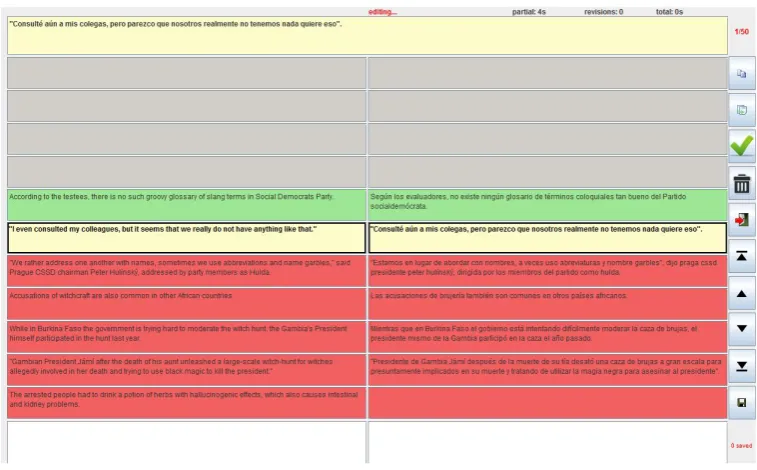
PET was developed in an object-oriented fashion using standard Java-6 libraries, hence it works on any platform running a Java Virtual Machine. For post-editing, the in-terface displays source and target language texts in two columns. Figure 1 shows these annotation window, where the left hand side column is for the visualization of the source text and the right hand side column enables the edit-ing of its translation. For translation, the right hand side column is empty. The unit of text to translate or edit is de-fined in the input file: it can be a sentence, like in Figure 1, a paragraph, phrase, or a text of any length. Units are seen in context, that is, surrounded by some preceding and forthcoming units.
Each unit is translated/edited at a time and navigation is achieved using the navigation bar on the right hand side. For the active unit, an extra box at the top of the window can display additional information, such as the original transla-tion, an alternative translation (from other MT system, for example), or a reference (human) translation.
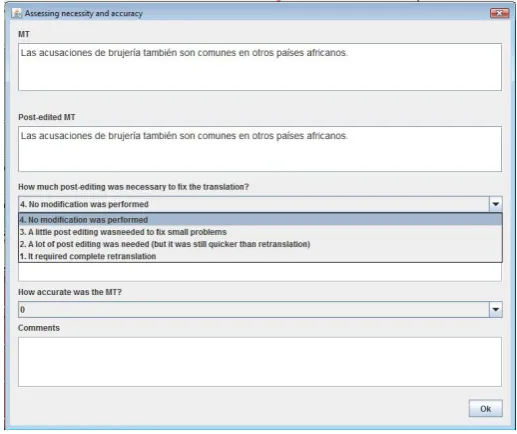
Once a unit is completed, an assessment window can be displayed to collect additional information about that unit, for example, overall translation quality or post-editing ef-fort scores, as shown in Figure 2. The type of assessment to be collected, as well as its scale, is set in a configuration file. Any number of assessment questions can be used, and multiple windows will be created if necessary. Optional comments regarding the assessment are also possible.
2.1. Translation/post-editing jobs
Units to be translated/edited are grouped in “jobs”. A job is therefore a sequence of units assigned to a human annotator. It may contain units to translate or edit, or a mixture of both, where each unit is identified by a unique index. For any unit, the only mandatory information to be provided as part of the input file is the source text. In the case of post-editing/revision, a job must contain a source text and a draft translation (machine or human). In addition, it may contain the reference translation.
Units may also contain a number of attributes that can be made visible to the translator or kept in the input/output files only, such as the “producer” of the translation, to in-dicate the MT system or human translator who produced a given draft translation. Other default attributes include the maximum length allowed for the translation or the maxi-mum time allowed for its editing. Any extra attributes that do not require changing the tool’s behavior can be added to the input file.
In addition, PET’s API provides an interface to add new attributes in the form of constraints and events allowing to further customize a job. This is done by stating that a spe-cific class adds a behavior to the job and it is controlled by a set of attributes. For instance, for the definition of the max-imum post-editing time for a unit, a “maxtime” attribute enables the constraint “Deadline” which triggers the event “EndTaskByForce”. As a consequence, PET forces a unit to end once a specific amount of time has passed since the
Figure 1: Annotation window
translation/editing of the unit started.
A job can be paused, interrupted and re-stared at any mo-ment after a unit is completed. Intermediate files are gen-erated and the overall job time is computed from summing over the editing time of individual units.
2.2. User interface
Using a simple configuration file, PET allows the cus-tomization of the following, among other features:
• how many units are displayed at a time
• what is displayed at the top box (e.g source text, refer-ence text)
• which attributes are displayed
• whether explicit assessments, and which assessments, are requested in the assessment window
• whether a unit should be hidden before its editing time starts to be recorded
• whether a unit can be edited multiple times
Other customizable features are described in PET’s user manual. In addition, the interface uses two customizable boxes (bottom of the window, Figure 1). These boxes may render additional information about words and/or phrases in the source (left box) and in the translation (right box) texts. Useful sub-sentential information includes para-phrases, alternative translations, definitions and links to ex-ternal sources with relevant information. This additional information needs to be provided in an XML file for a given translation/post-editing job. Entries are key-value pairs where the keys are words and/or phrases that may oc-cur in the text and values are the additional information for those words/phrases. By default the tool displays only the values that match the content of the active unit. The default rendering and selection criteria may be overridden using PET’s API.
2.3. Input/output format and quality indicators
The input format for the tool is XML, which facilitates the use of new attributes. For example, a post-editing job can be defined by the following basic elements for each unit, as shown in Figure 3: type of job (type), identifier of the unit (id), source file with source and reference texts (S producer and R producer), and system that produced the translation (MT producer).
The outcome of a task is organized as an annotation ob-ject per unit. This obob-ject contains the final translation, the effort indicators (e.g., time) obtained during the transla-tion/editing and any additional assessment. If PET is set to allow multiple edits of the same unit, for every unit there will be a list of annotation objects marked with revision stamps.
PET provides a few built-in effort indicators and assess-ment types, but many others can be added via the PET’s API. The default effort indicators and assessment types are:
• Editing time: time spent translating or editing a unit; • Assessing time: time spent assessing a unit (quality,
effort, etc.);
• Assessment tag: actual assessment tag amongst a pre-defined set;
• Keystrokes: number of keys pressed during the post-editing grouped by type of keys (deletion, alpha-numeric, etc.);
• HTER: Human Translation Edit Rate (Snover et al., 2006): edit distance between the draft translation and its post-edited version.
Figure 3: Extract of input file
Figure 4: Extract of ouput file
The outcome of a job is also stored in an XML file, such as the one in Figure 4. In this case, only the post-edited version and time indicators were produced (for editing and assessing the unit) and the unit was edited only once (“re-visions = 1”).
The distribution of the tool includes scripts to create input files and parse output files.
3.
Examples of use
3.1. Post-editing versus translation
Sousa et al. (2011) reports an objective way of measuring translation quality in terms of post-editing time using PET. The goals of the experiments were (i) to check whether post-editing sentences was quicker than translating them from scratch, and (ii) as a by product, since multiple MT systems were used, to compare these systems by ranking them according to the amount of time that was required for humans to post-edit their output.
Eleven human translators were asked to post-edit English-Portuguese sentences from TV series subtitles translated using four systems (Google Translate, Systran, SDL Tra-dos and Moses) and also to translate such sentences from scratch. Translators received a random selection of sen-tences and translations produced by different MT systems to translate or post-edit using PET.
For the translation task, annotators were also asked to as-sess the sentence according to a scale of difficulty (1 = dif-ficult; 2 = moderate; 3 = easy). For the post-editing task, annotators were asked to indicate the post-editing effort for each unit (1 = requires complete retranslation; 2 requires some retranslation, but post editing still quicker than re-translation; 3 = very little post editing needed; 4 = fit for purpose).
PET was used to collect the assessment scores given by the translators to every unit and also the time spent performing the translation/post-editing of that unit.
Because time was an important effort indicator in this
ex-periment, PET’s feature that hides a unit before its edit-ing starts was used. This prevented annotators from read-ing the source and translation texts (and possibly thinkread-ing about a correct translation) before they started the post-editing/translation.
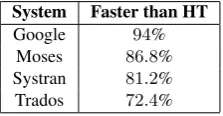
Using the information gathered by the tool, it was possible to rank the translation systems according to i) the scores as-signed by the annotators and ii) the average time the anno-tators spent post-editing the output of each system. These annotations also allowed contrasting post-editing and trans-lation tasks in terms of time. Table 1 summarizes the re-sults for these two aspects using time as measure. It shows that post-editing the output of any system is faster than translating subtitles from scratch. Post-editing was faster than translation in 72%-94% of the cases, depending on the quality of the translation system. On average for the four MT systems, it was found that post-editing sentences is 40% faster than translating them from scratch.
System Faster than HT
Google 94%
Moses 86.8% Systran 81.2% Trados 72.4%
Table 1: How often post-editing a translation system output was faster than translating the text from scratch.
The output of each system was also assessed in terms of TER/HTER using different types of reference translations: (i) the original single reference subtitle in Portuguese (R0);
(ii) the targeted reference (Pi), that is, a single post-edited
version of the machine translation; and (iii) all the trans-lations and post-edited versions of the machine translation collected as part of the task:R0, as above, plusR1−5= five
reference translations collected from the translation job, andR6−17= twelve reference translations obtained via the
post-editing of draft translations. The aim was to measure how close to any manually obtained translation the MT and TM outputs were and what percentage of the draft transla-tions was reused in the PE task. Table 2 shows the perfor-mance of the four systems in terms of TER/HTER. Note that apart from the first row (R0), the reference sets contain
targeted references.
The quality of the post-edited translations was also a con-cern in this experiment. Although the translators were asked to perform the minimum necessary operations while post-editing, they were instructed to produce translations that were “ready for publishing”. An automatic evalua-tion was conducted in order to compare each of the 12
sets of post-edited translations to the5sets of translations
References Google Moses Systran Trados R0 0.79 0.75 0.88 1.01
Pi 0.06 0.21 0.22 0.66
R0−17 0.06 0.19 0.21 0.62
then asked to use PET to post-edit as many sentences as possible following their order in four “tasks”. Each task was performed on a different day, and translators were givenone-hour per task. The order of the tasks was ran-domly defined, but each translator post-edited all four sub-sets:
• T1:600translations sorted -HTERmodel. • T2:600translations sorted -effortmodel. • T3:600translations sorted -timemodel. • T4:600translations without any sorting.
The number of sentences post-edited in each subset var-ied from 33 to 97, but we note that sentences have different lengths, and thus looking at the counts of word in those sen-tences is more informative. The final ranking of the trans-lation subsets was computed by counting the number of words that were post-edited in each test set. Based on these counts, Table 4 shows the average number of words post-edited per second (within the first hour of post-editing). These figures refer to the total number of words in the final post-edited sentences, including words which were kept as in the original MT.
Dataset Words/second
fr-en
T1:HTER 0.96
T2:effort 0.91
T3:time 1.09
T4: unsorted 0.75
en-es
T1:HTER 0.41
T2:effort 0.43
T3:time 0.57
T4: unsorted 0.32
Table 4: Number of words that could be post-edited per sec-ond in sentences ranked according to different QE models in one hour.
For both language pairs, post-editing only the best machine translations according to any QE model allows more words to be post-edited in a fixed amount of time than post-editing randomly selected machine translations (“unsorted”). The best rate is obtained withtimeas response variable in both fr-en and en-es datasets. This shows that the implicit an-notation of time using PET is a promising way of collect-ing traincollect-ing data for quality estimation. In this case, PET was used not only for data collection purposes, but also as a means to evaluate the usefulness of the QE models and compare different variations of such models.
4.
Conclusions
We have presented a simple tool for post-editing and as-sessing automatic translations that is MT system indepen-dent and allows customization at various levels, including the types of assessments that can be collected and restric-tions on the editing process (such as the length of post-edited units). We have also given a few examples of uses of such a tool: collecting information to train quality es-timation models, comparing different translation tools and
different quality estimation models, and contrasting post-editing and translation from scratch. The tool facilitates all these tasks, besides allowing for more controlled experi-ments, particularly with respect to time measurements.
The tool is available for download at: http:// pers-www.wlv.ac.uk/˜in1676/pet/andhttp: //www.dcs.shef.ac.uk/˜lucia/resources/.
5.
References
Chris Callison-Burch, Philipp Koehn, Christof Monz, Kay Peterson, Mark Przybocki, and Omar Zaidan. 2010. Findings of the 2010 joint workshop on statistical ma-chine translation and metrics for mama-chine translation. In
Proceedings of the Joint Fifth Workshop on Statistical Machine Translation and MetricsMATR, pages 17–53, Uppsala, Sweden.
Philipp Koehn, Hieu Hoang, Alexandra Birch, Chris Callison-Burch, Marcello Federico, Nicola Bertoldi, Brooke Cowan, Wade Shen, Christine Moran, Richard Zens, Chris Dyer, Ondˇrej Bojar, Alexandra Constantin, and Evan Herbst. 2007. Moses: open source toolkit for statistical machine translation. InProceedings of the 45th Annual Meeting of the Association for Computa-tional Linguistics: Demo and Poster Sessions, pages 177–180, Prague, Czech Republic.
Philipp Koehn. 2009. A Process Study of Computed Aided Translation. Machine Translation Journal, 23(4):241– 263.
Joseph Olive, Caitlin Christianson, and John McCary. 2011. Handbook of Natural Language Processing and Machine Translation: DARPA Global Autonomous Lan-guage Exploitation. Springer.
K. Papineni, S. Roukos, T. Ward, and W. Zhu. 2002. BLEU: a Method for Automatic Evaluation of Machine Translation. In40th Annual Meeting of the Association for Computational Linguistics, pages 311–318, Morris-town.
Matthew Snover, Bonnie Dorr, Richard Schwartz, Linnea Micciulla, and John Makhoul. 2006. A Study of Trans-lation Edit Rate with Targeted Human Annotation. In
Proceedings of the 7th Conference of the Association for Machine Translation in the Americas, pages 223–231. Sheila C. M. Sousa, Wilker Aziz, and Lucia Specia. 2011.
Assessing the post-editing effort for automatic and semi-automatic translations of DVD subtitles. InProceedings of the Recent Advances in Natural Language Processing Conference, Hissar, Bulgaria.