Evaluation of Textual Knowledge Acquisition Tools:
a Challenging Task
Ha¨ıfa Zargayouna, Adeline Nazarenko
LIPN
Universit´e Paris 13 - CNRS (UMR 7030) 99, avenue JeanBaptiste Cl´ement
-F-93430 Villetaneuse, France [email protected]
Abstract
A large effort has been devoted to the development of textual knowledge acquisition (KA) tools, but it is still difficult to assess the progress that has been made. The lack of well-accepted evaluation protocols and data hinder the comparison of existing tools and the analysis of their advantages and drawbacks. From our own experiments in evaluating terminology and ontology acquisition tools, it appeared that the difficulties and solutions are similar for both tasks. We propose a general approach for the evaluation of textual KA tools that can be instantiated in different ways for various tasks. In this paper, we highlight the major difficulties of KA evaluation, we then present our proposal for the evaluation of terminologies and ontologies acquisition tools and the associated experiments. The proposed protocols take into consideration the specificity of this type of evaluation.
1.
Introduction
A large effort has been devoted to the development of tex-tual knowledge acquisition (KA) tools, but it is still difficult to assess the progress that has been made. The results pro-duced by these tools are difficult to compare, due to the heterogeneity of the proposed methods and of their goals. Various experiments have been made to evaluate termino-logical and ontotermino-logical tools, some took the form of eval-uation challenges while others put focus on the application context.
Some challenges related to terminology have been set up (e.g.NTCIR1and CESART (Mustafa El Hadi et al., 2006)) but they did not have the popularity they deserved and were not renewed. Even if evaluation of ontology acquisition tool has its own workshop (EON2), no challenge has been organized and there is still no well-accepted evaluation pro-tocol and data.
Application-based evaluation were carried out in order to evaluate the impact of the acquired knowledge in practice;
e.g. for document indexing and retrieval (N´ev´eol et al., 2006; Wacholder and Song, 2003; K¨ohler et al., 2006), au-tomatic translation (Langlais and Carl, 2004), query expan-sion (Bhogal et al., 2007). Nonetheless none of the men-tioned experiences gave a global idea of the impact of these semantic resources on the applications in which they were exploited.
These experiments show that in terminology as well as in ontology acquisition, it remains difficult to compare exist-ing tools and to analyse their advantages and drawbacks. From our own experiments in evaluating terminology and ontology acquisition tools, it appeared that the difficulties and solutions are similar for both tasks. We propose a uni-fied approach for the evaluation of textual KA tools that can be instantiated in different ways for various tasks. The main originality of this approach lies in the way it takes into account the subjectivity of evaluation and the relativity of
1http://research.nii.ac.jp/ntcir 2
Evaluation of Ontologies for the Web
gold standards. The output of the systems is automatically tuned to the chosen gold standard instead of being com-pared to several human judgements as it can been done for the evaluation of machine translation.
In this paper, we highlight the major difficulties of KA eval-uation, we then present a unified proposal for the evaluation of terminologies and ontologies acquisition tools and the associated experiments. The proposed protocols take into consideration the specificity of this type of evaluation.
2.
Why are KA tools difficult to evaluate?
Various difficulties can explain the fact that no comprehen-sive and global framework has yet been proposed.
Complexity of artifacts The KA tasks themselves are difficult to delimit because their output are complex arti-facts. For instance, terminology and ontology acquisition tasks are related as soon as one considers the terminolog-ical labels that are associated with ontologterminolog-ical concepts. Even considered independently, a terminology and an on-tology have several components (at least terms, variants and semantic relations for terminologies; concepts, hierarchies and roles for ontologies) which cannot be evaluated all to-gether.
Heterogeneity of tools Even for a given KA task, there exists a wide variety of tools. For instance, a term extractor may produce twenty times as many terms as another for the same acquisition corpus. Some focus on the precision of the results while others favor the recall. Some extract only bi-word terms, some also consider more complex compounds. The same kind of heterogeneity can be observed for seman-tic class acquisition where the size and number of classes can vary from one system to another.
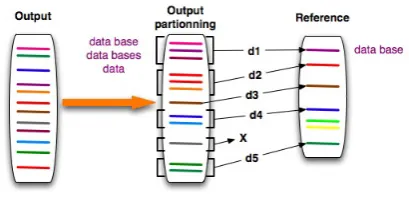
Figure 2: Output tuning. The tuning process is represented in an abstract way. The type and granularity of the gold standards are represented as various sizes and forms. The outputs of the systems are transformed so as to fit as much as possible to the chosen gold standard, before they are evaluated.
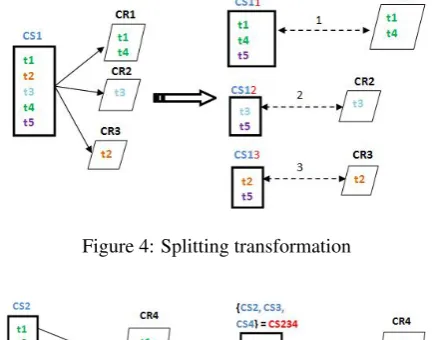
Figure 4: Splitting transformation
Figure 5: Merging transformation
4.3. Gradual relevance
The relevance of the output elements with respect to those of the gold standard is based on the matching and tuning steps. For each element of the tuned output (e0o∈T(O)), a gradual relevance score is computed.
Term extraction For term extraction evaluation,
relGS(e0o)is equal to the minimal distance of the terms of
e0oto the matching GS term:
relGS(e0o) = min e∈e0
o
(dt(e, egs))
Semantic class acquisition For semantic class acquisi-tion, the relevance value depends on the transformation step.
If the output class eo is unchanged, that means that it matches only one concept. Its relevance is given by the F-measure computed on the basis of the terms that it shares with its matching concept.
relGS(e0o) =f m(eo, egs) =
2∗P(eo,egs)∗R(eo,egs)
P(eo,egs)+R(eo,egs)
where P(eo, egs)and R(eo, egs)are precision and recall between output and GS elements. They are computed as follows:
P(eo, egs)= number of relevant terms of the output class (number of terms of the output class (eo)eo) and
R(eo, egs)= number of relevant terms of the output class (number of terms of the GS concept (egs)eo)
If a class e0o results from the merging of different output classes ei, its relevance is the average of the relevance of the original ones (ei):
relGS(e0o) =
P|X|
i=1f m(ei,egs) |X|
Wheree1, e2, ...e|X|are the classes merged ine0oand|X| is their number.
Finally, a tuned output (e0o) may result from a splitting op-eration applied on a class of the output (eo) that matches many GS concepts (egs). In that case, we want to take into account the proximity relation of the matching GS con-cepts. If these concepts are close to each other, the rele-vance is better than if they are apart. The relerele-vance ofe0o
(the generated subclass) is computed as follows:
1. We select the GS concept (egs)which has the maximal F-measure value (f m(eo, egs)) with the output class (eo). This conceptpis considered as central.
2. To compute relGS(e0o), the relevance values are weighted with a similarity value that expresses the proximity of various matching GS concepts with the central one (p). We use the measure of (Wu and Palmer, 1994) to compute a similarity between two concepts based on their distance:
Sim(p,egs) = 2* depth(C)
depthC(p)+depthC(egs)
WhereCis the closest common ancestor ofpandegs,
depth(X)etdepthY(X)are respectively the distance from X to the root of the ontology and the distance fromXto the root by way ofY.
Philippe Langlais and Michael Carl. 2004. General-purpose statistical translation engine and domain specific texts: Would it work? Terminology, 10(1):131–152. Li Ma, Yang Yang, Zhaoming Qiuand Guotong Xieand Yue
Pan, and Shengping Liu. 2006. Towards a complete owl ontology benchmark. In Springer Berlin / Heidelberg, editor, The Semantic Web: Research and Applications, volume 4011/2006, pages 125–139.
Alexander Maedche and Steffen Staab. 2002. Measur-ing similarity between ontologies. In The European Conference on Knowledge Acquisition and Management (EKAW’02).
Alvin F. Martin, John S. Garofolo, Jonathan C. Fiscus, Au-drey N. Le, David S. Pallett, Mark A. Przybocki, and Gregory A. Sanders. 2004. Nist language technology evaluation cookbook. InProc. of LREC’04).
Widad Mustafa El Hadi, Ismail Timimi, Marianne Dab-badie, Khalid Choukri, Olivier Hamon, and Yun-Chuang Chiao. 2006. Terminological resources acquisition tools: Toward a user-oriented evaluation model. InProc. of LREC’06, pages 945–948, Genova, Italy, May. Adeline Nazarenko and Ha¨ıfa Zargayouna. 2009.
Evaluat-ing term extraction. InRecent Advances in Natural Lan-guage Processing (RANLP).
Aur´elie N´ev´eol, Kelly Zeng, and Olivier Bodenreider. 2006. Besides precision & recall: Exploring alternative approaches to evaluating an automatic indexing tool for medline. InProc. of the AMIA Annual Symposium, pages 589–593.
Maria Teresa Pazienza, Marco Pennacchiotti, and Fabio Massimo Zanzotto. 2005. Terminology extrac-tion: An analysis of linguistic and statistical approaches. In S. Sirmakessis, editor, Knowledge Mining Series: Studies in Fuzziness and Soft Computing. Springer Verlag.
Sylvie Szulman, Nathalie Aussenac Gilles, and Sylvie De-spres. 2008. The Terminae Method and Platform for On-tology Engineering from Texts. InBridging the Gap be-tween Text and Knowledge - Selected Contributions to Ontology Learning and Population from Text, page paru. IOS press, 02.
Jiao Tao, Li Ding, and Deborah L. McGuinness. 2009. In-stance data evaluation for semantic web-based knowl-edge management systems. InHICSS ’09: Proceedings of the 42nd Hawaii International Conference on Sys-tem Sciences, pages 1–10, Washington, DC, USA. IEEE Computer Society.
Nina Wacholder and Peng Song. 2003. Toward a task-based gold standard for evaluation of np chunks and tech-nical terms. InProceedings of HTL-NAACL, pages 189– 196.
Zhibiao Wu and Martha Palmer. 1994. Verb semantics and lexical selection. InProceedings of the 32nd Annual Meetings of the Associations for Computational Linguis-tics, pages 133–138.
Ziqi Zhang, Jos´e Iria, Christopher Brewster, and Fabio Ciravegna. 2008. A comparative evaluation of term recognition algorithms. In Proceedings of the Sixth International Conference on Language Resources and