Yet Another Platform for Extracting Knowledge from Corpora
Francesca Fallucchi, Fabio Massimo Zanzotto
DISP - University of Rome “Tor Vergata” (Italy) [email protected], [email protected]
Abstract
The research field of “extracting knowledge bases from text collections” seems to be mature: its target and its working hypotheses are clear. In this paper we propose a platform, YAPEK, i.e.,Yet Another Platform for Extracting Knowledge from corpora, that wants to be the base to collect the majority of algorithms for extracting knowledge bases from corpora. The idea is that, when many knowledge extraction algorithms are collected under the same platform, relative comparisons are clearer and many algorithms can be leveraged to extract more valuable knowledge for final tasks such as Textual Entailment Recognition. As we want to collect many knowledge extraction algorithms, YAPEK is based on the three working hypotheses of the area: thebasic hypothesis, thedistributional hypothesis, and thepoint-wise assertion patterns. In YAPEK, these three hypotheses define two spaces: the space of thetarget textual formsand the space of thecontexts. This platform guarantees the possibility of rapidly implementing many models for extracting knowledge from corpora as the platform gives clear entry points to model what is really different in the different algorithms: the feature spaces, the distances in these spaces, and the actual algorithm.
1.
Introduction
The research field of “extracting knowledge bases from text collections” seems to be mature. Its target is clearly de-fined: methods and systems want to extract, with the mini-mal supervision, equivalences or relations between relevant textual elements, i.e., words, word sequences, or general-ized patterns. Its main working hypotheses are stable: (1) theBasic Hypothesisstating that similarities or relations between textual elements can be derived only looking at these textual elements (e.g., (Jacquemin, 2001)); (2) Har-ris’ Distributional Hypothesis (Harris, 1964) that gives a way to induce similarity between textual elements looking at their contexts in a corpus; (3) thePoint-wise Assertion Pattern Exploitation Hypothesis saying that specific tex-tual patterns can be used to extract relevant relations be-tween textual elements (firstly used in (Robison, 1970)). Its main strategies for realizing algorithms are stable: there are three strategies for going backward and forward between the two spaces, the space of the target textual ele-ments and the space of the contexts, defined by the above three working hypotheses. Finally,its principles and algo-rithms are used in many fields: lexical acquisition (e.g., (Baldwin et al., 2005)), terminology extraction and struc-turing (e.g., (Jacquemin, 2001)), ontology learning in the area of the semantic web (e.g., (Medche, 2002)), and learn-ing knowledge for knowledge-intensive applications (e.g., Question Answering, Information Extraction, Textual En-tailment Recognition, etc.).
Despite all this, frontiers and challenges of the field are somewhat unclear and real innovations of knowledge ac-quisition models presented in these years are difficult to de-termine. Two important points are still missing. Firstly, the field is still looking fora shared evaluation method that al-lows comparison between different approaches. This evalu-ation method is particularly difficult to define as the failure of the Ontology Learning Challenge in the Pascal Network of Excellence1 seems to demonstrate. Secondly, it is still
1
http://www.pascal-network.org
unclear how toeffectively use all the extracted knowledge: attempts to use extracted knowledge in tasks such as Tex-tual Entailment Recognition (Bar Haim et al., 2006) had very limited impact on performance.
In this paper we propose a platform, YAPEK, i.e.,Yet An-other Platform for Extracting Knowledge from corpora, that wants to be the base to collect the majority of algo-rithms for extracting knowledge bases from corpora. The idea is that, when many knowledge extraction algorithms are collected under the same platform, relative comparisons are clearer and many algorithms can be leveraged to ex-tract more valuable knowledge for final tasks such as Tex-tual Entailment Recognition. As we want to collect many knowledge extraction algorithms, YAPEK is based on the three working hypotheses of the area: thebasic hypothe-sis, thedistributional hypothesis, and thepoint-wise asser-tion patterns. In YAPEK, these three hypotheses define two spaces: the space of thetarget textual formsand the space of thecontexts. This platform guarantees the possibility of rapidly implementing many models for extracting knowl-edge from corpora as the platform gives clear entry points to model what is really different in the different algorithms: the feature spaces, the distances in these spaces, and the actual algorithm.
2.
Spaces and working hypotheses
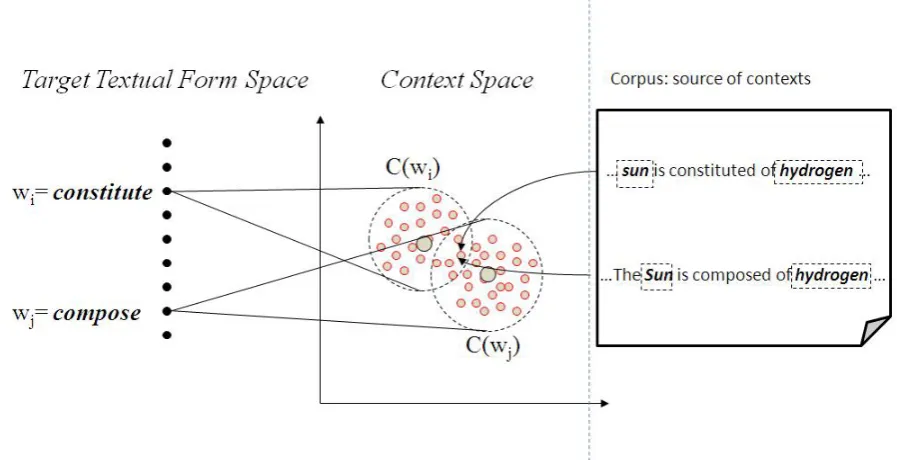
Maby knowledge extraction methods are based on the three working hypotheses: Basic Hypothesis (BH), Harris’ Dis-tributional Hypothesis (DH), and Point-wise Assertion Pat-tern exploitation hypothesis (PAP). As our aim is to define a platform that can be used to model many of these knowl-edge extraction methods, we need to clarify how these hy-potheses interact for extracting equivalences or relations among textual forms, i.e., how they can be used to capture language variability.
Figure 1: Two spaces for the three hypotheses
has to be defined a-priori. This is generally done analysing the frequency, or similar indicators, of the wordswin the corpus. The second applicability limitation depends on the fact that the contexts of eachwhave to be represented in the
F space. This means that the corpus has to be completely scanned. Only after the computation of the similarity be-tween different words can be done.
The general algorithm direct learning(C), that directly ap-plies the Distributional Hypothesis, is described in the fol-lowing. It takes in input a corpus C and return a set of equivalence classes Wi containing words or linguistic
structures:
direct learning(C)returns (W1,...,Wn)
Given a corpusCand the releted function
C:
1. Let W be the most important ele-ments inC
2. For eachwi∈W:
(a) initializeWi={wi}
(b) retreive all the contexts C(wi)
and map them in the feature spaceF
(c) eventually computeI(C(wi))
3. For each(wi, wj)∈W ×W:
(a) comupute
simctx(C(wi),C(wj))
(b) ifsimctx(C(wi),C(wj)) > αwi
then putwjinWi
The above algorithm has been largely employed. As we al-ready discussed in the previous sections, the methods differ
in the target of the analysis and the feature space in which the similarity is computed.
In (Glickman and Dagan, 2003), the direct learning has been used to extract similarity between verbs from a single corpus. The elements represented in the feature space F were then intensional represen-tations of verb contexts. The actual features were determined by the pair (V erbArg, ArgF iller) where
V erbArg is one of the possible verb arguments (e.g., the
subject, object, modif ier − f rom, modif ier −in, ...) andArgF illeris a word sequence. The value of this fea-ture was related to the frequency and the inverse document frequency.
In (Lin and Pantel, 2001), the algorithm has been used to discover equivalence relations between verbal linguistic ex-pressions connecting two arguments X and Y, e.g.X solved Y≈X found a solution to Y. Each of these verbal linguistic expressions is called patternp. The idea was to represent in a feature space the possible filler of the slotsX andY. The feature space represents intensionally a set of contexts of each pattern. The features were(s, w)wheresis the slot
X orY andwis a possible word filling the slot. Given a set of contexts where the patternpathas been found (the set will be calledpatas the pattern), the feature values of theI(pat)are computed as follows:
I(s,w)(pat) =mi(pat, s, w) (3)
wheremi(pat, s, w)is the point-wise mutual information (Church and Hanks, 1989):
mi(pat, s, w) =log p(pat, s, w)
p(pat, s)p(s, w) (4)
Probabilities are estimated with the maximum likelihood principle over the corpus. We define the vectorsIs(where
fol-Figure 2: Partial classes diagram of the feature space objects.
approach) by extracting substrings relating seeds in corpus sentences. The presence of any variant of the answer term causes the same treatment as for the original answer term. Nevertheless the patterns cannot handle long-distance de-pendencies. The approach has been tested on several rela-tions providing good results for specific relarela-tions (such as birthdate) whereas lower precision was revealed for generic and frequent ones (as is-a and part-of). Also this algorithm is in the line of learning the extracting approach.
Szpektor et al. (Szpektor et al., 2004) defined a fully unsu-pervised learning algorithm for web-based extraction of en-tailment relations. By assuming that the same meaning can be expressed in a text in a huge variety of surface forms, they focused on acquiring paraphrase patterns that repre-sent different forms in which a certain meaning can be ex-pressed. This approach has been applied to acquire entail-ment relations from the Web. Paraphrase acquisition re-sults in finding linguistic structures (called templates) shar-ing the same lexical elements describshar-ing the context of a sentence. These lexical elements are used as anchors. Tem-plates extracted from different sentences, while connecting the same anchors, are assumed to paraphrase each other. We recognized a structuring model for which we distin-guish between syntactic anchors (such as subject, object, verb) and context anchors (such as prepositional phrase). Main problems relate to both finding matching anchors and identifying template structure. Specific algorithms have been developed for both problems. A broad range of se-mantic relations varying from synonymy to more complex entailment have been extracted.
5.
YAPEK: Yet Another Platform for
Extracting Knowledge from corpora
Given the analysis of the previous section, the defini-tion of a knowledge extracdefini-tion platform is straightforward. Knowledge extraction methods are largely based on the above three working hypotheses. The differences depend on four important aspects:• the target information: the target forms and the
rela-tions they want to extract
• features and feature values: what are the spaces that are defined by the three hypotheses
• distance or similarity: what are the similarity func-tions that needs to be defined in these spaces
• how these two spaces are used: the knowledge-extraction methods backward and forward between the two spaces using different strategies
In YAPEK, it is possible to control all the four aspects us-ing clear APIs. This gives the possibility of implement-ing many of the approaches for extractimplement-ing knowledge from corpora. The platform gives APIs for defining: the target textual forms defined in the target textual form space, the feature vectors in the context space, and the similarity func-tions,rBH(wi, wj)andsimDH(C(wi), C(wj)), that needs
to be defined in these spaces.
The realized system allows to implement different ap-proaches for extracting knowledge. The system analyzes the given corpus according to the strategy used for realiz-ing knowledge extraction methods. Moreover it allows to implement the above three working hypotheses thanks to the general definition of the components of the system.
5.1. The feature space
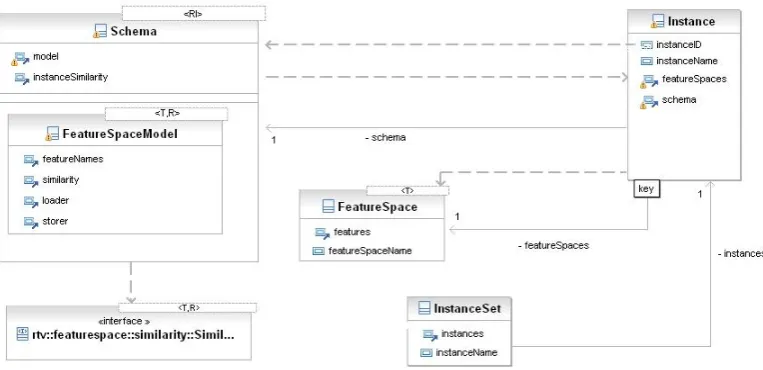
The three working hypotheses define different spaces where target textual formsandcontextsmay be represented. The relevant aspect is that each instance can be completely described by referring to a single space that includes all the possible feature subspaces related to the considered in-stance.
For each instance we can get specific information according to the selected feature space.
The partial class diagram is shown in Fig. 2. The principal feature space objects are:
Figure 3: Partial classes diagram of the learning algorithm
• InstanceSet: contains all instances extracted from the corpus;
• Instance: contains a single instance and its feature space.
• FeatureSpace: contains the space that includes all fea-ture subspaces.
Each new feature space implements the class FeatureS-pace and it is necessary to add it to the created instance ofSchema. Then it is possible to add feature subspaces to the new feature space.
It is also necessary to define the functions, e.g. the similar-ity, that operate in this space.
The similarity implements the classSimilarityand it is pos-sible to define different similarities according to the kind of the feature space and the working hypothesis.
5.2. The eXtended Dependency Graph
To model both target textual forms and context we use also the computational version of the eXtended Dependency Graph (XDG) (Basili and Zanzotto, 2002). An XDG is a dependency graph whose nodes C are constituents and whose edgesD are the grammatical relationsamong the constituents, i.e.X DG= (C, D).
Constituents (i.e. c ∈ C) are classical syntactic trees with explicitsyntactic heads,h(c), andpotential semantic gov-ernors,gov(c). Constituents can be represented as feature structures, having as relevant features:
• the head and thegov, having as domain C (the set of trees and subtrees derived fromC), and represent-ing respectivelysyntactic headsandpotential seman-tic governors;
• the typerepresenting the syntactic label of the con-stituent and having as domainΛ.
Moreover, a constituent can be either complex or sim-ple. A complex constituent is a tree containing other
constituents as sons (which are expressed by the feature
subConstituents). Asimple constituentrepresents a leaf node, i.e., a token span in the input sentence, that carries information about lexical items through the following fea-tures:
• surf ace, representing the actual form found in the to-ken span,
• lemma, taking values in the lexiconLand represent-ing the canonical form of the target surface,
• morphology, representing the morphological features of the inflected form.
On the other hand, dependencies in(h, m, T) ∈D repre-sent typed (whereT is the type) and ambiguous relations among a constituent, thehead h, and one of itsmodif iers m. The ambiguity is represented usingplausibility, a real value ranging between 0 and 1, where 1 stands for unam-biguous. Then,Dis defined as a subset ofC×C×Γ×(0,1], where the sets represent respectively the domains of the fea-tureshead,modif ier,type, andplausibility.
5.3. The algorithm hierarchy
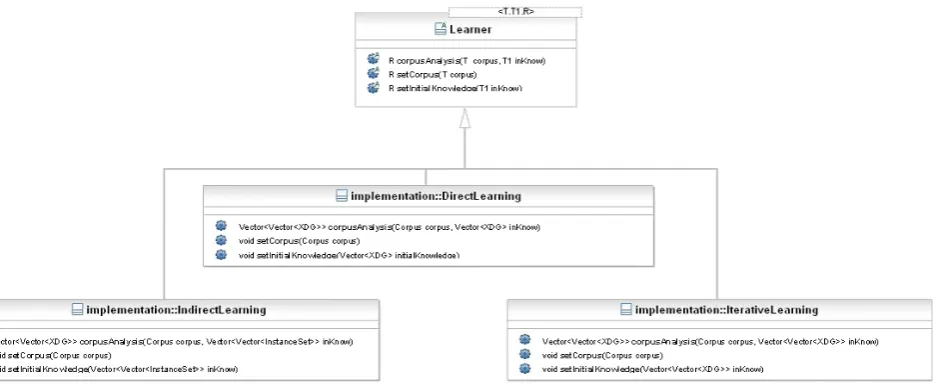
The realized system gives the possibility of implementing many of the approaches for extracting knowledge from cor-pus. In the Fig. 3 it is shown the partial classes diagram of the knowledge extraction algorithm.
Each class that extends theLearner class implements one of the three strategies for realizing knowledge extraction methods. These classes override the methods inherited from the respective super class and they specify input and output parameters types according to the implemented strategies.
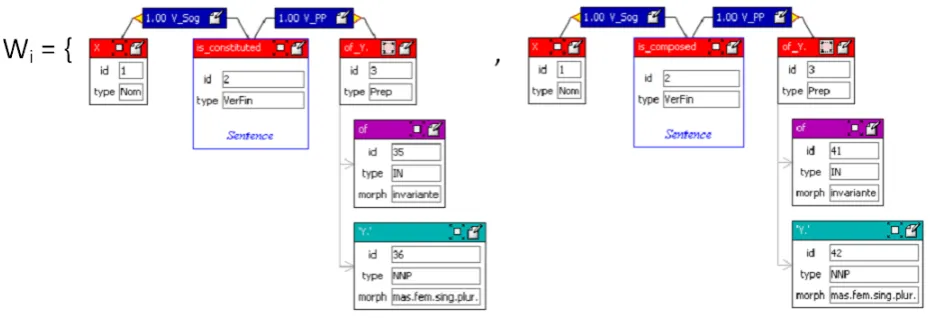
Figure 4: Example of a equivalence class
the output parameter type is the vector of the equivalence classes for all approaches.
Fig.4 shows an example of the equivalence class of the formsX is constituted of Y andX is composed of Y. The space of these forms are reported in Fig. 1.
The equivalence classWi, in this example, contains the
lin-guistic structure of the two contexts containing bothXand Y. The XDGs of these two forms is obtained and they rep-resent the grammatical relation among constituents. The constituents is constituted and is composed are the principal verb constituents of the two forms. These verbs have a grammatical relationV Sogwith the first variable X and a grammatical relationV PPwith a constituent that contains the second variable Y.
InDirectLearnig,corpusAnalysis()has in input the corpus and a vector of the most important elements in the cor-pus (V ector < XDG >) and returns a set of equivalence classes. In IndirectLearningthe method has in input the corpus and a vector of a-priori knowledge. Each Ki is a
vector ofInstanceSeti.e. the vector contains all instances and its feature space. InIterativeLearnigthe input consists of the corpus and a vector of a-priori equivalence classes that we represented with a vector of XDG.
6.
Conclusions and future work
In this paper we propose a platform, YAPEK, i.e.,Yet An-other Platform for Extracting Knowledge from corpora, that wants to incorporate many of the algorithms for ex-tracting knowledge bases from corpora. This is a very inter-esting computational model that can help in better compar-ing knowledge acquisition algorithms. We plan to include in this platform many of the existing algorithms.7.
References
Timothy Baldwin, Anna Korhonen, and Aline Villavicen-cio, editors. 2005. ACL-SIGLEX Workshop on Deep Lexical Acquisition, Ann Arbor, Michigan, June. Asso-ciation for Computational Linguistics.
Roy Bar Haim, Ido Dagan, Bill Dolan, Lisa Ferro, Danilo Giampiccolo, Bernardo Magnini, and Idan Szpektor. 2006. The II PASCAL RTE challenge. In PASCAL Challenges Workshop, Venice, Italy.
Roberto Basili and Fabio Massimo Zanzotto. 2002. Pars-ing engineerPars-ing and empirical robustness. Natural Lan-guage Engineering, 8/2-3.
John Burger and Lisa Ferro. 2005. Generating an entail-ment corpus from news headlines. In Proceedings of the ACL Workshop on Empirical Modeling of Semantic Equivalence and Entailment, pages 49–54, Ann Arbor, Michigan, June. Association for Computational Linguis-tics.
Kenneth Ward Church and Patrick Hanks. 1989. Word as-sociation norms, mutual information and lexicography. InProceedings of the 27th Annual Meeting of the Asso-ciation for Computational Linguistics (ACL), Vancouver, Canada.
Bill Dolan, Chris Quirk, and Chris Brockett. 2004. Un-supervised construction of large paraphrase corpora: Ex-ploiting massively parallel news sources. InProceedings of Coling 2004, pages 350–356, Geneva, Switzerland, Aug 23–Aug 27. COLING.
Oren Glickman and Ido Dagan. 2003. Identifying lex-ical paraphrases from a single corpus: A case study for verbs. In Proceedings of the International Confer-ence Recent Advances of Natural Language Processing (RANLP-2003), Borovets, Bulgaria.
Zellig Harris. 1964. Distributional structure. In Jerrold J. Katz and Jerry A. Fodor, editors,The Philosophy of Lin-guistics, New York. Oxford University Press.
Marti A. Hearst. 1992a. Automatic acquisition of hy-ponyms from large text corpora. InProceedings of the 15th International Conference on Computational Lin-guistics (CoLing-92), Nantes, France.
Marti A. Hearst. 1992b. Automatic acquisition of hy-ponyms from large text corpora. In Proc. of the 15th CoLing, Nantes, France.
Christian Jacquemin. 2001. Spotting and Discovering Terms through Natural Language Processing. sachusetts Institue of Technology, Cambrige, Mas-sachussetts, USA.
Dekang Lin and Patrick Pantel. 2001. DIRT: discovery of inference rules from text. InKnowledge Discovery and Data Mining, pages 323–328.
Se-mantic Web, volume 665 ofEngineering and Computer Science. Kluwer International.
George A. Miller. 1995. WordNet: A lexical database for English. Communications of the ACM, 38(11):39–41, November.
Patrick Pantel and Marco Pennacchiotti. 2006. Espresso: Leveraging generic patterns for automatically harvest-ing semantic relations. InProceedings of the 21st Inter-national Conference on Computational Linguistics and 44th Annual Meeting of the Association for Computa-tional Linguistics, pages 113–120, Sydney, Australia, July. Association for Computational Linguistics. Ted Pedersen, Siddharth Patwardhan, and Jason Michelizzi.
2004. Wordnet::similarity - measuring the relatedness of concepts. InProc. of 5th NAACL, Boston, MA.
Deepak Ravichandran and Eduard Hovy. 2002. Learning surface text patterns for a question answering system. In Proceedings of the 40th ACL Meeting, Philadelphia, Pennsilvania.
Harold R. Robison. 1970. Computer-detectable semantic structures.Information Storage and Retrieval, 6(3):273– 288.