A Positional Tagset for Russian
Jirka Hana and Anna Feldman
Charles University, Montclair State University [email protected], [email protected]
Abstract
Fusional languages have rich inflection. As a consequence, tagsets capturing their morphological features are necessarily large. A natural way to make a tagset manageable is to use a structured system. In this paper, we present a positional tagset for describing morphological properties of Russian. The tagset was inspired by the Czech positional system (Hajiˇc,2004). We have used preliminary versions of this tagset in our previous work (e.g.,Hana et al.(2004,2006);Feldman(2006);Feldman and Hana(2010)). Here, we both systematize and extend these preliminary versions (by adding information about animacy, aspect and reflexivity); give a more detailed description of the tagset and provide comparisons with the Czech system.
1.
Introduction
In this paper we present a positional tagset for capturing morphological properties of Russian words. The tagset was inspired by the Czech positional system (Hajiˇc,2004). We have used preliminary versions of this tagset in our previ-ous work (e.g.,Hana et al.(2004,2006);Feldman(2006); Feldman and Hana(2010)). Here, we both systematize and extend these preliminary versions (by adding information about animacy, aspect and reflexivity); give a more detailed description of the tagset and provide comparisons between the two systems. Technical details about the tagset can be found athttp://purl.org/net/rutags.
2.
Positional tagset
Russian has rich inflection. Thus, any tagset capturing its morphological features is necessarily large. A natural way to make a tagset manageable is to use a structured system. In such a system, a tag is a composition of tags each coming from a much smaller and simpler atomic tagset associated with a particular morpho-syntactic property (e.g. gender or tense).
Examples of structured tagsets are what we call positional tagsets and compact tagsets. In both systems, the tags are sequences of values encoding individual morphologi-cal features. In a positional tagset, all tags have the same length, encoding all the features distinguished by the tagset. Features not applicable for a particular word have a N/A value. In a compact tagset, the N/A values are left out. Usu-ally, part-of-speech or a similar category (e.g. the so-called SubPOS in the Czech Positional Tagset (Hajiˇc,2004)) de-termines which values are applicable and which are not. For example, AAFS4----2A---- in the Czech Positional Tagset and AFS42A in the Czech Compact Tagset (now obsolete) both encode the same information: adjective (A), feminine gender (F), singular (S), accusative (4), compar-ative (2), not-negated (A).
For large tagsets, a structured system has many practical benefits. For example,
1. Learnability: It is much easier to link traditional lin-guistic categories to the corresponding structured tag than to an unstructured atomic tag. While it takes
some time to learn the positions and the associated values of the Czech Positional Tagset, for most peo-ple, it is still far easier than learning the corresponding 4000+ tags as atomic symbols.
2. Decomposability: The fact that the tag can be decom-posed into individual components has been used in various applications. For instance, the tagger of (Ha-jic and Hladk´a,1998), for a long time the best Czech tagger, operates on the subtag level.
3. Systematic evaluation: The evaluation of tagging re-sults can be done in a more systematic way. Each category can be evaluated separately on each morpho-logical feature. Not only is it easy to see on which POS the tagger performs the best/worst, but it is also possible to determine which individual morphological features cause the most problems.
It is also worth noting that it is trivial to view a structured tagset as an atomic tagset (e.g. by assigning a unique natu-ral number to each tag), while the opposite is not true.
3.
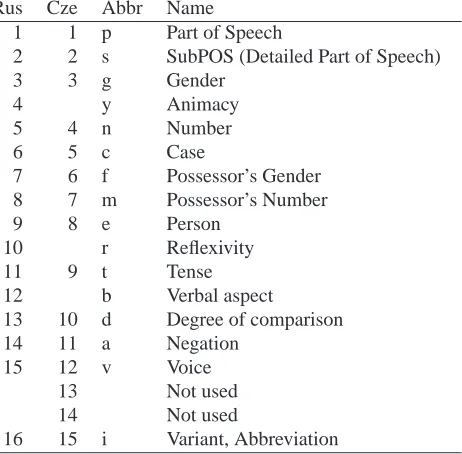
Positions
Pos Abbr Name Nr. of values
1 p Part of Speech 12
2 s SubPOS (Detailed Part of Speech) 42
3 g Gender 4
4 y Animacy 3
5 n Number 3
6 c Case 7
7 f Possessor’s Gender 4
8 m Possessor’s Number 2
9 e Person 4
10 r Reflexivity 2
11 t Tense 4
12 b Verbal aspect 3
13 d Degree of comparison 3
14 a Negation 2
15 v Voice 2
16 i Variant, Abbreviation 7
2. The set of values for a particular category: For exam-ple, Russian has neither vocative nor dual, nor does it have auxiliary or pronominal clitics; and the differ-ence between colloquial and official Russian is not as systematic and profound as in Czech.
3. Exact meaning of a particular value symbol.
4. Wildcards: The Russian tagset also uses far fewer wildcards (symbols representing a set of atomic val-ues). Even though wildcards might lead to better tag-ging performance, we intentionally avoid them. The reason is that they provide less information about the word, which might be needed for linguistic analysis or an NLP application. In addition, it is trivial to translate atomic values to wildcards if needed.
The Russian tagset contains only wildcards covering all atomic values (denoted byXfor all applicable po-sitions). There are no wildcards covering a subset of atomic values. Forms that would be tagged with a tag
containing a partial wildcard in Czech are regarded as ambiguous.
For example, where the Czech tagset uses Z (all genders except feminine), our Russian tagset uses
M (masculine) or N (neuter) depending on the con-text. Thus, Czech tomto ‘thismasc/neut.loc’ is tagged
as PDZS6--- in v tomto domˇe ‘in this housemasc’ and v tomto m´ıstˇe ‘in this placeneut’,
while Russian `etom ‘thismasc/neut.loc’ is tagged as
PDMXS6--- in v `etom dome ‘in this housemasc’ and PDNXS6--- in v `etom meste ‘in this placeneut’.
9.
Acknowledgement
The development of the tagset was supported by the GA ˇCR grant P406/10/P328 and by the NSF grant # 0916280.
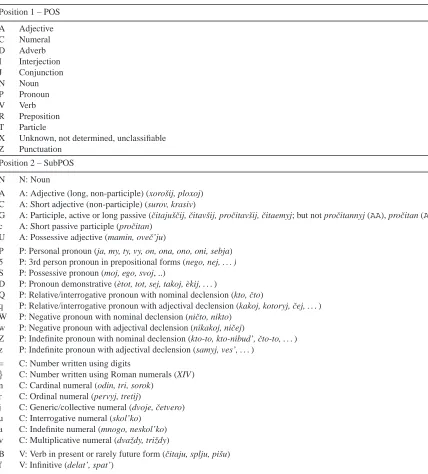
Table 3: Values of individual positions of the Russian tagset
Position 1 – POS
A Adjective C Numeral D Adverb I Interjection J Conjunction N Noun P Pronoun V Verb R Preposition T Particle
X Unknown, not determined, unclassifiable Z Punctuation
Position 2 – SubPOS
N N: Noun
A A: Adjective (long, non-participle) (xoroˇsij, ploxoj) C A: Short adjective (non-participle) (surov, krasiv)
G A: Participle, active or long passive (ˇcitajuˇsˇcij, ˇcitavˇsij, proˇcitavˇsij, ˇcitaemyj; but not proˇcitannyj (AA), proˇcitan (Ac) c A: Short passive participle (proˇcitan)
U A: Possessive adjective (mamin, oveˇc’ju)
P P: Personal pronoun (ja, my, ty, vy, on, ona, ono, oni, sebja) 5 P: 3rd person pronoun in prepositional forms (nego, nej, . . . ) S P: Possessive pronoun (moj, ego, svoj, ..)
D P: Pronoun demonstrative (`etot, tot, sej, takoj, `ekij, . . . )
Q P: Relative/interrogative pronoun with nominal declension (kto, ˇcto)
q P: Relative/interrogative pronoun with adjectival declension (kakoj, kotoryj, ˇcej, . . . ) W P: Negative pronoun with nominal declension (niˇcto, nikto)
w P: Negative pronoun with adjectival declension (nikakoj, niˇcej)
Z P: Indefinite pronoun with nominal declension (kto-to, kto-nibud’, ˇcto-to, . . . ) z P: Indefinite pronoun with adjectival declension (samyj, ves’, . . . )
= C: Number written using digits
} C: Number written using Roman numerals (XIV) n C: Cardinal numeral (odin, tri, sorok)
r C: Ordinal numeral (pervyj, tretij)
j C: Generic/collective numeral (dvoje, ˇcetvero) u C: Interrogative numeral (skol’ko)
a C: Indefinite numeral (mnogo, neskol’ko) v C: Multiplicative numeral (dvaˇzdy, triˇzdy)
i V: Imperative (spi, sdelaj, proˇcti) p V: Past tense (spal, ˇzdal)
e V: Gerund (delaja; pridja, otpisav)
b D: Adverb without a possibility to form negation and degrees of comparison (vverxu, vnizu, potom) g D: Adverb forming negation and degrees of comparison (vysoko, daleko)
F R: Part of a preposition; never appears isolated (nesmotrja) R R: Nonvocalized preposition (ob, pered, s, v, . . . )
V R: Vocalized preposition (obo, peredo, so, vo, . . . )
, J: Subordinate conjunction (esli, ˇcto, kotoryj) ˆ J: Non-subordinate conjunction (i, a, xotja, priˇcem)
I I: Interjection (oj, aga, m-da)
T T: Particle (li) # Z: Sentence boundary : Z: Punctuation
0 X: Part of a multiword foreign phrase X X: Unknown, Not Determined, Unclassifiable
Position 3 – Gender Distinguished for: N, A{ACGUc}, P{P5DLwSq8}, C{nra}, VB
F Feminine M Masculine N Neuter X Any gender
Position 4 – Animacy Distinguished for: N, A{AGU}, P{SDwqz}, C{nrja}
A Animate I Inanimate X Either
Position 5 – Number Distinguished for: N, A{ACGUc}, P{P5DwSq}, C{nra}, V{Bp}
P Plural S Singular X Any number
Position 6 – Case Distinguished for: N, A{AGU}, P, C{nrjua}
1 Nominative 2 Genitive 3 Dative 4 Accusative 6 Locative 7 Instrumental X Any case
Position 7 – Possessor’s Gender Distinguished for: PS, AU
F Feminine possessor M Masculine possessor N Neuter possessor X Possessor of any gender
Position 8 – Possessor’s Number Distinguished for: PP
P Plural possessor S Singular possessor
Position 9 – Person Distinguished for: P{P5S}, V{Bi}
1 1st person 2 2nd person 3 3rd person X Any person
Position 10 – Reflexivity Distinguished for: AG, P{P5S}, V
R Reflexive I Irreflexive
Position 11 – Tense Distinguished for: A{G}, V{Bp}
R Past
X Any (Past, Present, or Future)
Position 12 – Aspect Distinguished for: AG, V
P perfective I imperfective X either aspect
Position 13 – Degree of comparison Distinguished for: AA, Dg
1 Positive 2 Comparative 3 Superlative
Position 14 – Negation Distinguished for: N, A, Dg
A Affirmative (not negated) N Negated
Position 15 – Voice Distinguished for: AG, Ac
A Active P Passive
Position 16 – Variant Distinguished for: As needed
- Basic variant
1 Variant (generally less frequent)
2 Variant (generally rarely used, bookish, or archaic) 3 Variant (very archaic)
5 Variant (colloquial)
6 Variant (colloquial, generally less frequent) 7 Variant (colloquial, generally less frequent) 8 Abbreviations
Table 4: Overview of the Russian tagset
template description sample word sample tag
N – Nouns
NNgync---a-- noun golos
NNMIS4---A--A – NNMIS4---A--Adjectives (incl. Participles)
AAgync---da-- long adjective tjaˇzelyj
AAMIS4---1A--ACg-n---a-- short adjective krasiv
ACM-S---A--AGgync---rtb-av - long participle ˇcitajuˇsˇcij
AGMXS1---IIP-AA-tv∈ {PA,RA,XP} smejuˇsˇcajasja
AGFXS1---RRP-AA-i.e. present/past active, passive
AUgyncf---a-- possessive adjective muˇznin
AUMXS2M---A--Acg-n---aP- pass.perf.short participle proˇcitan
AcM-S---AP-P – pronoun
PP--nc--eI--- personal pronoun; e∈ {1,2} nam
PP--P3--1I---PPg-nc--3I--- personal pronoun 3rd person on
PPM-S1--3I---PP---c---R--- personal reflexive sebja sebja
PP---4---R---P5g-nc--3I--- personal p. in prep. forms nego
P5M-S2--3---PDgync--- demonstrative `etu
PDFXS4---PW---c--- negative (nominal declension) niˇcto
PW---1---Pwgync--- negative (adj declension) nikakoj
PwMXS1---PSgync-meI--- possessive moja
PSFXS1-S1I---PSXXXXfm3I--- possessive ego
PSXXXXMS3I---PSgync---R--- possessive reflexive svoj
PSMXS1---R---PQ---c--- relative/interrogative (nom decl) ˇsto, kto PQ---1---Pqgync--- relative/interrogative (adj decl) kakoj
PqMXS1---PZ---c--- indefinite (nom. decl.) kogo-to
PZ---4---Pzgync--- indefinite (adj. decl.) kakoj-to
PzMXS1---C – Numeral
C=--- numbers (using digits) 3.14
C=---C}--- roman numeral XVII
CnMAS3---Cngy -c--- cardinal numeral 2, poltora dvux
CnMA-2---Cn-y -c--- cardinal numeral 3,4 trx
Cn-A-4---Cn--yc--- cardinal numeral 5+ pjati
Cn-A-2---Crgync--- ordinal pervyj
CrMXS1---Cj-y -c--- generic/collective numeral dvoix
Cj-A-3---Cu---c--- interrogative skol’ko
Cu---x---Ca---c--- indefinite numeral neskol’ko
Ca---1---Cagync--- indefinite num. (adj decl.) mnogomu
CaMXS3---Cv--- multiplicative triˇzdi
Cv---V – verb
VB--n---ertb---- present (rarely fut.) finite form otryvaeˇs’
VB--P---2IPI----VBg-n----rRb---- past tense ˇcital
VBM-S----IRI----Ve---r-b---- gerund grozja
Ve---I-I----napisav
Ve---I-P----Vf---r-b---- infinitive spat’
Vf---I-I----Vi--n---er-b---- imperative rabotaj
Vi--S---2I-I----D – Adverb
Db--- adv. not forming negation/degrees tam Db---Dg---da-- adv. forming negation/degrees sil’nee
Dg---2A--R – Preposition
RR---c--- nonvocalized prep. with c case nad
RR---7---RV---c--- vocalized prep. with c case nado
RV---7---RF--- part of a multiword prep. nesmotrja
RF---J – Conjunction
Jˆ--- coordinating conj. i
Jˆ---J,--- subordinating conj. ˇcto
J,---T – particle
TT--- particle net
TT---I – TT---Interjection
II--- Interjection
II---Z – punctuation
Z#--- Sentence boundary
Z#---Z:--- Punctuation !
Z:---X – special
X0--- part of a multiword foreign phrase
X0---XX--- unknown
XX---References
Bermel, N. (1997). Context and the Lexicon in the De-velopment of Russian Aspect. Berkeley: University of California Press.
Dahl, O. (1985). Tense and Aspect Systems. Basil Black-well, Oxford.
Feldman, A. (2006). Portable Language Technology: A Resource-light Approach to Morpho-syntactic Tagging. Ph. D. thesis, The Ohio State University.
Feldman, A. and J. Hana (2010). A Resource-light Ap-proach to Morpho-syntactic Tagging. Language and Computers. Amsterdam–New York: Rodopi Press.
Hajic, J. and B. Hladk´a (1998). Tagging Inflective Lan-guages: Prediction of Morphological Categories for a Rich, Structured Tagset. In Proceedings of COLING-ACL Conference, Montreal, Canada, pp. 483–490.
Hajiˇc, J. (2004). Disambiguation of Rich Inflection: Com-putational Morphology of Czech. Prague, Czech Repub-lic: Karolinum, Charles University Press.
Hana, J., A. Feldman, L. Amaral, and C. Brew (2006). Tag-ging Portuguese with a Spanish tagger using cognates. In Proceedings of the Workshop on Cross-language Knowl-edge Induction, 11th Conference of the European Chap-ter of the Association for Computational Linguistics (EACL-2006), Trento, Italy.
Hana, J., A. Feldman, and C. Brew (2004). A Resource-light Approach to Russian Morphology: Tagging Rus-sian Using Czech Resources. In Proceedings of Empirical Methods for Natural Language Processing (EMNLP), Barcelona, Spain, pp. 222–229.
Isaˇcenko, A. V. (1968). Die russische Sprache der Gegen-wart. Halle-Saale: Niemeyer.
Karcevski, S. (1927). Syst`eme du Verbe Russe; Essai de Linguistique Synchronique. Prague: Plamja.