Associative Neural Network
Igor V. Tetko
Laboratoire de Neuro-Heuristique, Institut de Physiologie, Rue du Bugnon 7, Lausanne,
CH-1005, Switzerland, http://www.lnh.unil.ch and Biomedical Department, IBPC, Ukrainian
Academy of Sciences, Murmanskaya 1, Kiev-660, 253660, Ukraine
Received on
Address for correspondence: Igor V. Tetko
Institut de Physiologie, Université de Lausanne,
Rue du Bugnon 7, CH-1005 Lausanne, Switzerland
FAX: ++41-21-692.5505
e-mail: [email protected]
http://www.lnh.unil.ch/~itetko
Running head: Associative Neural Networks
Abstract
An associative neural network (ASNN) is a combination of an ensemble of the feed-forward
neural networks and the K-nearest neighbor technique. The introduced network uses correlation
between ensemble responses as a measure of distance amid the analyzed cases for the nearest
neighbor technique and provides an improved prediction by the bias correction of the neural
network ensemble. An associative neural network has a memory that can coincide with the
training set. If new data become available, the network further improves its predicting ability and
can often provide a reasonable approximation of the unknown function without a need to retrain
The traditional artificial feed-forward neural network (ANN) is a memoryless approach.
This means that after training is complete all information about the input patterns is stored in the
neural network weights and input data are no longer needed, i.e. there is no explicit storage of
any presented example in the system. Contrary to that, such methods as the k-nearest-neighbors
(KNN) (e.g., Dasarthy, 1991), the Parzen-window regression (e.g., Härdle, 1990), etc. represent
the memory-based approaches. These approaches keep in memory the entire database of
examples and their predictions are based on some local approximation of the stored examples.
The neural networks can be considered global models, while the other two approaches are usually
considered local models (Lawrence et al., 1996).
Consider a problem of multivariate function approximation from examples, i.e. finding a
mapping Rm => Rn from a given set of sampling points. For simplicity, let us assume that n=1. A
global model provides a good approximation of the global metric of the input data space Rm .
However, if the analyzed function, f, is too complicated, there is no guarantee that all details of f,
i.e. its fine structure, will be represented. Thus, the global model can be inadequate because it
does not describe equally well the entire state space with poor performance of the method being
mainly due to a high bias of the global model in some particular regions of space. The ANN
variance can also contribute to poor performance of this method (Geman et al., 1992). However,
the variance can be decreased by analysis of a large number of networks, i.e. using artificial
neural network ensemble (ANNE), and taking, for example, a simple average of all networks as
the final model. The problem of bias of ANN cannot be so easily addressed, e.g. simply by using
larger neural networks since such networks can fall in a local minimum and thus can still have a
The local models are based on some neighborhood relations and these methods are more
pertinent to exploring a fine structure of the analyzed function, i.e. they can have a lower bias
compared to a global model. However, while applying these methods the difficult question is
how to correctly determine the neighborhood relations in the analyzed space? The analyzed input
data, especially in practical applications, can have large number of dimensions and the actual
importance and contribution of each input parameter to the final representation is generally not
known.
Example 1. Consider an example of the sine function
y=sin(x) (1)
with dimension of vector x equal to 1. The training and test sets included N=100 and 1000 cases,
respectively, and the input values were uniformly distributed over the interval (0,π).
KNN method was used with
z(x)= 1
k y(xj) j∈Nk( x)
∑
(2)where z(x) is a predicted value for case x, Nk(x) is the collection of the k nearest neighbors of x
among the input vectors in the training set {xi}
N
i=1 using the Euclidian metric ||x,xi||. Notice, that
the memory of KNN was represented by the entire training set {xi}
N
i=1. The number k=1 was
selected to provide minimum leave-one-out error (LOO) for the training set. KNN calculated the
root mean squared error, rms=0.016, for the test set. A similar result, rms=0.022, was calculated
by an ensemble of M=100 ANNs with 2 hidden neurons (one hidden layer) trained according to
Levenberg-Marquardt algorithm (Press et al., 1994). The input and output values were
normalized to (0.1,0.9) interval and the sigmoid activation function was used for all neurons. In
this and in all further analyses 50% of cases were selected by chance and were used as a training
set in the early stopping method (Bishop, 1995). Thus, each neural network had its own training
and validation sets. Following ensemble learning a simple average of all networks was used to
predict the test patterns. The selected number of networks in the ensemble provided small
variance of the ensemble prediction and its standard mean error was less than 0.001, i.e. the main
error of ensemble prediction was due to the bias of the neural networks. The ANNE had a larger
bias and calculated a lower prediction ability, rms=0.20, when only one hidden neuron was used.
Notice, that in this specific example the KNN was based on the metric that corresponded
to the learned task (e.g., cases that had minimum distance in the input space also had minimum
distance in the output space) and its performance was quite good. However, the performance of
this method for the same example considerably decreases if the input metric changes, as it is
demonstrated by the next example.
Example 2. Let us use a two dimensional input vector x={x1, x2} in the Example 1, such as
y=sin(x)=sin(x1+x2) and both x1 and x2 are independent variables distributed over the same
interval.
The best KNN performance for this data, rms=0.13, k=2, was about an order of magnitude
worse than in Example 1. Thus, the Euclidian metric used was not optimal for the KNN method
and this method was unable to correctly determine the nearest neighbors in the space of new
variables.
On the contrary, the neural networks with one and two hidden neurons both provided
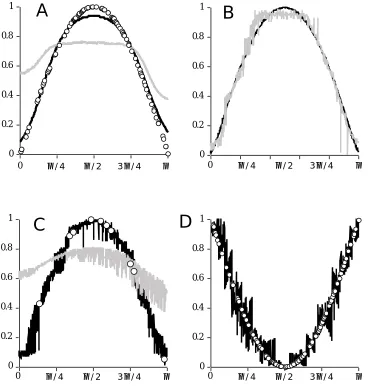
results that were very similar to Example 1, with rms=0.22 and rms=0.021, respectively (Figure
1A). Thus, both types of networks correctly learned the internal metric of the example, i.e.
Simple considerations given below can be used to improve predicting ability of neural
networks and KNN by using them in combination with each other.
Consider an ensemble of M neural networks
ANNE
[
]
M =ANN1 M ANNj M ANNM (3)
The prediction of a case xi, i=1,.., N can be represented by a vector of output values zi={z
i j}M
j=1
where j=1,...,M is the index of the network within the ensemble.
xi
[ ]
•[
ANNE]
M =[ ]
zi =z1i
M
zij
M zM i (4)
A simple average z i = 1 M zj
i
j=1,M
∑
was used in this study to predict the test cases with neuralnetworks.
In our previous study (Tetko and Villa, 1997) we proposed to use the square of Pearson’s
linear correlation coefficient rij2 (Press et al., 1994) between the vectors of predicted values zi and
zj as a measure of similarity (proximity) of analyzed cases in the space of ANNs. Assume also
that rij=0 for negative values rij<0.
The KNN results, rms=0.060, k=1, were significantly improved for this example when its
metric was based on rij2 estimated by an ensemble of ANNE with one hidden neuron. Better
results (rms=0.020, k=1) were achieved when the distance between cases was estimated using
The early stopping technique was an important factor contributing to this improvement.
The neural networks with one and two hidden neurons trained to convergence with all available
training cases predicted test set cases with rms=0.25 and rms=0.020, respectively. The KNN
method provided rms=0.082 (k=1) and only rms=0.26 (k=55) when the distance between cases
was estimated using the converged networks with one and two hidden neurons, respectively.
Thus, the observed improvement for the networks with one hidden neuron was lower than in the
case of the early stopping while the converged networks with two hidden neurons were unable to
correctly represent the metric of the investigated function.
A use of KNN method discarded the value z i calculated by ANNE. Thus the joint
performance of KNN and neural networks for this task could not be better than KNN results
calculated in the Example 1, i.e. rms=0.016. A better approach consisted of correcting the value
of z i according to formula
′
z i =z i+
1
k
(
yj −z j)
j∈Nk( x )∑
(5)where yi were the experimental values and the summation was over the k-nearest neighbor cases
determined using Pearson’s rij, as described above. Since the variance of ensemble prediction z i
was small, the difference (yi- z i) mainly corresponded to the bias of the ANNE for the case xi.
Thus this formula explicitly corrected the bias of the analyzed case according to the observed
biases calculated for the neighboring cases.
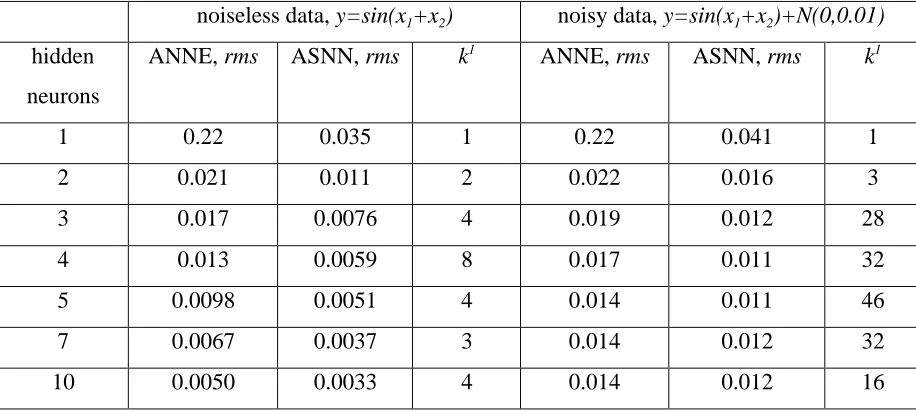
A use of equation (5) provided an improvement of the results, and rms=0.035 and
rms=0.011 were calculated following analysis of ANNE with one and two hidden neurons
respectively (Figure 1B). The increase of the number of hidden neurons continuously improved
noise with normal distribution, N(0,0.01), was added to the target function, a use of equation (5)
with more than 3 hidden neurons did not improve predicting ability of the method, rms=0.012,
which was very close to the theoretical value rms=0.01.
We refer to the proposed method as associative neural network (ASNN), since the final
prediction of new data is done according to the cases, i.e. prototypes of the analyzed example or
associations, found in the “memory” of the neural network. In the considered example memory of
ASNN was equal, like in the case of KNN, to the input training set. However, there is no
requirement that the memory of ASNN should always coincide with the training set. This
provides several interesting features of this network illustrated by the following examples.
Example 3. 10 data points were selected by chance from the initial training set of the
Example 2 and were used to train ANNE with two hidden neurons. The neural network and
ASNN calculated rms=0.25 and rms=0.13, respectively. However, when all 100 cases from the
training set were used as the “memory” of the ASNN the predicted results (rms=0.055) were
significantly improved and were similar to the results calculated by ANNE (rms=0.021) trained
with all data in Example 2 (Figure 1C). Thus, an increase of the ASNN memory provided a
significant improvement of its predicting ability without a need to retrain the neural network
ensemble.
It is possible to suppose that metric of space is more conservative feature compared to the
fine details of the analyzed function and the local details can be changed, e.g. when the analyzed
function is non-stationary in time. The ASNN is capable of easily adapting itself to such
Example 4. In this example the neural networks with two hidden neurons were trained
using the data from Example 2. However, after neural network training, the memory and the test
set of the ASNN were changed to the data generated according to formula
y=1-sin(x1+x2) (6)
The ASNN predicted the test cases with rms=0.078, i.e. provided a satisfactory extrapolation of
the analyzed data (Figure 1D). Notice, that from a point of view of ASNN this example simply
had a larger bias in comparison with the previous examples.
Example 5. However, if the underlining metric of space is changed and the function
y=sin(x1+0*x2) (7)
is used in Example 4, the ASNN provided much lower quality prediction of the test data,
rms=0.25.
Discussion
When predicting a property of an object, a person uses some global knowledge as well as
known properties of other similar objects (local knowledge). The final prediction represents some
weighted sum of both these contributions, and (5) provides a simple model of such process. This
equation also proposes how memoryless and memory-based methods could be combined to
improve their performances.
The current study emphasizes the importance of correlations for the information
processing. This is in agreement with experimental analysis of the recorded neuronal activity in
the brain of awakened animals that indicated a presence of sharp transient synchronization
synchronization (Hopfield and Brody, 2001) can be used to retrieve stored patterns from the
memory. The retrieved patterns can be used for the bias correction.
ASNN has two phases in the learning process. The first phase includes training of neural
network ensemble to correctly represent topology of the space. This is a difficult task and it has a
long training time, e.g. it can correspond to acquisition of driving experience by a person. The
second phase provides bias correction according to (5). This phase is used to optimize the number
of neighbors, k, in order to fit better the local features of the analyzed data. Consider a situation
when a driver replaces his car with a new model. Even though that new car may have some
specific features, only a slight adaptation of local rules, corresponding to local bias correction, is
required for the driver to achieve his optimal performance. To this extent Example 3 describes a
situation when a UK driver (left-side driving) comes to France (right-side driving), i.e. when he
has to discard his left-side driving experience. The separation of global and local corrections
makes it possible to substitute the “old” left-side driving experience with new knowledge and to
achieve quickly a good performance in the changed environment. Such a change requires
presence of some gating network, which decides whether old or new knowledge should be used
in each particular case. The gating network can also use some associations and a combination of
global/local corrections to make its decision.
A number of algorithms including the counterpropagation (Hecht-Nielsen, 1990), learning
vector quantization (Kohonen, 2001), MADALINE (Widrow and Lehr, 1990), support vector
machine (Vapnik, 1995), SMAC (Albus, 1975) and other methods have characteristics which
combine nearest neighbor techniques with supervised learning. While an accurate comparison of
performance of these algorithms with that of ASNN without a doubt deserves thorough study, all
cannot improve their generalization or provide a fast approximation of new function without
retraining, as it was demonstrated in Examples 2 and 3.
It will also be interesting to see, if other non-linear global approximation methods could
be used instead of the feed-forward neural networks. Another possibility is to investigate whether
other local regression techniques, for example using the weighted sum ( z i-yi)w(rij)/ w(rij) in
(5), could improve predicting properties of ASNN even further. In the current study the number
of neighbors, that is the smoothing parameter of the algorithm, was the same for the whole
function. This can be justified for functions that have approximately the same level of noise and
uniform distribution of cases over the investigated space. However, if the noise and the
distribution of samples are not uniform, the selection of the smoothing parameters depending on
the local topology could, probably, further improve prediction performance of ASNN.
Acknowledgments
This study was partially supported by INTAS-OPEN 97-0168 and Swiss NSF
2053-055753.98/1 grants. I thank Prof. Alessandro E.P. Villa, University of Lausanne, Dr. Igor V.
Litvinyuk, Steacie Institute for Molecular Sciences, Canada, and Prof. Roman M. Borisyuk,
References
Albus, J.S. (1975) A New Approach to Manipulator Control: The Cerebellar Model Articulation
Controller (CMAC). Trans. ASME J. Dyn. Syst. Meas. Control, 97, 220-227.
Bishop, M. (1995) Neural Networks for Pattern Recognition. Oxford University Press, Oxford.
Dasarthy, B. (1991) Nearest Neighbor (NN) Norms. IEEE Computer Society Press, Washington,
DC.
deCharms, R.C. and Zador, A. (2000) Neural representation and the cortical code. Annual Review
of Neuroscience, 23, 613-47.
Geman, S., Bienenstock, E. and Doursat, R. (1992) Neural Networks and the Bias/Variance
Dilemma. Neural Computation, 4, 1-58.
Härdle, W. (1990) Smoothing Techniques with Implementation in S. Springer-Verlag, New York.
Hecht-Nielsen, R. (1990) Neurocomputing. Addison-Wesley.
Hopfield, J.J. and Brody, C.D. (2001) What is a moment? Transient synchrony as a collective
mechanism for spatiotemporal integration. Proceedings of the National Academy of
Sciences of the United States of America, 98, 1282-1287.
Kohonen, T. (2001) Self-Organizing Maps. Springer, Berlin.
Lawrence, S., Tsoi, A.C. and Back, A.D. (1996) Function Approximation with Neural Networks
and Local Methods: Bias, Variance and Smoothness. In Bartlett, P., Burkitt, A. and
Williamson, R. (eds.), Australian Conference on Neural Networks. Australian National
University, Australian National University, pp. 16-21.
Press, W.H., Teukolsky, S.A., Vetterling, W.T. and Flannery, B.P. (1994) Numerical Recipes in
Tetko, I.V., Livingstone, D.J. and Luik, A.I. (1995) Neural network studies. 1. Comparison of
overfitting and overtraining. Journal of Chemical Information & Computer Sciences, 35,
826-833.
Tetko, I.V. and Villa, A.E.P. (1997) Efficient Partition of Learning Data Sets for Neural network
Training. Neural Networks, 10, 1361-74.
Vaadia, E., Haalman, I., Abeles, M., Bergman, H., Prut, Y., Slovin, H. and Aertsen, A. (1995)
Dynamics of neuronal interactions in monkey cortex in relation to behavioural events.
Nature, 373, 515-8.
Vapnik, V. (1995) The Nature of Statistical Learning Theory. Springer Verlag, New York.
Villa, A.E.P., Hyland, B., Tetko, I.V. and Najem, A. (1998) Dynamical cell assemblies in the rat
auditory cortex in a reaction-time task. Biosystems, 48, 269-277.
Widrow, B. and Lehr, M.A. (1990) 30 Years of Adaptive Neural Networks: Perceptron, Madaline
Table 1.Performance of ANNE and ASNN for Sine Function Approximation
noiseless data, y=sin(x1+x2) noisy data, y=sin(x1+x2)+N(0,0.01)
hidden
neurons
ANNE, rms ASNN, rms k1 ANNE, rms ASNN, rms k1
1 0.22 0.035 1 0.22 0.041 1
2 0.021 0.011 2 0.022 0.016 3
3 0.017 0.0076 4 0.019 0.012 28
4 0.013 0.0059 8 0.017 0.011 32
5 0.0098 0.0051 4 0.014 0.011 46
7 0.0067 0.0037 3 0.014 0.012 32
10 0.0050 0.0033 4 0.014 0.012 16
1
Number of nearest neighbors in (5). The performance of the methods is estimated using a test set
0 0.2 0.4 0.6 0.8 1
0 π/4 π/2 3π/4 π
D
0 0.2 0.4 0.6 0.8 10 π/4 π/2 3π/4 π
A
0 0.2 0.4 0.6 0.8 10 π/4 π/2 3π/4 π
B
0 0.2 0.4 0.6 0.8 10 π/4 π/2 3π/4 π
C
Figure 1. Sine function y=sin(x=x1+x2) approximation. For all examples the approximation
results are shown for 1000 test cases generated in Example 2 and using 100 networks in
the ensemble.
A) Sine approximation by ANNE of networks with one (gray) and two hidden neurons (black)
trained using 100 cases (circles).
B) ASNN results for the same example.
C) Sine approximation by ANNE (gray) trained with 10 cases (circles). ASNN results (black) are
shown using the same ensemble but after increasing the ASNN memory to 100 cases.
D) The ASNN results using ANNE from B) but after changing the ASNN memory to 100 cases