O R I G I N A L R E S E A R C H
Comparative Analysis of Color Matching System for
Teeth Recognition Using Color Moment
This article was published in the following Dove Press journal: Medical Devices: Evidence and Research
Justiawan1
Dian Agustin Wahjuningrum 2
Ratna Puspita Hadi2
Adienda Pajar Nurhayati 2
Kevin Prayogo2
Riyanto Sigit3
Zainal Arief4
1Department of Research and
Development, Tione Indonesia Jaya, Surabaya 60111, Indonesia;2Department of Conservative Dentistry, Faculty of Dental Medicine, Universitas Airlangga, Surabaya 60131, Indonesia;3Department of Informatic Engineering, Magister Program of Engineering Technology, Electronic Engineering Polytechnic Institute of Surabaya, Surabaya, Indonesia;4Department of Electrical Engineering, Magister Program of Engineering Technology, Electronic Engineering Polytechnic Institute of Surabaya, Surabaya, Indonesia
Video abstract
Point your SmartPhone at the code above. If you have a QR code reader the video abstract will appear. Or use:
https://youtu.be/2Ny_OiCbpC0
Background:In recent years, veritable image processing systems have been developed for
several field applications, some of which are recognition and classification. One such application is in the medical field for teeth color matching systems. The color matching technique is a feasible solution for classifying patients’teeth images to evaluate the suitable treatment of tooth replacement in dentistry. However the lighting conditions of the environ-ment and visual teeth color deficiency will be influenced or affected by the color matching performance.
Methods: This paper proposes the comparative analysis of a color matching system, using
K-nearest neighbors (KNN), neural network (NN), and decision tree (DT) algorithms to classify and recognize 16 types of dental images of persons that used several extracted features, from shade guide of teeth, with a digital camera, ranging from 250–300 lux lighting value. The extracted features are produced from RGB, HSV, and Lab color moment characteristic calculation of tooth samples. Those features were compared with input images using euclidean distance value.
Results:KNN algorithm in RGB characteristic achieves 97.5% within only a 0.02 second
computation time.
Conclusion: KNN algorithm in RGB characteristic provides the best performance when
compared to the other approaches.
Keywords:KNN algorithm, teeth recognition, color matching, color moment
Introduction
One major branch of medical sciences where an applicationfield of color matching
is being practiced is dentistry. For example, the damaged teeth of a patient might
require some treatments such asfilling or replacing the teeth with dentures. One of
the important processes is the determination of the teeth color. Unmatching color will result in unsuccessful treatment. In fact, almost the same color of tooth, the
lighting environment and also visual color teeth deficiency can be misleading,
influencing the dentist to determine the specific type of teeth color requirement at dental treatment. The situation is confusing to the dentist, creating an uncertainty in
their classification decision. Although a number of shade guide matching systems
are available for clinical use, the color space from the available dental shade guides are limited. This proves that the shade guide does not represent the full spectrum of
the natural patient’s teeth.1 Variations from individual perception of each color
appeared due to the visual color selection, depending on shape, size, position, surrounding illumination, and background color. Although the instrument-based shade matching technique represents a step towards an objective and accurate
Correspondence: Dian Agustin Wahjuningrum Department of Conservative Dentistry, Faculty of Dental Medicine, Universitas Airlangga, Mayjen Prof. Dr. Moestopo 47, Surabaya, East Java 60131, Indonesia
Tel +62 315030252 Fax +62 315022472
Email [email protected]
Medical Devices: Evidence and Research
Dove
press
open access to scientific and medical research
Open Access Full Text Article
Medical Devices: Evidence and Research downloaded from https://www.dovepress.com/ by 118.70.13.36 on 24-Aug-2020
color reproduction, it can be influenced by the skin color, the environment lighting, and lips color.2Determination of tooth color becomes subjective and qualitative.
One of the techniques, which has been developed for increasing the performance of the color matching system,
is shade-matching technologies in clinical dentistry.3
Shade-matching technologies help in determining and recognizing tooth color, reflecting objectivity and quanti-tatively instead of a misleading subjectivity and
qualita-tively. Classification of images is a set of technique or
method, used to identify images according to their
content.4 One application field of image processing is
a medical field that is required in a high accuracy level
system. An instrument of the color-measuring system with computerized color analysis allows more standardized and accurate color matching than conventional techniques.
Basically, the teeth color is composed from a white color with several different values. While the color white indicates a perfect light, which represents an end of a spectrum, human color perception is determined by the brightness, hue, and saturation. However, this condition is
not appropriate due to the modification of wavelength,
intensity and the amount of white light, which can be influenced by the brightness, hue, and saturation of color.
The color identity is specified by the wavelength of the
light. The color wavelength range, which can be captured
with human eyes, is at 380–780 nanometers. The
combi-nation from three basic elements of colors can produce color space parameters such as RGB, CMY, HSV, CIE XYZ, Lab, Luv, and YCrCb. The color space of RGB is determined, using three basic component colors, which are red (R), green (G), and blue (B), which is formed by electrical sensor frequency acquisition. RGB color spaces is widely applied at graphical computer system. The further development of color space is CMY, known as the cyan, magenta, and yellow component. CMY is sub-stractive color spaces that is applied in many printer devices. It is different from HSV, CIE XYZ, Luv, and YCrCb color space that is focused on non-linear transfor-mation based on RGB as the basic color space. Recording, transmission, and displaying system televisionused LUV and YCrCb color space. The main concept of LUV and YCrCb is separating its luminant element from UV and CbCr. Then HSV, CIE XYZ, and Lab are color spaces that can represent elements based on human eyesight. Due to this color matching system, it is applicable to computer
visualization and is always influenced by human eyesight
perception, especially the dentist’s; this system used RGB,
HSV, and LAB color spaces.10 In addition to its basic
element of colors, RGB, HSV, and Lab are the most widely used parameters of the image processing system. This is as a result of its simplified calculation, which can determine the characteristics model of the image, based on its color.
Many algorithms for image classification are proposed
under certain assumptions and constraints dependent on the color elements. Most color image detection methods can be categorized into four major classes, which are: knowledge-based methods, feature invariant approaches, template matching methods, and appearance-based meth-ods. Knowledge-based methods are based on rules,
pri-marily deduced from knowledge or its database
components. The feature invariants are obtained from the result of the characteristic data from its database. The remaining two classes, being the template matching and the appearance-based methods, are the main process for testing and verifying the system.
In this paper, we propose the comparative analysis of the color matching system for the teeth recognition. This research uses a 16 colors shade guide standard as the real data parameter, which is suitable for Indonesian teeth colors, using RGB, HSV, and Lab color models.
Thefirst step of this research involves taking the RGB, HSV, and Lab elements to the 16 sampled teeth color from images that have been taken earlier using a digital camera in 288 lux lighting parameter. The color feature of the teeth will be obtained using moment invariant and this
feature’s result will be classified and recognized using
KNN, NN, and DT algorithms to take the 16 types of dental color images. This system is assumed to have an accurate performance, based on the element color para-meter and the kind of algorithm involved. The time com-putation process is also analyzed in this system, which depicts the correlation between accuracy in performance and time computation of each algorithm.
Materials and Methods
In this section of the study, we describe some requirements processes which are implemented in this color teeth matching system for achieving high accuracy in result. Those are collecting the dental image for creating the database system, basing its parameter criteria especially on the taking images process.
Then, the identification process to the colors characteristics from its dental images using color models calculation and analysis. This color identification is called the pre-processing
Medical Devices: Evidence and Research downloaded from https://www.dovepress.com/ by 118.70.13.36 on 24-Aug-2020
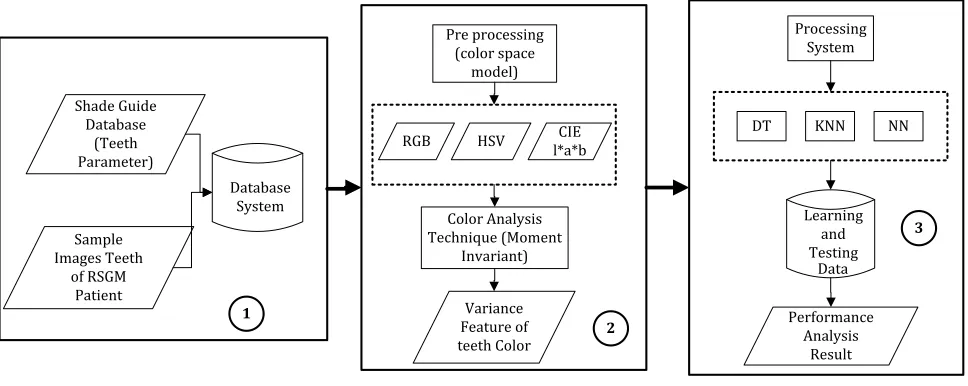
phase. According to the high variation result obtained from the pre-processing phase, it is required that some additional algo-rithms be used to classify the data, based on its identical characteristic using KNN, NN, and DT algorithms. The output from the classification process is the main feature which is represented by the characteristic of each type of dental image. These features are used in testing, validating, and measuring the accuracy level of this matching system. This proposed system is implemented with three main processes which are creating the database system, pre-processing, and processing, including the learning and testing process, as shown in
Figure 1.
Database System
The VitaPan dental shade guide consists of the 16 colors shade guide, which are standard real data parameters, suitable for the market. This phase of the study involves the collection of various general dental images of patients in the hospital by a digital camera, which has been
cali-brated prior, minimizing the influence of distance and
lighting condition. The lighting condition captured during this process is set at a range of 250–300 Lux level. These
dental images are stored in a specific template and can be
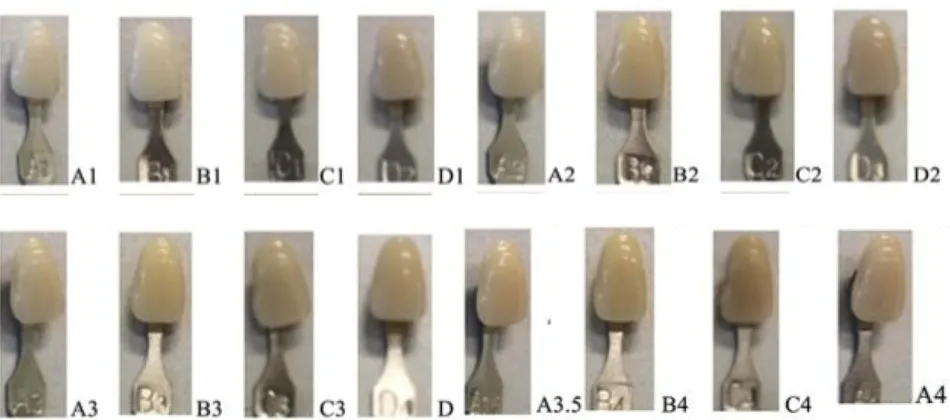
used as a database. Each dental image is classified as piece of images that has certain color for having match to the shade guide. Furthermore, the database also contain the 16 types of dental images, based on its shade guide as the matching reference. These 16 types of dental images, as
shown inFigure 2, are obtained from the teeth and mouth
hospital at Airlangga University, Surabaya.
The color intensity of dental images is very similar, hence these images will be cropped into regions which contain only a single tooth, based on the classified types at shade guides. The single tooth will be cropped again, based on the inter-section result, obtained from three horizontal and vertical partitions. These cropped areas will be formed into a 40x40 pixels size dimension, as Illustrated inFigure 3.
Pre-Processing System
The second step of this system is called pre-processing, aimed at determining the images characteristic from its colors. The color study can be performed, with the knowledge of a color key, containing the image. A popular technique for visual color determination is represented in three dimensions as the color spaces components. Those are RGB; red (r), green (g), and blue (b) as the primary colors. Combining all three pri-mary colors will produce lighter colors which can be seen as white colors. This color combination can be used to describe the teeth color characteristics that are contained, with white colors as the main color at their images. The RGB value of the dental images can be calculated using the following equation:
r¼ R
ðRþGþBÞ;g¼ G
ðRþGþBÞ;b¼ B
RþGþB
V¼maxðr;g;bÞ
(1)
The maximum value of each RGB parameters is
repre-sented by V. Then, according to the RGB result
calcula-tion, this parameter can be used as input initialization of HSV as the second color characteristics of this system.
Shade Guide Database
(Teeth Parameter)
Sample Images Teeth
of RSGM Patient
Pre processing (color space
model)
Database System
Color Analysis Technique (Moment
Invariant)
RGB HSV CIE
l*a*b
Variance Feature of teeth Color
Processing System
DT KNN NN
Performance Analysis
Result Learning
and Testing
Data
1
2
3
Figure 1System design of color matching for dental recognition. (1) Collecting data. (2) Extracting feature. (3) Learning and testing process.
Medical Devices: Evidence and Research downloaded from https://www.dovepress.com/ by 118.70.13.36 on 24-Aug-2020
S¼ 0;if !V ¼0
1minðVr;g;bÞ;V>0
(
H ¼
0;if !S¼0
60ðgbÞ
SV ;if !V ¼r
60 2þðbSVrÞ
h i
;if !V ¼g
60h2þðSrVbÞi;if !V ¼b
8 > > > > > > < > > > > > > :
H ¼Hþ360; if !H<0
(2)
HSV is contained with hue, value, and chroma parameters. Hue (H) is the main attribute color from another family of colors, whereas values (V) indicates the lightness level of the colors, and chroma (S) is the degree of color saturation. The value ofVhas been calculated before in equation (1) and will be used forHandScalculations as the conditional checking parameters, as shown in equation (2).
Inconsistencies in visual color determination by the dental matching system should be compared with another color mod-els calculation, Lab. Lab color modmod-els (L*a*b*) are repre-sented by the color characteristics based on coordinate values. TheL*refers to the lightness coordinate at the range value 0 (black) to 100 (white), while thea*andb*are chro-maticity coordinates from the red-green axis and yellow-blue axis, respectively. There are several steps for calculating the Lab values;first it should transform the RGB value calculation from equation (1) in the form of 3D coordinates (X, Y, Z) as derived in the following equation:9,10
X ¼0:412453Rþ0:357580Gþ0:180423B (3)
Y ¼0:212671Rþ0:715160Gþ0:072169B (4)
Z ¼0:019334Rþ0:119193Gþ0:950227B (5)
Figure 2Sixteen types of dental images from the shade guide reference. The VITAPAN classical A1–D4 shade guide (Internationally established dental shade guide commercial product). The arrangement of the shades in the VITAPAN classical family of shades is as follows: A1–A4 (reddish-brownish hue). B1–B4 (reddish-yellowish hue). C1–C4 (greyish hue). D2–D4 (reddish-grey hue). Chroma is designated with numerical values 1, 2, 3, and 4.
Figure 3Region area from dental image partition for each type. A1–A4, B1–B4, C1–C4, D1–D4 (the VITAPAN classical family shade guide; Internationally established dental shade guide commercial product).
Medical Devices: Evidence and Research downloaded from https://www.dovepress.com/ by 118.70.13.36 on 24-Aug-2020
Then, the value ofL*a*bcan be defined as follows:
L¼116f Y
Yn
16 (6)
a¼500 f X
Xn
f Y
Yn
(7)
b ¼200 f Y
Yn
f Z
Zn
(8)
Xn, Yn, Zn values are obtained from R=G=B=1, with the range ofR,G,Bat 0–1. Theffunction in equations (6–8)
is represented as f(q), which can be determined using
the following equation:
ðqÞ ¼ q
1
3; if q>0:008856 7:787qþ16=116; the others
(9)
The calculation result of each color model has high var-iative data. Due to that problem, this requires additional calculation based on the statistical approach. In this sys-tem, there are four statistical parameters used. Thefirst is the mean value calculation for describing the distribution of data of each color model, as calculated in equation (10).
μ¼ 1
MN ∑
M
i¼1∑
N
j¼1
Pij (10)
Then, for measuring the variative level of the color
mod-els, this is calculated by finding the square root from
variance calculation which is called the deviation standard.
σ¼
ffiffiffiffiffiffiffiffiffiffiffiffiffiffiffiffiffiffiffiffiffiffiffiffiffiffiffiffiffiffiffiffiffiffiffiffiffiffiffiffiffi
1
MN∑
M
i¼1∑
N
j¼1
Pijμ
2
s
(11)
The output from mean and deviation standard will result in the variative distribution model. There are two distribu-tions modeling systems, namely the asymmetry condition and pointed condition. The asymmetry condition can be illustrated as the negative value and the positive value in different levels. This condition can be recognized, using skewness calculation from its null values, as shown in the following equation:
θ¼
∑M i¼1∑
N
j¼1ð
PijμÞ3
MNσ3 (12)
The distribution of data at pointed condition, which is centralized at positive values while another set of data are at negative values, can be derived through the Kurtosis method.
γ¼
∑M i¼1∑
N
j¼1ð
PijμÞ4
MNσ4 3 (13)
According to statistical analysis for determining the
spe-cific characteristics of each color model from the dental
images, specific features, such as height, width, and the
color value were extracted. This process can be called feature extraction using the moment invariant technique, based on its statistical calculation.5
Processing Process
Due to the many features result obtained from the color
analysis phase, some classification algorithm is required
for determining the compatible data. This feature result
will be classified and recognized using KNN, NN, and DT
algorithms to take the 16 types of dental color images. Decision tree is aflowchart structure that resembles a tree (the tree), where each internal node denotes a test on an attribute, each branch represents the results of the test, and the leaf node represents a class or class distribution. The chronology of the decision tree is in the pan from the root node to the leaf node that holds the prediction. There are many algorithms for arranging the decision tree system, one of them is the C.45 algorithm. The C.45 algorithm can handle numeric data which is used to gain a ratio calcula-tion. It also requires an information value in bits unit from the object using the entropy concept. Entropy (S) is the number of bit units, which has been predicted for extract-ing the class (+ or -) from several random data at the sample, S. The value of entropy can be used for measuring the inauthenticity of S. The equation of entropy calculation at the S sample is derived as:11,12
Entropy Sð Þ;plog2pplog2p (14)
where S is the sample data of training process;p is
the number of positive resolution data, while p is the
number of negative resolution data. The result of entropy has some conditions for determining the expected data.
When Entropy (S)=0, all of the data is located at the
same class. Entropy (S)=1 if the numbers of positive and
negative in Sare the same. The number of positive and
negative are not the same when the range of entropy value is more than 0 and less than 1. After calculating the entropy value, the gain concept is also implemented to obtain the attribute of A which has a relative connection
to theSoutput. The calculation of gain is derived as:
Medical Devices: Evidence and Research downloaded from https://www.dovepress.com/ by 118.70.13.36 on 24-Aug-2020
Gain Sð ;AÞ;Entropy Sð Þ ∑ni¼1j jSi
S Entropy Sið Þ (15)
whereAis the attribute of the sample (S);nis the number of partitions of A attribute. |Si| is the number of samples from partitioniand |S| is the sample ofS.4
The second classification algorithm of this system is
NN (Neural Network). NN is the adaptive system that can
be modified by its structure based on external information
and internal information of its network. NN can be used for modeling the complex relation among input and output systems forfinding the data pattern. Neuron is the basic of learning process from NN. Every NN has an intercon-nected basic processing system. it is called neuron.
Network is learned using weight modification that has
relation between neuron during the training process.6
The last algorithm is KNN (K-nearest neighbors), the
instance-based learning algorithm.7 The KNN algorithm
works based on grouping of thekobject data which have
the same value as the given parameter. KNN is usually used for achieving the desired data at data training and data testing. The different value between data training and data testing is represented as the distance measurement using euclidean distance calculation:8
distance¼
ffiffiffiffiffiffiffiffiffiffiffiffiffiffiffiffiffiffiffiffiffiffiffiffiffiffiffiffiffiffiffiffiffiffiffiffiffiffiffiffiffiffiffiffiffiffiffiffiffiffiffiffiffiffiffiffiffiffiffiffiffiffiffiffiffiffiffiffiffiffiffiffiffiffiffiffiffiffiffiffiffiffiffiffi
a1b1
ð Þ2
þða2b2Þ2þ. . .þðanbnÞ2 q
(16)
where an and bn are the attribute values from the two
records process at data training and data testing, respec-tively. After that, the result between data training and data testing should be compared based on its attribute value to evaluate the similarity value of this algorithm. In the KNN algorithm, a higher similarity value will be shown, indicat-ing that the KNN modelindicat-ing system has been successfully implemented for providing the high accuracy level. The similarity value can be illustrated by using 0 and 1 level, the 0 value means the data is almost the same or the same while the 1 value means the data is absolutely different or not the same. However, this level has an immeasurable similarity level. Therefore, in the KNN algorithm, the similarity level can be calculated using multiplication
with some degree level known as weight (w) based on its
attribute number (n).
similarity pð ;qÞ ¼∑
n
i¼1f pð i;qiÞxwi
wi
(17)
where p is the new case data which can be used from the
testing data, while q is the case in storage which is
obtained from learning data. In this paper, the calculation of color models will be simulated using a Matlab simula-tor. Subsequently, the output value from color models calculation will be simulated again at a rapidminer
simu-lator for having the classification process using KNN, NN,
and DT algorithms. According to different result
performances of those algorithms, the analysis of this system considers two main parameters. These are the accuracy performance, based on the elements of color parameter and the kind of algorithm and processing time, which indicates the correlation between accuracy in per-formance and computation of each algorithm when this system is being implemented on a smart phone.
Results and Discussion
This system, which has been developed with relevant functionalities and usage-friendly, can be used by dentis-try. The proposed system is aimed at solving problems, associated with human visual subjectivity. To this end, measuring the successful level of this system can be ana-lyzed, based on learning accuracy, testing accuracy and processing time performance. There are 640 total data results, obtained from the pre-processing phase in the form of RGB, HSV, and Lab color models calculation.
Those data are classified, using DT, KNN, and NN,
based on each color model. As shown in Table 1, the
640 data are divided into 480 learning data and 160 testing data. Each learning datum is grouped into 30 data sets, while the testing data are grouped into 10 datasets. Therefore, there are 16 datasets which will be analyzed, adjustable to represent the 16 types of teeth.
Using a dataset which comprises and represents the 16 teeth types, the null hypothesis (H0) is used for basic election at the processing phase. Statistically, the null hypothesis (H0) indicates that there is no significant
rela-tionship with other parameters. As shown inTable 1, using
RGB color models at 0.05 error margin, the null
hypoth-esis (H0) shows that there is no significant relationship
between parameters measured. This calculation is based on momen color parameters such as mean (m), standard deviation (d), skewness (s), and curtosis (c). Then, R, G, and B are the components of RGB color models which are R (Red), G (green), and B (Blue).
The result of H0 shows that feature testing with those data using 0.05 degrees of freedom has a range interval
from−2.0017 to 2.0017, which are the range values at Rm,
Gm, and Bm.
Medical Devices: Evidence and Research downloaded from https://www.dovepress.com/ by 118.70.13.36 on 24-Aug-2020
According to the experimental results fromTable 2, the percentage of learning accuracy, obtained from the RGB color model, shows that using NN achieved the best per-formance at 97.92%. On the other hand, while the features from the RGB color model takes testing process, the best accuracy performance decreases to 92.50% with only a 2 seconds computation time in using the KNN algorithm. The KNN method in the RGB color model has the fastest computation time, when compared to the other algorithm. Comparison, based on three performance analyses, using
the KNN algorithm in the RGB model classification,
achieved the best performance, although in the learning process NN is better than KNN. Due to the result obtained, NN has many reductions in testing process, to be repre-sented by 76.88%. In addition, NN also takes a longer computation time, requiring up to 34 minutes, which is possible when applied to the real hardware for the color matching system.
On the other hand, it is different when using the HSV color model to this system. Using NN, the result obtained achieved 96.46% percentage accuracy in the learning pro-cess, which is better than DT and KNN algorithms. Following the result of the testing process, using NN has the best performance, representing 78.75%. However, the weakness of NN is that it took a longer computation time, up to 33 minutes, which is not suitable for hardware imple-mentation. When this is compared with the other algorithm in HSV color models, using the DT algorithm is compatible for hardware implementation in the color matching system. Using the DT algorithm achieved 84.38% in learning process and 76.88% in testing process; however, it is lower than NN performance. The computation time of the DT algorithm only required 58 seconds, which is faster than the NN algorithm. Using the NN algorithm with the Lab color model also achieved the best performance, representing 94.58% for the learning process and 80% for the testing process. Due to the weakness of NN computation time, the modeling system from the NN algorithm is not suitable for hardware implementation which required 34 minutes for processing the system. Using KNN is the feasible solution for the Lab color model system. The accuracy performance of KNN is
Table 1Hypothesis Null Calculation of RGB Using Color Model Parameters
Table 2The Experimental Result Data
Algorithm Percentage of Learning Accuracy
Percentage of Testing Accuracy
Computation Time (minutes: seconds)
RGB Color Model
DT 90.00% 85.63% 1:04
KNN 97.50% 92.50% 0:02
NN 97.92% 76.88% 34:44
HSV Color Model
DT 84.38% 76.88% 0:58
KNN 12.92% 12.50% 0:03
NN 96.46% 78.75% 33:26
Lab Color Model
DT 80.21% 68.75% 1:02
KNN 92.08% 77.50% 0:04
NN 94.58% 80.00% 34:04
Medical Devices: Evidence and Research downloaded from https://www.dovepress.com/ by 118.70.13.36 on 24-Aug-2020
92.08% in the learning process and 77.5% in the testing process, requiring a diminutive duration of 0.4 seconds processing time.
According to the color models comparison performance, RGB has the best performance when it is classified using the KNN algorithm, especially at a stable lighting condition (288 lux). The result obtained shows that RGB has accuracy performance in the testing process, with a significant repre-sentation of 92.50% within only a 0.02 seconds computation time. Contrary to this observation, the result obtained is different when the lighting condition is not constant in the range of 250–300 lux. The best color model system is using
the HSV or Lab color model, which cannot be influenced
by the lighting condition. The HSV color model is suitable with the use of the DT algorithm; on the other hand, the Lab is compatible when using the KNN algorithm.
Conclusions
In this paper we propose the comparative analysis of the color matching system for dental recognition, using color moment. The methodology used, based on color recognition, is presented to classify the tooth color models. The simula-tion result shows that this color matching system achieves the best performance with the use of the RGB color model with KNN algorithm classifier at stable lighting condition. On the other hand, at unstable lighting condition can be used with HSV and DT algorithm combination or Lab color
model with the KNN algorithm classifier.
Disclosure
The authors report no conflicts of interest in this work.
References
1. Jian W, Lin J, Alison S, John D, Shigemi I. Assessing the accuracy of computer color matching with a new dental porcelain shade system.
J Prosthet Dent.2014;111(3):247–253. doi:10.1016/j.prosdent.2013.
07.008
2. Tam WK, Lee HJ. Dental shade matching using digital camera.
J Dent Elsevier.2012;40(2):e3–e10. doi:10.1016/j.jdent.2012.06.004
3. Chu SJ, Richard DT, Paravina RD. Dental color matching
instru-ments and systems (review of clinical and research aspects).J Dent
Elsevier.2010;38(2):e2–e16. doi:10.1016/j.jdent.2010.07.001
4. Hicham R, Abdelmajid E, Farid B. Classification and recognition of
dental images using decisional tree. International Conference Computer Graphics, Imaging and Visualization (CgiV). IEEE
Xplore;2016:390–393.
5. Mangijao Singh S, Hemachandran K. Image retrieval based on the
combination of color histogram and color moment. Int J Comput
Appl.2010;58(3):27–34. doi:10.5120/9263-3441
6. Suprachaya V, Suphakant P. Neural network-based teeth recognition using singular value decomposition and color histogram. In: 2010 2nd International Conference on Information Engineering and
Computer Science. IEEE Xplore;2010. Available from:https://ieeex
plore.ieee.org/document/5677780?section=abstract.
7. Liu J, Zhao N, Runnan H. Study of color matching system for porcelain teeth. In: 2013 IEEE International Conference on Medical
Imaging Physics and Engineering. IEEE Xplore; 2013:19–20.
Available from:https://ieeexplore.ieee.org/document/6864558.
8. Annesha M, Joydeep M. Image clustering using color moments,
histogram, edge and K means clustering. Int J Sci Res. 2013;2
(1):532–537.
9. Dan S, Marius DP, Marius DS, Vladimir B, Tudor C, Simona B.
A software application to detect dental color.Appl Med Inf J.2015;37
(3):31–38.
10. Pecho OE, Ghinea R, Alessandretti R, et al. Visual and instrumental shade matching using CIELAB and CIEDE2000 color difference
formulas. Dent Mater. 2016;32:82–92. doi:10.1016/j.dental.
2015.10.015
11. Vasile P, Vasile C, Alex G, Diana D, Bogdan C. Decision support
system for color matching in dentistry. Informatica. 2015;LX
(1):111–119.
12. Li W, Wang W, Liu M. New color cluster algorithm for image retrieval. In: 2009 Third International Symposium on Intelligent
Information Technology Application. IEEE; 2009;3:561–564.
Available from:https://ieeexplore.ieee.org/document/5370007.
Medical Devices: Evidence and Research
Dove
press
Publish your work in this journal
Medical Devices: Evidence and Research is an international, peer-reviewed, open access journal that focuses on the evidence, technol-ogy, research, and expert opinion supporting the use and application of medical devices in the diagnosis, monitoring, treatment and management of clinical conditions and physiological processes. The
identification of novel devices and optimal use of existing devices
which will lead to improved clinical outcomes and more effective patient management and safety is a key feature of the journal. The manuscript management system is completely online and includes a very quick and fair peer-review system. Visit http:// www.dovepress.com/testimonials.php to read real quotes from pub-lished authors.
Submit your manuscript here:https://www.dovepress.com/medical-devices-evidence-and-research-journal
Medical Devices: Evidence and Research downloaded from https://www.dovepress.com/ by 118.70.13.36 on 24-Aug-2020