An Investigation into the
Application of Genetic
Programming Techniques to
Signal Analysis and Feature
Detection
Christopher H arris
A dissertation submitted in partial fulfilment of the requirem ents for the degree of
Doctor of Philosophy
of the
University of London
D epartm ent o f Com puter Science University College London
ProQuest Number: U642190
All rights reserved
INFORMATION TO ALL USERS
The quality of this reproduction is dependent upon the quality of the copy submitted.
In the unlikely event that the author did not send a complete manuscript and there are missing pages, these will be noted. Also, if material had to be removed,
a note will indicate the deletion.
uest.
ProQuest U642190
Published by ProQuest LLC(2015). Copyright of the Dissertation is held by the Author.
All rights reserved.
This work is protected against unauthorized copying under Title 17, United States Code. Microform Edition © ProQuest LLC.
ProQuest LLC
789 East Eisenhower Parkway P.O. Box 1346
Abstract
This thesis investigates the use o f the Genetic Programm ing (OF) machine learning paradigm to com puter vision problem domains related to the detection o f features within discrete data signals. The use o f OF to find a solution to such problem s involves two pieces o f design. The first is the set o f elements that the search process uses to construct possible problem solutions, know n as the primitive set. The second is the design o f an appropriate rew ard mechanism for candidate solutions, know n as the fitness function. The wide range o f signal types and features to be detected in com puter vision detection problem s ensures that representation o f both data and solutions is o f prim e im portance.
Tw o contributions made by this thesis are to provide approaches to both primitive set design and fitness function design that are generic to feature detection problems. A three-com ponent fitness function design is presented which reflects the desirable properties o f a generic feature detector. W ork is also presented on a design for a primitive set that is apphcable to a wide range o f signal processing problems. These techniques are explored using the classic problems o f edge detection and tem plate matching as experimental test-beds.
W ork in this thesis on edge detection produces filter functions that outperform those produced by human experts under real-world conditions. This process can be used to produce edge detectors optim ised for specific sets o f data.
Acknowledgements
This research was carried out under the Postgraduate Training Partnership Scheme at University College London, in conjunction w ith SIRA Ltd.
I w ould like to thank my supervisor, Bernard Buxton, for providing m uch useful general scientific advice and as a walking bibhography for com puter vision material. Bibhographic honourable mentions must also go to Bill Langdon, w hose tireless w ork on maintaining the G P bibhography saved me many hours o f fruitless search. Thanks also to BÜ1 for his advice and discussions on m atters relating to GP, and for the time he spent proof-reading and commenting early drafts o f this thesis. Danny A lexander gave constructive advice of the thesis from the point o f view o f a non-GPer.
Contents
1. Introduction... 12
1.1 M otivation... 13
1.2 Goals o f the th e s is ... 14
1.3 Structure o f the th e sis... 15
1.4 C ontributions... 16
2. A Detailed Description of Genetic Programming... 18
2.1 Genetic algorithms and genetic program m ing... 18
2.1.1 Genetic algorithms and genetic search ...18
2.1.2 Genetic program m ing... 22
2.2 Tackling a problem w ith G P ... 23
2.3 Program tree construction m ethods...26
2.4 C onvergence... 27
2.4.1 Program tree m an ip u latio n ...29
2.4.1.1 M u ta tio n ...29
2.4.1.2 C rossover...30
2.4.1.3 Soft brood sele c tio n ... 31
2.4.1.4 O ther genetic o p erato rs... 31
2.4.2.1 Ranking schemes vs. fitness proportionate sch em e s...32
2.4.2.2 Propagation of an individual w ith different selection sc h e m e s... 32
2.4.3 O ther m e th o d s... 34
2.4.4 Population-level techniques to reduce co n v erg e n ce... 35
2.4.4.1 D em es...35
2.4.4.2 Steady state G A s ... 36
2.4.4.3 Dynamic fitness functions...36
2.4.4.4 C o-evolution... 37
2.5 M o d u larisatio n ... 38
2.5.1 Automatically defined fu n ctio n s... 39
2.5.2 M odule acquisition... 40
2.5.3 A daptive rep resen tatio n ... 41
2.6 Expressive pow er o f G P ... 41
2.6.1 M em o ry ...42
2.6.2 Turing com pleteness, recursion and iteratio n ... 43
2.6.3 Strongly typed G P ... 43
2.6.3.1 Evolving data structu res...47
2.6.4 Flexible program representations... 48
2.7 Role o f the prim itive se t... 50
2.7.1 Search spaces in G P ... 50
2.7.2 D esirable properties o f a search s p a c e ...51
2.7.3 Sufficiency o f a set o f prim itives...53
2.7.4 Basis functions...54
2.7.5 Effects of prim itive sets upon search efficiency...54
2.7.6 Type systems in constraining s e a rc h ... 56
2.8 A pplying GP to signal processing problem s... 56
2.9 Current issues in G P ... 60
2.9.1 The Building Block Hypothesis in G P ... 61
2.9.2 Producing better solutions - scalability and generalisation... 62
2.9.3 Evolvability... 64
2.9.5 Iteration, recursion and the halting p rob lem ... 65
2.9.6 Im plem entation restrictions - tree sizes, growth, and parsim ony...65
3. GP for Detection Problems... 67
3.1 The nature o f detection p ro b lem s... 67
3.2 D esirable characteristics o f a d e te c to r... 68
3.3 Designing fitness functions for detection p ro b lem s... 70
3.3.1 Fitness function com plexity and its relation to the problem , to the type system and to the chances o f su c c e ss... 70
3.3.1.1 The exploitative nature o f GP and fitness function d e s ig n ... 70
3.3.1.2 Fitness function types, com plexity and S T O P ... 71
3.4 M achine learning o f detectors w ith Genetic P rogram m ing...72
4. Evolving an Edge Detection filter... 75
4.1 Convolution Filters for edge d ete c tio n ...76
4.1.1 The optim al filter. A theoretical treatm ent o f edge detection filte rs ...76
4.1.2 Translation to the digital d o m a in ... 78
4.2 Evolving a filter w ith Genetic Program m ing... 79
4.2.1 Five preparatory s te p s ... 79
4.2.2 Experim ental d e sig n ... 81
4.2.3 Evaluating the perform ance o f the evolved d etecto rs... 84
4.3 Results and perform ance evaluation o f d etecto rs... 86
4.3.1 O perator g ro u p s... 86
4.3.2 Perform ance ev alu atio n ... 86
4.3.3 R esu lts... 87
4.3.3.1 Results for underw ater test d a t a ... 87
4.3.3.2 Results for office environm ent test d a ta ... 87
4.3.3.3 Results for synthetic step edge d a ta ... 89
4.4 D iscu ssio n ...89
4.5 E volved edge detection o p e ra to rs ... 90
5.1 Representing an im a g e ...96
5.2 M atching im ages...97
5.3 G enerating tem plates w ith G P ... 98
5.4 Experimental design...101
5.5 Evaluation o f re s u lts ...104
6. Hierarchy in Genetic Programming... 109
6.1 Template matching with hierarchy... 113
6.1.1 Changing the base level rep resen tation...113
6.1.2 Chaining the structure o f program trees... 115
6.1.3 Isolating transform ations...116
6.1.4 Constraining constant generation...116
6.2 Experimental design... 118
6.3 R e s u lts ...120
6.3.1 Changing the base-level representation...120
6.3.2 Chaining the construction o f tr e e s ... 122
6.3.3 Isolating transform ations... 126
6.3.4 Constraining constant generation...126
6.4 D iscussion...132
6.4.1 The structural com plexity o f constrained program tre e s...132
6.4.2 Structuring, scalability and building b lo c k s...133
7. Complete Edge Detection with GP: Operating Directly on Signals... 139
7.1 Com plete edge detection w ith G P ...140
7.1.1 Evolving a com plete edge d etecto r... 140
7.2 Experimental design... 142
7.3 Computational efficiency o f signal-based prim itives... 145
7.4 R e s u lts ...146
7.4.1 Prelim inary ‘test’ ru n ... 147
7.4.3 Office environm ent sig n a ls... 149
7.4.4 U nderwater environm ent signals... 150
7.5 D iscu ssion ...152
8. Conclusions... 154
8.1 The future of G P ... 156
8.2 Future w o rk...157
9. Bibliography... 159
Appendix A: A practical tool for Genetic Programming... 169
A .l Introduction...169
A .2 Structure of a G P s y ste m ...169
A.2.1 Problem -dependent com ponents... 171
A .2.2 Problem -independent co m p o n en ts...172
A .3 The G P-CO M software s y ste m ... 172
A.3.1 System structure... 173
A .3.2 The population m an ag er...175
A.3.3 Code gen eratio n ... 177
A.3.4 Parallelism in Genetic P rogram m ing ... 181
A .3.5 Tree g en eratio n ... 184
A .3.6 Storage o f genetic m aterial... 185
A.3.7 Run-tim e custom isation... 185
List of Figures
Figure 2.1. Effect o f the genetic operators in the standard G A ...20
Figure 2.2. The genetic search c y c le ... 21
Figure 2.3. Effect o f genetic operators in G P ...24
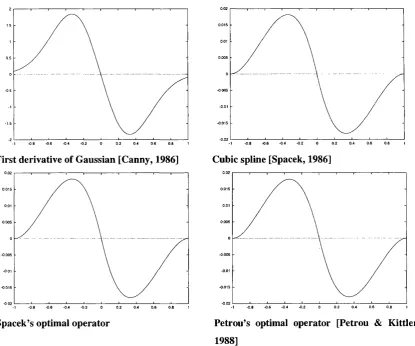
Figure 4.1. A signal containing step e d g e s ... 77
Figure 4.2. Four analytically derived edge detector fu n ctio n s... 80
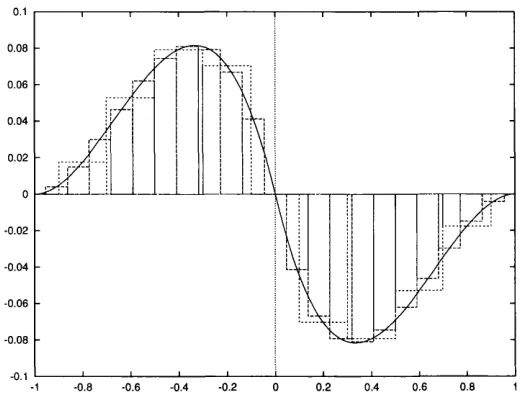
Figure 4.3. Sampling a filter at different rates...81
Figure 4.4. Exam ple training d a ta ... 85
Figure 4.5. Edge detector perform ances on underw ater test d a t a ...92
Figure 4.6. Edge detector perform ances on office environm ent test d a ta ...92
Figure 4.7. Edge detector perform ances on synthetic step edge d a ta ...93
Figure 4.8 O perator evolved on training data consisting o f synthetic step edges corrupted with Gaussian n o is e ...93
Figure 4.9. O perator evolved on training data taken from underw ater im age ensem ble ...94
Figure 4.10. O perator evolved on training data taken from office environm ent image ensem ble... 95
Figure 5.1. Training images used for template matching exp erim en t... 102
Figure 5.2. Fitness profiles for the ‘face’ p ic tu re ... 106
Figure 5.3. Fitness profiles for the 'cross' p icture... 107
Figure 5.4. B est o f run individuals for 'cross' p ic tu re ...108
Figure 5.5. B est o f run individuals for 'face' p icture... 108
Figure 6.1. Form ing a backbone o f connectives with c h a in in g ...116
Figure 6.2. Fitness profiles for line-based and com ponent-based representations on the 'cross' p ic tu re...123
Figure 6.3. Fitness profiles for line-based and com ponent-based representations on the 'face' picture... 124
Figure 6.5. Fitness profiles for com ponent-based representation w ith transform ation
isolation... 125
Figure 6.6. Fitness profiles for com ponent-based representation w ith constant constraint 127 Figure 6.7. B est o f run individuals for com ponent set (face p ic tu re)... 130
Figure 6.8. B est of run individuals for chaining set (face p ic tu re )...130
Figure 6.9. Best o f run individuals for transform ation isolation set (face p ic tu re)... 131
Figure 6.10. B est o f run individuals for constant constraint set (face p ic tu re )...131
Figure 6.11. Structural com plexity o f best evolved individuals with the structuring m ethods... 135
Figure 6.12. Structural com plexity versus fitness for com ponent-based representations 135 Figure 6.13. Effect o f adding chaining c o n strain t...136
Figure 6.14. Effect o f adding transform ation iso lation ... 137
Figure 6.15. Effect o f adding constant c o n strain t...138
Figure 7.1. Edge detection results for synthetic step edge training signals, no n oise 147 Figure 7.2. Edge detection results for synthetic edges training s e t...148
Figure 7.3. Edge detection results for synthetic edges test s e t ...148
Figure 7.4. Edge detection results for office environm ent training s e t...150
Figure 7.5. Edge detection results for office environm ent test s e t... 150
Figure 7.6. Edge detection results for underw ater environm ent training s e t ...151
Figure 7.7. Edge detection results for underw ater environm ent test s e t ... 151
Figure A .I. C onceptual structure o f the G P c y c le ...171
Figure A .2. Top-level structure o f G P-C O M ... 176
Figure A.3. Parallélisation m ethods in G P -C O M ...182
List of Tables
Table 4.1. The set o f term inals used by G P ...82
Table 4.2. The set o f functions used by the G P ...82
Table 4.3. Tableau for edge detection filter p ro b le m ... 83
Table 4.4: Theoretical operators used in perform ance evaluation... 87
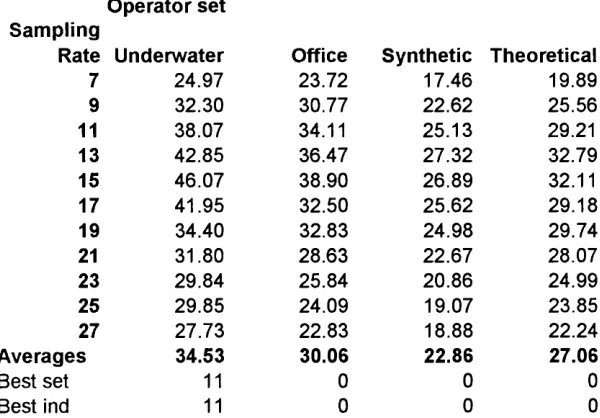
Table 4.5. Edge detector perform ances on underw ater test d a ta ... 88
Table 4.6. Edge detector perform ances on office environm ent test d a t a ... 88
Table 4.7. Edge detector perform ances on synthetic step edge d ata... 90
Table 5.1. Prim itive set for tem plate matching pro b lem ... 100
Table 5.2. Tableau for the tem plate m atching p ro b le m ... 101
Table 5.3. Fitness rewards and penalties for tem plate m atch in g ...102
Table 6.1. Com ponent-based prim itive s e t ...114
Table 6.2. Prim itive sets for c h a in in g ...117
Table 6.3. Prim itive set additions/replacem ents for transform ation iso la tio n ...117
Table 6.4. Prim itive set additions/replacem ents for constant calculation c o n stra in t 119 Table 6.5. Summarised results o f structuring experiment suite (maximum possible score is 132)... 128
Table 6.6. Correlations betw een fitness and structural com plexity (num ber o f line segm en ts)...134
Table 7.1. Prim itive set for signal-based edge d e te c tio n ... 142
Chapter 1
Introduction
In recent years the Genetic Programm ing (GP) paradigm o f machine learning, pioneered by John Koza, has attracted attention as a promising m ethod o f solving problem s by com puter. A wide variety o f problem domains have been show n to be amenable to treatm ent with G P due to the enorm ous flexibility o f representation afforded. It is an attractive answer to the question o f how to get com puters to solve problems because it uses the same m ethods as we do to solve problems on a com puter i.e. it creates com puter program s.
Applying G P to the task o f solving problems o f interest to real-w orld researchers is an im portant way to see how pow erful GP can be. Initially G P was used on small, relatively easy problems, either as a proof-of-concept or as a dem onstration that the representations w ere flexible enough to solve a wide range o f problems. [Koza, 1992] shows that GP can solve seemingly very different problems, such as evolving decision trees for input classification and evolving a playing strategy for a ‘Pac-M an’ game, if such problem s can be rephrased as problem s o f program induction.
pow er and flexibility o f the representations used could offer solutions not available with other learning paradigms. The w ork in this thesis looks at the special consideration that must be given by the designer o f a GP solution space to the issues o f primitive set (the elements used by G P to construct solutions to problem s) and fitness function (the m ethod o f rewarding and penalising solutions by rating their perform ance on specific tasks) design when tackling detection problems.
1.1 Motivation
While GP is a promising and exciting way to implement a problem solving strategy, at the time o f writing many o f the problems successflilly tackled with G P looked quite simple from the representational point o f view. L ots o f human effort was devoted to designing an encoding o f the problem s’ inputs such that the problem domains becam e very similar when GP was applied. The problems often boiled dow n to that o f evolving a correct number for a given input string, often with very simple fitness ftinctions, and having inputs with much reduced dimensionality due to pre-processing o f raw input data e.g. [Tackett, 1993]. This approach limits the classes o f problem s that can be solved, and the usefulness o f GP, by constraining the role GP has to play in producing answers. The use o f enhanced representational schemes such as Strongly Typed GP (STGP) [M ontana, 1995], in which program trees can return and manipulate arbitrary data types, was rriinimal and it appeared that problems solved w ere chosen because they w orked well within the fram ew ork that vanilla GP (i.e. w ithout typing mechanisms) offered. It was thought im portant that GP should be applied to problems that had real-w orld apphcability and that w ould be hard for GP to solve. The problem domains addressed in this thesis, edge detection and tem plate matching, were chosen in part for these reasons.
Certain classes o f problem cannot be adequately tackled by G P w ithout extending the scope o f the technique beyond that o f expressions involving simple numbers. Real- w orld problem s are often like this, which is the reason why m ost com puter program s have som e kind o f data abstraction within them. It was an aim o f this w ork to apply G P to real- w orld, relevant problem domains, which implies the use o f strong typing, hence m uch o f the w ork in this thesis involves the use o f data abstraction through STGP.
Looking at ways in which GP can solve problem s w ith strong typing brings up its ow n set o f questions. Fitness function design becom es orders o f m agnitude m ore com plex w hen values produced by program s are not just numbers. Primitive set design becom es a hard design issue since as well as the transform ations carried out within the primitives it is now necessary to consider how the trees can (and cannot) be constructed w ith the constraints o f a type system. This thesis considers both o f these design issues within the context o f detection problems in digital signals. D etection problem s are ideal as test-beds for GP for several reasons:
• The multi-dimensional nature o f detection problem s, varied types o f data within signals, and application o f statistical m ethods to those signals all point strongly tow ard the need to represent many different types o f data within program trees. These problems offer tough representational challenges that G P will have to cope with.
• M any detection problems are optim isation problem s w ith inherent noise, w here no ‘b est’ answer exists, and are thus suitable for solving in a m ultitude o f different ways. This is suited to the application o f GP as an alternative to human intuition.
1.2 Goals of the thesis
be addressed and m ethods for design and im plem entation o f these elements o f the machine learning process developed, within the context o f com puter vision detection problems. M oreover, solution forms should be developed from primitives that have wide apphcabihty, to a w hole class o f problems, to deflect charges o f over-specificity in primitive sets that w ould m ake solving problems trivial (alm ost solving the problem by hand by using extremely pow erful problem-specific primitives that dictate solution forms beforehand). Generic primitive sets need im proved search capabihty to w ork successfuUy [O ’Reilly, 1995, C hapter 3], so we will need to increase the scalabüity o f GP, i.e. the ability o f GP to solve instances o f problem s that it could not solve before.
The goals have to a large extent been achieved. W ork on producing edge detection füters in C hapter 4 shows that GP can successfully produce high-quahty solutions to a problem w here peak performance differences can be only fractions o f a percent. The abihty o f G P to solve binary template-matching problems, though the careful structuring o f primitive set type systems, is shown in Chapter 5 and im proved upon in C hapter 6. These m ethods are then apphed to the problem o f edge detection in C hapter 7 where GP is required to produce a much m ore com plex solution than before, using a prim itive set that is generic and could be applied to a range of detection problem s.
1.3 Structure of the thesis
After this introduction C hapter 2 presents a detahed description o f the process o f applying GP to a problem domain. It highhghts many o f the issues surrounding GP, arising either from its basis in Genetic Algorithms (GA) [Hohand, 1992] or from characteristics o f G P that are not found in a GA, and briefly describes approaches taken to address those issues. Additionally, C hapter 2 contains discussions o f research relevant to this thesis in the application o f G P to im age processing and signal processing problems.
Chapter 3 discusses the nature o f detection problems in general and how we can use the generic properties o f detectors as an (imphcit or explicit) basis for designing fitness functions. It presents a generic approach to the design o f fitness functions for all detection problems, taken from the w ork o f Canny [Canny, 1986] which is explored in Chapter 4.
that G P is capable o f producing extremely high-quality solutions to optim isation problem s in com puter vision.
Chapter 5 presents practical w ork in applying GP to a tem plate matching problem, using strong typing and a primitive set to draw arbitrary binary templates. This w ork is also used as a basis for extended tem plate matching experim ents in C hapter 6, which dem onstrates the use o f STG P as a versatile and pow erful constraint mechanism for program tree generation. This mechanism is explicitly em ployed to prom ote the hierarchical use o f different levels o f representation within program trees, and to provide methods o f structuring that significantly im prove perform ance in the chosen problem domain.
Chapter 7 employs the approaches to bo th fitness function design and primitive set design developed in Chapters 4, 5 and 6. Practical w ork on adopting problem-specific representations and conventions in this chapter employs traditional im age-processing techniques, applied via GP, to the problem o f edge detection. STG P is used to allow GP to produce solutions in the language o f the image processing engineer by employing a primitive set that im plem ents elementary techniques used in vision applications.
Chapter 8 concludes the main body o f the thesis w ith a discussion o f the m ethods developed and the results produced by the body o f practical w ork. Conclusions for the application o f G P to detection problem s in discrete signals are made. Avenues o f future work are also discussed.
The softw are system developed to perform the experiments for the practical w ork in this thesis is described in Appendix A. This system is used as an example to highlight and discuss issues in softw are design for genetic program m ing systems. Particular attention is paid to the structure o f the G P cycle and how softw are can be constructed to reflect that structure.
1.4 Contributions
This thesis makes five m ain contributions:
1. This thesis considerably extends the am ount o f w ork done on applying G P to image processing and com puter vision problem s so far. It is the first thesis to be devoted to this issue.
designed by human experts on real-w orld and synthetic data. This w ork provides new levels o f perform ance for edge detector filters in com puter vision and as such is a contribution to that field. M oreover, G P is show n to be able to produce high-quahty solutions to problem s using raw input data that has not been pre-processed. This gives G P extra credibihty as a problem solving strategy in real-w orld domains w here such data is prevalent, and reduces the role o f the hum an in the problem -solving process.
3. Strong typing is presented as a m ethod o f adding exphcit syntactic constraints to influence the construction o f program trees. This technique is extremely pow erful and can be used in many ways. This thesis uses such constraints in three ways in Chapter 6 to address problem s in the design o f a prim itive set.
4. Using these constraints, a technique is developed to increase the scalabüity o f G P to solve higher-order instances o f some problem s by enforcing a hierarchy o f abstraction in data types within program trees. Design o f primitive sets through judicious use o f strong typing permits the G P practitioner to guide the way potential solutions are constructed and increases the ability o f G P to find good solutions.
Chapter 2
A Detailed Description of Genetic Programming
This chapter o f the thesis performs a dual function. Firstly it describes the Genetic Program m ing process in some detail, going through each stage o f solving a problem with GP. Secondly it highlights particular issues that arise w hen applying G P to a problem , and summarises current research into im proved m ethods that address these issues. For a com prehensive survey o f G P see [Langdon, 1996a, Appendix B]. Finally, relevant literature, involving the applications o f G P to signal-oriented problem s, is briefly surveyed.
2.1 Genetic algorithms and genetic programming
G P draw s heavily from its roots in genetic algorithms and many issues in G P are in fact issues in G As. A description o f GP therefore necessarily must describe G As as well. W here G P com es into its own, and moves beyond conventional G As, is w ith the representational flexibility it provides.
2.1.1 Genetic algorithms and genetic search
with those that devote resources to speculative exploration o f less promising areas o f that space. Genetic search is an abstract search m ethod into which problem -specific elements must be added. Solutions are encoded in some form and the range o f such encodings defines the size and shape o f the solution space. A ssessm ent o f these encoded solutions is also problem-specific, and rates the individuals within the population to direct the search process. The stages involved in genetic search are as follows:
1. An initial population o f randomly created individuals is created. In the most basic form o f GA these are bit-strings encoding param eters to a solution form. E ach individual represents a possible solution to the problem, i.e. a single point within the space o f all solutions the can be generated w ith the chosen encoding.
2. Each individual within the population o f candidate solutions is rated according to how well it solves the required task. This is done by a problem -specific com ponent called the fitn e ss fu n ctio n , which maps points in the solution space to fitness values, usually single numbers, by assessing the candidate solutions over a number o f ‘fitness cases’ (the training set o f data), representative o f the w hole problem dom ain being tackled.
Mutation in GA. R eplaces random substring
C rossover in GA. Sw aps random substrings
Figure 2.1. Effect of the genetic operators in the standard G A
alteration to the candidate’s genetic makeup (its genome). The most common operators are mutation and crossover, although others can be used (see section 2.4.1.4). M utation changes a randomly selected portion o f the candidate’s genome into a new, randomly generated, piece o f genetic code. Crossover swaps randomly selected pieces o f genome between two different individuals in the population (see Figure 2.1). The new population may either be constructed in its entirety via the selection methods, and the genetic operations subsequently applied ‘in place’ to the reproduced individuals, or the reproduced individuals may be operated on while being reproduced, before being placed in the new population.
4. The new population takes the place o f the old one, and the process repeats from step 2. The cycle stops after some termination criterion has been satisfied, which can be related to the performance o f the search or can be a simple upper limit on the number of cycles performed.
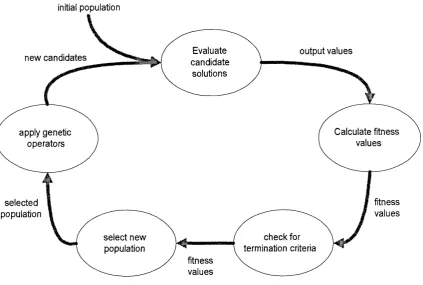
Figure 2.2 illustrates this cycle, which applies to both genetic algorithms and to GP. The cycle is a simplified analogy o f the Darwinian processes o f natural selection and survival o f the fittest, where organisms that are better at the ‘problem ’ o f surviving get to reproduce more than those that fail the test. Population-level evolution comes about when this natural selection works on a diverse range o f organisms each o f which has different
initial population
Evaluate candidate
solutions
output values new candidates
Calculate fitness values apply genetic
operators
fitness values selected
population
check for termination criteria select new
population
fitness values
Figure 2.2. The genetic search cycle
characteristics. The exploitation o f these differences leads to the selection o f some forms o f organism over others, whilst a background o f low -rate copying error (m utation) in the organism s’ genomes, and the mechanisms o f sexual reproduction (crossover) ensures the m aintenance of some kind o f diversity by producing novel genetic material.
The encoding o f the genetic material o f an individual is know n as the genotype o f that individual. This is distinct from the phenotype o f the individual, w hich is the visible expression o f the code within the genotype, the effect the genotype has on the outside world. In biology, our genotype consists o f strands o f D NA , but our phenotype encom passes not only how w e look but how we behave and interact w ith the outside world. In most G A or G P problem s the phenotype o f an individual is a property o f the fitness values it produces.
the fitness function onto a ‘height’ which represents the quality o f the solution. The genetic algorithm is a m ethod o f exploring this landscape in such a w ay that the chances of finding the highest point, the global optimum in the space, are increased.
F or many problems, a solution o f sufficient quahty may not be found before the maximum number o f generations (cycles) has been reached. Often it is necessary to repeat the search process several times to find a solution, each time starting w ith a different initial population (and hence a different sample o f the solution space). E ach instance o f the process is referred to as a run.
If w e keep the landscape metaphor, the selection process can be seen as a clustering method. After selection, m ore instances o f the better individuals survive and some o f the w orse individuals no longer appear. This has the effect o f increasing the average fitness o f the population due to the increase in frequency o f individuals with higher fitnesses. The best fitness value in the population remains unchanged by selection, however, since no novel individuals have been created. The subsequent role o f the genetic operators is therefore to move individuals around the landscape by altering their makeup, increasing the diversity in the population and allowing the search process to sample new areas o f the space. The greater number o f instances o f fitter individuals means that more novel individuals wül be made from copies o f relatively fit solutions than from unfit ones. If the solution space, the form o f w hich depends on the chosen encoding o f solutions and on the fitness function, has the right characteristics a small perm utation o f a fit individual stands a chance o f being fitter still than the original candidate solution from w hich it came, leading to the discovery o f progressively better and better solutions.
2.1.2 Genetic programming
There are three major differences betw een GP and the classical GA. W hilst G P uses the genetic search process described in section 2.1.1 to evolve the population o f candidate solutions, its representations differ enorm ously from those o f the standard GA.
problem dom ain being tackled and that the designer thinks may be useful in contributing to a good solution.
The name “G enetic Program m ing” com es from the notion that we are able to represent com puter program s with a tree-structured genom e. C om puter programm ing languages can be represented by formal gramm ars which are tree-based, so it is actually very simple to represent program code directly as trees. L eaf nodes in the program trees are thus know n as term inals, and internal nodes as functions. P rogram trees are randomly created by selecting elements at random from the provided primitives (known as the
fu n c tio n set and term inal set, or collectively as the prim itive set). W hen a function is selected for insertion into the tree, we must then select elements to fill the subtrees that represent that function’s param eters.
W ith the change in representation from G A to G P com es a change in the dynamics o f the search process. The search process in governed, against a background o f random change, by the interaction o f the selection m ethods, the genetic operators, the fitness function and the primitive set. The selection m ethods used in GP are the same as those used in G As but the operators must be redefined to cope w ith the different structure o f the genom e. The operators o f m utation and crossover are defined to w ork in a similar way to those used w ith bitstrings, but on random ly selected subtrees within the genome rather than substrings. This can be seen in Figure 2.3.
2.2 Tackling a problem with GP
M uch preparation is required when tackling a problem w ith GP. The cycle described in section 2.1.1 takes a num ber o f param eters, for which values need to be decided. The problem representation needs to be defined, the encoding o f solutions specified and the fitness function designed. Additionally, the following questions need to be answered before experim ental runs can take place:
• W hat is the set o f term inals to be used in the program trees?
• W hat is the set o f fu n c tio n s to be used in the program trees?
• W hat is the fitn e ss m easure?
• W hat values to give the param eters and variables f o r controlling the run e.g.
Mutation in GP. R eplaces random subtree
C rossover in GP. Sw aps random subtrees
Figure 2.3. Effect of genetic operators in GP
• H ow do we know when we have a good enough result?
• When do we term inate a run?
• H ow m any runs do we perform ?
• H ow are p rogram trees to he constructed? W hat d ifferen ces exist f o r trees created by
m utation, i f m utation is being used?
• W hat selection m e th o d is going to be used?
• W hat g enetic operators, and at w hat freq u en cies, are going to be applied?
Each o f these factors affects the search process, and consequently the chances of finding a successful solution. The interaction of genomic representation and fitness function together define the nature o f the search space. Such interactions are usually extremely complex, and the space is extremely high-dimensional. The selection methods and genetic operators together define the balance between exploration and exploitation,
that is, they determine how much effort is devoted to exploring parts of the space that show promise and how much effort goes into looking for new parts o f the space that may ultimately be more rewarding
There may also be practical considerations to think of. Run-times are usually an important factor, so some degree o f parallelism in execution might be beneficial. Memory overheads and run-time are also affected by the size o f the trees being processed, so some
controls might be needed to limit the maximum size o f a program tree. Im plem entation o f the G P system is also an issue, depending on the problem domain. For instance, the overhead o f the G P system and its operations is usually insignificant when com pared to the evaluation o f individuals’ fitness, so choice o f representation and execution m ethod o f the candidate program s could be an im portant one if the problem domain is inherently com putationally expensive.
As an example o f w hat decisions the GP practitioner might make, we wül use an exam ple problem that K oza tackles w ith G P in [Koza, 1992, section 7.3], which is a simple symbohc regression problem . Given a set o f 20 data points randomly sampled from a curve over the interval [-1.0, 1.0], G P needs to evolve a symbohc expression that passes through those data points in order to discover the underlying m odel to that data. Such an expression w ould be a functional form which w ould depend only on the independent variable x w ithin that interval. K oza thus picks the term inal set as simply
T = { x }
and supphes a num ber o f arithmetic and trigonom etric functions for the function set (where % is a protected division function, such that dividing by 0 returns 0).
F = {+, -, *, %, sin, cos, exp, rlogj
The decisions m ade are normally tabulated to produce a ‘tableau’, which provides a quick summary o f all these run param eters. Tableaux are used in the experimental w ork detailed in the later chapters o f this thesis (e.g. see Table 4.3). The rest o f this chapter includes m aterial on the choices available to the designer during each o f the steps hsted above, most o f which seek to improve search perform ance by reducing the tendency o f populations to converge prem aturely (see section 2.4). In addition, the m ethods used in the practical sections o f this thesis will be stated.
2.3 Program tree construction methods
P rogram trees in G P, either as a part o f the initial population in a run o r by the m utation operator, are generated randomly using elements o f the function set and term inal set only to produce tree nodes. M any methods can be used to generate these trees, starting from the ro o t and recursively filling in the low er levels o f the tree. In this section we only consider the canonical case o f un-typed, un-constrained GP. Enhancem ents such as strong typing (see section 2.6.3) have their ow n imphcations for tree generation (see section 2.9.6).
K oza uses tw o methods for generating program trees in [Koza, 1992]. The first m ethod, called “fuU” produces a tree o f maximum possible depth, w here aU leaves in the tree are at the specified maximum tree depth. This is achieved by simply picking from the function set only, for all depths except the maximum depth, w here only the term inal set is used. The second m ethod, called “grow ” involves picking randomly from the full primitive set at each point in the tree, terminating that branch if a term inal is selected. The depth constraint is again enforced by only picking from the terminal set if the depth limit is reached on a particular branch, but functions o r terminals may be chosen at levels higher than the m aximum depth. This method produces variably shaped trees, in contrast to the fixed shape trees produced by the “full” method.
F or the experim ents in this thesis, a different m ethod is used. Instead o f constraining the maximum size o f the trees by imposing a hard depth limit, a probabilistic m ethod is used to restrict tree growth. This m ethod is explained fully in A ppendix A.
2.4 Convergence
In nature, the process o f evolution is a continuous one. Species continue to adapt to changing environm ental conditions, including com petition from other species that are themselves evolving, and do not simply com e to a halt as far as evolutionary progress is concerned. Such a halt w ould be fatal to the species as it then succumbs to increasingly strong com petition. Yet in evolutionary com putation such stagnation occurs very often, and is called convergence.
Convergence is an issue at the heart o f many techniques to im prove the perform ance o f genetic search, many o f which will be detailed in the rest o f this section. The term is used to describe the state o f affairs when the population becom es largely hom ogenous, consisting largely o f variations on a single style o f solution. This genetic hom ogeneity com es about when a particular form o f solution benefits from increased selection over a number o f generations but doesn’t lead to necessarily fitter offspring, and hence dom inates the population. Such a phenom enon d oesn’t often occur in nature because the environm ental pressures are always changing, always dynamic, and the environm ent itself is incredibly complex. Any species w hich failed to adapt to its environm ent w ould be at a com petitive disadvantage and w ould eventually die out. In genetic search as used in G As and GP, the environment is rarely dynamic and the search process can often get stuck in a particular area o f the solution space.
Convergence in itself is not undesirable; it normally indicates that the search process has found a profitable area and is concentrating on that part o f the solution space. The problem is with prem ature convergence, w here the search stops prem aturely and doesn’t find a solution o f sufficient quahty. In seeking to delay convergence, researchers are trying to get the search to last longer before it gets attracted to a single region o f the solution space, to increase the chances o f finding a better attractor, w hilst retaining the tendency to exploit promising regions once found. W ith finite resources these tw o desirable properties contend w ith each other.
space by increasing the relative frequency o f the b etter solutions in the previous generation. The second force, which tends to prom ote exploration o f new areas o f the search space, is the action o f the genetic operators upon the program trees. These are responsible for the variation in the population once selection has been com pleted.
C onvergence com es about w hen a good genotype arises (that is, one w ith high fitness relative to the rest o f the population) that is phenotypically resistant to changes in genotype induced by the genetic operators. Once a good solution arises, it is reproduced several times in the next generation. Leaving aside the chances o f other, better solutions arising from other parts o f the population, we can see that the frequency o f a highly fit genotype in a population increases rapidly if instances o f that genotype are not perturbed in some significant way by the action o f a genetic operator.
There are three effects a genetic operation can have upon an individual program in term s o f its fitness:
1. The program ’s fitness can be relatively unaffected, either because the operation fails for some reason (a constraint laid dow n by the designer, perhaps), or because the operation succeeds but the change in genom e has little effect when expressed as fitness. In this case there is little change from the previous generation, and the frequency o f descendants o f that program will tend to increase rapidly w ithin the population.
2. The operation can have a deleterious effect on the program , reducing its fitness com pared to other instances o f the original program in the new population. In this case the new genotype is likely to be rem oved from the population over time, and the increase in instances o f the fit genotype is slowed only marginally by the loss o f a single instance. The frequency o f the fit genotype still increases exponentially.
3. The final possibility is that the action o f the operator increases the fitness o f the individual. In this case the new fitter genotype will begin to proliferate throughout the population, at the expense o f other, less fit genotypes.
present, which are already com m on in the population. The result is a kind o f stagnation w here the search is increasingly concentrated in a single area o f the search space, from which it is increasingly unlikely to escape. This usually leads to a sub-optim al solution (unless the population happens to converge on a globally optim al area), and results in w asted effort on the part o f the designer and CPU. The ability o f the system to continually produce fitter individuals is referred to as evolvability [W agner & Altenberg, 1994]. The maintenance o f the evolvability o f a population is therefore synonymous with the avoidance o f convergence, since the likelihood o f continually finding fitter individuals (and thus avoiding domination by a single genotype and its phenotypically similar variants) remains high.
M uch effort has been expended in modifying the search process to maintain evolvability. The rest o f this section concentrates on both novel and traditional techniques which enhance the abihty o f genetic search to counter the onset o f prem ature convergence. These can be broken dow n into m ethods that w ork at the individual level to increase the probability o f producing a fitter individual with a genetic operator, and ones that w ork at the population level, to reduce the rate o f propagation o f fitter individuals. Often such m ethods are combined, and each are at the mercy o f the noise present in genetic search. A fit individual may well be lost in the disruption caused by genetic operations before it has a chance to propagate, which is undesirable. This is an unavoidable possibihty, however, if we are to stick to a search process with finite storage and com putational resources.
2.4.1 Program tree manipulation
P rogram trees are manipulated by genetic operators. These operators can be unary or binary, and may produce a single offspring or a pair. These operators are responsible for introducing and maintaining the variabüity in fitness that drives the selection process, and can be seen as w orking against the selection methods in terms o f population diversity.
2.4.1.1 M utation
o f diversity. The use o f the term mutation comes from the biological m etaphor o f a random change being induced in a genom e as a fault in the reproductive process.
The classical m utation as used in GP is a random replacement o f part o f a program tree w ith a new ly-created subtree. A point in the program tree for replacem ent is chosen by a (either uniform or biased) random process, and the subtree headed by this point is excised. A new tree is randomly generated and inserted in its place. This new tree is often subject to depth restrictions in a similar w ay to the process detailed earlier for whole program trees, but with a m uch smaller depth limit. A typical depth limit used is 4. M utation produces a single offspring from a single parent.
M utation introduces (usually) entirely new genetic material into the gene pool. A lthough the nodes themselves (which are often called genes despite being a less than accurate analogy) are not new, the likelihood being that many instances o f each are already present in the population, the com bination o f these nodes is quite likely to be unique and thus some novelty is introduced, increasing the overall diversity o f the population. It is for this reason that m utation is often used to reduce the chances o f prem ature convergence.
2.4.1.2 Crossover
Crossover is the analogue o f the genetic recom bination process that takes place betw een paired chrom osom es o f D N A in ceU meiosis (the process by which reproductive cells, e.g. ova and sperm atozoa, are produced in many living organisms). In genetic search it involves the mixing o f genetic material from tw o parent individuals to produce one or tw o new individuals with different genotypes. A point is chosen at random in the first parent. A point is also chosen at random in the genom e o f the second parent. The subtrees headed by these nodes are then swapped. Each parent loses a section o f its ow n genom e and has it replaced w ith a section o f the other p aren t’s.
2.4.1.3 Soft brood selection
A lthough called soft brood selection [Tackett & Carmi, 1994], this technique uses no unusual selection m ethods (see 2.4.2) but instead is a modified recom bination operator. Tw o parents are chosen at random, and a ‘b ro o d ’ o f offspring is produced using the conventional crossover operator. A tournam ent is held within this brood, and the fittest offspring is reproduced into the next generation, even if it is less fit than either o f the parents. This m ethod encourages the production o f fitter offspring than the parents, and is aimed at directly increasing the evolvability o f the population.
2.4.1.4 O ther genetic operators
E diting is an operation designed to reduce the com plexity o f program trees. It w orks by applying a series o f dom ain-dependent editing rules to a genom e to rem ove obsolete code. F or instance, the code ( A N D ( T r u e , T r u e ) ) can be easily m atched and reduced to a
( T r u e ) w ith no phenotypic effect. Similar operations can be applied to arithmetic expressions and other Boolean expressions. This operation can either be used cosmetically, to reduce the size o f a program tree when being displayed for humans, or in a run to try and restrict tree growth. In a brief experiment, K oza shows that use o f the edit operation has httle or no effect upon the chances o f GP solving a simple problem such as the 6-multiplexer problem [Koza, 1992, section 25.5]. [Soule, F oster and Dickinson, 1996] use the editing operation to try and stop program grow th in GP, but it proved to be ineffective, as GP ju st evolved functional but non-executed code instead.
[Kinnear, 1993] uses the hoist operator in an experiment to evolve sorting netw orks with GP. H oist selects a random subtree within an individual and returns a copy o f that subtree as a new individual, ‘prom oting’ the subtree to program status. This w orks best in untyped GP. K innear’s w ork shows that, while the operator is not particularly advantageous to overall performance, it does have a role to play in controlling the size o f program trees.
2.4.2 Selection methods and convergence
o f the population to converge w ith the likelihood o f exploiting a better solution should one arise. Too much convergence leads to stagnation and sub-optim al solutions, too much caution leads to the loss of many potentially useful avenues o f search.
2.4.2.1 Ranking schem es vs. fitn e ss proportionate schem es
Selection schemes can be divided into fitness-proportionate and ranking schemes. Fitness proportionate schemes use the values produced by the fitness function directly to determ ine the num ber o f each individual that get reproduced. Ranking schemes use these values to produce an ordering o f individuals, which is then used to control the reproduction o f programs.
If fitness proportionate selection is used, normalised fitness values are calculated for each individual in the population. These values are calculated in such a way that the sum o f all normalised fitness values is equal to 1. Each individual is accordingly assigned a unique interval in the range [0,1] o f w idth equal to its normalised fitness value. A random number generator is then used to generate a value betw een 0 and 1, which maps directly to a single individual, with probability equal to the norm alised fitness o f that program . This individual is reproduced into the new population, and the process is repeated until the population is filled.
Ranking schemes use some function o f the ordering o f individuals to control reproduction. The most often used is tournam ent selection. In tournam ent selection, a random process is used to pick a num ber o f individuals from the old population. O f these individuals, the one with the highest fitness value (i.e. the best rank) is reproduced into the next population. The individuals picked are not rem oved from the old population. This process repeats until the new population is filled. The num ber o f individuals picked for each tournam ent is called the tournam ent size, and is an im portant param eter in determining the nature o f the selections produced. Too large a tournam ent size prom otes rapid convergence, too small and the nature o f the selection tends tow ards random ness.
2.4.2.2 P ropagation o f an individual with different selection schem es
It is this individual that, assuming that the population is going to converge, wül dom inate the population with its genotype or phenotypically sim ilar variants.
Propagation has been studied closely w hen apphed to schem ata (short sections o f genom e which contribute highly to the fitness o f individuals containing them, see section 2.7.1). The aim o f this section is how ever to give an informal notion o f the rate at which convergence occurs based purely on leading edge, dominating, individuals and selection m ethods, to give some idea how these m ethods affect convergence.
If fitness proportionate selection is used, the fittest individual wül reproduce in proportion to its normalised fitness value. So, for population size M, total norm ahsed fitness o f 1, and normahsed fitness value o f the best individual Nfinesu the num ber o f individuals reproduced is M (rounded dow n to an integer). The frequency o f this
individual increases exponentiaUy by a factor dependent on its norm ahsed fitness value and those o f the rest o f the population. As the frequency o f this dom inant individual increases, its fitness advantage decreases as the average fitness o f the population rises tow ard its peak fitness.
F or tournam ent selection, the fittest individual wih win every tournam ent in which it is entered. The chances o f this individual being selected for any tournam ent are 1/M, but w ith a tournam ent size o f T (that is, T individuals are chosen randomly to participate in each tournam ent), this becom es T/M. Since there are M tournam ents held in each selection, this means a total o f T tournam ents wih be w on by the fittest individual, so this individual will reproduce T times.
So, for a single selection phase, the number o f instances o f the fittest individual (previously present only once in the population) becom es T. The population wih becom e saturated w ith instances o f this individual in logr M generations using this selection m ethod, assuming the effects o f the genetic operators do not change the fitness o f each instance in any substantial way. Even for a smah tournam ent size such as 2 (the smahest possible value) this means that a population o f size 1000 w ould becom e saturated in only 10 generations if no novelty w ere introduced via the genetic operators. For fitness proportionate selection, the rate o f increase would depend on the actual fitness values, which w ould tend to homogenise over time as the fittest individuals dom inate the population.
o f convergence if fitness-proportionate selection is going to be used. That is, since individuals are rew arded according to how well they do in absolute term s, changing these terms alters the advantage held by fitter individuals and affects the rate o f convergence accordingly. F or tournam ent selection and other ranking schemes, individuals are rew arded for perform ance in relation to the rest o f the population. H ere, it only m atters that the individual is better, not how much better it is. F or these reasons, a rank-based selection m ethod is often popular as the designer does not have to pay attention to scaling o f the values produced by the fitness function. In this thesis all experim ents use tournam ent selection with a tournam ent size o f 2 which gives the slow est possible rate o f convergence.
An analysis o f various selection methods, and their takeover times (the time taken for a population to converge once a particularly strong individual has em erged, if no genetic operators are used), can be found in [Goldberg & D eb, 1991].
[Ryan, 1994] introduces a novel selection m ethod based on multiple criteria. A rank-based m ethod, it uses tw o ordered lists o f individuals w hich are based on separate fitness criteria. One list uses a traditional fitness function (i.e. the ability o f the individual to solve the problem) whilst the other is based on a modified fitness function with a size factor incorporated. Breeding is then done betw een individuals in the top sections o f each list, i.e. high-performing individuals are bred w ith good perform ers that are also short. This helps to maintain diversity by providing tw o different gene pools from which to produce new individuals. In addition to increasing perform ance on a sorting netw ork problem , this helped control program tree sizes (see section 2.9.6).
2.4.3 Other methods
fitness, so that multiple copies o f the same genome are selected out by the normal m ethods.
2.4.4 Population-level techniques to reduce convergence
W hilst genetic operators and selection m ethods w ork on the individual program s themselves, or their fitness values, other m ethods adapt the underlying structure o f the population-based search process to try and improve performance. The two main m ethods used which operate on populations in a different way are the Steady State G A (SSGA) and demie populations (otherw ise know n as geographic isolation). B oth take their inspiration from a closer adherence to the m etaphor with evolution in the natural environment.
2.4.4.1 D em es
In nature populations o f a particular species do not exist in a single large body o f individuals, com peting globally w ith each other for resources. A potentially m ore accurate m odel w ould have a number o f sub-populations o f the species, existing for the m ost part in geographic isolation from other sub-populations, each evolving in a shghtly different direction in response to differing environm ental conditions.
through the population if they prove to be better than their neighbours. The island model is particularly suited to large-scale parallehsation, as each sub-population can be adm inistered by a different machine or processor w ith httle overhead. Com m unication by m igration takes place after each generation has been evaluated, and individuals are sent between machines.
2.4.4.2 Steady state GAs
The m odel o f population evolution used in conventional G A search is a generational model, that is, it replaces entire populations at one time. This is in stark contrast to the natural world, where the birth and death o f individual organism s is a continuous process. The fitness o f an individual plays a significant part in determining only that individual’s chances o f survival and is largely independent o f the prow ess o f other individuals. The processes o f death and reproduction occur at the individual level and are based largely on that individual’s chances of survival (i.e. fitness).
A Steady State GA (SSGA ) [Syswerda, 1991] determ ines the m akeup o f a population at the individual level, rather than for a w hole population at a time. Rather than select M individuals and then apply genetic operators over all M, the SSG A produces one or tw o new individuals at a time, and inserts them into the existing population. These new individuals are picked from the existing population according to selection criteria similar to those that apply in the generational model, and may be altered by one o f the genetic operators. To maintain the population size, the new program s replace older individuals based on fitness criteria (i.e. po orer program s stand a larger chance o f being removed).
The population in a SSG A is updated frequently and to a small degree only. Each time new individuals are inserted, they are evaluated and the fitness distribution o f the entire population updated. This can mean shghtly m ore overhead for the GP system, but the extra com putation is usually insignificant com pared to that required by fitness evaluations. W hen comparing SSG A results with traditional G A experim ents, the term
generation equivalent is used to refer to the num ber o f replacem ents o f individuals that would be equivalent to replacing a single generation in panm ictic GAs.
2.4.4.3 D ynam ic fitn ess fu nctions
often the cases are the same every generation. Convergence can be delayed by shifting the evolutionary goalposts on a regular basis, giving the individuals new problem s to solve w hich differ slightly from those used previously (while retaining the essential properties that define the problem domain). Strategies which involve a random selection o f fitness cases each generation, from a poo l o f cases, can help prevent the search finding too- specific solutions to the problem (know n as overfitting). W e normally w ant to be sure about certain properties o f our training set, however, so such pools are inevitably limited in size. The search therefore is directed in a very constrained way to ensure the m aintenance o f such properties.
A m ore complex m ethod o f adapting the fitness function over the duration o f the run is Limited E rror Fitness (LEE, [Gathercole & Ross, 1997]), which dynamically adapts the order o f the training samples used and the maximum perm itted error for each genetic program , based on the current best perform ance in the population. This allows the adaptive scaling o f the hardness o f the problem, and also lets the population ‘kick -start’ in the event o f failure if the problem becom es too hard. This technique permits a longer search process by keeping the population out o f ruts in the search space, constantly pushing it in slightly different directions.
2A A A Co-evolution
Co-evolution provides a way to provide a large num ber o f fitness cases to drive the search, and to make the cases get m ore difficult as the search progresses, to force the evolution o f m ore general and m ore accom plished solutions.
by the candidate solutions. One particularly good exam ple o f this is a sorting netw ork w hich co-evolves with its test cases [Hillis, 1992].
Such an approach can be an elegant w ay to avoid stagnation in populations caused by prem ature convergence, by driving the evolution in different directions over time. This can also help evolution to find better, more general solutions to problems. Whilst co evolution lets the designer avoid the need to produce possibly large bodies o f fitness cases, it involves extra effort w hen designing the problem suite. In addition to the considerable design effort required to produce a search o f the ‘forw ard’ problem (the desired candidate solutions), additional effort needs to be put into implementing the ‘backw ard’ problem (evolving fitness cases to penalise solutions to the forw ard problem) as well. This m ore than doubles the effort required in the design phase, since as well as the interactions betw een primitive set and fitness function, the interactions betw een the tw o populations need to be considered. It is necessary to ensure that the backw ard problem is constrained so that it produces legal fitness cases, and also that these cases will prove sufficiently challenging for the forw ard problem. Finally, many problems may simply not be amenable to implem entation as a co-evolving population as there may not be a way to evolve progressively harder fitness cases. For this reason, co-evolution is not often used in problem-solving oriented domains, although it is very popular in ecosystem simulations [Cliff & M iller, 1996].
2.5 Modularisation
trees w ith fewer nodes, w hich are m ore easily understood and analysed). This is achieved through abstraction in the pro gram trees, finding code that can be re-used many times over w ithin the same program .
Currently in G P there are three approaches to abstraction, which are detailed in the rem ainder o f this section. They differ in the am ount o f effort required on the designers part, and in the scope o f the abstractions produced. These approaches all concentrate on the abstraction o f procedure within the program trees, how ever. The other kind o f abstraction used by human program m ers is that o f data abstraction, which m irrors the conceptual abstractions used when we analyse and break dow n a problem. W ork on using data abstraction w ithin G P is presented in Chapter 6 o f this thesis.
2.5.1 Automatically defined functions
Automatically Defined Functions (ADFs) [Koza, 1994] are inspired by structured program m ing m ethods w here code fragments in the program are encapsulated in distinct modules. Using ADFs allows GP to exploit this encapsulation and re-usability by evolving subroutines as separate code trees, along with the main program tree. W hen using ADFs with GP, each program tree is supplem ented with a num ber o f separate trees each o f which implements a single ADF. Each ADF tree is local to a single individual, and is not available to other individuals in the population. Calls to these ADFs are included in the primitive set o f the main program tree for that individual, allowing their use in the main program tree. Each A DF is a separate function in its ow n right, w ith a primitive set o f its own, that can take a num ber o f form al parameters. These param eters are supplied by the main program tree as subtrees o f a particular call to the ADF, the same w ay as w ith any other element o f the function set. During the evolutionary process, the main program tree and the A DF trees can be altered by the genetic operators. The idea is that the evolution o f the subroutines, and the use m ade o f them, is perform ed sim ultaneously.