IJEDR1401215
International Journal of Engineering Development and Research (www.ijedr.org)1205
State Of The Art and Integrated Process Design for
Microbioreactor Systems-A Review
1
Sirajo Lawal,
2Ali Abubakar Mohammed,
3Musa Lawal
Department of Chemical Engineering, Kaduna Polytechnic, Kaduna, Nigeria
1[email protected], 2[email protected], 3[email protected]
________________________________________________________________________________________________________
Abstract - Over the years, microbioreactors have been equipped with a variety of tools for online monitoring and measuring of environmental conditions and assessing the physiological state of microorganisms. Microorganisms have played an essential role in producing everyday commodities, such as alcohol, beverages, enzymes. Micro scale system such as microbioreactor offers the potential to develop disposable and miniaturized version of conventional bioreactor. Microbioreactors systems combine the ease of handling of shake flask operations while preserving the online sensing and control capabilities of stirred tank bench-scale bioreactors. It offers academia and the industry the capacity to acquire real-time experimental data through cheap and high-throughput experimentation under well-controlled conditions. However, in spite of development of microbioreactor technology, new challenges still exist. One obvious challenge is the need for efficient strategies for determining the optimal operating condition where both the design and control objectives of obtaining optimal throughput screening in a microbioreactor can be best achieved. Such strategy will increase the efficiency of the reactor and reduce its working hours drastically in addition to other advantages of performing experiments in a microbioreactor system. Current microbioreactor process design and control is analyzed in this review paper, focusing on state-of-the-art and proposing a new strategy for determining the optimal operating conditions where both the design and control objectives of obtaining optimal throughput screening with a microbioreactor can be achieved.
Index Terms—microbioreactors, attainable region, Oxygen demand, Dissolved oxygen
________________________________________________________________________________________________________
I.INTRODUCTION
A. Integrated Process Design of Microbioreactor
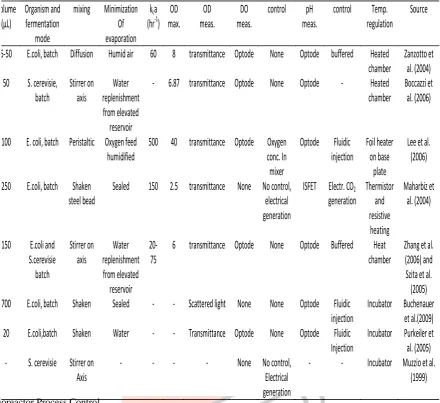
The early generation of microbioreactor was designed to increase levels of complexity, with Poly (dimethylsiloxane) and Poly (methyl methacrylate) (PDMS), by micro machining and multilayer thermal compression bonding procedures. Online optical measurements of optical density, pH, and dissolved
oxygen are integrated. Active mixing is made possible by a miniature magnetic stir bar. Plug-in-and-flow microfluidic connectors and fabricated polymer micro-optical lenses/connectors are integrated in the microbioreactors for fast set up and easy operation.
IJEDR1401215
International Journal of Engineering Development and Research (www.ijedr.org)1206
Table 1: Current microbioreactor design PlatformB. Microbioreactor Process Control
It is important to measure and control critical process variables online, especially parameters that are used in closed control loops. There are several means to measure and control these common parameters, with the advantages of each method.
In practice, temperature, pH, and dissolved oxygen are the most widely measured and controlled in situ parameters. Sensors for these are typically inserted into specially designed port on the vessel [6].
1) Temperature Control in Microbioreactor
Temperature measurement is easy to achieve in microbioreactor system. The control of temperature in a microbioreactor system is rather a difficult task to achieve. This is as a result of the high surface area of working volume ratio (S/V) in a microbioreactor system. Hence, the heat transfer in a microbioreactor system is large and very rapid. Another reason is the location of the heating element. It is important to place the heating element in a position where it will not create a large temperature gradient. This is particularly important for microbioreactor fabricated from PMMA and PDMS, because these materials have very low thermal conductivities of about 0.2 Wm-1K (Assa et al., 2008)[7] and 0.17 W m-1 K (Shin et al., 2003) [8]respectively.
Uniformity of temperature of temperature in the chamber of microbioreactor is also another problem in establishing a temperature control in microbioreactor system. Different techniques exist for achieving temperature uniformity in bioreactor chamber. First, several temperature sensors can be placed at different spots within the microbioreactor chamber to evaluate the temperature distribution. Secondly, monitoring heat images of thermal distribution patters by using a thermo or infrared camera in microbioreactor chamber (Liu et al., 2003[9] and [10]). Thirdly, a model describing mass and heat transfer in a microbioreactor can be used to stimulate a three-dimensional (3D) temperature distribution profile in a reactor chamber by using the finite element method which is now a standard engineering tool in software packages. Finally, an adequate and efficient mixing system that can keep cells in suspension can also provide uniformity of temperature in micro bioreactor system.
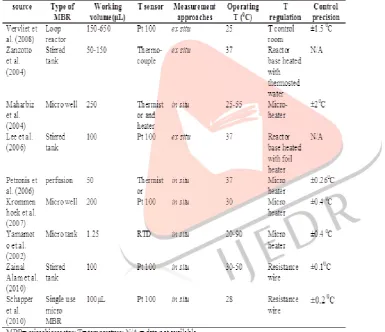
Numerous ways are available for efficient control of microbioreactor temperature. The most common and simplest method is to carry out the experiment with the microbioreactor in a temperature-controlled room or in an incubator (Vervliet et al., 2008[11] and Van et al., 2009[12]). It was shown that the temperature variation in the microbioreactor can be kept to within 1.50C of the desired set point in a temperature controlled room. The limitation of this temperature control method is that it is not feasible for parallel operation in a micro bioreactor at different operating temperatures. Another method of controlling temperature in microbioreactor system is to link the microbioreactor to a water bath and circulate thermostated water through the microbioreactor base. These
Volume
(μL)
Organism and
fermentation
mode
mixing
Minimization
Of
evaporation
k
La
(hr
-1)
OD
max.
OD
meas.
DO
meas.
control
pH
meas.
control
Temp.
regulation
Source
5-50
E.coli, batch Diffusion
Humid air
60
8
transmittance Optode
None
Optode buffered
Heated
chamber
Zanzotto et
al. (2004)
50
S. cerevisie,
batch
Stirrer on
axis
Water
replenishment
from elevated
reservoir
-
6.87 transmittance Optode
None
Optode
-
Heated
chamber
Boccazzi et
al. (2006)
100
E. coli, batch Peristaltic Oxygen feed
humidified
500 40 transmittance Optode Oxygen
conc. In
mixer
Optode
Fluidic
injection
Foil heater
on base
plate
Lee et al.
(2006)
250
E.coli, batch
Shaken
steel bead
Sealed
150 2.5 transmittance None No control,
electrical
generation
ISFET Electr. CO
2generation
Thermistor
and
resistive
heating
Maharbiz et
al. (2004)
150
E.coli and
S.cerevisie
batch
Stirrer on
axis
Water
replenishment
from elevated
reservoir
20-75
6
transmittance Optode
None
Optode Buffered
Heat
chamber
Zhang et al.
(2006) and
Szita et al.
(2005)
700
E.coli, batch
Shaken
Sealed
-
-
Scattered light None
None
Optode
Fluidic
injection
Incubator Buchenauer
et al.(2009)
20
E.coli,batch
Shaken
Water
-
-
Transmittance Optode
None
Optode
Fluidic
Injection
Incubator Purkeiler et
al. (2005)
-
S. cerevisie Stirrer on
Axis
-
-
-
-
None No control,
Electrical
generation
-
-
Incubator Muzzio et al.
IJEDR1401215
International Journal of Engineering Development and Research (www.ijedr.org)1207
methods have presented in the work of [13], [14], [1] and [15] have shown a reliable way of controlling temperature. Again, the drawback of this method is the limitation it imposes on the parallel operation of reactor at different temperatures. The addition of fluidic system increases the risk of liquid leakage and this can lead to failure of temperature control in the system. Microbioreactor developed by [2], [3], [16] and [17] have all demonstrated that temperature control in microbioreactors can also be achieved by integrating electrical micro heater embedded onto the microbioreactor. The temperature was controlled by maintaining the temperature of the copper base plate at a constant level by using a foil heater (Lee et al., 2006) [2]. Microbioreactor with incorporated heater onto a printed circuit board which was adhered to the base of the microbioreactor was demonstrated by Maharbiz [3] and [17] and their results show that the method can be used to control temperature in microbioreactor. [16] control temperature in a microbioreactor by embedding two electrode heaters into the side walls of the microbioreactor chamber. A low-cost temperature control method relying on the use of resistance wires as heating elements in microbioreactor contents has been developed by [18]. It was demonstrated that an on/off temperature controller applying a voltage to resistance wires embedded in the polymer results in accurate temperature control of the microbioreactor and provided a good disturbance rejection capability. The method of embedding and integrating heater onto the microbioreactors has shown to be the best method for controlling temperature in microbioreactor system. The method is simple and easy to incorporate into the microbioreactor. In addition, the method allows for parallel operation at different temperatures when thermal insulation preventing thermal transfer between the micro bioreactors is provided. It is important to provide temperature control loop because the micro bioreactor chamber is not thermally insulated and the surface area to work volume ratio is higher.Table 2 shows the state-of-the-art for temperature sensing and control in micro bioreactor.
C. pH Control in Microbioreactor
IJEDR1401215
International Journal of Engineering Development and Research (www.ijedr.org)1208
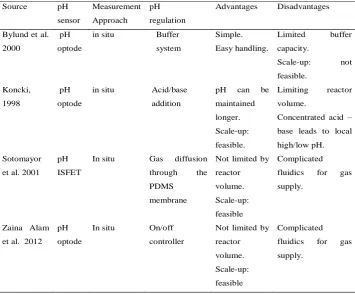
between 0-50 0C. The measurement range of most pH sensor spots is from pH 4 to 9 and they have a nonlinear response [19]. The ISFET pH sensors have a wider range of pH value (pH 2 to 12) and have a linear response that is similar to that of a standard pH probe and have a measurement accuracy of about 0.01 pH units with a response time of less than a second. ISFET pH sensors have wide temperature range of -45 0C to 120 0C. The drawback of ISFET pH sensor includes measurement drift and sensitivity to the surrounding light. Another drawback of this sensor is that the pH sensor chip required a reference electrode (Ag/AgCl reference electrode) to perform the pH measurement. This will imply that the micro bioreactor have to be designed such the embedded integrated ISFET pH chip is reusable so that the cost of the micro bioreactor is minimized. In spite of these limitations both sensors have provided adequate and rapid pH measurements in a micro bioreactor system over the last decade. Therefore, real time pH monitoring and measurement in microbioreactor is feasible.Control of pH in a microbioreactor is still undergoing development in the Bio-processing industry. One of the early attempts to control pH in a microbioreactor was by either using a buffered system or by intermittently injecting base or acid [20]. The simplest method of controlling pH in a microbioreactor is the use of buffers. But the use of buffer is not usually sufficient to maintain a constant pH level. This is because buffers have a limited buffering capacity and can only compensate for a few numbers of ions before losing their resistance to pH changes. The limitation on the buffer capacity can be overcome in a continuous culture microbioreactor system. Perfusion microbioreactor system with continuous feeding of freshly buffered nutrient medium enabled the reactor pH to maintain constant to within ±0.02.
pH in microbioreactor can also be controlled by the method of the intermittently injecting base or acid into the microbioreactor. The decrease in the pH value as a result of metabolic activity of the growing microorganisms in the microbioreactor can be adjusted by intermittently injecting a base solution. This method is limited by the microbioreactor volume. However, [21] (in Tab. 3) has shown that this limitation can be overcome by injecting gas into the microbioreactor. This gaseous pH control has been applied in a 24-well 4-6 ml microbioreactor system where NH3/CO2 was used as the injecting gas. An in situ electrolytic gas generation where
CO2 gas was dosed from underneath microbioreactor chamber through the semi permeable silicone membrane has also been developed by [3]. [22] demonstrated that the pH of a fermentation process can be controlled by injecting CO2 gas and NH3 vapor
into microbioreactor thus, both are yet to optimize their methods. [21] have optimized this method and showed the potential of introducing gases through a membrane to control pH in microbioreactor system. Table 3 describes the state of the art for pH control and monitoring in a micro bioreactor system.
Table 3: Current pH measurement and control methods in microbioreactor
II.METHODOLOGY
Integrated Process Design and Control Methodology
Microbioreactors technology offers the potential to develop disposable and miniaturized versions of bench-scale bioreactors for carrying out fermentation experiments. They are the easiest and cheapest means for performing parallel and controlled fermentation process. They combine the ease of handling of shake flask operations while preserving the online sensing and control capabilities of stirred-tank reactor. Microbioreactor technology thus offers academia and industry the capacity to acquire real-time experimental data via cheap and high throughput experimentation under well-controlled conditions. Although microbioreactors have been
Source pH
sensor
Measurement
Approach pH
regulation
Advantages Disadvantages
Bylund et al.
2000
pH
optode
in situ Buffer
system
Simple.
Easy handling.
Limited buffer
capacity.
Scale-up: not
feasible.
Koncki,
1998
pH
optode
in situ Acid/base
addition
pH can be
maintained
longer.
Scale-up:
feasible.
Limiting reactor
volume.
Concentrated acid –
base leads to local
high/low pH.
Sotomayor
et al. 2001 pH
ISFET
In situ Gas diffusion
through the
PDMS
membrane
Not limited by
reactor
volume.
Scale-up:
feasible
Complicated
fluidics for gas
supply.
Zaina Alam
et al. 2012 pH
optode
In situ On/off
controller
Not limited by
reactor
volume.
Scale-up:
feasible
Complicated
fluidics for gas
IJEDR1401215
International Journal of Engineering Development and Research (www.ijedr.org)1209
developed and are commercially available, other problem still exists. For example a strategy for finding the optimal parameters of microbioreactor which gives the best performance of the reactor where both design and control objectives are best satisfied. The recent trend in microbioreactor technology development in both academia and industry has necessitated the need for a strategy for screening microbioreactor for optimal throughput. Hence, in this review paper the concept of attainable region (AR) for IPDC as presented by [23] is adopted with some modification for screening microbioreactor for optimal throughput. The aim of this approach is to determine the optimal operating condition where both the design and control objectives of obtaining optimal throughput screening in a microbioreactor can be best achieved. The method consisted of four stages to find the optimal parameters which give the best performance of the microbioreactor [23]. 1) Pre-analysis 2) steady-state analysis 3) dynamic analysis 4) evaluation stage. Stage one, of this approach involves generating equilibrium data and locating the maximum point and value of the attainable diagram. Stage two, the established target is validated by finding the feasible values of design-control parameters. The third stage, the selected optimal operating conditions identified in the previous stage together with the corresponding design-control variables are analysis in terms of performance indices. This is to verify whether the selected point performance best satisfied the minimum value of the derivative of AR. The minimum value of derivative determines the sensitivity and controllability of the system. The last stage of this approach involves suggesting different ways of operating the microbioreactor to achieve optimal throughput. Figure 1 below describes the steps of the approach diagrammatically.III. CONCLUSION
Clearly, advances in microbioreactor technology have changed what was once a strikingly unusual laboratory technology into the mainstream. Importantly, the microbioreactor technology has proven to be scalable, so the data generated at the small scale is representative of larger scale operations. The platform provides almost no limit to the combinatorial number of experimental conditions that can be examined. It is now possible to conduct high throughput Bioprocess experimentation under highly control and monitor condition in a microbioreactor. However, in spite of the development of microbioreactor technology, new challenges still exist. One obvious challenge is the need for efficient strategies for determining the optimal operating condition where both the design and control objectives of obtaining optimal throughput screening in a microbioreactor can be best achieved. These challenges can be overcome by the above proposed method and the strategy will increase the efficiency of the reactor and reduce its working hours drastically in addition to other advantages of performing experiments in a microbioreactor system.
Stage 1: Pre-Analysis
Step 1.1: Variable analysis (Y & U)
Step 1.2: Operational Window Analysis
Stage 2: Design Control Target Selection
Step 2.1: Reaction Kinetic Checking
Step 2.2: Kinetic Prediction/Modeling
Step 2.3: Attainable Region Diagram Development
Step 2.4: Design-Control TargetSelection
Stage 3: Process Design Analysis
Step 3.1: Design and Process Variable Calculation
Stage 4: Process Control Analysis
Step 4.1: Disturbance Rejection Analysis
Step 4.2: Controller Design Selection
Stage 5: Final Selection and Verification
Step 5.1: Objective Function Calculation
Step 5.2: Experimental Verification
IJEDR1401215
International Journal of Engineering Development and Research (www.ijedr.org)1210
REFERENCES[1] Zanzotto A., Szita N., Boccazzi P., Lessard P., Sinkey A.J., Jensen K.F. (2004). Membrane aerated microbioreactor for high-throughput bioprocessing. Biotechnol. Bioeng. 87:243-254.
[2] Lee H. L., Boccazzi P., Ram R. (2006). Microbioreactor arrays with integrated mixers and fluid injectors for high-throughput experimentation with pH and dissolved oxygen control. Lab Chip. 6:1229-1235.
[3] Maharbiz M.M., Holtz W.J., Howe R.T., Keasling J.D. (2004). Microbioreactor arrays with parametric control for high-throughput experimentation. Biotechnol. Bioeng. 85:376-381.
[4] De Jesus M., Girard P., Bourgeois M., Baumgartner G., Jacko B., Amsfutz H., Wurm F.M. (2004). Tubespin satellites: a fast track approach for process development with animal cells using shaking technology. Bioche. Eng. J. 17:217-223
[5] Kostov Y., Harms P., Rao G. (2001). Bioprocess monitoring: current opinion. Biotechnol Journal. 13: 122-124
[6] Harms P., Kostov Y., Rao G. (2002). Bioprocess monitoring: current opinion. Biotechnol. Journal. 13:124-122.
[7] Assa p., Polakovic M., (2008), Design of a large scale surface-aerated bioreactor for biomass production using a VOC substrate. Biotechnology Journal, 132: 149-155.
[8] Shin F., Schilling N., Mader K., Gruchow M., Klotzbach U., Lindner G., Horlan R., Wagner I., Lauster R., Howitz S., Hoffmann S., Marx U. (2003). Design and prototyping of a chip-based multi-micro organoid culture system for substance testing, predictive to human (substance) exposure. Biotechnology Journal 148: 70-75.
[9] Liu Lee, P. Boccazzi, R. Ram (2003), Microbireactor arrays with Integrated mixers and fluid injectors for high-throughput experimentation with pH and dissolved oxygen control. Lab. Chip, vol. 6, 1229-1235.
[10] Yamamotto T., Nojima T., Fujii T. (2002). PDMS-Glass hybrid microbioreactor array with embedded temperature control device – Application to cell-free protein synthesis. Lab Chip. 2:197-202.
[11] Vervliet S.M., Ritzenthaler R., Normann J., Wagner E. (2008). Short-time effects of Benzalkonium Chloride and Atrazine on Elodea Canadensis using a miniaturized microbioreactor system for online monitoring of physiologic parameters Ecotoxicol. Environ. Saf. 69:254-62.
[12] Van Gulik W.M, Heijnen J.J, Krommenhoek E.E, Gardeniers J.G.E, Van den Berg A., Ottens M. (2009), Improving mixing in microbioreactor. Chem. Eng. Sci. 63: 3036-3046
[13] Szita N., Boccazzi P., Zhang Z., Boyle P., Sinskey A.J., Jensen K.F. (2005). Development of a multiplexed microbiorector system for high-throughput bioprocessing. Lab Chip. 5:819-826.
[14] Zhang Z., Perozziello G., Boccazzi P., Sinkey A.J., Geschke O. Jensen K.F. (2006). Microbioreactors for bioprocess development. Assoc. for Lab Aut. J. DOI:10.1016/j.jala.
[15] Boccazzi P., Zhang Z., Kurosawa K., Szita N., Bhattacharya S., Jensen K.F., Sinskey A.J. (2006). Differential gene expression profiles and real-time measurements of growth parameters in saccharomyces cerevisiae grown in microliter-scale bioreactors equipped with internal stirring. Biotechnol. Prog. 22(3), 710-717.
[16] Petronis S., Stangegaard M., Christensen C.B.V., Dufva M. (2006). Transparent polymeric cell culture chip with integrated temperature control and uniform media perfusion. Biotechniques journal. 40:368-376.
[17] Krommenhoek E.E., Van L.M., Gardeniers H., Van Galik W.M., VanDen B.A., Li X., Ottens M., Van Der W.L.A.M., Heijnen J.J. (2007). Lab-scale fermentation tests of microchip with integrated electrochemical sensors for pH, temperature, dissolved oxygen and viable biomass concentration, biotechnol. Bioeng. Journal. 99:884-920.
[18] Zainal Alam M.N.H., Schapper D., Gernaey K.V. (2010). Embedded resistance wire as heating element for temperature control in microbioreactors. J. micromech. Microeng. 20:055014 (10pp).
[19] John G.T., Heinzle E. (2007). Quantitative screening method for hydrolases in microplates using pH indicators: determination of kinetic parameters by dynamic pH monitoring. Biotechnol. Bioeng. 72:733-627.
[20] Buchenauer A., Hofmann M.C., Funke M., Buchs J., Mokwa W., Schnakenberg U. (2009). Microbioreactor for fed-batch fermentation with integrated online monitoring and microfluidic device. Biosen and Bioelec. Journal. 24:1411-1416.
[21] Zainal Alam, M.N.H, Gernaey K.V. (2012), Overview on design consideration for development of disposable microbioreactor prototype. Journal Teknologi (Science and Engineering), 59: 53-60.
[22] De jong J. Application of membrane technology in microfluidic devices (Ph.D. thesis), (2008), university of Twente, Twente. [23] Abdul Hamid M.K., Merlin A.M., Gurkan S., Krist V.G., John M.W., Rafiqul G. (2009). A model-based methodology for