Airlines Baggage Price Optimization Model
M.A. Andreev
K.P. Kovalev
E.I. Krudova
D. Okhrimenko
S.A. Titov
D.A. Wijler
April 2020
Abstract
Baggage overweight is a significant phenomenon in the air travel in-dustry which is both regulated by the governments and highly profitable for the airlines. The recent years increase in airlines’ profits is attributed to so-called ancillary payments – all consumer costs excluding the actual transportation fare. Baggage overweight fees, being a part of such pay-ments, have high profit-generation potential. Is the pricing for baggage overweight positioned correctly? The rationality of policies currently used by airlines is questionable, as they lack a customer-oriented marketing ap-proach. The general purpose of this research is to explore the possibilities of rational baggage overweight pricing for airlines by developing a multi-level price optimization model aimed to maximize company revenue. The modeling is based on determining consumer Willingness-To- Pay values for baggage overweight, and providing an optimal ticket price for them to maximize company expected revenue. The total profit value is forecasted too, based on the company market share and revenue level.
Keywords: WTP, price adjusting, price optimization, airlines, bag-gage price, optimization model.
1
Introduction
Today, ”Revenue management”, along with ”Airline revenue”, are highly impor-tant fields of scientific research according to the Scopus Scientific Value index. In the context of an ever-changing economic situation and a constant increase in aviation fuel prices, airline companies continuously explore new ways of op-timizing their costs and maximizing revenue. Nevertheless, it should be noted that there is a lack of research on baggage overweight price optimization, while current charges for baggage have become a significant part of airlines operat-ing revenue. Accordoperat-ing to the statistics given by the Bureau of Transportation Statistics (BTS) for the 1st and 2nd Quarters of 2019, total baggage fees among all U.S. airlines accounted for about 3.2 % of total operating revenue1 2.
op-timized, and are based on such business features as average market price for the ticket, variable costs, and company market positioning etc. The majority of airlines have fixed tariffs for overweight and oversized baggage depending on the class of ticket3 4.It appears that almost all airline companies do not pay much attention to this matter and do not take into consideration their cus-tomers’ Willingness-to-Pay (WTP). Such a way of doing business can lead to big reputational losses. In the middle of 2019, when the Russian governmen-tal transport regulator decreased the allowed minimal weight of hand baggage, several Russian airlines immediately dropped their size limits to the new min-imum and implemented new charges for excess baggage. It led to resentment among the majority of customers and after a big public trial, the air regulator updated the law and fixed the limit. This case perfectly illustrates that the baggage size and fees for extra weight should be finely optimized in order to sustain customer loyalty while trying to maximize revenue. Moreover, a lot of passengers try to avoid these extra payments by taking as much weight as they can on board. Sometimes it leads to grotesque cases. For instance, at the begin-ning of 2018, a man was refused a boarding pass by the British airlines because of putting on more than 10 layers of clothing in an effort to avoid paying full overweight price for only 2.5 kg of excess weight5. Much more often, passengers succeed in cheating meaning that airlines first of all lose money and secondly the safety of the flights with such passengers decreases due to an overabundance of onboard weight. The current pricing system should be changed to a more personalized form that depends on the amount of baggage overweight rather than a binary approach. Some companies, for example Aeroflot, implement special offers for customers who want to pay for baggage overweight before the
1Baggage Fees by Airline 2019, Bureau of Transportation statistics URL:
https://www.bts.gov/content/baggage-fees-airline-2019
2Operating Revenue, Bureau of Transportation statistics URL:
https://www.transtats.bts.gov
3Aeroflot overweight fees
URL:https://www.aeroflot.ru/ru-ru/information/preparation/luggage
4American Airlines overweight fees
URL:https://www.aa.com/i18n/travel-info/baggage/oversize-and-overweight-baggage.jsp
5
start of registration, these tariffs are still fixed. The following research paper will describe the optimization pricing model suggested for airlines management to create well-balanced charges for baggage overweight. Due to the complexity of the problem, a multi-level model has been implemented into this research. Starting with the basic model in the current preprint, on the further stage it will be transformed into the high-complexity model, which will take into ac-count a multiplicity of factors influencing the overweight price. This preprint will also include optimizational model inference, it’s testing on artificially gen-erated data, and further research design, including all necessary researches and input data acquisition schemes for model training.
2
Theoretical aspects
the analysis results depend on the ”reality” of the situation, where customers have to ”live” with their choice, as opposed to the hypothetical choice of CBC. The concept has been improved by the theory of the usefulness of the prod-uct to the consumer. A popular theoretical model based on this theory is the Hanemann model [Hanemann, 1984].
U(Y;X;Q) +e
, whereU(Y;X;Q) is the utility function for a consumer for various factors (Y
- Income, Q - quantity), e - free term (a random disturbance term with zero expected value). A consumer is offered goods at price A, based on which they choose whether to purchase goods based on a set of factors of consumer choice. The value will change like this:
U(Y −A;X;Q1) +e1
WTP is the likelihood that a consumer agrees to buy a product at a set price of A:
Probability (”a customer will say“ yes ””) = Pr (A≤W T P) This model was adapted by Kohli and Mahajan (1991): Probability (“a passenger agrees to pay for a product”) = 1, if
ui+ci≥u∗i +c ∗ i
Where:
ui−utility f rom the acquisition of product,
ci−costs f rom the acquisition of product(f or example, product purchase price), u∗i −service purchase price,
c∗i −costs f rom not using the product,
otherwise Pr (“A passenger agrees to pay for the product”) = 0
This theoretical WTP model will be used later in the development of a mathematical model for the WTP study. Price optimization is a combination of mathematical models for analyzing customer reactions to various product prices. The analysis is used to study the dependence of customer behavior on the price of a product [Pricing and revenue optimization, Phillips, Robert (2005)]. Algorithms for optimizing product prices include:
• Clustering, which is a selection of groups of goods in a graph, where ver-tices represent goods and edges stand for correlation links. The result of the analysis is the finding of closely related correlation of groups of goods.
• Regression analysis, which implies determining the dependence of a prod-uct on its demand, and the price of a group of relevant goods.
The problem defined in this research is NP hard where NP stands for non-deterministic polynomial acceptable problem.6 Prove of belonging to the set of NP hard problems is in the appendix of the research.
3
Methodology
During our research we have conducted an expert interview. The expert works at the Lufthansa Company – one of the leading airlines in the European market. The expert has a position in the commercial department, and develops air route optimization models. Apart from that, she has 4 years of experience in the airline industry and participates regularly in international airline congresses, and presents at forums. The expert has also consulted with her colleagues from the European low-cost airline who are more experienced in the pricing area. According to her, airlines do not take into account any customer factors, including WTP in the price creating process. They consider that the airlines are monopolists at the moment of the customer buying the additional baggage item, and that is why they can put any price on the baggage overweight. However, passengers try to cheat and to avoid these extra charges, which means that if they succeed, the airline loses money. This is strong evidence to show that airlines need a model which will be able to fix this situation, providing flexible charges depending on the value of baggage overweight, and that is exactly what our model does.
Further research justification
The goal of the proposed research model is to establish current market pecu-liarities in terms of both supplier (airlines) and consumer behavior and attitude towards the problem. There are several tasks and questions included in that for a complex understanding of the matter, and successful model development:
1. What is the current real market situation in terms of baggage overweight, pricing and marketing?
2. What are the main ways that consumers cheat? What exactly do compa-nies compete against it? How much money do they lose?
3. What are the criteria that consumers evaluate when making a decision whether to pay or whether to cheat?
4. How do these factors matter? What are the factor weights?
5. What is the consumers’ journey map when deciding on overweight bag-gage?
The description of the further research model
The airline-pricing model contains three main stakeholders:
6Daniel Pierre Bovet; Pierluigi Crescenzi (1994). Introduction to the Theory of Complexity.
1. Government
2. Company
3. Consumer
Our model does not take into consideration government factors as they take a very unpredictable and diverse role in a company’s pricing strategy. The further research will focus on two factors – a company’s current internal situation and consumer needs, and will be divided into several stages. In the research the company and consumer segments will be covered.
STAGE 1. DESK RESEARCH
This stage is the starting point of the research. First of all, it includes academic research that has been conducted. It is important to understand what research has already been done in airline price modeling, pricing models optimization and airlines’ consumer behaviour. Apart from that, airlines reports, financial data and market overviews is also good to consider for a current view on what is happening on the market, what is the real demand for this research and what is the professional significance of it. Moreover, this stage will help to form assumptions for further steps of the research.
STAGE 2. INTERNAL COMPANY RESEARCH
Company research that is conducted by means of expert interviews. Respon-dents will be selected based on several criteria: experience in the airline business, experience with commercial affairs in airlines, airline company and professional reputation. Thus it is crucial that the respondents work in a leading Euro-pean/Russian airline in an area close to the commercial department and have 3+ years of experience in the area.
The purpose of the interview is to gain inside knowledge of current pricing strategies for baggage and baggage overweight, current consumer criteria which are taken into consideration in pricing, and an understanding of consumer be-havior. The factors that we uncover during the interview will be used later in the optimization model. Apart from that, the interview may be used for backing proposals to the companies in the future stages of the project.
Currently, two interviews were conducted. One of the respondents had a wish of not being disclosed in any way, so we are not able to provide a transcript of the interview. The other interview is presented in the appendix.
STAGE 3. CONSUMER RESEARCH
Step 1. In order to optimize the baggage overweight pricing model and to consider the consumer needs, we suggest conducting a qualitative research, using in-depth interviews to gain the following information:
• If there are indirect competitive methods to transporting the baggage overweight without the airline fee ( post offices, etc);
• Assess the consumer journey map and define at which point the consumer decides to purchase baggage allowance or baggage overweight;
• Establish purchasing criteria at the moment of purchase;
The in-depth interview will not limit the respondents when answering and talk-ing about their experience, therefore, proper guidance is needed in order to gain insights that may be crucial for the research results.
The gained criteria will be the basis for the consumer WTP model. The re-spondents are travelers aged 18-55 who travel at least once a year. They will be segmented in the following way:
1. Travelers ‘by occasion’ (rarely travel);
2. Travelers who fly a few times per year for a vacation (2-4 trips per year);
3. Enthusiastic travelers (5+ times);
4. Business travelers (10+ times for business reasons);
Step 2
To evaluate the weight of each criteria in the model, next step is a quantative survey divided into 2 parts:
1. Survey imitating a real economic situation (A/B testing), to establish the sensitivity of the consumer to the context. It is needed to evaluate the weight of different contexts in the model.
2. Survey evaluating the weight of each criteria defined in Step 1 by the customers themselves.
A quantitative approach will help us to evaluate each factor and prove the assumptions made at the beginning. The previous respondents will be used, and the basis of the survey will be taken into the WTP model.
STAGE 4 (OPTIONAL) CONSUMER REAL-LIFE ANALYSIS
The following stage is optional but highly recommended for understanding the consumer behavior at the moment of purchase. The research is a real-life study of the decision-making process at the airport itself. The real-life study has the advantage that the situation is not modulated by researchers. Researchers have the opportunity to observe the subject of the study as it is, without any external influence.
There will be two interviewers:
• The other one conducts a survey of the same passengers after check- in. The survey includes questions on the purpose of the trip, context, the situation itself and what and why they decided to make their specific choice.
The research can give a unique insight on consumer behavior in a real-life situ-ation. The passengers usually come to the airport early, especially if they have baggage, therefore, they are mostly not in a hurry or annoyed to answer the questions. Apart from that, the researcher will be independent and will say that the research aims to optimize the baggage price.
4
Model Assumptions
The airflight ticket price formation is a multilevel process, i.e. it takes into account the intentions of each side involved in the value exchange. These sides are a government, an airline company and the consumers. The government regulates the airlines to achieve labor right compliance, passenger safety, and to maximize the utility for society as a whole. The consumers wish to extract maximum value out of airline services for the lowest cost. The factors they take into account include ticket price, baggage price, brand power, flight safety and customer loyalty programs. The company pursues higher profits achieved by maximizing revenue and minimizing costs. During our research we focus on the company’s level as the only one which can be optimized with a mathematical approach.
The model is based on the following assumptions:
• Rational Agents.
The customer in the model behaves rationally. We follow the microeconomic concept of Homo Economicus, therefore the customer compares all competitive factors of each market offering, before making the exchange decision, which is final. There is no information asymmetry, and competitor prices are known by each customer at any time.
• Ticket Classification.
We assume that each company sells only economy tickets and does not pro-vide any additional baggage allowance. Such tickets propro-vide a fixed amount of allowed baggage weight, and additional payments are needed to transport the baggage overweight.
• Baggage Overweight Focus.
The study is centered on optimizing the ticket prices for the company by mod-ifying the overweight fees.
into the optimizational model because of the complexity of such models. This group includes such variables as: pet transit price, extra-large baggage price, fragile baggage transportation price, additional sporting goods transportation price, etc.
The second is a group of external factors, which companies can’t control and which have a rather strong influence on the final ticket price. These factors are:
• Airplane’s fuel consumption,
• flight distance,
• cost of the fuel,
• existence and quantity of plane changes during the fligth,
• total cargo weight,
• the cost of airplane parking,
• local laws in the job security field
• ecological fees
5
Model of revenue optimization
In this particular case, the service is the transportation of additional baggage weight. It is important to stress that the provision of additional baggage al-lowance is a different service. The WTP model described in this chapter is based on the theory from the ”methodology of research”.
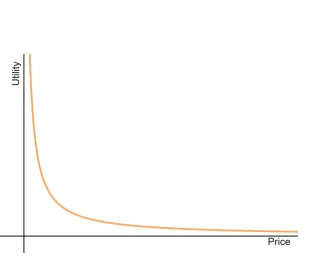
As in the theoretical part, we start with defining utility. Utility is growing with respect to a decrease in price, but it is not the only aspect that can influence utility. Therefore, we have stopped at regression with a negative exponent for Utility, partially based on previous studies (Figure1).
U tility= 1
a+b1x1+b2x2+...+bnxn
β1∗x1–is a weighted price f actor,
α–f ree member, indicating the overall ef f ect of unaccounted f actors
To simplify the work, at the beginning, we left only one variable in Utility and therefore in WTP, which is the price for every extra kilogram. Also, to select the correct function of our probability, we resorted to a graphical method of its representation, based on the materials of previously studied scientific papers (Wong, 2009; Miller, 2011; Shukla, 2019).
Figure 1: Utility vs Price
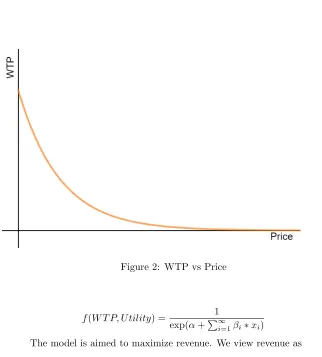
buyers who have used the service of transporting baggage overweight for a given price to the number of all potential passengers. Due to the fact that as the price increases, the service will become unavailable to some consumers, the function will have a negative gradient. When x (price) tends to infinity, the variable y (WTP) will be zero, because the money that a person is willing to spend on a service is a limited amount. If we imagine a system in which the monetary resource would not be limited, then y (WTP) would tend to infinity at x (Price) equal to zero. The same thing happens in the opposite situation, when the price is zero, then consumers are limited by their advantage. These conclusions can be drawn on the basis of the law on supply and demand7. Based on the above
considerations, we can talk about a graph that looks like a limited hyperbole (Figure2). Any company offers the purchase of an extra kilogram of baggage with a limit of 32 kg. This is due to both security and baggage handling for airport movers.
We believe that this distribution can be correlated with the logistic func-tion. Based on the previous studies:
f(W T P, U tility) = 1 exp(α+β∗x) or
f(W T P, U tility) = exp (U tility)−1
In the future, this model can be developed by adding other weighted factors x into the model:
7McConnell, C. R., Brue, S. L., Flynn, S. M. (2009). Economics: Principles, problems,
Figure 2: WTP vs Price
f(W T P, U tility) = 1 exp(α+P∞
i=1βi∗xi)
The model is aimed to maximize revenue. We view revenue as
Revenue=Q∗f(W T P, U tility)∗P rice
where Q - number of all tickets with overweight baggage. P rice - price for overweight, whereP rice=nX, n - number of kilogram overweight, X price for 1 kilogram. f(W T P, U tility) - the probability function purchase of a service by a consumer for a certain utility.
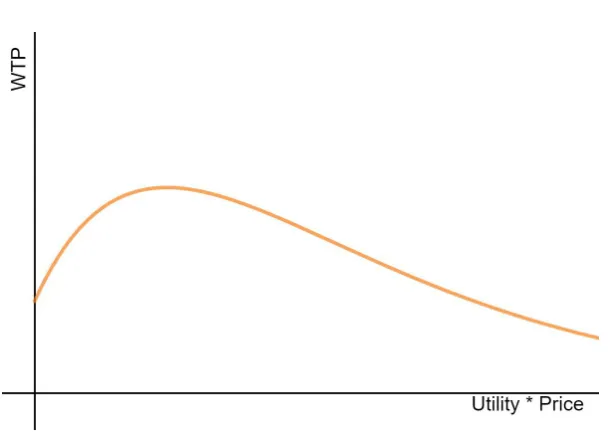
Maximizing revenue, we, first of all, look at the price and probability of purchase, without affecting Q (Figure3). In order to find out the maximum possible price, we need to differentiate the probability function multiplied by the price, since the area under the graph is important to us. However it would be much more efficient to take the natural logarithm first.
( ln(x1)
ln(ea+b1x1+b2x2+...+bnxn))
0=ln(ea+b1x1+b2x2+...+bnxn)−b1x1ln(x1)
x1ln2(ea+b1x1+b2x2+...+bnxn)
We have the right to logarithm the function, since the function of the logarithm is constantly increasing on the numerical line and the extremum of the prolitherified function will be at the same point.
ln(ea+b1x1+b2x2+...+bnxn)−b
1x1ln(x1)
x1ln2(ea+b1x1+b2x2+...+bnxn)
Figure 3: WTP vs Price*Utility
By equating the derivative with 0, we are looking for the extremum.
ln(ea+b1x1+b2x2+...+bnxn)−b
1x1ln(x1) = 0
a+b1x1+b2x2+...+bnxn−b1x1ln(x1) = 0
Derivingx1from this equation through analytical method still is an open
ques-tion, therefore dummy search of the extremum is performed through the pro-gramming approach. This way for optimization data is clear and justified by its brute force. Moreover, transition to programming is necessary because variation of variables requires computational power that cannot be performed manually. All the code description can be found in the appendix 2.
Then by substituting foundx1 in the formula of revenue we obtain
opti-mized value revenue, since all the terms of our formula are optimised.
Expansion of the model Good approximation of the model required sim-plification of the system as much as possible. However, real life systems are not that simple. In order to approach model to the valuable conditions, it has to be expanded.
Expansions which we need to check:
• Supplementation of the price for the whole flight as a parameter. (add price for the flight),
• Supplementation of flight duration as a parameter,
• Supplementation of the aircraft fuel cost as a parameter of the maximized function,
• Assumption that air company has different tariffs, such as budget, econ-omy.(add different types of tickets),
• Assumption that market of air transportation has several players. (several competitors like in game theory),
• Non-standard baggage: restructuring the model for baggage like skis, bi-cycles etc.,
• Airline positioning: supplementation of the airline market power as a parameter of the model,
• Assumption that passenger can get another luggage places straight on registration at the airport.
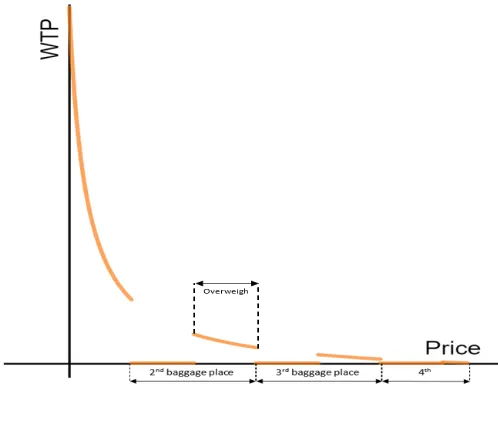
Upon reaching 32 kg, the buyer is requested to check in an additional piece of baggage, therefore, at some points of the schedule WTP = 0, because, as a service, buying an extra piece of baggage is different from paying for ex-cess baggage. Since the buyer is a rational maximizer, there will come a time when the price for excess baggage will be higher than the price for 2 pieces of baggage. In these intervals, the graph will “lie” on the Ox axis since the values of the variable y (WTP) will be zero, and therefore our function is a system of inequalities, sketched on Figure4.
6
Further research
The airline pricing model contains three main stakeholders – government, com-pany itself and consumer. Our model does not take into consideration gov-ernment factors as they take a very unpredicted and diverse role in company’s pricing strategy. The further research will focus on two stakeholders – inter-nal company’s current situation and consumer needs. Corporate research will be conducted by experts interviews – employees of leading European airlines. One of the interviewers had a wish of not being disclosed in any way, so we are not able to provide a transcript of the interview. The other interview is pre-sented below. In order to optimize additional baggage pricing model, consider-ing consumer needs in it, we suggest conductconsider-ing a qualitative research (in-depth interviews and surveys) to establish following points:
• In which cases consumer buys or refuses to buy additional baggage pieces (incl. overweight);
• If there are indirect competitive methods to buying additional baggage (send your stuff via post, etc);
• Build a clear consumer journey and define at which point on it consumer decides on the purchase;
• What are the criteria in the moment of purchase;
After defining the criteria, there will also be a survey imitating a real economic situation (A/B testing) to establish sensitivity of the consumer to the price. The survey is crucial to understand the weight of each criteria in the decision making process.
7
Conclusion
To summarise, it is vital to highlight that this pre-print was created to emphasize on the problem of the lack of balanced approaches of pricing for additional airline services and to design a further research.
In addition, there has been made a plan for further research, which will allow further research team to collect all the necessary data to complete the development of the WTP model and provide a complete solution to the airline management.
8
References
1. McFadden, D. (1974). The measurement of urban travel demand. Journal of Public Economics, 3(4), 303-328.
2. Hanemann, W. M. (1984). Welfare evaluations in contingent valuation experiments with discrete responses. American journal of agricultural economics, 66(3), 332-341.
3. Bohm, P. (1979). Estimating willingness to pay: why and how?. The Scandinavian Journal of Economics, 142-153.
4. Kohli, R., Mahajan, V. (1991). A reservation-price model for optimal pric-ing of multiattribute products in conjoint analysis. Journal of Marketpric-ing Research, 28(3), 347-354.
5. Marcus Burzlaff (2017). Aircraf fuel consumption - estimation and visu-alization. Haw Hamburg.
6. Joyce Maria Wilhelmina van Loon, Algorutmic Pricing, Netherlands, Datawyse, 2009. p. 12-13, 29-30.
7. Durnev Valery Georgievich, Zetkina Oksana Valeryevna, Zetkina Alena Igorevna, Murin Dmitry Mikhailovich (2016). On the coNP-completeness of the “Injective Backpack” task. Applied Discrete Mathematics, (3 (33)), 85-92.
8. Daniel Pierre Bovet; Pierluigi Crescenzi (1994). Introduction to the The-ory of Complexity. Prentice Hall. p. 69.
9
Appendix
1: Interview transcript
T. – team R. – respondent
R.– I do work in commercial department that is why I know the basics of pricing from my colleagues, but I never had the experience of working on price models myself.
T.– Thank you, we would be happy to hear the details that you know on the matter. We are interested, which factors do companies take into account?
R. - Usually it is a matter of the existing market price and company’s willingness to risk their reputation. We have to understand that the prices for additional baggage do not vary much among companies and it is a matter of risk if the company wants to lift the prices much higher than the market price. Therefore, I believe they take into account the net costs (fuel, etc) and the rest is margin varying on the positioning of the company on the market.
T.– Do we understand correctly that any consumer factors are not con-sideredamp; Willingness to pay, e.g?
R.– No, I do not think elasticity or any consumer research-based factors are taken into account. Airlines are monopolists in the moment of buying the additional baggage piece; again, as far as they want to go, it is a matter of reputation.
T. – So, the additional baggage is usually bought at the airport, not in advance?
R.– Yes, of course, if we talk about overweight, it is always at the airport, I am not even sure that you can buy it online. As for additional baggage pieces, right, it is usually taken in advance. Then there is another case, when the hand luggage is not in the right dimensions, so the customer has to give it as a baggage and then he buys it at the airport.
T.– Thank you for the information, it was very valuable to us. Maybe you have something to add?
R.– No, I think we pretty much covered it all.
2: NP hardness of the problem The pricing problem is a complicated two-level game between customer and the company where each side has opposite wills. On one side, a company has products; on the other, a customer has preference bundles. Customers make a purchase when their preference bundles fit their budget. From the point of view of the airline, the goal is to “attach” customers with the products in a way that maximum purchases would take place, by determining optimal prices for the products. The price is affected by a multitude of factors, including behavioral patterns and preferences or flight details. Clearly, including every factor in the model would make it NP hard, from the viewpoint of linear programming 8. Therefore, the ability to solve
the problem is limited by the computing power available at the moment. In order to mathematically model and solve the problem certain assumptions have to be considered. Particularly, that observed airline has only one product and consequently only one preference bundle for the customer.
8Joyce Maria Wilhelmina van Loon, Algorutmic Pricing, Netherlands, Datawyse, 2009. .
A more formal approach of proving NP-hardness of that problem is to reduce the problem of the research to the one, which is already proved to be NP-hard.One problem that looks similar is the knapsack problem.
Substituting something that is put in the knapsack with one variable that affects utility in this case.
Substituting weight of the thing by coefficient of the variable.
Substituting cost of the thing by change in price with change of variable. Substituting minimum cost knapsack should fit by sum of all changes of a ticket price after adding all the variables to consideration.
Substituting maximum weight knapsack can fit with the sum of all coefficients of variables.
After these changes, the problem of optimization, which is present in the re-search, is reduced to the knapsack problem, which is known to be NP hard.
9
3: Description of the program The code of the program can be found on
the GitHub repository.
The purpose of the program is to be a tool, which can obtain optimal values of WTP and price, simultaneously, based on the formulas from analytical solution of the problem. The idea behind the whole program is to compare results of the function values with different inputs and return the optimal. Instruction: In order to optimize revenue or to find the optimal price for baggage overweight:
1. One have to open input file and change the values for those that are required. After all the changes, file have to be saved. Default values are in the testing regime currently.
a) Current median of the price is very inaccurate evaluation of the price that is suggested currently. Default value = 0.6342, which is 634.2 rubles for the kilogram.
b) Parameter beta is the value of importance of the particular attribute that affect the price. In the extended case should be found in a number not bigger than 10. Likeb1, b2....b10. Due to the complexity of the problem. Sum of the
coefficients beta tends to be 1, however in this particular case should not be bigger than 0.9 for the price of 1 kilogram. Default value = 0.7
c) Parameter alpha normalizes the model. Several times bigger than current median in order to make exponent value strictly negative, but mostly because of the original function graph. Default value = -6
d) Number of the average overweight kilograms per person, overall on the flight during certain period of time. Default = 0.1
9Durnev Valery Georgievich, Zetkina Oksana Valeryevna, Zetkina Alena Igorevna, Murin
e) Quantity of the customers during certain period of time. Default = 10000 f) Deviation of the price. Exactly +- this value to the price will be the region of the search.
2. Run the python file
Code description Most of the programs can be divided on 3 stages: input, processing of data and output. In that case, all three stages are present.
• Input
Transportation of required parameters is performed by .txt file reading. Then by seeking for symbols “[” and “]”, the sought-for values, which are placed between them are obtained. All the input data is stored in one array throughout the whole program.
• Processing
In this part of the code, program is creating new file in the same directory, as it is present. File of the CSV format in which all the values are stored with comma as a delimiter. It is the representation of the normal distribution for the given number of required values and deviation. After that, the program opens this file and values from it are inserted in the formula for WTP one by one, saving the largest result. Next step is calculating the revenue by inserting all the parameters that are already known at that moment.
• Output
The program simply prints the result to the console.
• Possible improvement