Volume 2009, Article ID 576972,16pages doi:10.1155/2009/576972
Research Article
Fast Subspace Tracking Algorithm Based on
the Constrained Projection Approximation
Amir Valizadeh
1, 2and Mahmood Karimi (EURASIP Member)
11Electrical Engineering Department, Shiraz University, 713485 1151 Shiraz, Iran 2Engineering Research Center, 134457 5411 Tehran, Iran
Correspondence should be addressed to Amir Valizadeh,[email protected]
Received 19 May 2008; Revised 4 November 2008; Accepted 28 January 2009
Recommended by J. C. M. Bermudez
We present a new algorithm for tracking the signal subspace recursively. It is based on an interpretation of the signal subspace as the solution of a constrained minimization task. This algorithm, referred to as the constrained projection approximation subspace tracking (CPAST) algorithm, guarantees the orthonormality of the estimated signal subspace basis at each iteration. Thus, the proposed algorithm avoids orthonormalization process after each update for postprocessing algorithms which need an orthonormal basis for the signal subspace. To reduce the computational complexity, the fast CPAST algorithm is introduced which hasO(nr) complexity. In addition, for tracking the signal sources with abrupt change in their parameters, an alternative implementation of the algorithm with truncated window is proposed. Furthermore, a signal subspace rank estimator is employed to track the number of sources. Various simulation results show good performance of the proposed algorithms.
Copyright © 2009 A. Valizadeh and M. Karimi. This is an open access article distributed under the Creative Commons Attribution License, which permits unrestricted use, distribution, and reproduction in any medium, provided the original work is properly cited.
1. Introduction
Subspace-based signal analysis methods play a major role in contemporary signal processing area. Subspace-based high-resolution methods have been developed in numerous signal processing domains such as the MUSIC, the minimum-norm, the ESPRIT, and the weighted subspace fitting (WSF) methods for estimating frequencies of sinusoids or directions of arrival (DOA) of plane waves impinging on a sensor array. In wireless communication systems, subspace methods have been employed for channel estimation and multiuser detection in code division multiple access (CDMA) systems. The conventional methods for extracting the desired infor-mation about the signal and noise subspaces are achieved by either the eigenvalue decomposition (EVD) of the covariance data matrix or the singular value decomposition (SVD) of the data matrix. However, the main drawback of these conventional decompositions is their inherent complexity.
In order to overcome this difficulty, a large number of approaches have been introduced for fast subspace tracking in the context of adaptive signal processing. A well-known method is Karasalo’s algorithm [1], which involves the full
SVD of a small matrix. A fast tracking method (the FST algorithm) based on the Givens rotations is proposed in [2]. Most of other techniques can be grouped into several fam-ilies. One of these families includes classical batch methods for EVD/SVD such as QR-iteration algorithm [3], Jacobi SVD algorithm [4], and power iteration algorithm [5], which have been modified to fit adaptive processing. Other matrix decompositions have also successfully been used in sub-space tracking. The rank-revealing QR factorization [6], the rank-revealing URV decomposition [7], and the Lankzos-diagonalization [8] are some examples of this group. In another family, variations and extensions of Bunch’s rank-one updating algorithm [9], such as subspace averaging [10], have been proposed. Another class of algorithms considers the EVD/SVD as a constrained or unconstrained optimization problem, for which the introduction of a projection approximation leads to fast subspace tracking methods such as PAST [11] and NIC [12] algorithms. In addition, several other algorithms for subspace tracking have been developed in recent years.
which increases the computational complexity. The neces-sity of orthonormalization depends on the post-processing method which uses the signal subspace estimate to extract the desired signal information. For example, if we are using MUSIC or minimum-norm method for estimating DOA’s or frequencies from the signal subspace, the orthonor-malization step is crucial, because these methods need an orthonormal basis for the signal subspace.
From the computational point of view, we may distin-guish between methods havingO(n3), O(n2r), O(nr2), or O(nr) operation counts wherenis the number of sensors in the array (space dimension) andris the dimension of signal subspace. Real-time implementation of subspace tracking is needed in some applications and regarding that the number of sensors is usually much more than the number of sources (n r), algorithms with O(n3) or even O(n2r) are not preferred in these cases.
In this paper, we present a recursive algorithm for tracking the signal subspace spanned by the eigenvectors corresponding to the r largest eigenvalues. This algorithm relies on an interpretation of the signal subspace as the solution of a constrained optimization problem based on an approximated projection. The orthonormality of the basis is the constraint which is used in this optimization problem. We will derive both exact and recursive solutions for this problem. We call our approach as constrained projection approximation subspace tracking (CPAST). This algorithm avoids the orthonormalization step in each iteration. We will show that order of computation of the proposed algorithm is O(nr), and thus, it is appropriate for real-time applications.
This paper is organized as follows. In Section 2, the signal mathematical model is presented, and signal and noise subspaces are defined. InSection 3, our approach as a con-strained optimization problem is introduced and derivation of the solution is described. Recursive implementations of the proposed solution are derived inSection 4. InSection 5, fast CPAST algorithm withO(nr) complexity is presented. The algorithm used for tracking the signal subspace rank is discussed inSection 6. InSection 7, simulations are used to evaluate the performance of the proposed algorithms and to compare these performances with other existing subspace tracking algorithms. Finally, the main conclusions of this paper are summarized inSection 8.
2. Signal Mathematical Model
Consider the samplesx(t), recorded during the observation time on the n sensor outputs of an array, satisfying the following model:
x(t)=A(θ)s(t) +n(t) , (1)
wherex ∈Cnis the vector of sensor outputs,s∈Cr is the
vector of complex signal amplitudes,n ∈ Cnis an additive
noise vector,A(θ) = [a(θ1),a(θ2),. . .,a(θr)] ∈ Cn×r is the
matrix of the steering vectorsa(θj), andθj, j = 1, 2,. . .,r
is the parameter of the jth source, for example, its DOA. It is assumed thata(θj) is a smooth function of θj and that
its form is known (i.e., the array is calibrated). We assume
that the elements ofs(t) are stationary random processes, and the elements ofn(t) are zero-mean stationary random processes which are uncorrelated with the elements ofs(t). The covariance matrix of the sensors’ outputs can be written in the following form:
R=Ex(t)xH(t)=ASAH+Rn, (2)
where S = E{s(t)sH(t)} is the signal covariance matrix
assumed to be nonsingular (“H” denotes Hermitian trans-position), andRnis the noise covariance matrix.
Let λi and ui(i = 1, 2,. . .,n) be the eigenvalues and
the corresponding orthonormal eigenvectors ofR.In matrix notation, we haveR = UUH with = diag(λ
1,. . .,λn)
andU = [u1,. . .,un], where diag(λ1,. . .,λn) is a diagonal
matrix consisting of the diagonal elementsλi. If we assume
that the noise is spatially white with the equal varianceσ2, then the eigenvalues in descending order are given by
λ1≥ · · · ≥λr> λr+1= · · · =λn=σ2. (3)
The dominant eigenpairs (λi,ui) fori =1,. . .,r are termed
the signal eigenvalues and signal eigenvectors, respectively, while (λi,ui) fori =r+ 1,. . .,nare referred to as the noise
eigenvalues and noise eigenvectors, respectively. The column spans of
US=[u1,. . .,ur] , UN =[ur+1,. . .,un] (4)
are called as the signal and noise subspace, respectively. Since the input vector dimensionnis often larger than 2r, it is more efficient to work with the lower dimensional signal subspace than with the noise subspace.
Working with subspaces has some benefits. In the applications that the eigenvalues are not needed, we can apply subspace algorithms which do not estimate eigenvalues and avoid extra computations. In addition, sometimes it is not necessary to know the eigenvectors exactly. For example, in the MUSIC, minimum norm, or ESPRIT algorithms, the use of an arbitrary orthonormal basis of the signal subspace is sufficient. These facts show the reason for the interest in using subspaces in many applications.
3. Constrained Projection Approximation
Subspace Tracking
A well-known method for computing the principal sub-space of the data is projection approximation subsub-space tracking (PAST) method. It tracks the dominant subspace of dimension r spanned by the correlation matrix Cxx.
The columns of signal subspace of PAST method are not exactly orthonormal. The deviation from the orthonormality depends on the signal-to-noise ratio (SNR) and the forget-ting factor β. This lack of orthonormality affects seriously the performance of post-processing algorithms which are dependant on orthonormality of the basis. To overcome this problem, we propose the following constrained optimization problem.
Letx∈Cnbe a stationary complex valued random vector
is assumed to be positive definite. We consider the following minimization problem:
minimize
W J
(W(t))=t
i=1
βt−ix(i)−W(t)y(i)2
subject to WH(t)W(t)=Ir,
(5)
where Ir is the r × r identity matrix, y(t) = WH(t −
1)x(t) is the r-dimensional compressed data vector, and W is an n×r (r ≤ n) orthonormal subspace basis full rank matrix. Since the above minimization is the PAST cost function, (5) leads to the signal subspace. In addition, the aforementioned constraint guarantees the orthonormality of the signal subspace. The use of the forgetting factor 0< β≤ 1 is intended to ensure that data in the distant times are downweighted in order to preserve the tracking capability when the system operates in a nonstationary environment.
To solve this constrained problem, we use Lagrange multipliers method. So, after expanding the expression for J(W(t)), we can replace (5) with the following problem:
minimize
W h(W)=tr (C)−2tr
⎛ ⎝t
i=1
βt−ix(i)yH(i)WH(t)
⎞ ⎠
+ tr
⎛ ⎝t
i=1
βt−iy(i)yH(i)WH(t)W(t) ⎞ ⎠
+λWHW−I r
2
F,
(6)
where tr(C) is the trace of the matrixC, · F denotes the
Frobenius norm, and λis the Lagrange multiplier. We can rewriteh(W) in the following form:
h(W)
=tr (C)−2tr
⎛ ⎝t
i=1
βt−ix(i)yH(i)WH(t)
⎞ ⎠
+ tr
⎛ ⎝t
i=1
βt−iy(i)yH(i)WH(t)W(t) ⎞ ⎠
+λtrWH(t)W(t)WH(t)W(t)−2WH(t)W(t) +I r
. (7)
Let∇h=0, where∇is the gradient operator with respect to W, then we have
−
t
i=1
βt−ix(i)yH(t) +
t
i=1
βt−iW(t)y(i)yH(t)
+λ−2W(t) + 2W(t)WH(t)W(t)=0,
(8)
which can be rewritten in the following form:
W(t)=
⎛ ⎝t
i=1
βt−ix(i)yH(i) ⎞ ⎠
×
⎡ ⎣t
i=1
βt−iy(i)yH(i)−2λIr+ 2λWH(t)W(t) ⎤ ⎦
−1 .
(9)
If we substituteW(t) from (9) into the constraint which is WHW=I
r, we obtain ⎡
⎣t i=1
βt−iy(i)yH(i)−2λIr+ 2λWH(t)W(t) ⎤ ⎦ −H × ⎡ ⎣ ⎛ ⎝t
i=1
βt−iy(i)xH(i) ⎞ ⎠ ⎤ ⎦ ⎡ ⎣ ⎛ ⎝t
i=1
βt−ix(i)yH(i) ⎞ ⎠ ⎤ ⎦ × ⎡ ⎣t
i=1
βt−iy(i)yH(i)−2λI
r+ 2λWH(t)W(t) ⎤ ⎦
−1
=Ir.
(10)
Now, we define matrixLas follows:
L=
t
i=1
βt−iy(i)yH(i)−2λI
r+ 2λWH(t)W(t). (11)
It follows from (9), (10), and (11) that
L−H
⎡ ⎣ ⎛ ⎝t
i=1
βt−iy(i)xH(i) ⎞ ⎠ ⎤ ⎦ ⎡ ⎣ ⎛ ⎝t
i=1
βt−ix(i)yH(i) ⎞ ⎠ ⎤ ⎦L−1=I
r.
(12)
Right and left multiplying (12) byLandLH, respectively, and
using the fact thatL= LH, we get ⎡
⎣ ⎛ ⎝t
i=1
βt−iy(i)xH(i) ⎞ ⎠ ⎤ ⎦ ⎡ ⎣ ⎛ ⎝t
i=1
βt−ix(i)yH(i) ⎞ ⎠ ⎤ ⎦=L2.
(13)
It follows from (13) that
L=
⎡ ⎣ ⎛ ⎝t
i=1
βt−iy(i)xH(i) ⎞ ⎠ ⎛ ⎝t
i=1
βt−ix(i)yH(i) ⎞ ⎠ ⎤ ⎦
1/2
=CH
xy(t)Cxy(t) 1/2
,
(14)
where (·)1/2
denotes the square root of a matrix andCxy(t)
is defined as follows:
Cxy(t)= t
i=1
Using (11) and the definition ofCxy(t), we can rewrite (9) in
the following form:
W(t)=Cxy(t)L−1. (16)
Now, using (14) and (16), we can achieve the following fundamental solution:
W(t)=Cxy(t)
CHxy(t)Cxy(t) −1/2
. (17)
This CPAST algorithm guarantees the orthonormality of the columns of W(t). It can be seen from (17) that for calculation of the proposed solution just Cxy(t) is needed
and calculation ofCxx(t), which is a necessary part of some
subspace estimation algorithms, is avoided. Thus, efficient implementation of the proposed solution can reduce the complexity of computations and this is one of the advantages of this solution.
Recursive computation of then×r matrix Cxy(t) (by
using (15)) requires O(nr) operations. The computation of W(t) using (17) demands additional O(nr2) + O(r3) operations. So, the direct implementation of the CPAST method given by (17) needsO(nr2) operations.
4. Adaptive CPAST Algorithm
Let us define an r ×r matrix Ψ(t) which represents the distance between consecutive subspaces as below:
Ψ(t)=WH(t−1)W(t). (18)
SinceW(t−1) approximately spans the dominant subspace ofCxx(t), we have
W(t)≈W(t−1)Ψ(t). (19)
This is a key step towards obtaining an algorithm for fast subspace tracking using orthogonal iteration. Equations (18) and (19) will be used later.
Then×r matrix Cxy(t) can be updated recursively in
an efficient way which will be discussed in the following sections.
4.1. Recursion for the Correlation MatrixCxx(t). Letx(t) be
a sequence of n-dimensional data vectors. The correlation matrix Cxx(t), used for signal subspace estimation, can be
estimated recursively as follows:
Cxx(t)= t
i=1
βt−ix(i)xH(i)=βCxx(t−1) +x(t)xH(t) ,
(20)
where 0 < β < 1 is the forgetting factor. The windowing method used in (20) is denoted as exponential windowing. Indeed, this kind of windowing tends to smooth the varia-tions of the signal parameters and allows a low complexity update at each time. Thus, it is suitable for slowly changing signals.
For sudden signal parameter changes, the use of a truncated window offers faster tracking. However, subspace
trackers based on the truncated window have more compu-tational complexity. In this case, the correlation matrix is estimated in the following way:
Cxx(t)= t
i=t−l+1
βt−ix(i)xH(i)
=βCxx(t−1) +x(t)xH(t)−βlx(t−l)xH(t−l)
=βCxx(t−1) +z(t)GzH(t) ,
(21)
wherel >0 is the length of the truncated window, andzand Gare defined in the following form:
z(t)=
x(t) ... x(t−l)
n×2,
G=
1 0 0 −βl
2×2 .
(22)
4.2. Recursion for the Cross Correlation Matrix Cxy(t). To
achieve a recursive form for Cxy(t) in the exponential
window case, let us use (15), (20), and the definition ofy(t) to derive
Cxy(t)=Cxx(t)W(t−1)
=βCxx(t−1)W(t−1) +x(t)yH(t).
(23)
By applying projection approximation (19) at timet−1, (23) can be rewritten in the following form:
Cxy(t)≈βCxx(t−1)W(t−2)Ψ(t−1) +x(t)yH(t)
=βCxy(t−1)Ψ(t−1) +x(t)yH(t).
(24)
In the truncated window case, the recursion can be obtained in a similar way. To this end, by using (21), employing projection approximation, and doing some manipulations, we get
Cxy(t)=βCxy(t−1)Ψ(t−1) +z(t)GzH(t) , (25)
where
z(t)=
y(t) ... WH(t−1)x(t−l)
n×2. (26)
4.3. Recursion for Signal SubspaceW(t). Now, we want to find a recursion for fast update of signal subspace. Let us use (14) to rewrite (16) as below
W(t)=Cxy(t)Φ(t) , (27)
where
Φ(t)=CH
xy(t)Cxy(t) −1/2
. (28)
Substituting (27) into (24) and right multiplying by Φ(t), results the following recursion:
W(t)≈βW(t−1)Φ−1(t−1)Ψ(t−1)Φ(t)
Now, left multiplying (29) byWH(t−1), right multiplying it
byΦ−1(t), and using (18), we obtain
Ψ(t)Φ−1(t)≈βΦ−1(t−1)Ψ(t−1) +y(t)yH(t).
(30)
To further reduce the complexity, we apply the matrix inversion lemma to (30). The matrix inversion lemma can be written as follows:
(A+BCD)−1=A−1−A−1BDA−1B+C−1−1DA−1. (31)
Using matrix inversion lemma, we can replace (30) with the following equation:
Ψ(t)Φ−1(t)−1=1 βΨ
−1(t−1)Φ(t−1)I
r−y(t)g(t)
,
(32)
where
g(t)= yH(t)Ψ−1(t−1)Φ(t−1)
β+yH(t)Ψ−1(t−1)Φ(t−1)y(t). (33)
Now, left multiplying (32) byΦ−1(t) leads to the following recursion:
Ψ−1(t)=1 βΦ
−1(t)Ψ−1(t−1)Φ(t−1)I
r−y(t)g(t)
.
(34)
Finally, by taking an inverse from both sides of (34), the following recursion is obtained forΨ(t):
Ψ(t)=βIr−y(t)g(t)
−1Φ−1(t−1)Ψ(t−1)Φ(t).
(35)
It is straightforward to show that for the truncated window case, the recursions forW(t) andΨ(t) are as follows:
W(t)=βW(t−1)Φ−1(t−1)Ψ(t−1)Φ(t)
+z(t)GzH(t)Φ(t) ,
Ψ(t)=βIr−z(t)vH(t) −1
Φ−1(t−1)Ψ(t−1)Φ(t) , (36)
where
v(t)= 1 βΦ
H(t−1)Ψ−H(t−1)z(t)
×
G−1+1 βz
H(t)Ψ−1(t−1)Φ(t−1)z(t)
−H
.
(37)
Using (24) and (28), an efficient algorithm for updatingΦ(t) in the exponential window case can be obtained. It is as follows:
α=xH(t)x(t) ,
U(t)=βΨH(t−1)CHxy(t−1)x(t)
yH(t) , (38)
Ω(t)=CHxy(t)Cxy(t)
=β2ΨH(t−1)Ω(t−1)Ψ(t−1)
+U(t) +UH(t) +αy(t)yH(t) ,
(39)
Φ(t)=Ω−1/2(t). (40)
Similarly, it can be shown that an efficient recursion for truncated window case is as follows:
U(t)=βΨH(t−1)CHxy(t−1)z(t)
GzH(t) ,
Ω(t)=β2ΨH(t−1)Ω(t−1)Ψ(t−1) +U(t)
+UH(t) +z(t)GHzH(t)z(t)GzH(t) ,
Φ(t)=Ω−1/2(t).
(41)
The pseudocodes of the exponential window CPAST algo-rithm and the truncated window CPAST algoalgo-rithm are presented in Tables1and2, respectively.
5. Fast CPAST Algorithm
The subspace tracker in CPAST can be considered a fast algorithm because it requires only a single nr2 operation count in the computation of the matrix product W(t − 1)(Φ−1(t−1)Ψ(t−1)Φ(t)) in (29). However, in this section, we further reduce the complexity of the CPAST algorithm.
By employing (34), then (29) can be replaced with the following recursion:
W(t)=W(t−1)Ir−y(t)gH(t)
Ψ(t)
+x(t)yH(t)Φ(t).
(42)
Further simplification and complexity reduction comes from an inspection of Ψ(t). This matrix represents the distance between consecutive subspaces. When the forgetting factor is relatively close to 1, this distance will be small andΨ(t) will approach to the identity matrix. Our simulation results approve this claim. So, we use the approximationΨ(t)=Ir
to simplify the signal subspace recursion as follows:
W(t)=W(t−1)−W(t−1)y(t)gH(t)
+x(t)yH(t)Φ(t). (43)
To further reduce the complexity, we substituteΨ(t)=Irin
(30) and apply the matrix inversion lemma to it. The result is as follows:
Φ(t)=1
βΦ(t−1)
Ir−
y(t)fH(t)
fH(t)y(t) +β
Table1: Exponential window CPAST algorithm.
The algorithm Cost (MAC count)
W(0)=
⎡ ⎢ ⎢ ⎣
I · · ·
0 ⎤ ⎥ ⎥
⎦; Cxy(0)=
⎡ ⎢ ⎢ ⎣
I · · ·
0 ⎤ ⎥ ⎥
⎦; Φ(0)=Ω(0)=Ψ(0)=Ir
FORt=1, 2,. . .DO
y(t)=WH(t−1)x(t) nr
Cxy(t)=βCxy(t−1)Ψ(t−1) +x(t)yH(t) 2nr
U(t)=β(CH
xy(t−1)x(t))yH(t) nr+r2
Ω(t)=β2Ω(t−1) +U(t) +UH(t) +y(t)(xH(t)x(t))yH(t) n+O(r2)
Φ(t)=Ω−1/2(t) O(r3)
W(t)=W(t−1)(βΦ−1(t−1)Ψ(t−1)Φ(t)) +x(t)(yH(t)Φ(t)) nr2+nr+O(r2)
g(t)= yH(t)Ψ
−1(t−1)Φ(t−1)
β+yH(t)Ψ−1(t−1)Φ(t−1)y(t) O(r2)
Ψ(t)=βIr−y(t)g(t))−1Φ−1(t−1)Ψ(t−1)Φ(t) O(r2)
Table2: Truncated window CPAST algorithm.
The algorithm
W(0)=
⎡ ⎢ ⎢ ⎣
I · · ·
0 ⎤ ⎥ ⎥
⎦; Cxy(0)=
⎡ ⎢ ⎢ ⎣
I · · ·
0 ⎤ ⎥ ⎥
⎦; Φ(0)=Ω(0)=Ψ(0)=Ir
G=
⎡ ⎣1 0
0 −βl
⎤ ⎦
2×2
FORt=1, 2,. . .DO
y(t)=WH(t−1)x(t)
z(t)=x(t) ... x(t−l)
n×2
z(t)=y(t) ... WH(t−1)x(t−l)
r×2 Cxy(t)=βCxy(t−1)Ψ(t−1) +z(t)GzH(t)
U(t)=βΨH(t−1)(CH
xy(t−1)z(t))GzH(t)
Ω(t) =β2ΨH(t−1)Ω(t−1)Ψ(t−1) +U(t)
+UH(t) +z(t)GH(zH(t)z(t))GzH(t) .
Φ(t)=Ω−1/2(t)
W(t)=βW(t−1)Φ−1(t−1)Ψ(t−1)Φ(t) +z(t)GzH(t)Φ(t)
v(t)=1 βΦ
H(t−1)Ψ−H(t−1)z(t)
×[G−1+ 1 βz
H(t)Ψ−1(t−1)Φ(t−1)z(t)]−H
Ψ(t)=β(Ir−z(t)vH(t))−1Φ−1(t−1)Ψ(t−1)Φ(t)
where
f(t)=ΦH(t−1)y(t). (45)
In a similar way, it can be shown easily that usingΨ(t) = Ir for the truncated window case, yields the following
recursions:
W(t)=W(t−1)−(W(t−1)z(t))vH(t)
+z(t)GzH(t)Φ(t) ,
Φ(t)=1
βΦ(t−1)
Ir−z(t)vH(t)
,
(46)
where
v(t)= 1 βΦ
H(t−1)z(t)
G−1+1 βz
H(t)Φ(t−1)z(t) −H
.
(47)
The above simplification reduces the computational com-plexity of the CPAST algorithm toO(nr).So, we name this simplified CPAST algorithm as fast CPAST. The pseudo-codes for exponential window and truncated window ver-sions of fast CPAST are presented in Tables 3 and 4, respectively.
6. Fast Signal Subspace Rank Tracking
Most of subspace tracking algorithms just can track the dominant subspace and they need to know the signal subspace dimension before they begin to track. However, the proposed fast CPAST can track the dimension of the signal subspace. For example, when this algorithm is used for DOA estimation, it can estimate and track the number of signal sources.
Table3: Exponential window fast CPAST algorithm.
The algorithm Cost (MAC count)
W(0)=
⎡ ⎢ ⎢ ⎣
I · · ·
0 ⎤ ⎥ ⎥
⎦; Φ(0)=Ω(0)=Ψ(0)=I
FORt=1, 2,. . .DO
y(t)=WH(t−1)x(t) nr
f(t)=ΦH(t−1)y(t) r2
g(t)= yH(t)Φ(t−1)
β+yH(t)Φ(t−1)y(t) r
Φ(t)= 1
βΦ(t−1)(Ir−
y(t)fH(t)
fH(t)y(t) +β) 3r2+r
W(t)=W(t−1)−(W(t−1)y(t))g(t) +x(t)(yH(t)Φ(t)) 3nr+r2
Table4: Truncated window fast CPAST algorithm.
The algorithm
W(0)=
⎡ ⎢ ⎢ ⎣
I · · ·
0 ⎤ ⎥ ⎥
⎦; Cxy(0)=
⎡ ⎢ ⎢ ⎣
I · · ·
0 ⎤ ⎥ ⎥
⎦; Φ(0)=Ω(0)=Ψ(0)=I
G=
⎡ ⎣1 0
0 −βl
⎤ ⎦
2×2
FOR t=1, 2,. . .DO
z(t)=
x(t) ... x(t−l)
n×2 y(t)=WH(t−1)x(t)
z(t)=y(t) ... WH(t−1)x(t−l)
r×2 v(t)=β1ΦH(t−1)z(t)[G−1+1
βzH(t)Φ(t−1)z(t)]
−H
Φ(t)=β1Φ(t−1)[Ir−z(t)vH(t)]
W(t)=W(t−1)−(W(t−1)z(t))vH(t) +z(t)(GzH(t)Φ(t))
subspace dimension. Any algorithm which can estimate and track the σ2(t) can be used in the subspace rank tracking algorithm.
Suppose that the input signal can be decomposed as a linear superposition of a signal s(t) and zero mean white Gaussian noise processn(t) as follows:
x(t)=s(t) +n(t). (48)
As the signal and noise are assumed to be independent, we have
Cxx=Cs+Cn, (49)
whereCs=E{ssH}andCn=E{nnH} =σ2In.
We assume thatCshas at mostrmax < nnonvanishing eigenvalues. Ifris the exact number of nonzero eigenvalues, we can use EVD to decomposeCsas below:
Cs=
V(sr) ... V(sn−r) Λ(r)
s 0
0 0
⎡ ⎢ ⎢ ⎣
V(sr)H
. . . V(sn−r)H
⎤ ⎥ ⎥ ⎦
=V(r)
s Λ(sr)V(r) H s .
(50)
It can be shown that the data covariance matrix can be decomposed as follows:
Cxx=V(sr)ΛsV(r) H
s +VnΛnVHn, (51)
whereVn denotes the noise subspace. Using (49)–(51), we
have
V(sr)ΛsV(r) H
s +VnΛnVHn =Vs(r)Λ(sr)V(r) H
s +σ2In. (52)
SinceCxy(t)=Cxx(t)W(t−1), (39) can be replaced with the
following equation:
Ω(t) =CH
xy(t)Cxy(t)
=WH(t−1)C2
xx(t)W(t−1)
=WH(t−1)V(r)
s (t)Λ2s(t)V(r) H
s (t) +Vn(t)Λ2n(t)VHn(t)
×W(t−1).
(53)
Using projection approximation and the fact that the domi-nant eigenvectors of the data and the domidomi-nant eigenvectors of the signal are equal, we conclude thatW(t)=V(sr). Using
this result and the orthogonality of the signal and noise subspaces, we can rewrite (53) in the following way:
Ω(t)=WH(t−1)W(t)Λ2
s(t)WH(t)W(t−1)
=Ψ(t)Λ2s(t)ΨH(t).
Table5: Signal subspace rank estimation.
For each time step do Fork=1, 2,. . .,rmax
ifΛs(k,k)> ασ2
r(t)=r(t) + 1; increment estimate of number of sources end
end
Multiplying left and right sides of (52) byWH(t−1) and
W(t−1), respectively, we obtain
Λs=Λ(sr)+σ2Ir. (55)
Asris not known, we replace it withrmax, and take the traces of both sides of (55). This yields
tr (Λs)=tr
Λ(rmax)
s
+σ2r
max. (56)
Now, we define the signal powerPsand the data powerPxas
follows:
Ps= 1
ntr
Λ(rmax)
s
=1
ntr (Λs)− rmax
n σ
2, (57)
Px= 1
nE
xHx. (58)
An estimator for data power is as follows:
Px(t)=βPx(t−1) +1
nx
H(t)x(t). (59)
Since the signal and noise are statistically independent, it follows from (57) that
σ2=Px−Ps=Px−1
ntr (Λs) + rmax
n σ
2. (60)
Solving (60) forσ2gives [14]
σ2= n n−rmax
Px−
1 n−rmax
tr (Λs). (61)
The adaptive tracking of the signal subspace rank requires
Λsand the data power at each iteration.Λscan be obtained
by EVD ofΩ(t) and the data power can be obtained using (59) at each iteration. Table 5 summarizes the procedure of signal subspace rank estimation. The parameter α used in this procedure is a constant that its value should be selected. Usually, a value greater than one is selected forα. The advantage of using this procedure for tracking the signal subspace rank is that it has a low computational load.
7. Simulation Results
In this section, we use simulations to demonstrate the applicability and performance of the fast CPAST algorithm and to compare the performance of fast CPAST with other subspace tracking algorithms. To do so, we consider the use of the proposed algorithm in DOA estimation context. Many of DOA estimation algorithms require an estimate of the
−80
−60
−40
−20 0 20 40 60 80
DO
A
(d
eg
)
0 100 200 300 400 500 600
Snapshots
Figure1: The trajectories of sources in the first simulation scenario.
0 10 20 30 40 50 60 70 80
M
axim
u
m
p
rincipal
ang
le
(deg)
0 100 200 300 400 500 600
Snapshots
Figure2: Maximum principal angle of the fast CPAST algorithm in the first simulation scenario.
signal subspace. Once this estimate is obtained, it can be used in the DOA estimation algorithm for finding the desired DOA’s. So, we investigate the performance of fast CPAST in estimating the signal subspace and compare it with other subspace tracking algorithms.
Fast CPAST and KARASALO
−1 0 1 2 3
M
ax.
pr
incipal
ang
le
ra
tio
(dB)
0 100 200 300 400 500 600
Snapshots (a)
Fast CPAST and PAST
−10
−5 0 5
M
ax.
pr
incipal
ang
le
ra
tio
(dB)
0 100 200 300 400 500 600
Snapshots (b) Fast CPAST and PC
−30
−20
−10 0 10
M
ax.
pr
incipal
ang
le
ra
tio
(dB)
0 100 200 300 400 500 600
Snapshots (c)
Fast CPAST and FAST
−10
−5 0 5 10
M
ax.
pr
incipal
ang
le
ra
tio
(dB)
0 100 200 300 400 500 600
Snapshots (d) Ratio between CPAST2 and BISVD1
−6
−4
−2 0 2
M
ax.
pr
incipal
ang
le
ra
tio
(dB)
0 100 200 300 400 500 600
Snapshots (e)
Ratio between CPAST2 and BISVD2
−20
−15
−10
−5 0
M
ax.
pr
incipal
ang
le
ra
tio
(dB)
0 100 200 300 400 500 600
Snapshots (f) Fast CPAST and OPAST
−0.5 0 0.5 1 1.5
M
ax.
pr
incipal
ang
le
ra
tio
(dB)
0 100 200 300 400 500 600
Snapshots (g)
Ratio between CPAST2 and NIC
−4
−3
−2
−1 0 1
M
ax.
pr
incipal
ang
le
ra
tio
(dB)
0 100 200 300 400 500 600
Fast CPAST and PROTEUS1
−15
−10
−5 0 5
M
ax.
pr
incipal
ang
le
ra
tio
(dB)
0 100 200 300 400 500 600
Snapshots (i)
Fast CPAST and PROTEUS2
−15
−10
−5 0 5 10
M
ax.
pr
incipal
ang
le
ra
tio
(dB)
0 100 200 300 400 500 600
Snapshots (j) Fast CPAST and API
−4
−3
−2
−1 0 1
M
ax.
pr
incipal
ang
le
ra
tio
(dB)
0 100 200 300 400 500 600
Snapshots (k)
Fast CPAST and FAPI
−3
−2
−1 0 1
M
ax.
pr
incipal
ang
le
ra
tio
(dB)
0 100 200 300 400 500 600
Snapshots (l)
Figure3: Ratio of maximum principal angles of fast CPAST and other algorithms in the first simulation scenario.
−80
−60
−40
−20 0 20 40 60 80
DO
A
(d
eg
)
0 100 200 300 400 500 600
Snapshots
Figure 4: The trajectories of sources in the second simulation scenario.
iteration are introduced by Badeau et al. [17,18]. The FAST algorithm is proposed by Real et al. [19].
In the following subsections the performance of the fast CPAST algorithm is investigated using simulations. In
Section 7.1, the performance of fast CPAST is compared with the algorithms mentioned inTable 6in several cases. In
Table6: Subspace tracking algorithms used in the simulations and their complexities.
Algorithm Cost (MAC count)
Fast CPAST 4nr + 2r+ 5r2
KARASALO nr2+ 3nr+ 2n+O(r2) +O(r3) PAST 3nr+ 2r2+O(r)
BISVD1 nr2+ 3nr+ 2n+ O(r2) +O(r3) BISVD2 4nr+ 2n+ O(r2) +O(r3) OPAST 4nr+n+ 2r2+O(r) NIC 5nr+O(r) +O(r2)
PROTEUS1 (3/4)nr2+ (15/4)nr+O(n) +O(r) +O(r2) PROTEUS2 (21/4)nr+O(n) +O(r) +O(r2)
API nr2+ 3nr+n+ O(r2) +O(r3) FAPI 3nr+ 2n+ 5r2+O(r3)
PC 5nr+O(n)
FAST Nr2+ 10nr+ 2n+ 64 +O(r2) +O(r3)
Fast CPAST and KARASALO
−4
−2 0 2
M
ax.
pr
incipal
ang
le
ra
tio
(dB)
0 100 200 300 400 500 600
Snapshots (a)
Fast CPAST and OPAST
−20
−15
−10
−5 0
M
ax.
pr
incipal
ang
le
ra
tio
(dB)
0 100 200 300 400 500 600
Snapshots (b) Fast CPAST and NIC
−3
−2
−1 0 1 2
M
ax.
pr
incipal
ang
le
ra
tio
(dB)
0 100 200 300 400 500 600
Snapshots (c)
Fast CPAST and FAST
−18
−16
−14
−12
−10
M
ax.
pr
incipal
ang
le
ra
tio
(dB)
0 100 200 300 400 500 600
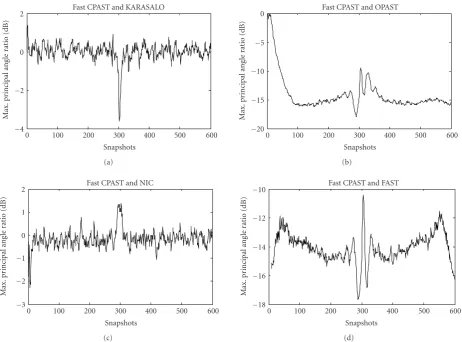
Snapshots (d)
Figure5: Ratio of maximum principal angles of fast CPAST and several other algorithms in the second simulation scenario.
algorithm with truncated window is compared with that of fast CPAST algorithm with exponential window.
In all simulations of this subsection, we have used the Monte Carlo simulation and the number of simulation runs used for obtaining each point is equal to 100. The only exceptions areSection 7.3and part 4 inSection 7.2where the results are obtained using one simulation run.
7.1. Comparison of the Performance of Fast CPAST with That of Other Algorithms. In this subsection, we consider a uniform linear array where the number of sensors isn=17 and the distance between adjacent sensors is equal to half wavelength. In each scenario, an appropriate value is selected for the forgetting factor. In stationary case, old data could be useful. So, large values of forgetting factor (β=0.99) are used. On the other hand, in nonstationary scenario where old data are not reliable, smaller values (β=0.75) are used. Generally, the value selected for the forgetting factor should depend on the variation of data and improper choosing of forgetting factor can degrade the performance of the algorithm.
In the first scenario, the test signal is the sum of signals of two sources plus a white Gaussian noise. The SNR of each source is equal to 10 dB.Figure 1shows the trajectories of
these sources. Since this scenario describes a stationary case, a forgetting factor ofβ=0.99 has been selected.
Figure 2 shows the maximum principal angle of fast CPAST algorithm in each snapshot. Principal angles [20] are measures of the difference between the estimated and real subspaces. The principal angles are zero if the compared subspaces are identical. InFigure 3, the maximum principal angle of fast CPAST is compared with other subspace track-ing algorithms. In comparisons, the ratio of the maximum principal angles of fast CPAST and the other algorithms are obtained in decibels using the following relation:
20 log
θCPAST
θalg
, (62)
whereθCPASTandθalgdenote the maximum principal angles of the fast CPAST and any of the algorithms mentioned in
Table 3, respectively. This figure shows that the performance of the fast CPAST is much better than the PC, FAST, BISVD2, PROTEUS1, and PROTEUS2 after the convergence of algorithms. In addition, it can be seen from this figure that the fast CPAST has faster convergence rate than the PAST, BISVD1, NIC, API, and FAPI algorithms.
Fast CPAST and KARASALO
−1.5
−1
−0.5 0 0.5 1
M
ax.
pr
incipal
ang
le
ra
tio
(dB)
0 100 200 300 400 500 600
Snapshots (a)
Fast CPAST and PAST
−2
−1.5
−1
−0.5 0 0.5
M
ax.
pr
incipal
ang
le
ra
tio
(dB)
0 100 200 300 400 500 600
Snapshots (b) Fast CPAST and NIC
−3
−2
−1 0 1
M
ax.
pr
incipal
ang
le
ra
tio
(dB)
0 100 200 300 400 500 600
Snapshots (c)
Fast CPAST and PC
−20
−15
−10
−5 0 5
M
ax.
pr
incipal
ang
le
ra
tio
(dB)
0 100 200 300 400 500 600
Snapshots (d)
Figure6: Ratio of maximum principal angles of fast CPAST and several other algorithms in the third simulation scenario.
−350
−300
−250
−200
−150
−100
−50 0 50
De
vi
ation
fr
o
m
o
rt
honor
m
alit
y
(dB)
0 100 200 300 400 500 600
Snapshots PAST
Fast CPAST API
Figure7: Deviation from orthonormality for three algorithms in the third scenario.
algorithms in a nonstationary environment. The test signal is the sum of signals of two sources plus a white Gaussian noise.
Figure 4shows the trajectories of the sources. Because of the nonstationarity of the environment, the forgetting factor is chosen as β = 0.75. The SNR of each source is equal to 10 dB. The simulation results showed that the performance of fast CPAST in this scenario is better than most of the other algorithms mentioned in Table 3 and approximately the same as few of them. In Figure 5, the ratio of the maximum principal angle of fast CPAST and some of these algorithms are shown in dB.
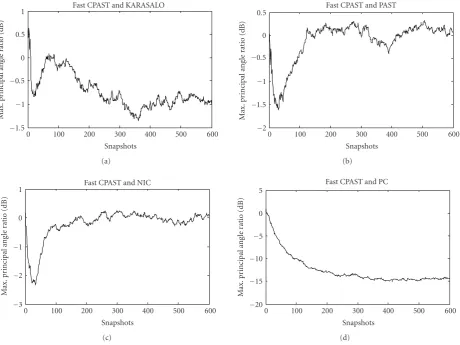
In the third scenario, we consider two sources that are stationary and are located at [−5◦, 5◦]. The SNR of each of them is equal to −5 dB. In this scenario βwas equal to 0.99.The simulation results showed that the performance of fast CPAST in this scenario is better than some of the other algorithms mentioned inTable 3after convergence. For other algorithms ofTable 3, fast CPAST has a faster convergence, but the performances are similar after the convergence. In
Figure 6, the ratio of the maximum principal angle of fast CPAST and some of these algorithms are shown in dB.
0 10 20 30 40 50 60 70 80 90
M
ean
of
maxim
u
m
p
rincipal
ang
le
(deg)
−30 −20 −10 0 10 20 30
SNR (dB)
Figure8: Mean of maximum principal angle versus SNR for two stationary sources located at [−50◦, 50◦].
0 10 20 30 40 50 60 70
M
ean
of
maxim
u
m
p
rincipal
ang
le
(deg)
0 10 20 30 40 50 60
Number of sensors (n)
Figure9: Mean of maximum principal angle versus number of sen-sors for five stationary sources located at [−10◦, −5◦, 0◦, 5◦, 10◦].
The deviation of the subspace weighting matrix W(t) from orthonormality can be measured by means of the following error criterion [18]:
20 logWH(t)W(t)−IrF
. (63)
We consider the third scenario for investigating the devi-ation of the subspace weighting matrix from orthonormality.
Table 7shows the average of orthonormality error given by (63) for algorithms in Table 6. It can be seen fromTable 7
that fast CPAST, KARASALO, OPAST, BISVD1, PROTEUS2, FAPI, FAST, API, and PROTEUS1 outperform the other algorithms. In addition, a plot of variations of the orthonor-mality error with time (snapshot number) is provided in
Figure 7for the fast CPAST, API, and PAST algorithms. The
Table 7: Average of orthonormality error given by (63) for algorithms mentioned inTable 6in the third simulation scenario.
Algorithm Orthonormality error
fast CPAST, KARASALO, OPAST, BISVD1, about−300 dB
PROTEUS2, FAPI, FAST about−300 dB
API about−285 dB
PROTEUS1 about−265 dB
PAST, NIC about−30 dB
PC about 0 dB
BISVD2 about 30 dB
−30
−20
−10 0 10 20 30
DO
A
(d
eg
)
0 100 200 300 400 500
Snapshots
Figure 10: Real trajectories of three crossing-over targets versus number of snapshots.
results for other algorithms are not presented here to keep the presentation as concise as possible.
7.2. Effect of SNR,n,and Nonstationarity on the Performance of the Fast CPAST Algorithm. In this section, we consider a uniform linear array where the number of sensors is n = 17 and the distance between adjacent sensors is equal to half wavelength. The exceptions are Sections7.2.2and7.2.3
where we change the number of sensors.
7.2.1. Effect of the SNR. In this part of Section 7.2, we investigate the influence of SNR on the performance of the fast CPAST algorithm. We consider two sources that are stationary and are located at [−50◦, 50◦].The performance is evaluated for SNR’s from −30 dB to 30 dB. Figure 8
shows the mean of maximum principal angle for each SNR. Simulations using fast CPAST and MUSIC showed that for a SNR of−10 dB a mean square error of about 1 degree can be reached in DOA estimation.
−30
−20
−10 0 10 20 30
DO
A
(d
eg
)
0 100 200 300 400 500
Snapshots
Figure11: Estimated trajectories of the three crossing-over targets versus number of snapshots.
0 1 2 3 4 5 6 7 8 9 10
R
eal
or
estimat
ed
n
umber
o
f
sour
ces
0 500 1000 1500
Snapshots Real number of sources AIC
MDL
Proposed algorithm Figure12: Real and Estimated number of sources versus number of snapshots.
CPAST is investigated. To do so, we consider five sources that are stationary and are located at [−10◦, −5◦, 0◦, 5◦, 10◦] and their SNR is 5 dB.Figure 9shows the mean of maximum principal angle forn∈ {6, 7,. . ., 60}. It can be seen that the subspace estimation algorithm reaches its best performance forn ≥ 18 and it remains approximately unchanged with increasingn.
7.2.3. Effect of a Nonstationary Environment. In this part, we use MUSIC algorithm for finding the DOA’s of signal sources impinging on an array of sensors. Let{si}ni=1denote the orthonormal eigenvectors of covariance matrix R. We assume that the corresponding eigenvalues of R are sorted in descending order. We know that the MUSIC method
0 10 20 30 40 50 60 70 80 90
0 200 400 600 800 1000
Snapshots Exponential window Truncated window
Figure13: Maximum principal angle of the fast CPAST algorithm with exponential and truncated windows.
gives consistent estimates of the DOA’s as the minimizing arguments of the following cost function:
fMUSIC(θ)=aH(θ)
In−SSH
a(θ) , (64)
whereSis any orthonormal basis of the signal subspace like S=(s1,. . .,sr), anda(θ) is the steering vector corresponding
to the angleθ.
To demonstrate the capability of the proposed algorithm in target tracking in nonstationary environments, we con-sider three targets which have crossover in their trajectories. The trajectories of these three targets are depicted in
Figure 10. The SNR for each of the three targets is equal to 0 dB and the number of sensors is 17. We have used the fast CPAST algorithm for tracking the signal subspace of these targets, the MUSIC algorithm for estimating their DOA’s, and the Kalman filter for tracking their trajectories. The simulation result is shown inFigure 11. It can be seen from Figures9and10that the combination of fast CPAST, MUSIC, and Kalman filter algorithms has been successful in estimating and tracking the trajectories of the sources.