Volume 2007, Article ID 49597,10pages doi:10.1155/2007/49597
Research Article
An Efficient Kernel Optimization Method for Radar
High-Resolution Range Profile Recognition
Bo Chen, Hongwei Liu, and Zheng Bao
National Key Laboratory for Radar Signal Processing, Xidian University, Xi’an 710071, Shaanxi, China
Received 15 September 2006; Accepted 5 April 2007
Recommended by Christoph Mecklenbr¨auker
A kernel optimization method based on fusion kernel for high-resolution range profile (HRRP) is proposed in this paper. Based
on the fusion of l1-norm and l2-norm Gaussian kernels, our method combines the different characteristics of them so that not only
is the kernel function optimized but also the speckle fluctuations of HRRP are restrained. Then the proposed method is employed to optimize the kernel of kernel principle component analysis (KPCA) and the classification performance of extracted features is evaluated via support vector machines (SVMs) classifier. Finally, experimental results on the benchmark and radar-measured data
sets are compared and analyzed to demonstrate the efficiency of our method.
Copyright © 2007 Bo Chen et al. This is an open access article distributed under the Creative Commons Attribution License, which permits unrestricted use, distribution, and reproduction in any medium, provided the original work is properly cited.
1. INTRODUCTION
Radar automatic target recognition (RATR) is to identify the unknown target from its radar-echoed signatures. Tar-get high-range-resolution profile contains more detail tar-get structure information than that of low-range-resolution radar echoes, so it plays an important role in RATR commu-nity [1–4]. As is known, radar HRRP is a strong function of target aspect, and serious speckle fluctuation may exist when target-radar orientation changes, which makes HRRP RATR a challenge task. In addition, target may exist at any posi-tion in real system, thus the posiposi-tion of an observed HRRP in a time window will vary between measurements, and this time-shift variation should be compensated when perform-ing classification [1–4].
Kernel methods have been applied successfully in solving various problems in machine learning community. A kernel-based algorithm is a nonlinear version of linear algorithm where, through a nonlinear functionΦ(x), the input vector
xhas been previously transformed to a higher dimensional spaceF in which we only need to compute inner products (via a kernel function). The attractiveness of such algorithms stems from their elegant treatment of nonlinear problems and their efficiency in high-dimensional problems. For the HRRP recognition, there exists complex nonlinear relation between targets due to the noncooperation and maneuvering characteristic of targets. Therefore, kernel methods cannot be
directly applied to recognition unless the above three prob-lems of influencing HRRP recognition can be solved, which will significantly improve the classification performance [1]. Given two input vectorsxandy, their inner product in feature space,F, can be written in the form of kernelKas
K(x,y)=Φ(x)·Φ(y). (1) The popular kernel functions are Gaussian kernelK(x,y)= exp(−γx−y2) withγ >0 and polynomial kernelK(x,y)=
((x·y) + 1)p with p ∈ N. The choice of the right embed-ding is of crucial importance, since each kernel will create a different structure in the embedding space. The ability to as-sess the quality of an embedding is hence a crucial task in the theory of kernel machines. Recently, Xiong et al. [5] pro-pose an alternate method for optimizing the kernel function by maximizing a class separability criterion in the empiri-cal feature space. In this paper, we give an extension of the method which can fuse multiple kernel functions. Then for the HRRP recognition, the proposed method is employed to combine the two Gaussian kernels based on l1-norm and l2
Finally, the classification performance of features ex-tracted by optimized KPCA is evaluated via support vector machines (SVMs) [7] based on the benchmark and radar-measured HRRP datasets.
2. PROPERTIES OF RADAR HRRP
The radar works in the optics region, and the electromag-netism characteristics of targets can be described by the scat-tering center target model, which is widely used and also proved to be a suitable target model in SAR and ISAR appli-cations. An HRRP is the coherent sum of time returns from target scatterers located within a range resolution cell, which represents the distribution of target scattering centers along the radar line of sight [3]. Themth complex returned echo in thenth range cell can be written as
xn(m)= In
i=1 σn,iexp
−j
4πRn,i(m)
λ +θn,i
, (2)
whereIndenotes the number of target scatterers in thenth range cell, Rn,i(m) denotes the distance between radar and theith scatterer in themth sampled echo,σn,iandθn,idenote the amplitude and initial phase of theith scatterer echo, re-spectively.
If the target orientation changes, its HRRP will be changed subsequently. Two phenomena are responsible for it. The first is the scatterer’s motion through range cell (MTRC). Given target rotation angle larger enough, the scat-terers range variation will be larger than a range resolution cell, thus make the HRRP changed. Apparently the target ro-tation angle, which leads to MTRC, is subjective to the range resolution of radar and target-cross length. The second phe-nomenon is the HRRP’s speckle effect. Since an HRRP is the coherent summation of multiple scatterers echoes in one range cell, even the target rotation angle meets the condition of target rotation angle limitation to avoid the occurring of MTRC, the phase of each scatterer echo will be changed, thus their coherent summation will be changed subsequently.
If MTRC occurs, it means that the target scattering cen-ter model changed. In this case, it is required more templates to represent the target HRRPs. As to the speckle effect, an ef-fective method of HRRP similarity scalar is needed to elim-inate its influence on recognition performance, such as the l1-norm distance [8].
3. FUSION KERNEL BASED ONl1-NORM AND
l2-NORM GAUSSIAN KERNELS
3.1. l1-norm andl2-norm Gaussian Kernels
Due to complicated nonlinear relations between radar tar-gets, empirically Gaussian kernel is chosen to perform HRRP recognition, which is proved by the empirical results in [1]. As the above, radar HRRP has the property of speckle effect especially for propeller-driven aircraft, the running propeller of which modulates the echoes and leads to the great fluc-tuation of echoes. Usually, l2-norm Gaussian kernel is used,
which includes a square operation and augments the influ-ence of the elements of large value in a vector, which will also enhance the effect of speck fluctuation on recognition. Since [8] shows us that l1-norm distance criterion can decrease the
fluctuation produced by propeller, l1-norm Gaussian kernel
can eliminate the speckle effect of HRRP,
KX1(t),X2(t)=exp−γ X1(t)−X2(t) l1, (3) whereX1(t) andX2(t) denote two individual HRRPs, andγis a kernel parameter, which can be determined by a particular criterion.
However, the useful information of HRRP exists in only a part of all range cells and the rest are noise signal. Although l1-norm distance can eliminate the speckle effect, the side
lobes also have been driven up, which means the increase of the interference of the noise to signal. Whereas l2-norm
dis-tance can work well on decreasing the noise effect, so we ex-pect to combine the two Gaussian kernels based on different scales to learn a kernel function adaptive to HRRP data. In the next section, a kernel optimization method will be given.
3.2. Kernel optimization based on fusion Kernel in the empirical feature space
Although kernel-based methods such as KPCA [1] can repre-sent complex nonlinear relations among targets, the choices of kernels and the kernel parameters still greatly influence the classification performance. Obviously, a poor choice will degrade the final results. Ideally, we select the kernel based on our prior knowledge of problem domain and restrict the learning to the task of selecting the particular pattern func-tion in the feature space defined by the chosen kernel. Unfor-tunately, it is not always possible to make the right choice of kernel a priori. Furthermore, there is no general kernel suit-able to all datasets. Therefore, it is necessary to find a data-dependent objective function to evaluate kernel functions. The method by Xiong et al. [5] employs a data-dependent kernel similar to that used in [6] as the objective kernel to be optimized. In this section, we firstly review the kernel opti-mization method.
3.2.1. Kernel optimization based on the single Kernel (SKO)
Given a two-class training data (x1,z1), (x2,z2),. . ., (xm,zm) ∈ Rd × {±1}, wherexi ∈ Rd is the ith sample andzi∈ {±1}the label corresponding toxi. Given two data samplesxandy, a data-dependent kernel function is used,
k(x,y)=q(x)q(y)k0(x,y), (4)
wherex,y ∈ Rd,k0(x,y), called the basic kernel, is an or-dinary kernel such as a Gaussian or polynomial kernel, and
q(·) is a factor function of the form
q(x)=α0+ n
i=1 αik1
x,ai
, (5)
wherek1(x,ai)=e−γ1x−ai
2
or local centers of the training data, andαi’s are the com-bination coefficients which need normalizing. According to [9,10], evidently the data-dependent kernel satisfies the Mer-cer condition for a kernel function.
The kernel matrices corresponding tok(x,y) andk0(x,y) are denoted byKandK0, so (4) can be rewritten as
K=QK0Q, (6)
where Q is a diagonal matrix, whose diagonal ele-ments are {q(x1),q(x2),. . .,q(xm)}. We denote the vectors (q(x1),q(x2),. . .,q(xm))T, and (α0,α1,. . .,αn)T by qandα, respectively. Then, we have
q(α)=
⎛ ⎜ ⎜ ⎜ ⎜ ⎝
1 k1x1,a1 · · · k1x1,an
1 k1x2,a1 · · · k1x2,an
..
. ... . .. ... 1 k1xm,a1
· · · k1xm,an
⎞ ⎟ ⎟ ⎟ ⎟ ⎠ ⎛ ⎜ ⎜ ⎜ ⎜ ⎝ α0 α1 .. . αn ⎞ ⎟ ⎟ ⎟ ⎟ ⎠=K1α.
(7)
Here, the following quantity for measuring the class sepa-rability is used as the kernel quality function in the empirical feature space
J= trace
Sb
traceSw
, (8)
whereSb =
2
i=1pi(μi−μ)(μi−μ)T is the “between-class scatter matrix” andSw = (1/n)
n
i=1(xi−μ)(xi−μ)T the “within-class scatter matrix,”μis the global mean vector,μi is the mean vector ofith class, and pi =ni/nis the prior of
ith class. It is obvious that optimizing the kernel throughJ
means increasing the linear separability of training data in feature space so that the performance of kernel machines is improved.
Now for the sake of convenience, we assume that the first
m1data belong to classC1, that is,zi =1,i ≤ m1, and the remainingm2data belong toC2(m1+m2 =m). Then, the kernel matrix can be written as
K= K11 K12 K21 K22 , (9)
whereK11,K12,K21, andK22represent the submatrices ofK
of orderm1×m1,m1×m2,m2×m1,m2×m2, respectively. Now we can construct two kernel scatter matrices in the fea-ture space as the following matrices:
B= ⎛ ⎜ ⎜ ⎜ ⎝ 1
m1K11 0
0 1
m2K22,
⎞ ⎟ ⎟ ⎟ ⎠− ⎛ ⎜ ⎜ ⎜ ⎝ 1 mK11 1 mK12 1 mK21 1 mK22 ⎞ ⎟ ⎟ ⎟ ⎠, W= ⎛ ⎜ ⎜ ⎜ ⎜ ⎜ ⎜ ⎜ ⎝
k11 0 · · · 0 0 k22 · · · 0
..
. ... . .. 0
0 0 · · · kmm
⎞ ⎟ ⎟ ⎟ ⎟ ⎟ ⎟ ⎟ ⎠ − ⎛ ⎜ ⎜ ⎝ 1
m1K11 0
0 1 m2K22 ⎞ ⎟ ⎟ ⎠. (10)
Similarly, matricesB0 andW0 correspond to the basic kernelK0. According to [3, Theorem 1], we can use the kernel scatter matrices to representJ,
J(α)= 1TmB1m 1T
mW1m =
q(α)TB0q(α)
q(α)TW0q(α), (11) where 1mis the vector of ones of the lengthm.
To maximizeJ(α), the standard gradient approach is em-ployed and an updating equation for maximizing the class separabilityJis given by the following:
α(n+1)=α(n)+η
K1TB0K1
qα(n)
T
W0qα(n)
−Jα(n)
KT
1W0K1
qα(n)
T
W0qα(n)
α(n),
(12)
ηis the learning rate and to ensure the convergence of the algorithm, a gradually decreasing learning rate is adopted,
η(t)=η0
1− t
N
, (13)
whereη0is the initial learning rate,Ndenotes a prespecified number of iterations, andtthe current iteration number.
We utilize artificially-generated data in two dimensions in order to illustrate graphically the influence of kernel func-tions on classification. Both class 1 (denoted by “∗”) and class 2 (“◦”) were generated from mixtures of two Gaussians by Ripley [11] with the classes overlapping to the extent that the Bayes error is around 8.0% and the linear SVM error is 10.5%.
KPCA was used to extract feature with three initial “bad guesses” of kernel matrices (Gaussian kernels withγ = 10 and γ = 0.25, polynomial kernel with p = 2. For nota-tion simplificanota-tion: the three kernels were respectively noted as G10, G0.25, and P2) which were all normalized. Linear SVM was used as a classifier. Figure 1(a) shows the orig-inal distribution with 125-example training set (randomly chosen from original Ripley’s 250). Figure 1(b) shows the projection of training set in the Gaussian kernel (γ = 10) induced feature space. The test error (the associated 1000-example test set) for KPCAG10 (26.8%) is far inferior to
the original without KPCA which means it is a mismatched kernel.Figure 1(c)shows the projection of the training set through KPCAG0.25. The test error for KPCAG0.25 (10.3%)
is slightly inferior to the original, which means a matched kernel.Figure 1(d)shows the projection of the training set through KPCAP2. The test error for KPCAP2 (10.7%) is
slightly inferior to the original. Figures1(e),1(f),1(g)show the projections of the training set after SKO-KPCAG10,
SKO-KPCAG0.25, and SKO-KPCAP2. A value of γ1 of the
−1.5 −1 −0.5 0 0.5 1 The first dimension
(a) −0.2
0 0.2 0.4 0.6 0.8 1 1.2
T
h
e
se
cond
dimension
−0.7−0.5−0.3 −0.1 0.1 0.3 0.5 0.7 The first principle component
(b) −0.6
−0.4 −0.2 0 0.2 0.4 0.6 0.8
The
sec
ond
p
ri
nciple
co
m
p
o
n
en
t
−0.6 −0.4 −0.2 0 0.2 0.4 0.6 The first principle component
(c) −0.4
−0.3 −0.2 −0.1 0 0.1 0.2 0.3 0.4
The
sec
ond
p
rinciple
co
m
p
o
n
en
t
−0.8−0.6−0.4−0.2 0 0.2 0.4 0.6 0.8 The first principle component
(d) −0.8
−0.6 −0.4 −0.2 0 0.2 0.4 0.6
The
sec
ond
p
rinciple
co
m
p
o
n
en
t
−0.7−0.5−0.3 −0.1 0.1 0.3 0.5 0.7 The first principle component
(e) −0.6
−0.4 −0.2 0 0.2 0.4 0.6 0.8
The
sec
ond
p
rinciple
co
m
p
o
n
en
t
−0.15 −0.1−0.05 0 0.05 0.1 0.15 The first principle component
(f) −0.05
0 0.05
The
sec
ond
p
rinciple
co
m
p
o
n
en
t
−0.4 −0.2 0 0.2 0.4 The first principle component
(g) −0.25
−0.2 −0.15 −0.1 −0.05 0 0.05 0.1 0.15
The
sec
ond
p
rinciple
co
m
p
o
n
en
t
and SKO-KPCAP2(10.1%) were superior to those before
ker-nel optimization.
However, we can see that the performance of SKO method is very dependent on and limited by the initial se-lected kernel. Which kernel function should be sese-lected to be optimized, Gaussian kernel or other ones? How can we learn a better kernel matrix from different kernels correspond-ing to different physical interests adaptive to the input data? These problems are difficult to handle for the SKO method. In the next section, we generalize the SKO method to a kernel optimization algorithm based on fusion kernel (FKO).
3.2.2. Kernel optimization based on fusion Kernel (FKO)
It is evident that the method by Xiong et al. [5] is effective to improve the performance of the kernel machines, since the targets are linearly separable in the feature space. Also the experimental results in [5] prove it valid. Nevertheless, the kernel optimization method is based on the single ker-nel, which means that if a basic kernel functionK0 is cho-sen beforehand, we have to optimize the kernel based on the single embedding space, the optimization capability will be limited consequentially. To generalize the method we extend it to propose a more general kernel optimization approach combining with the idea of fusion kernel mentioned in the above.
If we chooseLkernel functions, (6) can be represented as
K=
L
i=1
QiK0(i)Qi, (14)
whereK0(i)is theith basic kernel,Qiis the factor matrix cor-responding toK0(i).BandWare modified as
Bfusion=
L
i=1 Bi,
Wfusion=
L
i=1 Wi,
(15)
where
Bi=
⎛ ⎜ ⎜ ⎜ ⎝ 1 m1K (i) 11 0
0 1
m2K (i) 22 ⎞ ⎟ ⎟ ⎟ ⎠− ⎛ ⎜ ⎜ ⎜ ⎝ 1 mK (i) 11
1
mK (i) 12
1
mK (i) 21
1
mK (i) 22 ⎞ ⎟ ⎟ ⎟ ⎠,
Wi=
⎛ ⎜ ⎜ ⎜ ⎜ ⎜ ⎜ ⎜ ⎜ ⎜ ⎜ ⎜ ⎝
k11(i) 0 · · · 0
0 k22(i) · · · 0
..
. ... . .. 0
0 0 · · · kmm(i)
⎞ ⎟ ⎟ ⎟ ⎟ ⎟ ⎟ ⎟ ⎟ ⎟ ⎟ ⎟ ⎠ − ⎛ ⎜ ⎜ ⎜ ⎝ 1 m1K (i) 11 0
0 1
m2K (i) 22 ⎞ ⎟ ⎟ ⎟ ⎠. (16)
According to (11), the fusion kernel quality function
Jfusioncan be written as
Jfusion= 1TmBfusion1m 1T
mWfusion1m =
L
i=1qiTB0(i)qi
L
i=1qTiW
(i) 0 qi
, (17)
where
qi=
⎛ ⎜ ⎜ ⎜ ⎜ ⎜ ⎜ ⎝
1 k1x1,a1 · · · k1x1,an
1 k1x2,a1 · · · k1x2,an
..
. ... . .. ... 1 k1xm,a1
· · · k1xm,an
⎞ ⎟ ⎟ ⎟ ⎟ ⎟ ⎟ ⎠ ⎛ ⎜ ⎜ ⎜ ⎜ ⎜ ⎜ ⎜ ⎝
α(0i) α(1i)
.. .
α(ni)
⎞ ⎟ ⎟ ⎟ ⎟ ⎟ ⎟ ⎟ ⎠
=K1α(i).
(18)
The matricesB0(i) andW (i)
0 correspond to the basic kernel K0(i).α(i)is the combination coefficient vector corresponding
toK0(i).
Therefore, (17) can be derived as
Jfusion= qTB
fusion 0 q qTWfusion
0 q
, (19)
where
B0fusion=
⎡ ⎢ ⎢ ⎢ ⎢ ⎢ ⎢ ⎢ ⎣
B(1)0 0 · · · 0
0 B0(2) · · · 0
..
. ... . .. ... 0 0 0 B0(L)
⎤ ⎥ ⎥ ⎥ ⎥ ⎥ ⎥ ⎥ ⎦ , Wfusion 0 = ⎡ ⎢ ⎢ ⎢ ⎢ ⎢ ⎢ ⎢ ⎣
W0(1) 0 · · · 0
0 W0(2) · · · 0
..
. ... . .. ... 0 0 0 W0(L)
⎤ ⎥ ⎥ ⎥ ⎥ ⎥ ⎥ ⎥ ⎦ ,
q=q1 q2 · · · qL
= ⎡ ⎢ ⎢ ⎢ ⎢ ⎢ ⎢ ⎣
K1 0 · · · 0 0 K1 · · · 0
..
. ... . .. ... 0 0 · · · K1
⎤ ⎥ ⎥ ⎥ ⎥ ⎥ ⎥ ⎦ ⎡ ⎢ ⎢ ⎢ ⎢ ⎢ ⎢ ⎣ α(1) α(2) .. .
α(L)
⎤ ⎥ ⎥ ⎥ ⎥ ⎥ ⎥ ⎦
=Kfusion 1 αfusion,
(20)
andK1fusion is anLm×L(n+ 1) matrix,αfusion is a vector of
lengthL(n+ 1).
Obviously, we can find that the form of (19) is the same as that of the right-hand side of (11), so through (12), our result can also be given by the following
αfusion(n+1)
=αfusion (n) +η
K1fusion
T
Bfusion0 K1fusion qαfusion
(n)
T
Wfusion 0 q
αfusion (n)
−Jfusion
Kfusion 1
T
Wfusion 0 K1fusion qαfusion(n)
T
W0fusionq
αfusion(n)
αfusion(n) .
−0.15 −0.1 −0.05 0 0.05 0.1 0.15 The first principle component
−0.04 −0.03 −0.02 −0.01 0 0.01 0.02 0.03 0.04
The
sec
ond
p
rinciple
component
(a)
0 50 100 150
Combination coefficient indices −0.04
−0.02 0 0.02 0.04 0.06
C
o
mbination
co
e
ffi
cients
G0.25 P2 G10
(b)
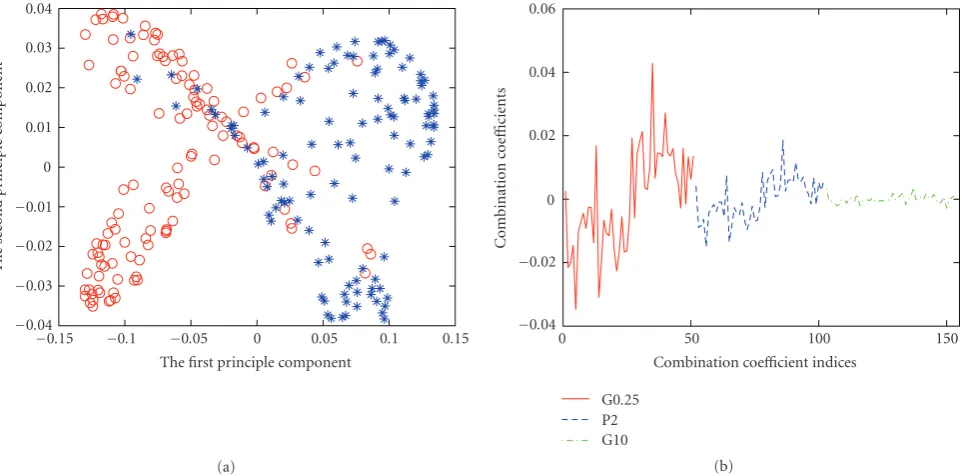
Figure2: The results of Ripley’s data after FKO. (a) Two-dimensional projection of the training data in the optimized feature space. (b) the
combination coefficientsαfusion.
WhenL=1, it is just the single kernel optimization. Figure 2(a) shows the projection of the training set in the empirical feature space after the FKO. The parameters were the same as those of the single kernel optimization. The classifier was still linear SVM. The test error (9.0%) demon-strates the improvement of the performance of the classifica-tion. Meanwhile, shown inFigure 2(b)are the combination coefficients of three initial kernels,αfusion. FromFigure 2(b),
we can clearly find that after kernel optimization, the combi-nation coefficients of the mismatched kernel G0.1 have been far less than other ones. Equivalently, our method automati-cally selected G4 and P2 kernels to be optimized, which both match the Ripley’s data for classification.
4. EXPERIMENTAL RESULTS
4.1. Benchmark datasets
In order to evaluate the performance of our method, we firstly test it on the four-benchmark datasets, namely, the ionosphere, Pima Indians diabetes, liver disorder, wiscon-sin breast cancer (WBC, where the 16 database samples with missing values have been removed) which are downloaded from the UCI benchmark repository [12]. Except Pima data with training and test sets, in order to evaluate the true performance, other data are randomly partitioned into two equal and disjoint parts which are respectively used as train-ing and test sets.
As the above, kernel optimization methods were ap-plied to KPCA. Linear SVM classifier was utilized to evaluate the classification performances. We used a Gaussian kernel
function, a polynomial kernel functionK2(x,y)=((xT·y) + 1)p, and a linear kernel functionK3(x,y) = xT ·y as ini-tial basic kernel matrices. And all kernels were normalized. Firstly, the values of kernel parameters for the three kernel functions of KPCA without kernel optimization were respec-tively selected by 10-fold cross-validation. Then the chosen kernel functions were applied as the basis kernels in (4).σ1’s in (5) were also selected using 10-fold cross-validation. 20 lo-cal centers were selected to form the empirilo-cal core set{ai}. The initial learning rateη0was set to 0.08 and the total iter-ation numberTwas set to 400. Meanwhile, the procedure of determining the parameters of SKO was the same as FKO.
Experimental results on benchmark data are summarized in Table 1. It is evident that FKO can further improve the classification performance and at least as the same as the SKO method. The combination coefficients of three kernels in the four experiments has also been illustrated inFigure 3. We find that the combination coefficients of FKO are dependent on the classification performance of the corresponding ker-nel in SKO. As shown inFigure 3, the better the kernels can work after the optimization of SKO, the larger the combina-tion coefficients of FKO are. Apparently, FKO can automati-cally combine three fixed parameter kernels.
4.2. Measured high-resolution range profile (HRRP) radar data set
0 10 20 30 40 50 60 Combination coefficient indices
−0.2 −0.15 −0.1 −0.05 0 0.05 0.1 0.15 0.2
C
o
mbination
co
e
ffi
cients
G P L
(a)
0 10 20 30 40 50 60
Combination coefficient indices −0.08
−0.06 −0.04 −0.02 0 0.02 0.04 0.06 0.08
C
o
mbination
co
e
ffi
cients
G P L
(b)
0 10 20 30 40 50 60
Combination coefficient indices −0.06
−0.04 −0.02 0 0.02 0.04 0.06 0.08 0.1
C
o
mbination
co
e
ffi
cients
G P L
(c)
0 10 20 30 40 50 60
Combination coefficient indices −0.06
−0.04 −0.02 0 0.02 0.04 0.06 0.08 0.1 0.12
C
o
mbination
co
e
ffi
cients
G P L
(d)
Figure3: The combination coefficients corresponding to four datasets. (a) BCW; (b) pima; (c) liver; (d) ionosphere.
Citation S/II, are measured continuously when the targets are flying. The projections of target trajectories onto the ground plane are shown inFigure 4. The measured data of each tar-get are divided into several segments, the training data and test data are chosen from different data segments, respec-tively, which means, the target orientations corresponding to the test data and training data are different, the maximum elevation difference between the test data and training data is about 5 degrees. The 2nd and the 5th segments of Yark-42, the 5th and the 6th segments of An-26, the 6th and the 7th
segments of Cessna Citation S/II are chosen as the training data the total number of which is 300, all the rest data seg-ments are chosen as tests data, the total number of which is 2400. And in the kernel optimization, 50 local centers from the training data are used as empirical cores. Additionally, the original HRRPs are preprocessed by power transforma-tion (PT) to improve the classificatransforma-tion performance, which is defined as
−5 0 5 Km 0
20 40 60
Km
1
2 3 4 5
Radar
(a) Yark-42
−20 −15 −10 −5 0 Km
0 5 10 15
Km
3 2
1 4
5 6 7 7
Radar
(b) An-26
−20 −15 −10 −5 0 Km
0 5 10 15
Km
3 2
1
4 5
6 7
Radar
(c) Cessna Citation A/II
Figure4: The projection of target trajectories onto the ground plane. (a) Yark-42, (b) An-26, (c) cessna citation S/II.
Table1: The comparison of recognition rates of different methods
in different experiments.K1,K2, andK3, respectively, correspond to
Gaussian, polynomial, and linear kernels.
K1 K2 K3
BCW
KPCA 88.96% 90.45% 88.58%
KPCA with SKO 88.96% 96.94% 97.1%
KPCA with FKO — 97.33%
Pima
KPCA 73.72% 64.15% 63.48%
KPCA with SKO 73.72% 66.21% 64.63%
KPCA with FKO — 74.10%
Liver
KPCA 71.19% 69.47% 66.19%
KPCA with SKO 74.67% 73.36% 73.47%
KPCA with FKO — 75.17%
Ionosphere
KPCA 93.11% 93.11% 89.73%
KPCA with SKO 93.11% 93.55% 89.38%
KPCA with FKO — 93.55%
where X(t) denotes an individual HRRP. The reason that using PT can improve the classification performance is ex-plained as that the nonnormality distributed original HRRPs will become near normality distribution after PT, thus makes the performance of many classifiers optimal. From HRRP physical properties of view, PT amplifies the weaker echoes and compresses the stronger echoes so as to decrease the speckle effect in measuring the HRRPs similarity. The details about PT can be referred to [13].
One-against-all linear SVM classifiers are trained for the feature vectors extracted by SKO-KPCA, FKO-KPCA, and KPCA without the kernel optimization, respectively. The pa-rameters in the experiments are listed inTable 2. The exper-imental results are shown inFigure 5, where thex-axis rep-resents the number of principle components and the y-axis the recognition rate.
In Figures5(a)–5(c), each target recognition rates in dif-ferent KPCA methods are shown respectively. Figure 5(d) indicates the average recognition rates. From Figures 5(a) and5(d), we can find that KPCA with l1-norm and fusion
Table2: The parameters in the experiment.
γ Empirical centers no. γ1 η0 Iteration no.
KPCA1 0.001
KPCA2 0.001
SKO-KPCA1 0.001 50 1 0.02 200
SKO-KPCA2 0.001 50 1 0.001 200
FKO-KPCA 0.001 50 1 0.0003 200
Note: KPCA1 and KPCA2 correspond to KPCA with l1-norm and
2-norm Gaussian kernels; SKO-KPCA1 and SKO-KPCA2
correspond to KPCA with l1-norm and 2-norm Gaussian kernels
after single kernel optimization; FKO-KPCA represents KPCA after
fusion kernel optimization based on l1-norm and 2-norm Gaussian
kernels.
Gaussian kernels perform better than with l2-norm Gaussian
kernel because of the different performances on An26. Due to the modulability of the propeller of An26 on the HRRPs, there still exists speckle effect even in a small angle sec-tor. Therefore, l1-norm Gaussian kernel can be employed to
eliminate the large fluctuation so as to improve the recogni-tion performance. By the fusion of l1-norm Gaussian kernel,
FKO-KPCA also works well. Meanwhile, Figure 5(d)shows that the recognition rate of l1-norm Gaussian kernel
SKO-KPCA reaches 96.30% when the number of principle com-ponent equals 140, while FKO-KPCA method only needs 90 components to reach its best classification rate 96.27%. Since the fewer components mean lower computational complex-ity, FKO-KPCA can extract effective features to reduce the computational complexity in comparison KPCA with l1
-norm Gaussian kernel. Why can FKO-KPCA outperform KPCA with l1-norm Gaussian kernel? In our opinion, the
possible reason is that when restricting the speckle effect, l1
-norm distance also augments the noise to interfere the sig-nal, therefore, FKO-KPCA achieves better performance on Cessna and Yark42 than KPCA with l1-norm Gaussian
20 40 60 80 100 120 140 Number of PCs
88 90 92 94 96 98 100
R
ec
o
gnition
rat
es
(%)
KPCA1 KPCA2 SKO-KPCA2
SKO-KPCA1 FKO-KPCA (a)
20 40 60 80 100 120 140
Number of PCs 88
90 92 94 96 98 100
R
ec
o
gnition
rat
es
(%)
KPCA1 KPCA2 SKO-KPCA2
SKO-KPCA1 FKO-KPCA (b)
20 40 60 80 100 120 140
Number of PCs 88
90 92 94 96 98 100
R
ec
o
gnition
rat
es
(%)
KPCA1 KPCA2 SKO-KPCA2
SKO-KPCA1 FKO-KPCA (c)
20 40 60 80 100 120 140
Number of PCs 88
90 92 94 96 98 100
R
ec
o
gnition
rat
es
(%)
KPCA1 KPCA2 SKO-KPCA2
SKO-KPCA1 FKO-KPCA (d)
Figure5: Recognition rates on the measured radar HRRP data versus number of principle components in three experiments. (a) An-26 (b) Cessna (c) Yark-42 (d) average recognition rates.
origin KPCA and l1-norm SKO-KPCA even decreased the
recognition rates.
5. CONCLUSIONS
In this paper, a kernel optimization method with learning ability for radar HRRP recognition is proposed. The method can adaptively combine the different characteristics of l1
-norm and l2-norm Gaussian kernels, so that not only is the
ACKNOWLEDGMENT
This work is supported by the National Science Foundation of China (no.60302009).
REFERENCES
[1] B. Chen, H. Liu, and Z. Bao, “PCA and kernel PCA for radar
high range resolution profiles recognition,” inProceedings of
IEEE International Radar Conference, pp. 528–533, Arlington, Va, USA, May 2005.
[2] B. Chen, H. Liu, and Z. Bao, “An efficient kernel
optimiza-tion method for high range resoluoptimiza-tion profile recognioptimiza-tion,” in
Proceedings of IEEE International Radar Conference, pp. 1440– 1443, Shanghai, China, October 2006.
[3] L. Du, H. Liu, Z. Bao, and M. Xing, “Radar HRRP target
recog-nition based on higher order spectra,”IEEE Transactions on
Signal Processing, vol. 53, no. 7, pp. 2359–2368, 2005. [4] L. Du, H. Liu, Z. Bao, and J. Zhang, “A two-distribution
com-pounded statistical model for radar HRRP target recognition,”
IEEE Transactions on Signal Processing, vol. 54, no. 6, pp. 2226– 2238, 2006.
[5] H. Xiong, M. N. S. Swamy, and M. O. Ahmad, “Optimizing
the kernel in the empirical feature space,”IEEE Transactions
on Neural Networks, vol. 16, no. 2, pp. 460–474, 2005. [6] S. Amari and S. Wu, “Improving support vector machine
classifiers by modifying kernel functions,”Neural Networks,
vol. 12, no. 6, pp. 783–789, 1999.
[7] V. Vapnik,The Nature of Statistical Learning Theory, Springer,
New York, NY, USA, 1995.
[8] Z. Bao, M. Xing, and T. Wang,Radar Imaging Technique,
Pub-lishing House of Electronics Industry, Beijing, China, 2005. [9] B. Sch¨olkopf, S. Mika, C. J. C. Burges, et al., “Input space
ver-sus feature space in kernel-based methods,”IEEE Transactions
on Neural Networks, vol. 10, no. 5, pp. 1000–1017, 1999.
[10] J. Shawe-Taylor and N. Cristianini,Kernel Methods for Pattern
Analysis, Cambridge University Press, Cambridge, UK, 2004.
[11] B. D. Ripley,Pattern Recognition and Neural Networks,
Cam-bridge University Press, CamCam-bridge, UK, 1996.
[12] C. Blake, E. Keogh, and C. J. Merz, “UCI repository of ma-chine learning databases,” Tech. Rep., Department of In-formation and Computer Science, University of California,
Irvine, Calif, USA, 1998. http://www.ics.uci.edu/∼mlearn/
MLRepository.html.
[13] H. Liu and Z. Bao, “Radar HRR profiles recognition based on
SVM with power-transformed-correlation kernel,” in
Proceed-ings of International Symposium on Neural Networks (ISNN
’04), vol. 3173 ofLecture Notes in Computer Science, pp. 531–
536, Dalian, China, August 2004.
Bo Chenreceived his B.Eng. and M.Eng. de-grees in electronic engineering from Xidian University in 2003 and 2006, respectively. He is currently a Ph.D. student in the Na-tional Key Lab of Radar Signal Processing, Xidian University. His research interests in-clude radar signal processing, radar auto-matic target recognition, kernel machine.
Hongwei Liureceived his M.S. and Ph.D. degrees all in electronic engineering from Xidian University in 1995 and 1999, respec-tively. He joined the National Key Lab of Radar Signal Processing, Xidian University since 1999. From 2001 to 2002, he is a vis-iting scholar at the department of electri-cal and computer engineering, Duke Uni-versity, USA. He is currently a Professor and Director of National Key Lab of Radar
Sig-nal Processing, Xidian University. His research interests are radar automatic target recognition, radar signal processing, and adaptive signal processing. He is with the Key Laboratory for Radar Signal Processing, Xidian University, Xi’an, China.
Zheng Baograduated from the Communi-cation Engineering Institution of China in 1953. Currently, he is a Professor at Xid-ian University and an AcademicXid-ian of the Chinese Academy of Science. He is the au-thor or coauau-thor of six books and has pub-lished more than 300 papers. Now his re-search work focuses on the areas of space-time adaptive processing, radar imaging, and radar automatic target recognition. He