Ecological Meta-Analysis of Density-Dependent Processes in the
Transmission of Lymphatic Filariasis: Survival of Infected Vectors
EDWIN MICHAEL,1,2LUCY C. SNOW,1,3
ANDMOSES J. BOCKARIE4
J. Med. Entomol. 46(4): 873Ð880 (2009)
ABSTRACT The survival rate of infected vectors represents one of the fundamental components that inßuence the transmission dynamics of mosquito-borne diseases. Despite the occurrence of a number of studies investigating mosquito survival after infection with Þlarial worms, there remains conßicting evidence from both laboratory and Þeld experiments as to the existence and mechanism for parasite-induced mortality among Þlarial mosquitoes. Here, we used a mixed effects meta-analytical framework to combine the data from all available vectorÐhuman host blood feeding experiments to evaluate the evidence for the impact of parasite load on the mortality rates of the three major lymphatic Þlariasis transmitting mosquito genera,Culex,Aedes,andAnophelesmosquitoes, over the extrinsic incubation period of parasitic infection. The results show that, despite the application of this approach, or in the case ofAnophelesusing a convention Þxed effects logistic regression analysis supplemented with additional survival analysis of longitudinal data, no strong association between mortality rate and microÞlariae (mf) uptake for either of the three mosquito genera is apparent in the combined data. Instead, a key Þnding is that study effects played a more crucial role in determining the levels of mortality observed in these experimental studies. This was most revealing in the case of
Culex, given that the largest single study in terms of both the number of data points and range of mf intensities, in contrast to smaller studies, showed a signiÞcant positive association between mf intensity and mortality, indicating that in this genus at least, the detrimental effect of infection may be manifested only at the highest mf intakes. Although no density dependence in vector mortality was also observed forAedes, possibly because of the use of restricted human mf intensity range in previous studies, an intriguing Þnding was that a signiÞcantly higher overall mortality was observed for this genus over mf intake ranges that produced much less corresponding mortality inCulexandAnopheles. The results also indicate that currently very little can be said about the survival rate ofAnopheles
mosquitoes infected with Þlarial worms because of the striking paucity of data for this genus. Further studies, using standardized methods and covering an appropriate range of mf uptake intensities and using study frameworks that allow the design and comparison of data from both experimental and Þeld experiments, are clearly indicated if we are to reliably quantify the likely effect of Þlarial infection on vector survival.
KEY WORDS Wuchereria bancrofti, lymphatic Þlariasis, vector survival, ecological meta-analysis
The ability of the vector to survive infection is one of the major factors that determine the transmission of mosquito-borne diseases, such as lymphatic Þlariasis. Because the extrinsic incubation periods of parasites are usually relatively long compared with the vector mean life expectancy, estimates of vectorial capacity and hence the parasite basic reproductive number or ratio,R0, are particularly susceptible to changes in
vector survival rates (Dye 1986, 1992). In addition to
the natural daily mortality experienced by mosquitoes in the Þeld (Laurence 1963), it is has been suggested that there may be additional mortality experienced by infected mosquitoes as a result of carrying Þlarial in-fection (Rosen 1955, Wharton 1957a, Jordan and Goatly 1962, Lindsay and Denham 1986). Such infec-tion-induced mortality is of particular interest when trying to understand the population dynamics of lym-phatic Þlariasis transmission for a number of reasons. At its simplest, it may act to regulate disease trans-mission in endemic areas by reducing the number of infected vectors. Morever, if mortality is density-de-pendent, i.e., higher mortality is associated with in-creased infection intensity within the mosquito, then mass drug administration aimed at reducing human microÞlarial (mf) levels (and hence mosquito infec-tion intensity) may lead to an increase in survival of the mosquito population and hence to an increase in
1Department of Infectious Disease Epidemiology, Imperial
Col-lege London, St. MaryÕs Campus, Norfolk Place, London W2 1PG, United Kingdom.
2Corresponding author, e-mail: [email protected]. 3Centre for Epidemiology and Risk Analysis, Veterinary
Labora-tories Agency, New Haw, Addlestone KT15 3NE, United Kingdom.
4Centre for Neglected Tropical Diseases, Liverpool School of
Tropical Medicine, Pembroke Place, Liverpool L3 5QA, United Kingdom.
transmission in the long-term (Pichon 2002). The study of this question has become even more pressing given the growing realization that, in endemic areas where Þlariasis and malaria co-occur and are trans-mitted by the same anopheline mosquitoes, any in-tervention that may increase vector survival could clearly result in an increase in the incidence of malaria in treated communities (Manga 2002, Burkot et al. 2006).
The difÞculties in measuring mosquito survival in the Þeld, and particularly in separating out the effects of natural mortality, infection related mortality, and parasite mortality within the mosquito host, mean that there exist few studies that has allowed conclusive analysis of this topic under natural Þeld conditions (Laurence 1963, Krafsur and Garrett-Jones 1977, Das et al. 1995). For this reason, the study of the detri-mental effects that Þlarial worms may induce on their vectors has been largely restricted to laboratory stud-ies, where vector mortality can be investigated under more controlled conditions. However, although a number of such studies have indicated a detrimental impact of high intensity infection on vector survival, manifested either at speciÞc points in the extrinsic incubation period or as a steady reduction in survival over this period (Rosen 1955; Wharton 1957a, b; Jor-dan and Goatly 1962; Crans 1973; Lindsay and Denham 1986; Ellrot 1987; Failloux et al. 1995), others by con-trast have found no association (Samarawickrema et al. 1985b, Bryan and Southgate 1988). Furthermore, it may be expected that different species and genera of mosquito will vary in their susceptibility to the adverse affects of heavy infection because of regulatory mech-anisms limiting the numbers of parasites within the mosquitoes (Bryan et al. 1976). We also suggest that differences between studies in experimental factors such as variations in mosquito collection and mainte-nance, sample sizes used, host infection density, and methods used to measure infection intensity mean that making simple comparisons based on these data are likely to be problematic.
This paper forms the third in a series of ecological meta-analyses aiming to use published data from mos-quitoÐhuman feeding experiments to elucidate the occurrence of density-dependent infection processes in the vectors of lymphatic Þlariasis (Snow and
Mi-chael 2002, Snow et al. 2006). We have previously shown, using this approach, signiÞcant evidence for the occurrence and operation of density-dependent mechanisms governing the uptake and development ofW. bancroftilarvae within vector mosquitoes. The primary aim of this study was to apply a similar amal-gamated analysis of available experimental data to inspect the evidence for any additional density-de-pendent effect of parasite load on the mortality of the three main lymphatic Þlariasis transmitting vector genera:Culex, Aedes,andAnophelesmosquitoes.
Materials and Methods
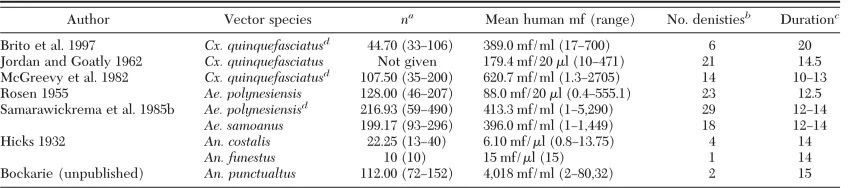
An extensive survey of the literature (using both electronic searches and manual tracing of references from publications obtained from the electronic search) showed seven experimental vectorÐhuman host blood feeding studies that Þtted the criteria for inclusion to our meta-analysis that they must report raw data on (1) the microÞlarial (mf) density of hu-man hosts on which mosquitoes were fed and (2) the subsequent survival of mosquitoes at the end of the extrinsic incubation period for each of the three main Þlariasis transmitting vectors (Table 1). Because of a lack of information regarding the intrinsic differences in the nature of infection caused byWuchereriaand
Brugiaworms in the mosquito, the analysis was re-stricted to studies in which onlyW. bancroftiinfected human volunteers were used. One additional unpub-lished study, carried out in Papua New Guinea (PNG) usingAnopheles punctulatus s.l.by one of the authors (Bockarie), was also included in the analysis because it contained data not only on the survival of mosqui-toes after the completion of the incubation period but also of survival over time during this period, which enabled a more robust longitudinal analysis of para-site-induced mortality for this genus in addition to that outlined above.
Variation in the methods used to estimate human mf density can cause signiÞcant problems when attempt-ing to compare Þlarial infection data from different studies (Snow and Michael 2002). To allow the use of the data from different sources in this study, it was thus necessary to carry out a standardization, Þrst to nu-merically standardize all measures of human mf
den-Table 1. Details of studies used in this analysis
Author Vector species na Mean human mf (range) No. denistiesb Durationc
Brito et al. 1997 Cx. quinquefasciatusd 44.70 (33Ð106) 389.0 mf/ml (17Ð700) 6 20 Jordan and Goatly 1962 Cx. quinquefasciatus Not given 179.4 mf/20l (10Ð471) 21 14.5 McGreevy et al. 1982 Cx. quinquefasciatusd 107.50 (35Ð200) 620.7 mf/ml (1.3Ð2705) 14 10Ð13 Rosen 1955 Ae. polynesiensis 128.00 (46Ð207) 88.0 mf/20l (0.4Ð555.1) 23 12.5 Samarawickrema et al. 1985b Ae. polynesiensisd 216.93 (59Ð490) 413.3 mf/ml (1Ð5,290) 29 12Ð14
Ae. samoanus 199.17 (93Ð296) 396.0 mf/ml (1Ð1,449) 18 12Ð14 Hicks 1932 An. costalis 22.25 (13Ð40) 6.10 mf/l (0.8Ð13.75) 4 14
An. funestus 10 (10) 15 mf/l (15) 1 14
Bockarie (unpublished) An. punctualtus 112.00 (72Ð152) 4,018 mf/ml (2Ð80,32) 2 15
aMean numbers plus ranges (in parentheses) of mosquitoes fed per mf density. bNo. of human mf densities studied.
cApproximate time from feeding to end of study.
sity into mf per 20l of peripheral blood and then to convert all human mf densities into expected values for the mean number of mf ingested by the mosqui-toes. The latter also enabled estimates of mortality based on mf intensity in the mosquito rather than human mf density, a more reliable estimate of mos-quito infection levels because of nonlinearitites in the relationship between the two (Snow and Michael 2002).
We used a logistic regression framework to study the relationship between the mean mf uptake and the proportion of mosquitoes alive at the end of the ex-trinsic incubation period. To effectively use data from all the available studies and to generalize the results beyond these studies, binomial logistic regression analyses were carried out by Þtting separate general-ized linear mixed-effects models (GLMMs) to the data from each of the three vector genera (Pinheiro and Bates 2000, Zuur et al. 2007). This method enables the estimation of both the overall genera-speciÞc rela-tionship in addition to study-speciÞc survival relation-ships within each genus. The GLMMs were Þtted by either deÞning the intercept, or both the slope and intercept, of a linear logistic regression model for the relationship between mean mf host density and vector survival, as random effects (and so allowing analysis of not only how the overall level of survival varies be-tween studies but also how the relationship with mf uptake intensity varies between studies within each genera [Pinheiro and Bates 2000]). Determining which of these terms required to be speciÞed as a random parameter was done by inspecting the varia-tion observed in the parameter values (intercepts and slopes) obtained by Þrst Þtting conventional linear logistic regressions to the data from each study (Pin-heiro and Bates 2000). Thus, for each genera, after the Þts of conventional linear logistic regression models relating vector survival to mf uptake, the study-spe-ciÞc 95% conÞdence intervals (CLs) of the intercepts
and slopes of these Þtted models were inspected to determine which of these parameters varied signiÞ-cantly between studies and thus required to be incor-porated into the GLMM as a random effect. Both the conventional linear logistic regression and the mixed-effects logistic regression GLMM models were Þtted using the Splus statistical software. The linear logistic regression model was Þt to the data using the gener-alized linear model (GLM) function in Splus, whereas the GLMM models were Þtted using the glmmPQL routine in the MASS library under a binomial family argument: this method relies on penalized quasi like-lihood, an approximation to maximum likelike-lihood, to Þt mixed effects regression models (Schall 1991, Breslow and Clayton 1993). Because of the scarcity of data on mosquito survival for anopheline mosquitoes, how-ever, only the linear logistic regression model was applied to examine the relationship between infection intensity and survival for this genus with the data from all studies pooled. In the additional study of M.J.B. (unpublished data), two groups ofAn. punctulatus
mosquitoes were fed on two individuals with known mf density (two mf/ml [0.05 mf/20l] and 8,032 mf/ml [207 mf/20l]) and daily mortality recorded for each of the groups for the following 15 d. The survival curves of the two groups were Þtted and compared by carrying out a log-rank test using the nonparametric survival analysis functions, survÞt and survdiff, available in Splus (Tableman and Kim 2004).
Results
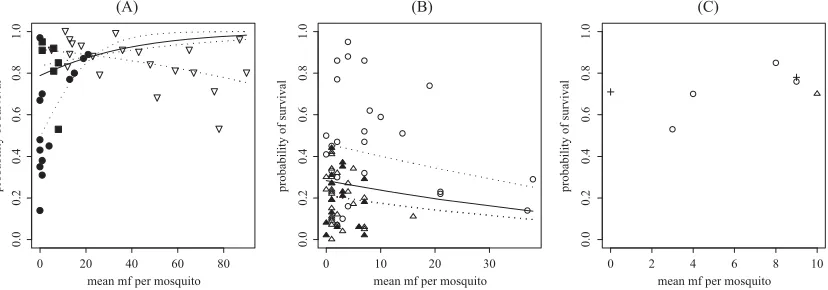
Details of the data from each of the studies used in this analysis are given in Table 1 and indicate that existing single studies on vector survival varied con-siderably with regard to both mosquito sample size and the range and levels of human mf density used in the survival experiments. Figure 1 shows the genera speciÞc scatterplots of the associations between
pre-mean mf per mosquito
probability of survival
0 20 40 60 80
0.0
0.2
0.4
0.6
0.8
1.0
mean mf per mosquito
probability of survival
0 10 20 30
0.0
0.2
0.4
0.6
0.8
1.0
mean mf per mosquito
probability of survival
0 2 4 6 8 10
0.0
0.2
0.4
0.6
0.8
1.0
) C ( )
B ( )
A (
dicted mean mf intake by the mosquitoes and the proportion of vectors that survived (data from each study denoted by a separate symbol). The plotted raw data show not only the overall patterns of mosquito survival with estimated mf intake intensities for each vector genus but also the considerable effect that between-study heterogeneities may exert on these patterns. They also highlight the striking paucity of the available data forAnopheles (Fig. 1C). The overall mean genera-speciÞc mortality was similar for Anoph-eles(24%) andCulex(27%) but seem to be signiÞ-cantly higher for the pooledAedesdata (71%).
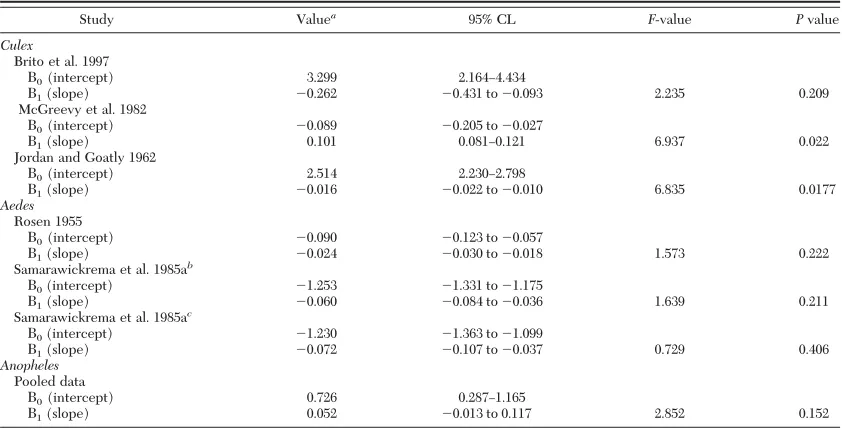
The results of the conventional logistic regression models used to study the effect of mf intensity on the survival rate of mosquitoes in each study are shown in Table 2. Estimated mean values and the 95% CLs of the intercept (0) and slope (1) parameters of the
lo-gistic linear regression model (with mf uptake as a single explanatory variable) are given for each study, along with thePvalues for theF-test when each full model is compared with the null model of no associ-ation between mf intensity and vector survival. It can be seen that in the case of the three studies usingAedes
mosquitoes, there seems to be no signiÞcant associa-tion between mf intensity and the proporassocia-tion of mos-quitoes that survive the incubation period (P⬎0.05 for all studies). This lack of a relationship together with the fact that the 95% CLs for the slope parameter (1) either overlap or are very close, in contrast to the
wide variation observed in the CL values of the in-tercept parameter (0), led us to specify only the
intercept as a random effect in the GLMM for this genus, thereby making the assumption that, while the pattern of the mf intensityÐvector survival association is the same for all these studies, the level of mosquito
survival may vary between studies. In contrast, the results for the three studies usingCulexmosquitoes were more variable, with two of the studies showing a signiÞcant association between mf intensity and mosquito survival (Table 2). Indeed, although the largest of these studies, that of Jordan and Goatly (1962), showed a signiÞcant reduction in mosquito survival with increasing parasite intensity, the much smaller study (in terms of the range of mf uptakes studied) of McGreevy et al. (1982) paradoxically showed the opposite, with vector survival appearing to increase with increasing infection levels (Fig. 1A). These observed between-study differences in the vec-tor survival relationship with parasitic infection inten-sity, and the lack of overlaps in the 95% CLs for both the parameters of each of the Þtted study-speciÞc linear logistic regressions, thus led us to incorporate both the intercept and slope as random effects in our GLMM for this genus. The analysis of the pooled
Anophelesdata showed mf intensity to have no signif-icant effect on vector survival (P⫽0.152); however, the paucity of the data for this genus makes drawing Þrm conclusions regarding the potential impact of infection intensity on vector survival difÞcult, and therefore we relied on the longitudinal analysis ofAn. punctulatussurvival described below to draw Þrmer conclusions regarding parasite-induced vector mor-tality for this genus.
Table 3 portrays the results of the mixed effects logistic regression analysis carried out on theCulex
andAedesdata using the glmmPQL routine described above, with model Þts shown in Fig. 1. The solid lines in the graphs correspond to the overall genus-speciÞc mf intensityÐvector survival relationship as estimated by the Þxed part of each of the mixed effects model
Table 2. Results of the generalized logistic linear model (GLM) fits to individual studies
Study Valuea 95% CL F-value Pvalue
Culex
Brito et al. 1997
〉0(intercept) 3.299 2.164Ð4.434
〉1(slope) ⫺0.262 ⫺0.431 to⫺0.093 2.235 0.209
McGreevy et al. 1982
〉0(intercept) ⫺0.089 ⫺0.205 to⫺0.027
〉1(slope) 0.101 0.081Ð0.121 6.937 0.022
Jordan and Goatly 1962
〉0(intercept) 2.514 2.230Ð2.798
〉1(slope) ⫺0.016 ⫺0.022 to⫺0.010 6.835 0.0177
Aedes Rosen 1955
〉0(intercept) ⫺0.090 ⫺0.123 to⫺0.057
〉1(slope) ⫺0.024 ⫺0.030 to⫺0.018 1.573 0.222
Samarawickrema et al. 1985ab
〉0(intercept) ⫺1.253 ⫺1.331 to⫺1.175
〉1(slope) ⫺0.060 ⫺0.084 to⫺0.036 1.639 0.211
Samarawickrema et al. 1985ac
〉0(intercept) ⫺1.230 ⫺1.363 to⫺1.099
〉1(slope) ⫺0.072 ⫺0.107 to⫺0.037 0.729 0.406
Anopheles Pooled data
〉0(intercept) 0.726 0.287Ð1.165
〉1(slope) 0.052 ⫺0.013 to 0.117 2.852 0.152
described in Table 3, whereas the dashed lines show the study-speciÞc Þxed effect relationships for each genus. The results forCulexclearly indicate a lack of a signiÞcant overall relationship between mf intensity and mosquito survival in the combined data (slope of the Þxed effects model component statistically insig-niÞcant,P⫽0.296; Table 3), most probably as a direct result of the marked variability observed for this re-lationship between individual studies (as highlighted by the dashed lines in Fig. 1A). Similarly, even when the slopes of the relationships between mf intensity and vector survival were held to be similar with only the levels of mortality assumed to vary between stud-ies for theAedesdata, the overall mean relationship for this genus was also not statistically signiÞcant (P⬎ 0.05; Table 3; Fig. 1B).
The second part of our analysis sought to supple-ment the modeling of theAnophelesdata described above and relied on unpublished data from feeding experiments carried out usingAn. punctualtuss.l. in
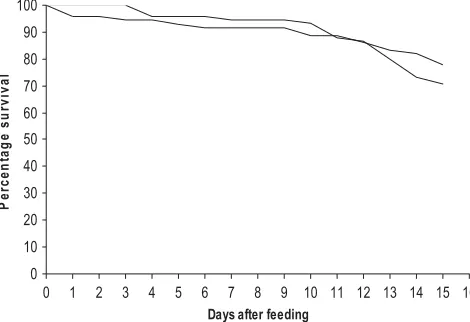
PNG. This study recorded daily survival for two batches of mosquitoes carrying high and low level infections respectively over the course of the extrinsic incubation period. Figure 2 shows the daily survival for both groups, with total mortality over the whole 15 d being 29% for the low infection group and 22% for the high. A log-rank test showed no signiÞcant differ-ence in survival between the two groups (2⫽0.8,P⫽
0.382), supporting the above Þndings forAnopheles
that higher loads of infection at least for the levels studied here do not cause increased mortality.
Discussion
The coevolution of parasites and their hosts is com-plex, but in general, natural selection would be ex-pected to favor a parasite that did not kill its host for at least for as long as it takes for the parasite to mature and achieve successful transmission. Our results, based on combining evidence across a range of similar
Table 3. Results of generalized linear mixed model (GLMM) fits toCulexandAedesmosquitoes with overall population (fixed effects) and study-specific estimates for each genus
Model Value 95% CL df t-value Pvalue
Culex
Random slope and intercept
〉0(intercept) 1.304 ⫺0.017 to 2.625 37 1.935 0.061
〉1(slope) 0.032 ⫺0.031 to 0.095 37 1.018 0.315
Study-speciÞc Þts 〉0(intercept) 〉1(slope)
Jordan and Goatly 1962 2.363 ⫺0.014
McGreevy et al. 1982 1.616 0.0177
Brito et al. 1997 ⫺0.034 0.087
Aedes
Random intercept
〉0(intercept) ⫺0.926 ⫺1.627 to⫺0.224 68 ⫺2.589 0.012
〉1(slope) ⫺0.024 ⫺0.053 to 0.005 68 ⫺1.588 0.117
Study-speciÞc Þts 〉0(intercept) 〉1(slope)
Rosen 1955 ⫺0.158 ⫺0.024
Samarawickrema et al. 1985a ⫺1.301 ⫺0.024 Ae. polynesiensis
Samarawickrema et al. 1985a ⫺1.320 ⫺0.024 Ae. samoanus
0 10 20 30 40 50 60 70 80 90 100
0 1 2 3 4 5 6 7 8 9 10 11 12 13 14 15 16
Days after feeding
P
e
rc
en
ta
g
e
su
rv
iv
al
studies, would thus seem, on the surface, to support this outcome in the case of the survival of mosquito hosts infected withW. bancrofti.However, it is per-tinent to note in this regard that for the studies using
Culexmosquitoes, the largest single study, in terms of both the number of data points and range of mf in-tensities investigated, showed a signiÞcant study-level positive association between mf intensity and mos-quito mortality (Jordan and Goatly 1962). Sama-rawickrema and Laurence (1978) also working with
Wuchereria-infectedCx. quinquefasciatusnoted a sim-ilar detrimental effect of infection on vector survival but only above intakes of 20 mf per mosquito. Jordan and Goatly (1962) is the only study to cover this range in the data included here, and hence their study result could be more representative of the true relationship for this mosquito genus. Further support thatCulex
requires additional investigation comes from a more recent study (Krishnamoorthy et al. 2004), in which
Cx. quinquefasciatuswere found to suffer 21% higher mortality after feeding on a microÞlaremic volunteer as opposed to an amicroÞlarmeic one, with excess mortality risk presumably related to the level of in-fection in the mosquitoes. The studies of McGreevy et al. (1982) and Brito et al. (1997) were also carried out using Cx. quinquefasciatus mosquitoes but covered much smaller ranges of mf intakes and showed con-trastingly a decrease in mortality over this range. This result is a paradox much discussed in previous papers (Brengues and Coz 1972, Pichon et al. 1980, Bryan and Southgate 1988), with one explanation suggested be-ing that this observed increase in survival of the in-fected vectors could be caused by inin-fected mosquitoes becoming less mobile (e.g., because of the effect of infection on ßight capability; Townson 1970) and hence causing themselves less injury in the cage than their lightly or uninfected counterparts (Brengues and Coz 1972, Pichon et al. 1980, Bryan and Southgate 1988). The inconsistency in the results forCulexcould thus be related to both experimental artifacts and between-study differences in the ranges of human mf densities studied (and hence mf uptakes); however, overall, the results suggest that, in this genus at least, the detrimental effect of infection if or when it occurs may be manifest only at the highest mf intakes.
The situation for the other two vectors is less clear. The comparison of overall mosquito survival over the entire incubation period suggests that, on the whole,
Aedesmosquitoes suffer a much higher level of mor-tality (71%) over all mf intensities compared with eitherAnopheles(24%) andCulex(27%). This sup-ports other Þndings (Rosen 1955), in which this excess mortality inAedeswas attributed to the higher num-bers of infective third-stage larvae (L3) developing within these vectors. We have previously shown that the maximum numbers of L3 developing inCulexand
Anophelesare much lower than inAedesas a result of stronger regulation of mf uptake and L3 development in the former mosquitoes (⬇5 versus 20 L3; Snow et al. 2006), indicating that the higher levels of mosquito mortality observed in theAedesmosquitoes may be caused by a greater development or migration of
lar-vae through the hemocele in this mosquito. However, an intriguing Þnding from our study is that the higher mortality of infectedAedesmosquitoes occurred over mf intensity ranges that did not produce a similar mortality rate inCulexandAnopheles(Fig. 1), sug-gesting that it is unlikely that the higher mortality of these mosquitoes is related to infection intensity per se. Instead, this outcome may represent either a higher natural or experimentally induced susceptibility of these mosquitoes to carrying Þlarial infection. This is further supported by the fact that there seems to be little evidence of density dependence in the observed mortality in these mosquitoes with increasing infec-tion intensity, although the data on survival for this genus is also only available up to 40 mf per host, the same burden at which detrimental effects inCulex
appear.
A major limitation as far as the analysis forAnopheles
is concerned is the lack of available published data making conclusions regarding infection-induced mor-tality difÞcult presently for this genus. Thus, our Þnd-ing of no association between infection intensity and mortality could imply that the severe regulation in mf intake and hence restricted development of L3 seen in this genus may mean that fewer larvae are likely to be present in the mosquito to cause excess motality (Pi-chon 1974, Southgate and Bryan 1992, Snow and Mi-chael 2002) or that this outcome may be an artifact of severely limited data.
Although mixed effects meta-analytical frameworks as used here may clearly provide a powerful tool for resolving questions not fully evident from single smaller studies, by essentially facilitating the combi-nation of data appropriately from separate studies and thereby increasing analytical power to detect ecolog-ical relationships (Michael et al. 1994, Anrnqvist and Wooster 1995, Meyers and Mertz 1998, Snow and Michael 2002, Snow et al. 2006), our results support the view that the success of this approach is ultimately related to the quality of the data in primary studies (Osenberg et al. 1999). A major problem in this regard in this study was clearly the lack of large published datasets exploring parasite-induced mosquito mortal-ity, particularly with respect toAnopheles.In addition, we showed that smaller studies are likely to describe only a small part of the entire relationship, and in particular, we highlight how the restricted ranges ofx
variables (here mf uptake intensities) typically cov-ered by such experiments (McGreevy et al. 1982, Brito et al. 1997) may contribute to wide variations in study-speciÞc survival for the same genus and even species (e.g., opposing relationships forCx. quinquefasciatus). These Þndings show that future studies must use suf-Þciently large sample sizes and address vector survival particularly at higher mf intakes if we are to clarify and conÞrm the Þnding in this study that detrimental ef-fects of Þlarial infection on mosquito survival may occur only at the higher infection intensities that may arise in Þlarial vectors.
corresponding effects of infection under natural trans-mission settings. Laboratory experiments ignore many indirect costs of infection, such as reduced ßight ca-pability (Townson 1970) or reduced feeding ability (Molyneux and Jeffries 1986). Furthermore, labora-tory studies often use unnatural vectorÐparasite cou-ples, or laboratory colonies, removing any evolution-ary resistance to the detrimental effects of infection that mosquitoes may have evolved to local parasites. Thus, infective rates seen in the laboratory may be far higher than those seen in Þeld studies (Pichon 2002). However, although Þeld studies may provide a more realistic estimate of mortality rates under natural con-ditions, there are also a number of limitations involved in the investigation of this question using wild mos-quitoes. First, it is difÞcult to distinguish between parasite mortality versus mosquito mortality because of the added effect of age, because the operations of all of these three variables will manifest as a reduction in the numbers of infected mosquitoes, although using uninfected age-matched controls will mitigate against this problem to a signiÞcant extent. Second, there is no way of accurately estimating the density of mf in the blood of the human host on which mosquitoes fed, leading to estimates of infection levels in investigated mosquitoes to be based either on mean mf levels in the human populations or means in sampled, wild caught mosquitoes. Furthermore, factors such as multiple Þ-larial infections (Samarawickrema 1967, Krafsur and Garrett-Jones 1977), climatic factors, and co-infection with malaria parasites (inAnopheles) could have com-peting detrimental effects on survival (Gad et al. 1979, Ferguson and Read 2002a), and hence confound any survival analysis. Note also that most experimental studies typically investigate vector mortality either only over or at the end of a single extrinsic incubation period. Thus, although these experiments provide in-formation on the effect of parasite-induced vector mortality on the level of transmission from a single transmission cycle arising from mf uptake to output of L3, they provide little data on any effects that infection may have on the long-term survival rate of infected mosquitoes.
The importance of the Þnding of a lack of an in-fection effect on mosquito survival, not only forW. bancroftibut perhaps also in the case ofPlasmodium
(Ferguson and Read 2002b), is that it implies that interventions against both parasites are unlikely to result in enhanced parasite transmission as a result of increased vector host survival as infection intensity falls. In the case ofAnopheles, it also suggests that reduction in levels of one parasite will not enhance the transmission of the other. If true, these results will clearly increase the prospects of parasite control. However, this study has highlighted how the existence of between-study heterogeneities in methodology and experimental conditions can severely confound the outcomes of experiments aiming to investigate this topic. Future studies must not only be based on well-designed studies that use standardized methods and cover relevant mf intake ranges, but must crucially also develop and apply frameworks that allow the
design and interpretation of data from comparable Þeld and laboratory studies, if we are to reliably quan-tify the effects of parasitic infection on vector mor-tality.
Acknowledgments
The authors thank the Medical Research Council, United Kingdom, for studentship support of L.S. E.M. gratefully acknowledges the Þnancial support of U.S. Public Health Service NIH Grant R01 AI69387Ð01A1 for facilitating this work. M.J.B. is thankful for the Þnancial support of U.S. Public Health Service NIH ICIDR Grant U19 AI33061 during the writing of this manuscript.
References Cited
Anrnqvist, G., and D. Wooster. 1995. Meta-analysisÑsyn-thesizing research Þndings in ecology and evolution. Trends Ecol. Evol. 10: 236Ð240.
Brengues, J., and J. Coz. 1972.Receptivite comparee de trois especes du complexAnopheles gambiaeGiles presentes en Afrique de lÕOuest, vis-a-vis deWuchereria bancrofti Cobbold. Cahiers ORSTOM Ser. Entomol. Med. Parasitol. 10: 207Ð215.
Breslow, N. E., and D. G. Clayton. 1993. Approximate in-ference in generalized linear mixed models. J. Am. Stat. Assoc. 88: 9Ð25.
Brito, A. C., P. Williams, G. Fontes, and E.M.M. Rocha. 1997. A comparison of two Brazilian populations ofCulex quin-quefasciatus(Say, 1823) from endemic and non-endemic areas to infection withWuchereria bancrofti(Cobbold 1877). Mem. Inst. Oswaldo Cruz 92: 33Ð36.
Bryan, J. H., and B. A. Southgate. 1988.Factors affecting the transmission ofWuchereria bancroftiby anopheline mos-quitoes. 2. Damage to ingested microÞlariae by mosquito foregut armatures and development of Þlarial larvae in mosquitoes. Trans. R. Soc. Trop. Med. Hyg. 82: 138Ð145. Bryan, J. H., P. Oothman, B. J. Andrews, and P. B. McGreevy. 1976.Effects of pharyngeal armature of mosquitoes on microÞlariae ofBrugia pahangi.Trans. R. Soc. Trop. Med. Hyg. 68: 14.
Burkot, T. R., D. N. Durrheim, W. D. Metrose, R. Speare, and K. Ichimori. 2006.The argument for integrating vector control with multiple drug administration campaigns to ensure elimination of lymphatic Þlariasis. Filaria J. 5: 1Ð7. Crans, J. W. 1973.Experimental infection ofAnopheles gam-biaeandCulex pipiens fatiganswithWuchereria bancrofti in coastal east Africa. J. Med. Entomol. 10: 189Ð193. Das, P. K., S. Subramanian, A. Manoharan, K. D. Ramaiah, P.
Vanamail, B. T. Grenfell, D.A.P. Bundy, and E. Michael. 1995.Frequency distribution ofWuchereria bancrofti in-fection in the vector host in relation to human host: evidence for density dependence. Acta Trop. 60: 159Ð165. Dye, C. 1986. Vectorial capacity: must we measure all its
components? Parasitol. Today 2: 203Ð209.
Dye, C. 1992.The analysis of parasite transmission by blood-sucking insects. Annu. Rev. Entomol. 37: 1Ð19. Ellrot, D. 1987.The effect of different microÞlarial
densi-ties ofBrugia malayiinMastomys natalensison the mor-tality of the vectorAedes aegpti.Trop. Med. Parasitol. 38: 344.
Ferguson, H. M., and A. F. Read. 2002a. Genetic and envi-ronmental determinants of malaria parasite virulence in mosquitoes. Proc. R. Soc. Lond. Ser. B. 269: 1217Ð1224. Ferguson, H. M., and A. F. Read. 2002b.Why is the effect of
malaria parasites on mosquito survival still unresolved? Trends Parasitol. 18: 256Ð261.
Gad, A. M., W. A. Maier, and G. Piekarski. 1979.Pathology ofAnopheles stephensiafter infection withPlasmodium berghei.Zietschrift Parasitenkunde 60: 249Ð261. Hicks, E. P. 1932.The transmission ofWuchereria bancrofti
in Sierra Leone. Ann. Trop. Med. Parasitol. 26: 407Ð422. Jordan, P., and K. D. Goatly. 1962. Bancroftian Þlariasis in Tanganyika: a quantative study of the uptake, fate and development of microÞlariae ofWuchereria bancroftiin Culex fatigans.Ann. Trop. Med. Parasitol. 56: 173Ð187. Krafsur, E. S., and C. Garrett-Jones. 1977. The survival in
nature ofWuchereria-infectedAnopheles funestusGiles in north-eastern Tanzania. Trans. R. Soc. Trop. Med. Hyg. 71: 155Ð160.
Krishnamoorthy, K., S. Subramanian, G. J. van Oortmarssen, J.D.F. Habbema, and P. K. Das. 2004.Vector survival and parasite infection: the effect ofWuchereria bancrofti on its vectorCulex quinquefasciatus.Parasitology 129: 1Ð8. Laurence, B. R. 1963.Natural mortality in two Þlarial
vec-tors. Bull W.H.O. 28: 229Ð234.
Lindsay, S. W., and D. A. Denham. 1986.The ability ofAe. aegyptimosquitoes to survive and transmit infective lar-vae ofBrugia pahangiover successive blood meals J. Hel-minthol. 60: 159Ð168.
Manga, L. 2002.Vector-control synergies between Ôroll back malariaÕ and the Global Programme to Eliminate Lymphatic Filariasis in the African region. Ann. Trop. Med. Parasitol. 96: S129ÐS132.
McGreevy, P. B., N. Kolstrup, J. Tao, M. M. McGreevy, and T. F. Marshall. 1982.Ingestion and development of Wuchereria bancroftiinCulex quinquefasciatus, Anopheles gambiaeandAedes aegptiafter feeding on humans with varying densities of microÞlariae in Tanzania. Trans. R. Soc. Trop. Med. Hyg. 76: 288Ð296.
Meyers, R. A., and G. Mertz. 1998.Reducing uncertainty in the bilogical basis of Þsheries management by meta-anal-ysis of data from many populations: a synthesis. Fisheries Res. 37: 51Ð60.
Michael, E., B. T. Grenfell, and D.A.P. Bundy. 1994.The association between microÞlaraemia and disease in lym-phatic Þlariasis. Proc. R. Soc. Lond. Ser. B 256: 33Ð40. Molyneux, D. H., and D. Jeffries. 1986.Feeding behaviour
of pathogen infected vectors. Parasitology 92: 721Ð736. Osenberg, C. W., O. Sarnelle, S. D. Cooper, and R. D. Holt.
1999.Resolving ecological questions through meta-anal-ysis: goals, metrics and models. Ecology 80: 1105Ð1117. Pichon, G. 1974.Relations mathematiques entre le nombre
des microÞlares ingerees et le nombre des parasites chez differents vecteurs naturels ou experimentaux de Þlari-oses. Cahiers ORSTOM Ser. Entomol. Med. Parasitol. 4: 199Ð216.
Pichon, G. 2002. Limitation and facilitation in the vectors and other aspects of the dynamics of Þlarial transmission: the need for vector control againstAnopheles-transmitted Þlariasis. Ann. Trop. Med. Parasitol. 96: S143ÐS152. Pichon, G., J. Prodhon, and F. Riviere. 1980.Filarioses:
surdispersion parasitaire et surinfection de lÕhote
inver-tebre. Cahiers ORSTOM Ser. Entomol. Med. Parasitol. 18: 27Ð47.
Pinheiro, J. C., and D. M. Bates. 2000. Mixed-effects models in S and S-PLUS. Springer, New York.
Rosen, L. 1955.Observations on the epidemiology of human Þlariasis in French Oceania. Am. J. Hyg. 61: 219Ð248. Samarawickrema, W. A. 1967.A study of the
age-composi-tion of natural populaage-composi-tions ofCulex pipiens fatigans Wied-erman in relation to the transmission of Þlariasis due to Wuchereria bancroft(Cobbold) in Ceylon. Bull. W.H.O. 37: 117Ð137.
Samarawickrema, W. A., and B. R. Laurence. 1978.Loss of Þlarial larvae in a natural mosquito population. Ann. Trop. Med. Parasitol. 72: 561Ð565.
Samarawickrema, W. A., G.F.S. Spears, F. Sone, K. Ichimori, and R. F. Cummings. 1985a.Filariasis transmission in Samoa. I. Relation between density of microÞlariae and larval density in laboratory-bred and wild-caughtAedes (Stegomyia) polymesiensis (Marks) and wild-caught Aedes(Finlaya)samoanus(Gruenberg) Ann. Trop. Med. Parasitol. 79: 89Ð100.
Samarawickrema, W. A., G.F.S. Spears, F. Sone, K. Ichimori, and R. F. Cummings. 1985b.Filariasis transmission in Samoa. II. Some factors related to the development of microÞlariae in the intermediate host. Ann. Trop. Med. Parasitol. 79: 101Ð107.
Schall, R. 1991.Estimation in generalised linear models with random effects. Biometrika 78: 719Ð727.
Snow, L. C., and E. Michael. 2002.Transmission dynamics of lymphatic Þlariasis: density-dependence in the uptake ofWuchereria bancroftimicroÞlariae by vector mosqui-toes. Med. Vet. Entomol. 16: 409Ð423.
Snow, L. C., M. J. Bockarie, and E. Michael. 2006. Trans-mission dynamics of lymphatic Þlariasis: vector-speciÞc density dependence in the development ofWuchereria bancroftiinfective larvae in mosquitoes. Med. Vet. Ento-mol. 20: 261Ð272.
Southgate, B. A., and J. H. Bryan. 1992. Factors affecting transmission ofWuchereria bancroftiby anopheline mos-quitoes. 4. Facilitation, limitation, proportionality and their epidemiological signiÞcance. Trans. R. Soc. Trop. Med. Hyg. 86: 523Ð530.
Tableman, M., and J. S. Kim. 2004.Survival analysis using S. Analysis of time-to-event data. Chapman & Hall/CRC, Boca Raton, FL.
Townson, H. 1970. The effect of infection withBrugia pa-hangion the ßight ofAe. aegpti.Ann. Trop. Med. Parasitol. 64: 411Ð420.
Wharton, R. H. 1957a.Studies on Þlariasis in Malaya: ob-servations on the development ofWuchereria malayiin Mansonia(Mansonioides)longipalpis.Ann. Trop. Med. Parasitol. 51: 278Ð296.
Wharton, R. H. 1957b.Studies on Þlariasis in Malaya: the efÞciency ofMansonia longipalpisas an experimental vec-tor ofWuchereria malayi.Ann. Trop. Med. Parasitol. 51: 422Ð439.
Zuur, A. F., E. N. Ieno, and G. M. Smith. 2007.Analysing ecological data. Springer, New York.