Volume 2006, Article ID 62052, Pages1–17 DOI 10.1155/ASP/2006/62052
Space-Time Joint Interference Cancellation Using
Fuzzy-Inference-Based Adaptive Filtering
Techniques in Frequency-Selective
Multipath Channels
Chia-Chang Hu,1Hsuan-Yu Lin,1Yu-Fan Chen,2and Jyh-Horng Wen1, 3
1Department of Electrical Engineering, National Chung Cheng University, Min-Hsiung, Chia-Yi 621, Taiwan 2Department of Communications Engineering, National Chung Cheng University, Min-Hsiung, Chia-Yi 621, Taiwan 3Institute of Communication Engineering, National Chi Nan University, Puli, Nantou 545, Taiwan
Received 7 March 2005; Revised 29 May 2005; Accepted 19 July 2005
Recommended for Publication by Helmut Bolcskei
An adaptive minimum mean-square error (MMSE) array receiver based on the fuzzy-logic recursive least-squares (RLS) algorithm is developed for asynchronous DS-CDMA interference suppression in the presence of frequency-selective multipath fading. This receiver employs a fuzzy-logic control mechanism to perform the nonlinear mapping of the squared error and squared error variation, denoted by (e2,Δe2), into a forgetting factorλ. For the real-time applicability, a computationally efficient version of
the proposed receiver is derived based on the least-mean-square (LMS) algorithm using the fuzzy-inference-controlled step-size μ. This receiver is capable of providing both fast convergence/tracking capability as well as small steady-state misadjustment as compared with conventional LMS- and RLS-based MMSE DS-CDMA receivers. Simulations show that the fuzzy-logic LMS and RLS algorithms outperform, respectively, other variable step-size LMS (VSS-LMS) and variable forgetting factor RLS (VFF-RLS) algorithms at least 3 dB and 1.5 dB in bit-error-rate (BER) for multipath fading channels.
Copyright © 2006 Hindawi Publishing Corporation. All rights reserved.
1. INTRODUCTION
Direct-sequence code-division multiple access (DS-CDMA), a specific form of spread-spectrum transmission, has been adopted as the multiaccess technology for nonorthogonal transmission in the third-generation (3G) mobile cellular systems, such as wideband CDMA (W-CDMA) or multi-carrier CDMA (MC-CDMA). This sort of the code-division multiaccess techniques requires no time or frequency coor-dination among the mobile stations. However, the so-called near-far problem and the multipath fading are the major impediments to maintain reliable communication links in CDMA systems.
It is well known that an adaptive minimum mean-square error (MMSE) linear receiver [1] has immunity to the near-far problem and the interference floor in performance exhib-ited by the conventional matched filter reception. In addi-tion, a linear MMSE receiver can be implemented as an adap-tive tapped delay line (TDL), analogous to a linear equalizer, with a relatively low complexity. However, the computation
of the MMSE solution involves the calculation of the inverse of the input autocorrelation matrix, which costs a complex-ity ofO((MN)3). HereMdenotes the size of the MMSE
re-ceiving array andNis the processing gain of the CDMA sys-tem so thatMN indicates the number of tap weights of the linear MMSE filter. This cost is even more expensive when the linear MMSE receiver operates in a nonstationary mul-tipath environment. In practice, the filter-coefficient vector of the MMSE-type receiver can be obtained from the train-ing sequence and the received signal by means of conven-tional adaptive filtering techniques, such as the least-mean-square (LMS) [2] and the recursive least-squares (RLS) [3] approaches. The LMS provides simple implementation but suffers from slow convergence, while, on the other hand, the RLS converges much faster as compared with the LMS, but it possesses more computational complexity. The drawback of slow convergence of an LMS-based algorithm, due to its de-pendence on the eigenvalue spread, is overcome in an RLS algorithm [3] by replacing the gradient step-size μwith a gain matrix, denoted byR−1
Honig et al. proposed an adaptive blind LMS implementa-tion of the MMSE-type receiver based on the concept of the constrained minimum output energy (CMOE) for multiuser detection. An adaptive blind RLS version of the MMSE re-ceiver was presented in [5] by Poor and Wang In [5], the pro-posed rotation-based QR-RLS algorithms for both the blind adaptation mode and the decision-directed adaptation mode were developed and implemented efficiently.
In recent years, the concept of fuzzy logic is used in many different senses. Fuzzy logic can be treated as a tool for embedding structured human knowledge into workable algorithms. In a wider sense, fuzzy logic is a fuzzy set the-ory of classes with unsharp or fuzzy boundaries. Systems designed and developed utilizing fuzzy-logic methods have been shown to be more efficient than those based on conven-tional approaches [6]. Notably, a fuzzy-logic controller (FLC) has been applied successfully to the fuzzy-neural scheme for on-line system identification [7] and the strength-based power control strategy in wireless multimedia cellular sys-tems [8,9]. In principle, FLC provides an adaptation mech-anism that converts the linguistic control strategy based on the characteristics of mobile radio channels into an adaptive parameter-control strategy. By using the defuzzification, the fuzzy control decisions are converted to a crisp control com-mand which is used to adjust properly the level of the param-eter of interest. To improve the FLC performance, the use of a fuzzy proportional-plus-integral (PI) control is addressed in [10].
In the present paper, an adaptive robust MMSE array-receiver is proposed based on a fuzzy-logic controlled LMS or RLS algorithm for space-time joint asynchronous DS-CDMA signals. The FLC system is employed to perform the non-linear mapping of the input variables into a scalar adapta-tion step-size μof the LMS algorithm or a forgetting fac-torλof the RLS algorithm in response to the channel vari-ation. Note that the input variables of the FLC system may include the error signal, duration of training, squared error, input power, and any other useful variables. Owing to the flexibility and richness of the fuzzy-inference control system, it may produce many different mappings that are especially suitable for applications in nonlinear and time-varying cel-lular systems. In [11], the behavior of different adaptive LMS algorithms with the fuzzy step size is analyzed. Experimental results show that the fuzzy step-size LMS (FSS-LMS) algo-rithms proposed by the author in [11] possess superior con-vergence characteristics than other existing variable step-size LMS (VSS-LMS) approaches [12,13]. In particular, the per-formance of the FSS-LMS system with two inputs ofe2and
NT is noticeable, wheree2 is the squared error andNT
de-notes the duration of training. Unfortunately, the quantity of NT may not be attainable to the category of adaptive
blind-based receivers. In [14], the authors proposed the variable forgetting factor linear least-squares (VFF-LLS) algorithm to improve the tracking capability of channel estimation. These works motivate the development of the linear MMSE CDMA receiver with a fuzzy-logic controlled two-parameter system of (e2,Δe2) instead of (e2,N
T), whereΔe2[n]=|e2[n]−e2[n−
1]|indicates the squared error variation at timen. In other
words, the pair values of (e2,Δe2) are calculated and fed to
the FLC system to assign an exact value ofμorλfor the cor-responding adaptive receiver on an iterative basis in order to improve the convergence characteristic and steady-state MSE simultaneously. Most of the fuzzy inference rules are derived by a human expert or extracted from numerical data. In this paper, we focus attention on the fuzzy rules which ac-cumulate past experience operating in the practical applica-tions. Therefore, it seems natural and reasonable to expect that wireless communication systems with the use of a two-parameter (e2,Δe2)-FLC produce better convergence
char-acteristics than those with only single-parameter (e2)-FLC.
Furthermore, the pair of (e2,Δe2) provides the FLC system
with more precise channel dynamic-tracking and adaptation capability than the pair of (e2,N
T). This is because the
“aux-iliary” parameter Δe2 offers an effective and robust means
to monitor instantaneous fluctuations of a fast-fading mul-tipath channel and assists the FLC system in selecting an ap-propriate value forμorλ. It is remarkable that the proposed FLC-based approaches produce a faster speed of convergence without trading offthe steady-state performance.
Computational requirements of the proposed fuzzy-logic-controlled LMS and RLS algorithms of the MMSE re-ceiver, abbreviated as FLC-LMS and FLC-RLS hereafter, are evaluated in this paper. Slightly additional computational load is incurred in the fuzzification (table lookup), inference (MIN, MAX, and PROD operators), and defuzzification pro-cesses. There is also additional cost which comes from the preparation of the two input variables, (e2,Δe2), prior to
the fuzzification process. Fortunately, these operations can be done very efficiently in the latest range of DSPs which pro-vide single-cycle multiply and add, table lookup, and com-parison instructions. The computational load is compared to other known MMSE CDMA algorithms as well.
The material included in this paper is organized as fol-lows. InSection 2, an asynchronous DS-CDMA signal model is outlined. For demodulation, an adaptive linear MMSE ar-ray receiver is employed and implemented by the fuzzy-logic controlled LMS and RLS algorithms. The proposed MMSE CDMA receiver is developed in Section 3. Section 3.1 de-scribes briefly the ideal MMSE solution for DS-CDMA inter-ference suppression. InSection 3.2, the LMS and FLC-RLS algorithms of the MMSE CDMA receiver are derived in detail.Section 3.3presents the analysis to compare the com-putational load of the proposed algorithms with other equiv-alent DS-CDMA schemes. InSection 4, a brief review of ex-isting VSS-LMS and VFF-RLS algorithms is provided. The convergence/tracking capability and the steady-state perfor-mance of the proposed MMSE receiver under the frequency-selective multipath fading channel is analyzed inSection 5. Finally, concluding remarks are given inSection 6.
2. SIGNAL MODEL
An asynchronous DS-CDMA system operating over a dy-namic fading multipath channel is considered. The transmit-ted baseband signalrl(t) for userlis obtained by spreading a
equiprobable±1 random variables, onto a spreading wave-formsl(t). That is,
rl(t)=
∞
i=−∞
Eldl[i]sl
t−iTb
, (1)
whereEl denotes bit energy of userl. The spreading
wave-formsl(t) is generated by modulating a spreading sequence
cl,k ∈ {−1, 1},k=0, 1,. . .,N−1, of lengthNwith a train
of rectangular chip waveforms,ψ(t), of durationTc=Tb/N,
that is,
sl(t)= N−1
k=0
cl,kψ
t−kTc
, t∈0,Tb
, (2)
whereTbis the bit interval. In [15], a multipath fading
chan-nel of userlcan be described by its baseband complex im-pulse response
hl(t)= Kl
j=1
al jδ
t−τl j
, (3)
where Kl denotes the total number of distinct, resolvable,
propagation paths of userl. In this paper,Kl is set equally
for all users. Here δ(·) denotes the Dirac delta function, al j is the complex channel fading coefficient, andτl j is the
propagation delay, which are associated with the jth propa-gation path of userl. To model frequency-selective fading, multipath components are assumed to fade independently [16]. The discretized sequence of channel coefficients for the lth user is a complex Gaussian random process obtained by passing complex white Gaussian noise through a filter with transfer functionκ/1−(f / fD)2, whereκ=1/π fD is a
nor-malization constant, fD = v/λ is the maximum Doppler
frequency, andv is the user’s vehicle speed. In general, the value of the normalized fading rate, fDTb, that is, the
prod-uct of the Doppler frequency and the symbol period, deter-mines the degree of signal fading. For slowly fading chan-nels, fDTb1. In other words, the transmitted signal of the
lth user is distorted by a frequency-selective multipath chan-nel, modeled in discrete time by anKl-tap tapped delay line
(TDL) whose coefficients are represented byhl[n]=[hl1[n],
hl2[n],. . .,hlKl[n]], whereKlis known as the delay spread of
the channel. The multipath spread of the channel is assumed to be less than one symbol period in this paper. The chan-nel coefficients of userl,hl j[n], j = 1, 2,. . .,Kl, are
inde-pendent random variables with Rayleigh distribution. Inde-pendent fading on each path implies thathl j[n] andhlk[n],
j=k, are independent for alln.
After multipath fading channel “processing,” the total re-ceived signal at the receiver is a superposition of propagated signals from allK users and the background channel noise. The received signalr(t) can be written as
r(t) =
K
l=1
rl(t) +n(t),
=
K
l=1
El Kl
j=1
al jbl j
∞
i=−∞ dl[i]sl
t−iTb−τl j
+n(t),
(4)
wheren(t) is an additive white Gaussian noise (AWGN) vec-tor. TheM×1 linear array response vectorbl jfor thejth path
of thelth user’s signal is defined bybml j =ej2π(m−1)(d/λ) sinθl j,
m = 1, 2,. . .,M, where λ is the carrier wavelength,d de-notes the element spacing of the antenna, andθl j identifies
the angle of arrival (AOA). In addition, it is assumed that all channels are constant during each symbol period and the re-ceiver’s clock is synchronized with the reception of the first path of the desired user, say of user 1, that is,τ11 = 0 [17].
Note that the term asynchronous means that the timings of signals and multipaths from different users received by the base station in either intracell or intercell are not the same. In other words, the propagation delays associated with the propagation paths of different users are considered in this pa-per.
3. RECEIVER ARCHITECTURE
For convenience, the proposed receiver is described by means of a baseband-equivalent structure. The received signal of each individual antenna element is passed through a filter that is matched to the square-wave chip waveform. Ifrm(t)
is themth component ofr(t) in (4), the output of themth antenna element is
zm(t)=
t
−∞ψ(t−t )r
m(t)dt=
Tc
0 rm(t−u)du, (5)
form = 1, 2,. . .,M. Subsequently, the output of this chip matched filter (MF) is sampled at the chip rate 1/Tcover the
multipath extended (N +Kl−1)-chip period for one-shot
data detection. These discrete-time outputs are used as the inputs ofMadaptive, (N+Kl−1)-element TDLs with a tap
spacing ofTcto formMsuch (N+Kl−1)-element data
vec-tors. Assume that the output signals of the chip MFs are sam-pled at the timesnTc. The TDLs for theM-element antenna
array are expressed as anM×(N+Kl−1) data array, given
by
Z[n]
= ⎡ ⎢ ⎢ ⎢ ⎢ ⎢ ⎢ ⎢ ⎣ z1 nTc z1
(n−1)Tc
· · · z1
n−N−Kl+2
Tc z2 nTc z2
(n−1)Tc
· · · z2
n−N−Kl+2
Tc .. . ... . .. ... zM nTc zM
(n−1)Tc
· · · zM
n−N−Kl+2
Tc ⎤ ⎥ ⎥ ⎥ ⎥ ⎥ ⎥ ⎥ ⎦ . (6)
The data matrixZ[n] is then “vectorized” by sequencing all matrix rows to form theM(N+Kl−1) vector as follows:
x[n]=VecZ[n]=
x1[n],x2[n],. . .,xMN+Kl−1[n] T
. (7)
The symbol (·)T denotes matrix transpose. The vector x[n] in (7) denotes the joint space-time data of the
CM×(N+Kl−1) complex vector domain, and thex
i[n] fori =
1, 2,. . .,M(N+Kl−1) are the data components of the
weight vector of a filter for vectorx[n] is expressed as the column vector,
w[n]=
w1[n],w2[n],. . .,wMN+Kl−1[n] T
. (8)
The components of the weight vectorw[n]∈CM(N+Kl−1)×1
are adapted to minimize the MSE at the output of the TDLs (i.e., an MMSE-type filter coefficients) and determined ex-plicitly later in (16) and (21). The output of the tapped delay-line adaptive filter forx[n] is the inner product of the vectors in (7) and (8) as follows:
y[n]=w†[n]x[n]=
M(N+Kl−1)
i=1
wi∗[n]xi[n], (9)
where the superscripts (·)† and (·)∗ denote the conjugate transpose (Hermitian) of a matrix and the conjugate of a complex number, respectively.
3.1. MMSE demodulator
In [1], the minimum mean-square error (MMSE) linear equalizer for asynchronous CDMA systems was first pro-posed by Xie et al. as a nonadaptive receiver. This was fol-lowed by various adaptive recursive implementations which operated in a decision-directed (DD) mode [18–20]. Later it was shown in [4] that the linear MMSE receiver can be op-erated in a blind adaptation manner which obviates the ne-cessity of training. The MMSE receiver often is employed to detect the desired information symbol, owing to its simple implementation and excellent performance. Letx[n] denote the observation vector obtained at time clockn. The linear MMSE receiver has the form
d1[n]=sgn
Rew†[n]x[n], (10)
where sgn denotes the sign operator, Re{·} takes the real part, andx[n] is given by (7). The weight vector w[n] ∈ CM(N+Kl−1)×1is chosen to minimize the MSE,
MSE[n]=Ee[n]2, (11)
where the output error e[n] between the decision statistic and the transmitted symbol is expressed by
e[n]=d1[n]−y[n]=d1[n]−w†[n]x[n]. (12)
It is easy to show that the ideal MMSE solution of the weight vectorw[n] is given by the vector
wMMSE[n]=E
x[n]x†[n]−1Ed∗1[n]x[n]
=R−x1[n]p1[n],
(13)
where Rx[n] = E{x[n]x†[n]}and p1[n] = E{d1∗[n]x[n]}
are the input autocorrelation matrix and the steering vector, that is, the result of correlating the desired bit with the obser-vation vectors, respectively. The notationE{·}denotes the
expected-value operator. The MSE achieved by the MMSE solution in (13) is given by
MMSE[n]=min
w[n]MSE[n]=1−p †
1[n]R−x1[n]p1[n]
=1−w†MMSE[n]p1[n].
(14)
Then the estimate of the information symbol d1[n] is
ob-tained from the expression
d1[n]=sgn
Rep†1[n]Rx−1[n]x[n]
. (15)
In practice, an adaptive linear MMSE demodulator is usually achieved by means of training with respect to a known train-ing or pilot sequence{d1[k]}NTk=1of lengthNT, followed by a
DD adaptation utilizing the estimate symbold1as the
feed-back information for better adaptation. The adaptive imple-mentation can be realized using a variety of well-known al-gorithms, for example, stochastic gradient (SG), least squares (LS), and recursive least-squares (RLS). In this paper, the adaptive implementations of the LMS and the RLS for the proposed MMSE demodulator are described in detail as fol-lows:
LMS adaptation
An adaptive LMS-type filter calculates the estimates of the receiver tap-weight vector by minimizing the MSE in (11), that is,E{|d1[n]−w†[n]x[n]|2}. The tap-weight estimate at
the (n+ 1)th iteration using information available up to the iterationnis
w[n+ 1]=w[n] +μd1∗[n]−x†[n]w[n]
x[n], (16)
where the positive scalar μ denotes the step size of the LMS algorithm, which depends on the statistics of the ob-servation vector x[n]. For stability, μ needs to be implic-itly bounded in magnitude by the values of its minimum (μmin = 0 or the smallest possible value) and maximum
(μmax=mink(2/|αk|), whereαkstands for thekth eigenvalue
ofRx[n]) values.
RLS adaptation
The convergence rate of the LMS algorithm depends princi-pally upon the eigenvalue spread ofRx[n]. In an environment yieldingRx[n] with a large eigenvalue spread, the LMS algo-rithm converges with a slow speed. This problem is solved in an RLS algorithm by replacing the gradient step-sizeμwith a gain matrixR−1
x [n] at iterationn, producing the weight up-date equation
w[n]=w[n−1] +R−1 x [n]
d∗1[n]−x†[n]w[n−1]
x[n], (17)
withRx[n] given by
Rx[n]=λRx[n−1] +x[n]x†[n]
=
n
k=0
where the quantity ofλ∈(0, 1] is normally referred to as the exponential weighting factor, or forgetting factor, of the RLS algorithm. The reciprocal of 1−λis a measure of thememory of the algorithm. The special case, asλapproaches one, cor-responds to infinite memory. The inverse ofRx[n] required in (17) is computed by theWoodbury’s identity1[21]
R−1
x [n]=λ−1Rx−1[n−1]−λ −2R−1
x [n−1]x[n]x†[n]R−x1[n−1] 1+λ−1x†[n]R−1
x [n−1]x[n] . (19)
The matrix is usually initialized asR−1
x [0]=δ−1Iwithδ >0, whereIis theM(N+Kl−1)×M(N+Kl−1) identity matrix.
An adaptive RLS-type filter calculates the estimates of the tap-weight vector by minimizing the cumulative exponentially-weighted squared error, that is,
n
k=0
λn−ke[k]2= n
k=0
λn−kd
1[k]−w†[k]x[k]
2
. (20)
By using (19), the recursive equation of the RLS algorithm in (17) for updating the tap-weight vector at iteration nis reexpressed as
w[n]=w[n−1] +ξ∗[n]k[n]
=w[n−1] +d∗1[n]−x†[n]w[n−1]
k[n], (21)
where the scalar ξ[n] = d1[n]−w†[n−1]x[n] defines a
priori estimation error, which is generally different from the a posteriori estimation error e[n] defined in (20), and the M(N+Kl−1)-vectork[n] denotes the time-varying gain
vec-tor given by
k[n]= P[n−1]x[n]
λ+x†[n]P[n−1]x[n] (22)
with theM(N+Kl−1)×M(N+Kl−1) matrixP[n], which
is defined by the inverse autocorrelation matrixR−1
x [n], com-puted by theRiccatiequation as follows:
P[n]=λ−1P[n−1]−λ−1k[n]x†[n]P[n−1]. (23)
By rearranging (22), the fact thatP[n]x[n] equals the gain vectork[n] is easily verified.
3.2. Fuzzy-inference-based LMS and RLS adaptation
The conventional LMS-based adaptive filter uses a constant step size to update its weight coefficients in response to the changing environment. A large step size usually leads to a faster initial convergence, but results in larger fluctuation in the steady-state MSE. The opposite phenomena occur when a small step size is utilized. To overcome this problem, the de-cision of the step size is generally made by a tradeoffbetween convergence time and steady-state error.
1Woodbury’s identity (or thematrix inversion lemma)A−1 = (B−1 +
CD−1C†)−1 =B−BC(D+C†BC)−1C†Bis applied to (19) withA=
Rx[n],B−1=λRx[n−1],C=x[n], andD−1=1.
Adaptive filter
FIR filter
LMS/RLS
Defuzzification
int
erfac
e
Fuzzy rule base
Inference engine
F
u
zzification int
erfac
e
Dela
y
Fuzzy inference system (FIS) x[n]
y[n]
d1[n]
+
− e[n]
e2[n]
+
− Δe2[n]
e2[n−1] γ[n]
Figure 1: Block diagram for the FLC-LMS and FLC-RLS
algo-rithms.
The use of the exponential weighting factorλin the RLS algorithm, in general, is intended to ensure that the data in the distant past are “forgotten” in order to afford the possi-bility of following the statistical variations of the observable data when the filter operates in a nonstationary environment. To improve the dynamic-tracking capability of the adaptive filter, the RLS algorithm equipped with an adaptive iterative scheme is usually introduced for tuning the time-dependent value ofλ[n] at discrete time indexn.
A novel approach, which uses the fuzzy inference sys-tem (FIS), is developed here to adjust adaptively the step-sizeμfor the LMS algorithm or the forgetting factorλ for the RLS algorithm at each time index. This proposed fuzzy-based MMSE CDMA receiver provides superior conver-gence/tracking characteristic and smaller steady-state MSE over the conventional LMS and EW-RLS MMSE CDMA re-ceivers. In what follows, the symbolγ[n] is employed to stand for both time-dependent variablesμ[n] andλ[n] at timen.
In this paper, the two-input one-output FIS, which oper-ates based on the principle of fuzzy logic proposed originally by Zadeh [22], takes in two inputs, the squared error (e2[n]),
and the squared error variation (Δe2[n]) at thenth iteration.
In general, the basic configuration of the FIS comprises four essential components, namely, (i) a fuzzification interface, (ii) a fuzzy rule base, (iii) an inference engine, and (iv) a de-fuzzification interface, which map two inputs (e2[n],Δe2[n])
into an outputγ[n] for adaptive filtering schemes, as shown inFigure 1. The general format for the proposed FLC-LMS and FLC-RLS approaches to assign a suitableγ[n] at time in-dexnis formulated as
e[n]=d1[n]−y[n]=d1[n]−w†[n]x[n], Δe2[n]=e2[n]−e2[n−1],
FLC-LMS, FLC-RLS :γ[n]=FISe2[n],Δe2[n],
wheree[n], d1[n], and y[n] represent the error signal, the
transmitted information bit, and the output of the adaptive filter, respectively, at the time instantn. The function of each component in the FIS is introduced briefly as follows.
Fuzzification interface
The fuzzification interface converts the values of each input parameter into suitable linguistic values that can be viewed as terms of fuzzy sets. These fuzzy sets are used for partition-ing the continuous domains of the FIS input/output variables into a small number ofP-overlapping regions labeled with linguistic terms, such as small (S), medium (M), large (L), and very large (VL) in the case ofP=4, as shown in Figures
2and3. In other words, the input variables to the FIS are transformed to the respective degrees to which they belong to each of the appropriate fuzzy sets by using membership func-tions (MBFs, possibility distribufunc-tions, degrees of belonging). In this paper, the triangular-shaped MBF is employed and defined as follows:
mB(x)=
⎧ ⎪ ⎪ ⎪ ⎪ ⎪ ⎪ ⎪ ⎪ ⎨ ⎪ ⎪ ⎪ ⎪ ⎪ ⎪ ⎪ ⎪ ⎩
0, ifx < a, x−a
c−a, ifx∈[a,c], b−x
b−c, ifx∈[c,b], 0, ifx > b,
(25)
wherea,b, andcdenote the lower bound, upper bound, and centroid of a triangle, respectively. Figures2and3illustrate three MBFs of (a) the squared error (e2), (b) the squared
er-ror variation (Δe2), and (c) the variableγfor the FLC-LMS
and FLC-RLS algorithms, respectively. In the case ofP =4, four triangular MBFs with centroids of the very large (VLc),
large (Lc), medium (Mc), and small (Sc) MBFs, respectively,
are selected to cover the entire universe of discourse (do-main, universe), as illustrated in Figures2and3. Thus, the FIS utilizes two fuzzy inputs, (e2[n],Δe2[n]), and determines
the respective degree to which they belong to each of the ap-propriate fuzzy sets via triangular MBFs. The crisp numer-ical inputs need to be limited to their respective domain of the input variables. The output of the fuzzification process demonstrates a fuzzy degree of membership between 0 and 1.
Fuzzy rule base
The fuzzy rule base consists of the knowledge of the applica-tion domain and the attendant control goals. It consists of a fuzzy database and a linguistic (fuzzy) control rule base. The fuzzy database is used to define linguistic control rules and fuzzy data manipulation in the FLC. The control rule base characterizes the control goals and control policy by means of a set of linguistic control rules.
More generally, the operation of this component is to construct a set of fuzzy IF-THEN rules of the following form: for example, IF the squared error is “L” OR the squared er-ror variation is “M,” THEN the value ofγis “M.” The “OR”
S M L VL
Sc Mc Lc VLc
e2
0 1
mB
(
e
2)
Sc=10−2
Mc=0.05
Lc=0.1 VLc=0.5 (a)
S M L VL
ΔSc ΔMc ΔLc ΔVLc Δe2
0 1
mB
(
Δ
e
2)
ΔSc=10−3 ΔMc=10−2
ΔLc=0.1 ΔVLc=0.3
(b)
S M L VL
μSc μMc μLc μVLc
μ
0 1
mB
(
μ
)
μSc=3∗10−4
μMc=6∗10−4
μLc=1∗10−3
μVLc=2∗10−3
(c)
Figure2: Three MBFs of the FLC-LMS algorithm spread over their
respective universe of discourse: (a) the squared errore2, (b) the
squared error variationΔe2, and (c) the variableμ.
S M L VL
Sc Mc Lc VLc
e2
0 1
mB
(
e
2)
Sc=10−2
Mc=0.1
Lc=0.2 VLc=0.3 (a)
S M L VL
ΔSc ΔMc ΔLc ΔVLc Δe2
0 1
mB
(
Δ
e
2)
ΔSc=5∗10−3 ΔMc=5∗10−2
ΔLc=0.1 ΔVLc=0.2
(b)
S M L VL
λSc λMc λLc λVLc
λ
0 1
mB
(
λ
)
λSc=0.94
λMc=0.96
λLc=0.98
λVLc=1
(c)
Figure3: Three MBFs of the FLC-RLS algorithm spread over their
respective universe of discourse: (a) the squared errore2, (b) the
squared error variationΔe2, and (c) the variableλ.
In this paper, we claim that the convergence is just at the beginning in case of a “VL”e2and a “VL”Δe2and a very large
step size is used to increase its convergence rate. On the other hand, the adaptive filter is assumed to operate in the steady-state status when bothe2andΔe2show “S” and a small step
size is adopted to lower its steady-state MSE. In particular, we may declare that a huge estimation error has occurred when e2 is “S” andΔe2indicates “VL” and a small step size is
as-signed to system in order to stabilize system performance. This particular rule prevents algorithms from overreacting to some abnormal conditions which cause an unexpectedly abrupt jump in the error, therefore, making them robust
e2
Δ
e
2
μ S M L VL
ΔS μS μS μM μM
ΔM μS μM μM μL
ΔL μM μM μL μVL
ΔVL μS μM μL μVL
μS=0.0003 μM=0.0006
μL=0.001 μVL=0.002
Figure4: Predicate box for the FLC-LMS algorithm.
e2
Δ
e
2
λ S M L VL
ΔS λVL λL λM λS
ΔM λL λL λM λS
ΔL λL λL λM λS
ΔVL λM λM λS λS
λS=0.94 λM=0.96
λL=0.98 λVL=1
Figure5: Predicate box for the FLC-RLS algorithm.
algorithms while compared to the other numericbased al-gorithms. The key concepts of the fuzzy rules are shared and used to establish a common foundation for both the LMS and RLS algorithms in order to make the best choice for the γ. All the fuzzy inference rules used for the proposed LMS and RLS algorithms are summarized in Figures4and5, re-spectively.
Inference engine
1500 1000
500 0
Number of iterations 10−3
10−2
10−1
100
101
MSE
C-RLS
FLC-RLS (“AND”) FLC-RLS (“OR”)
Figure6: Mean square error (MSE) versus the number of iterations
Lparameterized by fuzzy operators for the FLC-RLS with the pa-rametersK =10 (Kintra =8,Kinter =2),Kl =3,M =1, SNR=
20 dB, and a multipath fading rate=1/500 fade cycle/symbol.
shown inFigure 6. In general, the use of the “OR” operator is able to produce better performance than the “AND” op-erator in multipath Rayleigh-fading channels. Subsequently, this is followed by the implication process, which defines the reshaping task of the consequent (THEN-part) of the fuzzy rule based on the antecedent. The input for the implication process is a single number given by the antecedent, and the output is a fuzzy set. Implication process is implemented for each rule. A min (minimum) operation is generally em-ployed to truncate the output fuzzy set for each rule. Since decisions are based on the testing of all of the rules in an FIS, the rules need to be combined in some manner in order to make a decision. Aggregation is the process by which the fuzzy sets that represent the outputs of each rule are com-bined into a single fuzzy set. Aggregation only occurs once for each output variable, just prior to the process of defuzzi-fication. The input of the aggregation process is the list of truncated output functions returned by the implication pro-cess for each rule. The output of the aggregation propro-cess is one fuzzy set for each output variable.
Defuzzification interface
Before feeding the signal to the adaptive filter, we need a de-fuzzification process to get a crisp decision. The procedure for obtaining a crisp output value from the resulting fuzzy set is called defuzzification. Note the subtle difference be-tween fuzzification and defuzzification: fuzzification repre-sents the transformation of a crisp input into a vector of membership degrees, and defuzzification transforms a fuzzy set into a crisp value. In other words, the defuzzification
interface converts fuzzy control decision into crisp, nonfuzzy (physical) control signals. These control signals are applied to adjust the value of the variable γ in order to improve convergence/tracking capability of the proposed CDMA re-ceiver. The crisp nonfuzzy control command is computed by the centroid-defuzzification method. The reason for us-ing the center-of-gravity or fuzzy centroid-defuzzification method instead of other defuzzification methods such as first-, middle-, and largest-of-maximum and center-of-area for singletons is because the fuzzy centroid-defuzzification method yields an excellent performance, for example, the smallest MSE, and grants itself well to be implemented on the DSP. The other approaches require comparison opera-tions to be carried out which complicate the implementation of defuzzification in DSP. The centroid-defuzzification out-putγ[n] is calculated by [23]
γ[n]= q
i=1γi[n]mB
γi[n]
q
i=1mB
γi[n]
, (26)
whereqis the number of discrete samples of the output MBF, γi[n] is the value at the location used in approximating the
area under the aggregated MBF, andmB(γi[n])∈[0, 1]
indi-cates the MBF value at locationγi[n]. To alleviate the
com-putational load in the centroid-defuzzification calculation, fewer pointsqmust be used. The calculation ofγ[n] in (26) returns the center of the area under the aggregated MBFs. The adaptive parameterγ[n] which is determined from (26) is used to update the adaptive filter coefficients in (16) and (21) ofSection 3.1.
3.3. Computational complexity analysis
We first evaluate the extra complexity requirements by intro-ducing the (2-to-1)-FIS in the adjustment of valueγ. In gen-eral, the increase in complexity comes in the form of special instructions, to perform table lookups and comparisons in the IF-THEN rules and additional multiplications and addi-tions in the defuzzification process.Table 1lists the required multiplications, additions, and special instructions to per-form the FIS, which come primarily from the preparation and fuzzification of two input variables, fuzzy OR operations, fuzzy minimum implication, aggregation of the output, and the centroid-defuzzification output process [24,25].
For simplicity of notation, letΥstand for the number of (N+Kl−1) in what follows. The computational
com-plexity of the conventional adaptive LMS algorithm, in terms of multiplications and additions, can be easily shown to be equal to 2MΥ+ 1 and 2MΥ+ 1 per tap-weight update, re-spectively. In [12], Harris et al. proposed the VSS-LMS ap-proach which requires 6MΥmultiplications, 2MΥadditions,
Table1: Computational load (per iteration) for the FIS.
FIS Mult. and div. Add. and sub. Special instructions
Two fuzzified inputs 1 for computinge2 1 for computingΔe2 8 lookups
Fuzzy OR operator — — 16 compares
Fuzzy min implication — — 16 lookups
Aggregation of output
— — 16qmax. operations
using max operator
Defuzzification using centroid
q+ 1 2q —
method overq-point interval
(2-to-1)-FIS q+ 2 2q+1 24 lookups + 16 compares
+ 16qmax. operations
Table2: Computational complexity (per iteration) for the LMS, RLS, FLC-LMS, and FLC-RLS.
Algorithm Mult. and div. Add. and sub. Special instructions
C-LMS 2MΥ+ 1 2MΥ+ 1 —
Harris’s VSS-LMS [12] 6MΥ 2MΥ Υsign operations + 2Υcompares
Kwong’s VSS-LMS [13] 2MΥ+ 4 2MΥ+ 2 2 compares
FLC-LMS 2MΥ+q+ 3 2MΥ+ 2q+ 2 24 lookups + 16 compares
+ 16qmax. operations
C-RLS 2(MΥ)2+ 4MΥ 2(MΥ)2+ 3MΥ+ 2 —
FLC-RLS 2(MΥ)2+ 4MΥ+q+ 2 2(MΥ)2+3MΥ+2q+3 24 lookups + 16 compares
+ 16qmax. operations
the FLC-LMS is slightly heavier than that of the conventional LMS (C-LMS), but it is still a tolerable level.
The conventional RLS (C-RLS) algorithm requires 2(MΥ)2+ 4MΥmultiplications and 2(MΥ)2+ 3MΥ+ 2
addi-tions, which involve the derivations of the filtered informa-tion vectorv[n]=P[n−1]x[n], gain vectork[n], a priori es-timation errorξ[n], weight vectorw[n], and autocorrelation inverseP[n]. It is evident that the C-RLS approach based on the matrix inversion lemma for recursively updatingR−1
x [n] requiresO((MΥ)2) complexity. It should be emphasized that
the proposed FLC-RLS is able to achieve the same order of complexity as the conventional one, but produces a better performance in convergence and data demodulation. Finally, the computational complexity, in terms of multiplications, additions, and special instructions, of the compared algo-rithms is summarized inTable 2.
4. REVIEW OF EXISTING LMS AND RLS ALGORITHMS
In this section, three variable step-size LMS (VSS-LMS) ap-proaches (Algorithms I∼III) and three variable forgetting factor (VFF-RLS) RLS approaches (Algorithms IV ∼ VI), which we use to analyze and compare the behavior of the proposed FLC-LMS and FLC-RLS algorithms in the simu-lations, are explained briefly.
Algorithm I (Harris’s VSS-LMS)
In order to improve the performance of the LMS algo-rithm, the class of VSS-LMS algorithms was introduced. The
VSS-LMS algorithm proposed in [12] by Harris et al. controls the step size by examining the polarity of successive sam-ples of the estimation errors. If there arem0consecutive sign
changes (i.e., in steady-state mode), the step size is decreased by an appropriate amount, whereas if there arem1
consecu-tive signs unchanged (i.e., in tracking mode), the step size is increased by an appropriate amount [12]. The thresholds of m0andm1are selected based on the requirements and
appli-cations.
Algorithm II (Kwong’s VSS-LMS)
Kwong and Johnston [13] proposed an alternative scheme that adjusts the step size based on the fluctuation of the pre-diction squared error. The algorithm in [13] uses a time-variable step size, which is adjusted as follows:
μ[n+ 1]=fμ[n],e[n]=κ1μ[n] +κ2e2[n], (27)
whereκ1andκ2are two positive scalars,e[n] is the filter
out-put error at time instantn, f(·) denotes the function of the arguments, and
μ[n+ 1]= ⎧ ⎪ ⎪ ⎪ ⎨ ⎪ ⎪ ⎪ ⎩
μmax, ifμ[n+ 1]> μmax,
μmin, ifμ[n+ 1]< μmin,
μ[n+ 1], otherwise.
(28)
Hereμmaxandμminare the minimum and the maximum
The constantμmax is chosen to ensure that the MSE of the
algorithm remains bounded. The value ofκ1needs to be
se-lected in the range of (0, 1) to provide exponential forgetting.
Algorithm III (Aboulnasr’s VSS-LMS)
In [13], the transient and steady-state analysis of the VSS-LMS is given and the theoretical misadjustment is derived for both stationary and nonstationary cases. However, from the analysis presented in [13] the value of the misadjustment and the convergence speed depend on both coefficientsκ1andκ2.
Therefore, we can conclude that the VSS-LMS increases the convergence speed but still has the drawback between a fast convergence and a small steady-state error. Another adaptive LMS algorithm with a time-varying step size was introduced by Aboulnasr and Mayyas in [26] to improve the steady-state performance of the VSS-LMS algorithm in [13]. The step-size update of the VSS-LMS algorithm of [26] is described by the following equations:
μ[n+ 1]= fμ[n],p[n]=κ1μ[n] +κ2p2[n],
μ[n+ 1]= ⎧ ⎪ ⎪ ⎪ ⎨ ⎪ ⎪ ⎪ ⎩
μmax, ifμ[n+ 1]> μmax,
μmin, ifμ[n+ 1]< μmin,
μ[n+ 1], otherwise,
(29)
where
p[n]=κ3p[n−1] +
1−κ3
e[n]e[n−1]. (30)
Constantsκ1andκ2are the same as those of Kwong’s
VSS-LMS algorithm. The positive constant κ3 is an exponential
weighting parameter. Using an approximation of the error autocorrelation p[n] in the step-size update, the influence of the measurement noise is reduced and the algorithm per-forms better at the steady state. However, also in the case of this algorithm the steady-state misadjustment depends on all three parameters (κ1,κ2, andκ3), so the dependence between
the convergence speed and the steady-state error still exists.
Algorithm IV (the EW-RLS with an optimal fixed forgetting factor)
In [27], an explicit expression of the optimal forgetting factor for the EW-RLS algorithms (OFFF-RLS) is derived based on a prior Doppler power spectrum of theJakes’fading channel model [28] as follows:
λopt=1− 8
π2f2
DEx Klσn2
1/3
, (31)
whereExis the average energy ofx[n]. It is reflected in (31) thatλoptneeds to be updated by fDand SNR.
Algorithm V (the gradient-based variable forgetting factor RLS)
The control of the forgetting factor is to adjustλto minimize the error criterion, given as
J[n]=1 2E
ξ[n]2. (32)
The essence of the gradient-based variable forgetting factor RLS (GVFF-RLS) algorithm [29] is to use the dynamic equa-tion of the MSE to calculate the gradient recursively rather than using the noisy instantaneous estimate. By using the steepest descent (SD) method, the forgetting factor is up-dated recursively as
λ[n]=λ[n−1]−α· ∇λ
J[n]λ+
λ−, (33)
where∇λ(·)=∂(·)/∂λandαis a positive small learning-rate
parameter. The bracket in (33) is a clipper function with the ceilingλ+and the floorλ−. Thus, taking the derivative ofJ[n] in (32) with respect toλ, the minimization problem of (32) yields a set of iterative equations as follows:
k[n]= P[n−1]x[n]
λ[n−1] +xH[n]P[n−1]x[n], (34)
ξ[n]=d1[n]−wH[n−1]x[n], (35) w[n]=w[n−1] +ξ∗[n]k[n], (36) P[n]=λ−1[n−1]I−k[n]xH[n]P[n−1], (37)
λ[n]=λ[n−1] +α·ReΦH[n−1]x[n]ξ∗[n]λ+ λ−, (38)
S[n]= ∇λ
P[n]
=λ−1[n]I−k[n]xH[n]S[n−1]
×I−x[n]kH[n]+x[n]kH[n]−P[n],
(39)
Φ[n]=∇λ
w[n]=I−k[n]xH[n]Φ[n−1]+S[n]x[n]ξ∗[n]. (40)
Algorithm VI (VFF-LLS algorithm)
In [30], the cost function with the use of noise variance weighting is adopted for better performance, which is de-fined as
J[n]= 1 2E
ξ[n]2
σ2
n
!
. (41)
problem of (41) leads to the following:
k[n]=P[n]x[n] σ2
n
,
λ[n]="λ[n−1] + α σ2
n
·ReΦH[n−1]x[n]ξ∗[n]#λ+ λ−,
S[n]=λ−1[n]$I−k[n]xH[n]S[n−1]
I−x[n]kH[n]+x[n]kH[n] σ2
n
−P[n] %
,
Φ[n]=I−k[n]xH[n]Φ[n−1] +S[n]x[n]ξ∗[n] σ2
n
.
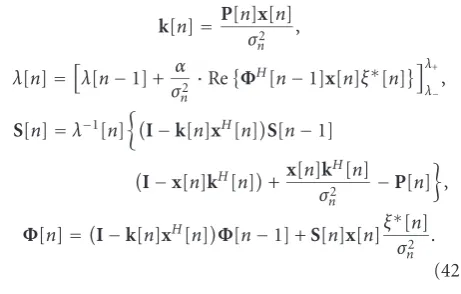
(42)
The equations forξ[n],w[n], andP[n] remain unchanged (i.e., the same expressions as (35)–(37)).
5. NUMERICAL RESULTS
In computer simulations, an asynchronous BPSK DS-CDMA system with the number of usersK=Kintra+Kinteris
consid-ered in the presence of frequency-selective multipath fading. Users 1∼Kintraare assumed to be users in the active cell and
users 1∼Kinterare the intercell interferers. The spreading
se-quence of each user in the active cell is a Gold sese-quence of lengthN = 31 while the spreading codes for intercell in-terferers are random codes. For a frequency-selective mul-tipath fading channel, each user signal is assumed to experi-enceKl=3 independent Rayleigh-fading paths due to
multi-path reflections and independent angle of arrival (AOA) dis-tributed uniformly in (−π/2,π/2). The relative delays of dif-ferent users and paths are multiples ofTc. The user of
in-terest, say of user 1, is the user to be acquired in the pres-ence of intersymbol interferpres-ence (ISI) and multiple-access interference (MAI). The information about the in-cell and inter-cell interferers is assumed to be unavailable at the base station receiver. The antenna array receiver employs uni-formly spaced linear-array antenna withMelements of half-wavelength spacing. In addition, the linear MMSE receiver is assumed to employ a known training sequence{d1[k]}NTk=1
of lengthNT =100, followed by a DD adaptation for rapid
adaptive convergence. The settings of the MBFs parame-ters required for the FIS of the FLC-LMS and FLC-RLS are shown in Figures 2and3, respectively. It must be empha-sized that these are not the only settings for the input and output fuzzy variables. In simulations, the performance of the proposed FLC-based algorithms is evaluated and com-pared with three VSS-LMS (i.e., Harris’s VSS-LMS [12] with m0 = m1 = 4, Kwong’s VSS-LMS [13] with κ1 = 0.97
andκ2 = 4.8×10⁻⁴, and Aboulnasr’s VSS-LMS [26] with
κ1 = 0.97,κ2 =4.8×10⁻⁴, andκ3 =0.1) and three
VFF-RLS (i.e., the OFFF-VFF-RLS [27], GVFF-RLS [29], and VFF-LLS [30]) algorithms. The LMS step sizeμis chosen to be con-servatively limited by 2/trace(Rx[n]), where trace(Rx[n]) in-dicates the total tap-input power of the filter. With this step size, the LMS filter, given the limitations of the independence assumption [21], guarantees the convergence to the optimal Wiener solution in the mean and in the mean square. The
RLS forgetting factorλis assumed to be bounded by the val-ues of 0.94 (λ−) and 1.0 (λ+) in simulations. The
learning-rate parameterαis set to 0.005. All experimental curves are obtained using 2×10⁴independent trials.
First of all, the convergence behavior and the steady-state performance of the proposed FLC-LMS and FLC-RLS algo-rithms is presented inFigure 7in terms of the number of iter-ationsLin the presence of the Rayleigh-fading channel with a medium-fading rate=1/500 fade cycle/symbol. Figures7(a)
and7(b)presents the results with the parameters K = 10
(Kintra = 8,Kinter =2),Kl = 3,M = 1, and SNR=10 dB.
In general, a large step size causes a faster convergence speed and a larger MSE fluctuation. The characteristic exhibits en-tirely reverse when a small step size is utilized. Experimental results inFigure 7(a)show that the proposed FLC-LMS ap-proach possesses a faster rate of convergence without trad-ing offthe steady-state performance. Thus, it is evident that the behavior of the FLC-LMS in convergence and steady state takes the advantage of both the large and small step sizes. Moreover, the FLC-LMS algorithm produces a comparable convergence and steady-state performance to the C-RLS al-gorithm. Furthermore, it is demonstrated inFigure 7(b)that the FLC-RLS algorithm provides the fastest speed of con-vergence and the smallest steady-state misadjustment among all the other algorithms. The proposed FLC-RLS algorithm possesses a superior capability of transient response and dy-namic tracking to a sudden environment change that makes it possible to operate in a dynamic fading channel. The com-parison between the FLC-LMS and FLC-RLS algorithms is provided as well and shown inFigure 7. The FLC-RLS al-gorithm produces a better convergence characteristic and a lower steady-state MSE as compared to the FLC-LMS algo-rithm, but incurs a heavier computation and implementa-tion load.
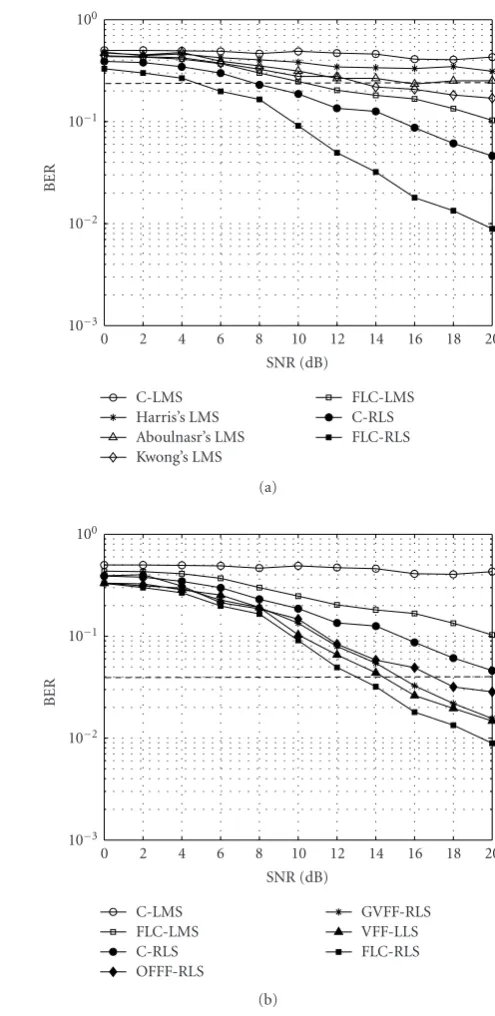
Figure 8 demonstrates the bit-error-rate (BER) per-formance of the LMS-based, RLS-based, FLC-LMS, and FLC-RLS approaches as a function of SNR under the MAI and Rayleigh-fading environment. Evidently, the FLC-RLS achieves a much better BER performance than other schemes, because of the use of a fuzzy variable forgetting fac-torλin response to the time-varying channels. Simulation results in Figure 8show that a significant improvement in BER performance is achieved by the FLC-based algorithms. More specifically, the FLC-LMS approach in Figure 8(a)
achieves, respectively, 3 dB and 6 dB over the Kwong’s and Aboulnasr’s VSS-LMS algorithms at a specific BER require-ment of 0.25 (marked by a dashed line in Figure 8(a)) for multipath Rayleigh-fading channels. The BER improvement is enhanced further when the FLC-LMS algorithm is com-pared with the C-LMS and Harris’s VSS-LMS algorithms. Moreover, it is clearly seen fromFigure 8(b) that the FLC-RLS approach accomplishes 8 dB, 4 dB, 2.1 dB, and 1.5 dB over the C-RLS, OFFF-RLS, GVFF-RLS, and VFF-RLS, re-spectively, at a fixed BER of 4×10⁻²(marked by a dashed
1500 1000
500 0
Number of iterations 10−2
10−1
100
101
MSE
C-LMS
Harris’s VSS-LMS Aboulnar’s VSS-LMS Kwong’s VSS-LMS
FLC-LMS C-RLS FLC-RLS (a)
1500 1000
500 0
Number of iterations 10−2
10−1
100
101
MSE
C-LMS FLC-LMS C-RLS OFFF-RLS
GVFF-RLS VFF-LLS FLC-RLS (b)
Figure7: Mean square error versus the number of iterationsLfor
(a) C-LMS, VSS-LMS, and FLC-LMS, and (b) C-RLS, VFF-RLS, and FLC-RLS, both cases with the parametersK =10 (Kintra =8,
Kinter =2),Kl =3,M=1, SNR=10 dB, and a multipath fading
rate=1/500 fade cycle/symbol.
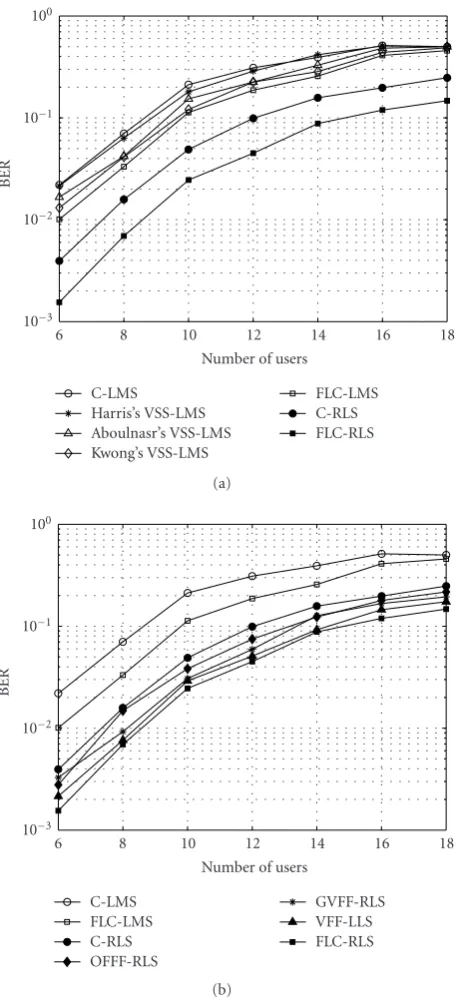
InFigure 9, the BER performance for various LMS and RLS algorithms is presented in terms of the number of users K forKl = 3,M = 2, SNR=10 dB, and a multipath
fad-ing rate=1/500 fade cycle/symbol. Each interfering user in the simulations is assumed to have a received power equal to the desired user. It should be pointed out that an increase
20 18 16 14 12 10 8 6 4 2 0
SNR (dB) 10−3
10−2
10−1
100
BER
C-LMS Harris’s LMS Aboulnasr’s LMS Kwong’s LMS
FLC-LMS C-RLS FLC-RLS (a)
20 18 16 14 12 10 8 6 4 2 0
SNR (dB) 10−3
10−2
10−1
100
BER
C-LMS FLC-LMS C-RLS OFFF-RLS
GVFF-RLS VFF-LLS FLC-RLS (b)
Figure8: BER performance versus SNR for (a) C-LMS, VSS-LMS,
and FLC-LMS, and (b) C-RLS, VFF-RLS, and FLC-RLS, both cases with the parametersK=17 (Kintra=15,Kinter=2),Kl=3,M=2,
and a multipath fading rate=1/500 fade cycle/symbol.
in system capacity is achieved under a fixed performance re-quirement when either the FLC-LMS or the FLC-RLS algo-rithm is employed.
18 16 14 12 10 8
6
Number of users 10−3
10−2
10−1
100
BER
C-LMS
Harris’s VSS-LMS Aboulnasr’s VSS-LMS Kwong’s VSS-LMS
FLC-LMS C-RLS FLC-RLS (a)
18 16 14 12 10 8
6
Number of users 10−3
10−2
10−1
100
BER
C-LMS FLC-LMS C-RLS OFFF-RLS
GVFF-RLS VFF-LLS FLC-RLS (b)
Figure9: BER performance versus the number of usersK for (a)
C-LMS, VSS-LMS, and FLC-LMS, and (b) C-RLS, VFF-RLS, and FLC-RLS, both cases with the parametersKl =3,M=2, SNR=
10 dB, and a multipath fading rate=1/500 fade cycle/symbol.
illustrates the BER performance of the FLC-RLS algorithm versus SNR parameterized by the P-partitioned MBFs for
K =17 (Kintra=15,Kinter=2),Kl =3,M=2, and a
mul-tipath fading rate=1/500 fade cycle/symbol. Experimental results in Figure 10(a) show that the DS-CDMA systems with a two-input (e2,Δe2)-FIS outperform the systems with
one-input (e2)-FIS. It is noticed that the FLC-LMS with a
20 15
10 5
0
SNR (dB) 10−3
10−2
10−1
100
BER
FLC-LMS FLC-RLS
FLC-LMS w/oΔe2
FLC-RLS w/oΔe2
(a)
20 15
10 5
0
SNR (dB) 10−3
10−2
10−1
100
BER
FLC-RLS (4−e2region, 2−Δe2region)
FLC-RLS (4−e2region, 4−Δe2region)
FLC-RLS (8−e2region, 4−Δe2region)
(b)
Figure10: (a) BER performance of the proposed FLC-LMS and
FLC-RLS algorithms versus SNR parameterized by the size of the FISs and (b) BER performance of the proposed FLC-RLS algorithm versus SNR parameterized by the size of theP-partitioned MBFs, forK=17 (Kintra=15,Kinter=2),Kl=3,M=2, and a multipath
fading rate=1/500 fade cycle/symbol.
(e2, Δe2)-FIS demonstrates a comparable performance in
demodulation to the FLC-RLS with a (e2)-FIS. In
20 18 16 14 12 10 8 6 4 2 0
SNR (dB) 10−3
10−2
10−1
100
BER
Matched filter Single element 2 elements
3 elements 4 elements
Figure11: BER performance of the proposed FLC-RLS algorithm
versus SNR parameterized by the array of theM-element receiving antenna forK=17 (Kintra=15,Kinter=2),Kl=3, and a multipath
fading rate=1/500 fade cycle/symbol.
parameter Δe2 provides the proposed MMSE receiver with
the precise knowledge of the fast-fading channels and enables rapid adaptive convergence.
InFigure 11, the BER performance of the FLC-RLS al-gorithm is presented in terms of SNR parameterized by the size of theM-element receiving antenna array forK = 17
(Kintra =15,Kinter=2),Kl=3, and a multipath fading rate
=1/500 fade cycle/symbol. The proposed FLC-RLS provides superior performance as an increasing function of the size of theM-element antenna array. This is made possible because the MAI and ISI between users are suppressed successfully by the proposed algorithm in that they adaptively place nulls in the directions of the stronger interference. AnM-element beamforming array antenna is known to be able to perform beamforming withM−1 degrees of freedom to control the directions ofM−1 nulls of the antenna. Furthermore, the FLC-RLS array receiver yields a superior performance in de-modulation over the conventional receiver that uses a stan-dard matched filter.
Simulation results in Figures12and13(a)demonstrate the BER performance of the FLC-RLS algorithm as a func-tion of SNR parameterized by a variety of FISs forK = 17
(Kintra=15,Kinter=2),Kl=3,M=2, andNT =2000 in the
presence of the stationary and nonstationary environments, respectively. In a stationary environment, the FLC-RLS sys-tems with two-input FIS (i.e., (e2,N
T) or (e2,Δe2)) provide
a better BER performance than the FLC-RLS systems with a single input (e2)-FIS, as shown inFigure 12. Notably, it is
dif-ficult to evaluate the difference in demodulation achieved by parametersNT andΔe2. However, the improvement in
de-modulation is substantial when the proposed FLC-RLS algo-rithm operates in a nonstationary (i.e., a multipath fading
20 18 16 14 12 10 8 6 4 2 0
SNR (dB) 10−3
10−2
10−1
100
BER
FLC-RLS (e2)
FLC-RLS (e2, N
T)
FLC-RLS (e2,Δe2)
Figure12: BER performance of the proposed FLC-RLS algorithm
versus SNR parameterized by a variety of FIS forK =17 (Kintra =
15,Kinter=2),Kl=3,M=2, andNT=2000 in the presence of the
stationary environment.
rate=1/500 fade cycle/symbol) environment, as illustrated inFigure 13(a). This is because the FLC-RLS algorithm with the (e2,N
T)-FIS fails to track effectively the statistical
varia-tions of the dynamic fading channels, due to the use of the fixed-length duration of training. Similar results are shown in Figure 13(b) for the convergence/tracking performance when the proposed FLC-RLS algorithm operates in a non-stationary environment with a multipath fading rate=1/200 fade cycle/symbol. Again, the use of a (e2,Δe2)-FIS
demon-strates a much better convergence and steady-state character-istic in multipath dynamic fading channels.
6. CONCLUSIONS