Volume 2007, Article ID 63192,11pages doi:10.1155/2007/63192
Research Article
Using Geometrical Properties for Fast Indexation of
Gaussian Vector Quantizers
E. A. Vassilieva, D. Krob, and J. M. Steyaert
Laboratoire d’Informatique de l’Ecole Polytechnique (LIX), Ecole Polytechnique, 91128 Palaiseau Cedex, France Received 2 November 2005; Revised 26 August 2006; Accepted 10 September 2006
Recommended by Satya Dharanipragada
Vector quantizationis a classical method used in mobile communications. Each sequence ofdsamples of the discretized vocal signal is associated to the closestd-dimensionalcodevectorof a given set calledcodebook. Only the binary indices of these codevectors (the codewords) are transmitted over the channel. Since channels are generally noisy, the codewords received are often slightly different from the codewords sent. In order to minimize the distortion of the original signal due to this noisy transmission, codevectors indexed by one-bit different codewords should have a small mutual Euclidean distance. This paper is devoted to this problem of index assignment of binary codewords to the codevectors. When the vector quantizer has a Gaussian structure, we show that a fast index assignment algorithm based on simple geometrical and combinatorial considerations can improve the SNR at the receiver by 5dB with respect to a purely random assignment. We also show that in the Gaussian case this algorithm outperforms the classical combinatorial approach in the field.
Copyright © 2007 E. A. Vassilieva et al. This is an open access article distributed under the Creative Commons Attribution License, which permits unrestricted use, distribution, and reproduction in any medium, provided the original work is properly cited.
1. INTRODUCTION
Taking into account the constraints of the transmission chan-nel between the base transceiver stations (BTS) and mobile stations (MS), voice is coded in mobile networks with the help of techniques allowing to minimize the quantity of in-formation required for its good reconstitution. Among these techniques one findsvector quantization. This method con-sists of replacing the vector yfrom Rd, obtained by finite
discretization of the input vocal signal, by the element ci,
taken from a setC = {c0,c1,. . .,cN−1} of vectors of
refer-ence, which is the closest toy. The setCis called acodebook and its elements thecodevectors. Instead of transmitting the initial discretization y, one transmits a string of 0’s and 1’s which is thebinary codewordb(ci) associated with the
code-vectorciof the codebookCwhich is the closest toy. Because
of some interfering noises on the transmission channel, the stringsactually received can be different fromb(ci). The
out-put signal is thencjsuch thatb(cj)=s(seeFigure 1). In what
follows, the mappingbthat associates with each codevectorci
a binary wordb(ci) representing a nonnegative integer will be
called theindexation(or theindex assignment) of the code-book. We will also refer tob(ci) as theindexassociated with
the codevectorci.
c0
c.1 . .
cN 1
Codebook C
b(cj)=s
y
VQ b(ci) Channel s D cj Vector quantizer Decoder Figure1: Signal transmission by vector quantization.
stationary unvoiced, nonstationary unvoiced, onset, nonsta-tionary voiced, or stanonsta-tionary voiced. Depending on the frame type, either a eight-rate, fourth-rate, half-rate, and full-rate codec is selected. While background noise and stationary unvoiced frames are represented by a spectrum and energy modulated noise and are encoded with the fourth or eight rate codec, voiced frames are encoded with the full or half rate codec according to an extension of CELP, namely ex-tended CELP (eX-CELP). For such frames with a low pitch gain, eX-CELP behaves similarly as traditional CELP. For frames with high and stable pitch gain eX-CELP uses less bits for pitch encoding and allow more for excitation representa-tion (see [4,5] or [6] for further details).
In spite of its evident success in modern speech coding technologies, vector quantization has also a big drawback: the slightest transmission error on the string representing a binary codeword (e.g., one single bit error) can induce a very large difference (in terms of Euclidean distance) between the input and the output codevectors and, by consequence, an important distortion of the transmitted signal. Hence, the indexation of the codebook should be as robust as possible with respect to this problem.
The practical importance of vector quantization induced a relatively active research on the indexation problem. The main classical indexation algorithms that can be found in the literature (cf. [7–12]) are using general optimization techniques or heuristics. While achieving high performance, these methods require time consuming convergence stages.
A few combinatorial approaches (cf. [13,14]) have also been proposed. These methods do not use any a priori as-sumption on the geometrical structure of the codebook. In this paper, we will study the problem of indexation starting of a hypothesis that the vectors of the codebook are distributed according the multidimensional Gaussian laws (we show that this hypothesis holds in practical situations). We use the fact that Gaussian laws can be approximated in adiscrete manner by binomial laws to design new combinatorial algorithms of indexation resulting in higher performance and lower time complexity.
The paper is organized as follows. InSection 2a mathe-matical formulation of the index assignment problem and a short survey of the existing methods are presented.Section 3
starts with a brief discussion justifying the hypothesis of the Gaussian structure of the codebook and a presentation (through several examples) of a classical discrete model of
Gaussian distribution in terms of binomial coefficients. Fur-ther, a combinatorial algorithm based on this model for the assignment of binary codewords to the codevectors of vec-tor quantizer is developed. InSection 5the performance of the algorithm is analyzed. It is compared with that of the Wu and Barba’s algorithm and of a system with randomly chosen binary codewords. Finally,Section 6includes some prelimi-nary ideas on potential applications of the algorithm and a conclusion.
2. VECTOR QUANTIZATION: PRINCIPLES AND CLASSICAL APPROACHES
2.1. Mathematical formulation of the problem
In this paper, we will assume that the vector quantizer is de-signed and fixed. That means we have a finite set (codebook)
C= {c0,c1,. . .,cN−1} ⊂Rdof codevectors as well as a
map-ping (the quantizer) Q : Rd → C, that associates to each
vectoryofRd(input signal), the elementcfromCsuch that
the Euclidean distance between y andcis minimal. Binary codewords on the output of vector quantizer are to be sent over a noisy channel. The channel is assumed to be a binary, symmetric, and memoryless chanel (BSC) with error prob-ability . The length of the binary codewords is fixed and equalK=log2N(i.e.,N=2K). The objective is to construct
an indexation mappingb(as defined above) that makes this communication model as robust as possible with respect to transmission errors while having a minimum time complex-ity.
In order to formalize this statement we need to introduce some new notations and to define our performance criteri-ons. Assume that the codevectorci occurs with probability
p(ci). Let p(b(cj)| b(ci)),i,j = 0, 1,. . .,N−1, denote the
conditional probability of decodingcjwhen transmittingci,
which is equal to
pbcj
|bci
=dH(b(ci),b(cj))(1−)N−dH(b(ci),b(cj)), (1) wheredH(b(ci),b(cj)) is the Hamming distance between the
binary words associated with codevectors ci andcj. Let us
also denote by d (ci,cj) the distance between codevectors
ci and cj. In this paper we will consider the widely used
squared-error distortion based on the usual Euclidean dis-tance:
d(x,y)= x−y2. (2)
Then the distortion performance criterion we adopt is deter-mined in the following manner:
D=
N−1
i=0
N−1
j=0 pci
pbcj
|bci
dci,cj
. (3)
2.2. Classical approaches
2.2.1. Heuristics
Since the problem is precisely formulated, in the rest of this section we envisage to recall some design and perfor-mance issues related to vector quantization for noisy chan-nels. However, before we start several comments are in order. There are two main questions concerning vector quanti-zation that (apart from some exceptions as [15] or [16]) are usually treated separately: how to distribute the codevectors over the source, and how to choose the codewords, or indices, so that the effect of channel errors is not too degrading on the performance. This is due to the vector extension of the the-orem for scalar quantization by Totty and Clark (see [17]) suggesting the separation of the overall distortion into the sum of the quantization distortion and the channel distor-tion for the squared-error distordistor-tion measure. Here we will mainly refer to the articles devoted to resolving the second question (as well as our present paper).
One more preliminary remark we wish to make is con-cerning the difficulty of index assignment problem. In fact, it is well known that the search problem of index assignment is
NP-hard (see, e.g., [18]) and, as a consequence, all the pro-posed algorithms are necessarily suboptimal.
For this reason, most of heuristic algorithms we can find in literature first perform a deterministic search in a set of admissible configurations and then, in order not to termi-nate in a local minimum of a cost function, adopt a random-ized approach (e.g., randomly generating the next configu-ration and allowing within reasonable limits the configura-tions of higher cost than the present). Among the first pa-pers that assessed an index assignment problem for vector quantization by an heuristic approach one can find those of De Marca and Jayant [7], and of Chen et al. [19]. Farvardin [20] employed to the problem a simulated annealing algo-rithm. Zeger and Gersho [12] proposed a binary switching method, where pairs of codevectors change index in an iter-ative fashion, determined by a cost function. Potter and Chi-ang [18] presented a paper using minimax criterion based on hypercube that improves the worst case performance, im-portant for the image perception. Knagenhjelm and Agrell employed the Hadamard transform to derive first an objec-tive measure on success of index assignment [10] and then, to design efficient index assignment algorithms [11]. Similar theory was applied by Hagen and Hedelin [16] for designing vectors quantizers with good index assignments.
2.2.2. Combinatorial approaches
Only a few combinatorially flavored approaches have already been proposed. Cheng and Kingsbury (cf. [13]) designed a recursive algorithm based on hypercube transformations.
Wu and Barba (cf. [14]) proposed a method with smaller time complexity than the above solutions. Within their ap-proach, minimization programs over the set of nonassigned codevectors are successively solved for each codeword. The
aim of these minimization programs is to ensure that the Eu-clidean distance between two codevectors, which have been assigned codewords with Hamming distance equal to one, is kept low. More precisely, given a codebook with 2Kelements,
the algorithm is initialized by assigning the codeword com-posed ofK0’s to the codevector with the highest occurrence probability and then by indexing itsKclosest neighbors with the codeword of Hamming weight 1. Then for each already assigned codeword b all the binary words having a Ham-ming distance of 1 withb and higher Hamming weight are attributed one after the other to the not yet assigned code-vectors minimizing a given criterion.
2.3. Limitations of the classical combinatorial approach and baseline of our method
Although Wu and Barba’s method provides a simple and el-egant solution allowing good improvement of the system’s robustness to noise, this method does not consider any geo-metrical properties of the quantizer. Throughout this paper, we show how taking into account its geometrical structure may allow further reduction of the time complexity while in-creasing the performance. Using a classical discrete model of the Gaussian distribution we split the codebook into zones where each zone corresponds to a predefined set of code-words. Performing minimization programs within the zones rather than within the whole dictionary saves time complex-ity. Besides, at each step of the assignment process, it pro-vides a better solution for the trade-offbetween optimizing the current codeword assignment and those of the remaining ones. In the following section, we present the discrete model of the Gaussian distribution we used to split the codebook. The index assignment method itself is described afterwards.
3. GAUSSIAN VECTOR QUANTIZERS AND DISCRETE MODEL OF GAUSSIAN DISTRIBUTION
3.1. Working with Gaussian codebooks
Our index assignment approach is specially designed for codebooks whose codevectors are distributed according to multidimensional Gaussian laws. The best results are for the codebooks with Gaussian distributions close to symmet-ric with respect to their mean point. However, the numeri-cal simulations on nonsymmetric Gaussian codebooks pre-sented at the end of the paper show that our method is also very well adapted for nonsymmetric Gaussian distributions with different variance values along the different principal di-rections.
The Gaussian hypothesis is valid in practical situations. Indeed, we studied several real codebooks provided by indus-trial partners. The results of applying Kolmogorov-Smirnov test to random samples, representing each coordinate, are satisfactory. Besides the reader is proposed to seeFigure 2for a projection on a plane of a real four-dimensional codebook
andFigure 3for a normalized repartition of the codevectors
2000 1500 1000 500 0 500 1000 1500 2500
2000 1500 1000 500 0 500 1000 1500 2000
Figure2: Projection on a plane of a real codebook withN=256.
2.5 2 1.5 1 0.5 0 0.5 1 1.5 2 2.5 0
5 10 15 20 25 30
Figure 3: Normalized repartition of the projections of another codebook along its principal axis.
3.2. A classical discrete model of Gaussian distribution
In our algorithm the codebookCis interpreted as anN-point discrete realization of the Gaussian distribution. More pre-cisely, we use the well-known approximation in terms of bi-nomial coefficients of the Gaussian density. This section gives a description of the one-dimensional version of this model followed by its generalization tod(d >1) dimensions.
One-dimensional model
LetSbe a segment on the line of length (K+ 1)r(rbeing the parameter of the model). Consider a partition ofSintoK+ 1 adjacent segments numbered from left to rightS0,S1,. . .,SK
of equal lengthron the line. AnN-point discrete approxima-tion of the Gaussian distribuapproxima-tion centered on the mean point ofSwith standard-deviation 2r is obtained by considering
4 3 2 1 0 1 2 3 4
0 0.05 0.1 0.15 0.2 0.25 0.3 0.35 0.4
Binomial approximation Standard Gaussian distribution
Figure4: Binomial approximation of the standard Gaussian distri-bution forK=15.
thepdf:
p1(x)= 1 Nr
K i
, ifx∈Si (4)
and 0 ifxdoes not belong to any of the segments. This step function corresponds to the repartition histogram that one would get ifNpoints were distributed onSsuch thatKiof them are inSi(seeFigure 4for the binomial approximation
forK=15).
Generalization tod-dimensional symmetric Gaussian distributions
In d (d > 1) dimensions, the model is generalized by re-placing the segments on the line by regions delimited by hy-perspheres. LetSbe ad-ball with centerOintersected by a hyperplaneHcontainingO. As we are considering symmet-ric Gaussian distributions any hyperplane containingOcan be indifferently chosen. Then a carefully defined system of K/2+ 1 embeddedd-balls centered inO
S⊃S1⊃ · · · ⊃SK/2 (5)
provides together with the hyperplaneH the partition ofS
intoK + 1 regionsSi(0 ≤ i ≤ K) of equald-content. Let
r (parameter of the model) be the radius of the central and smallest ball. Then the radiuses of the balls are related by the following equations:
Ri=d(K+ 1)/2−i r, i=0,. . ., (K−1)/2, for oddK
Ri=d
K+ 1−2i r, i=0,. . .,K/2, for evenK.
(6)
The regions Si andSK+1−i (with i = K/2) are the
sym-metric halves ofSi\Si+1with respect to the splitting
hyper-planeH. For oddKtwo central regionsS(K−1)/2andS(K+1)/2
S0 S1 S2 S3 S4 S5 S6S7
Figure5: Partition of a 128 point 2-dimensional Gaussian code-book into 8 regions.
central regionSK/2 is simply the central ballSK/2. Similarly
to the one-dimensional case we have an approximation of the Gaussian distribution centered inOand with variance-covariance matrix (2r)2I(whereIis the identity matrix) by
considering thepdf:
pd(x)= 1
N×VolSi
K i
, ifx∈Si (7)
and 0 if x /∈ S(Vol (Si) denotes the content of Si). As in
the previous case, this step function corresponds to the d -dimensional histogram depicting the geometrical repartition ofNpoints distributed in such a way thatKiof them are in
Si(i=0,. . .,K).
3.3. Link with Gaussian codebooks
In a few words, the main feature of the model is that anN
point Gaussian codebook can be approximately partitioned into K + 1 regions with equal d-content, each region be-ing bounded by twod-dimensional semihyperspheres such that the radiuses of the hyperspheres are related by (6), and the number of points in theith region isKi(see Figure 5
for a two-dimensional example withK =7). Note, that the above discrete model is chosen as it suits very well our prob-lem. Indeed, it gives a very natural way to split a Gaussian codebook containing 2K elements intoK+ 1 subsets ofK
i
codevectors (i=0,. . .,K). The binomial coefficientKican also be interpreted as the number of codewords of lengthK
and fixed Hamming weighti. That suggests for the Gaussian codebooks of size 2K the existence of a natural
correspon-dence between these subsets of codevectors and the subsets of codewords of fixed Hamming weight. Using this idea we develop an index assignment method in the next section.
4. INDEX ASSIGNMENT
Let us first present the general idea of the proposed approach and then focus on its full description.
4.1. The guiding principle
Looking at (3), one can remark that the couples of codewords with mutual Hamming distance equal to one are of particu-lar interest. Indeed, they correspond to one-bit error on the transmission channel. When theBERis much less than one, the signal’s distortion is mainly due to this kind of error. To keep the average distortion low, we need to minimize the Eu-clidean distance between codevectors indexed by neighbor-ing codewords. It is also important to keep in mind the trade offbetween minimizing this distance for a particular pair of codewords and minimizing the sum of all the Euclidean distances between codevectors having neighboring codeword assignments.
We address these two issues through a two stage algo-rithm. During a preprocessing stage we split the given code-book into zones according to the discrete model described in the previous section. This allows us to establish a correspon-dence between the subsets of the codewords of a given Ham-ming weight and the subsets of codevectors belonging to a given zone. Due to this correspondence the codewords that differ only in one bit (and therefore belonging to the subsets with Hamming weight difference equal to one) are associ-ated to subsets of geometrically close codevectors of adjacent zones. This repartition of the codebook into zones allows to conceive the algorithm as the sequence of consecutive mini-mization programs, each of them treating only the codevec-tors of adjacent zones. Therefore the time complexity is sig-nificantly reduced compared to the methods searching the whole codebook (see, e.g., [14]). Besides, limiting the search for the minima to predefined zones insures that the first lo-cal optimizations will not be done to the detriment of the following ones.
To understand better the importance of this repartition into zones, let us consider the special case when the code-vectors have equal occurrence probability 1/N. Without loss of generality we consider that K is an odd integer (similar calculations can be conducted whenK is even). As one can see it onFigure 5, the maximal Euclidean distances between two vectors from two adjacent zones is upper-bounded by the sum of the radiuses of the two correspondingd-balls. As a re-sult, the distortion due to one-bit error between codewords of weightpand those of weightp−1 is upper bounded by
d
(K+ 1)2−p+d(K+ 1)2−(p−1)r. (8)
There are Kp codewords associated to the codevectors of zone pand each of them has pneighboring codewords as-signed to codevectors of the previous zone. The contribution of the one-bit errors to the distortion that would occur if we assume this repartition into zones is therefore less or equal to
D≤
N
K
p=0
K p
pd(K+ 1)2−p
+ d
(K+ 1)2−(p−1)r.
(9)
If we consider the codevectors as independent random vari-ables distributed inRd according to the centered Gaussian
law of variance-covariance (2r)2I, the average distortion due
to one-bit error for a random indexation is given by
E(D)= 2N
N
i=1
KEdc1,c2
, (10)
where we took into account that each codeword hasK neigh-bors. The coefficient 1/2 insures that we do not count twice the contribution from each couple of neighboring code-words. The average distance between two codevectors is com-puted using the Gaussian assumption
Edc1,c2
= 1
2r√2πd
Rd×Rdd
c1,c2
×exp
−c1 2
8r2
exp
−c2 2
8r2
dc1dc2,
Edc1,c2
=√2r 2πd
Rd×Rdd
c1,c2
×exp
−c1 2
2
exp
−c2 2
2
dc1dc2.
(11)
The ratioρof the upper-bound (9) to the average distortion (10) is only a function of the length of the codewordsKand the dimensiond, namely,
ρ(K,d)
=
K
p=0
K−1
p−1
d
(K2+ 1)−p+d
(K2+ 1)−(p−1)
2K
√
2πd Rd×Rd
dc1,c2
exp
−|c1|2
2
exp
−|c2|2
2
dc1dc2 .
(12)
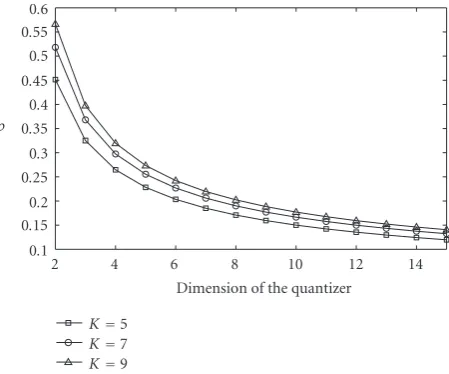
Figure 6plots this ratio as a function ofdforK = 5, 7, 9.
We see that the improvement of the repartition into zone scheme with respect to a random indexation becomes more and more substantial as the dimension of the vector quan-tizer increases.
In practical situations, codebooks may not be strictly symmetric Gaussian. Hence, the partition of the codebook into zones we adopt will not exactly respect the specific ge-ometrical bounds of the regions of the model. Rather, these bounds are adapted such that each zone accommodates the necessary number of codevectors and that the maximal dis-tance between two vectors of adjacent zones is minimized. This is achieved by defining the radius of eachd-ball as the distance from the codebook’s mean point of the most re-mote codevector belonging to it. Also we split each d-ball by hyperplanes orthogonal to the principal direction of the codebook, since the dispersion of the projection of the code-vectors along this axis is the most significant. For each ball, an appropriate hyperplane is chosen so its splitting results in two subsets of codevectors of equal cardinality. The method
2 4 6 8 10 12 14
Dimension of the quantizer 0.1
0.15 0.2 0.25 0.3 0.35 0.4 0.45 0.5 0.55 0.6
ρ
K=5
K=7
K=9
Figure6:ρas a function of the dimension for various values ofK.
we proposed in the following sections can thus be applied to any codebook. However, for the codebooks having the code-vectors mainly concentrated around the mean point, this partition appears to be better justified for the model contin-ues to be a good approximation.
4.2. Repartition of the codebook into zones
The repartition into zones is performed according to the fol-lowing procedure. Transfer the center of coordinates to the mean point of the codebookC and use the eigenvectors of the covariance matrix (computed by assuming equal weight for each point) ofCas a new basis. Choose any of the pos-sible orientations for this new system of coordinates. Select the principal axis, that is, the eigenvector corresponding to the greatest eigenvalue. Definem0as the median value of the
coordinates of the codevectors on this axis andM0as the
hy-perplane orthogonal to the principal axis that containsm0.
The hyperplaneM0 splits thed-dimensional space into two
subspaces withN/2 points ofCeach. Then, we sort all the codevectors ofCin an ascending order with regard to their distances to the new center of coordinates, that results in an ordered setπ:
π=ci0< ci1<· · ·< ciN−1
. (13)
Among the codevectors located to the left ofM0(i.e., having
a coordinate value on the principal axis less thanm0) select
the one maximizing the Euclidean distance to zero. Similarly, among the codevectors to the right ofM0select the one
sat-isfying the same criterion. These two points constitute zones
Z0andZK of our codebook. Numbering of zones is chosen
in such a way, that the numberi of a zoneZi corresponds
both to the cardinalityKiof subsetZiand the number of
codewords with Hamming weightito be assigned to it later on.
The other zones are built in an iterative fashion. Suppose that we already created 2pzones and that the ordered set
π\Z0∪ · · · ∪Zp−1∪ZK∪ · · · ∪ZK−p+1
Mp 1 Mp
Zp 1
Zp
ZK p
ZK p+1
New origin (center of the codebook)
Principal axis of covariance
Figure7: Iterative construction of the zones (only codevectors be-longing to zonesZp−1,Zp,ZK−p+1, andZK−pare shown).
is still not partitioned. In this ordered set consider the sub-set of the lastKp+KK−pcodevectors (ifKis even and only two last zones are still not defined consider the lastKp code-vectors). Find the median coordinatempof this subset with
respect to the principal axis of the basis and, as well,Mpthe
median hyperplane. Then zone Zp is defined as the set of
codevectors of the considered subset located to the left ofMp,
and the other half of the codevectors constitute zoneZK−p.
The process of repartition of the codebookCinto zones (cre-ation of zonesZpandZK−p) is illustrated byFigure 7.
4.3. Iterative assignment
We use the partition ofCinto zones to construct a recursive procedure of indexation on which our combinatorial method relies.
Step 1. We assign the codeword
K
00· · ·0 to the codevector of
zoneZ0and the codeword
K
11· · ·1 to the codevector of zone
ZK.
Step 2. We proceed by assigning the indices to codevectors of zonesZ1andZK−1, the next ones on the way to zero and both
having cardinalityK. We assign randomly all the K code-words of Hamming weight 1 to the codevectors of zoneZ1,
and all theK codewords of Hamming weightK−1 to the codewords of zoneZK−1.
Step 3(2 ≤ p ≤ (K−1)/2). Suppose now that we have already made p steps resulting in assignment of indices to all the codevectors within the first 2pzonesZ0,. . .,Zp−1and ZK,. . .,ZK−p+1. We proceed by assigning all the codewords of
Hamming weight pto the codevectors of zoneZp. For each
such binary codewordbpj
j ∈1,. . .,Kpwe consider the codevectorscip−1of zoneZp−1such thatdH(b(cip−1),bpj)=1,
that is, the codevectors that were previously indexed with a codeword one-bit different frombpj. Then we look for the
codevectorcpj belonging to the subset of zoneZpcontaining
only codevctors that have not been yet indexed (further de-notedZ∗p) minimizing the contribution to the distortion
cpj =arg min c∈Z∗p
cip−1∈Zp−1
dH(b(cip−1),bpj)=1
pcip−1
dcip−1,c
. (15)
Finally, we assign the binary codewordbpjto this
codevec-tor (i.e.,b(cpj)=b p
j). In other words, we look for the
code-vectors minimizing the distortion due to one-bit error dur-ing the transmission of the codewords of the previous zone. We proceed in a similar fashion to index the vectors in zone
ZK−p.
4.4. Time complexity
Let us now estimate the time complexity of the algorithm described above. The repartition into zones being neglegi-ble with respect to the sequence of minimization programs we focus on this last point. For each program of minimiza-tion or equivalently each index assignment, the number of elementary operations performed is proportional to the size of the searched set of codevectors. When assigning the ith codeword of thepth zone of anN=2Kvector quantizer, this
minimizing point is searched amongKp−icodevectors. The global complexityCN is then given by
CN =O
⎧ ⎪ ⎨ ⎪ ⎩ K
p=0
(K p)−1
i=0
K p −i ⎫ ⎪ ⎬ ⎪ ⎭ =O K
p=0
1 2 K p K p + 1 =O 1 2 2K K
+ 2K
=O 2K K . (16)
Now using Sterling formula gives a simple asymptotic equiv-alent to the algorithm complexity, namely,
CN =O
(2K)2K√4πKeK2
e2KKK√2πK2
=O
(2)2K
√ πK =O N2
log2N
.
(17)
For comparison purposes we compute the complexity of Wu and Barba’s method. We notice that this algorithm follows a similar fashion of sequential minimization programs. How-ever the minimizations are not performed within zones but in the set of all the codevectors remaining unindexed. The complexity of this algorithm is given by
CWuBarba
N =O
N−1
i=0
(N−i)
=O
N(N+ 1) 2
=ON2.
As a result, our algorithm has a complexity that can be ne-glected at asymptote with respect to the Wu and Barba’s method.
5. SIMULATION RESULTS
5.1. Simulations on real Gaussian codebooks
We conducted numerical simulations on three four-dimen-sional real codebooks provided by our industrial partner. For each of these codebooks, statistics of occurrence of the codevectors in real life mobile communications were pro-vided as well. Five-second samples of real life conversation from 200, 000 different speakers were gathered to derive these statistics. Speech signals were encoded through an extended CELP process (similarly as in CDMA) based on each of the provided codebooks for prediction errors quantization and coding. Using these statistics we computed the expected out-put SNRs yielded by various indexation schemes as functions of the channel bit error rate on a typical mobile commu-nication speech signal (having the same statistics).Figure 8
presents these output SNRs resulting from the following in-dex assignment schemes: random inin-dex assignment, Wu and Barba’s algorithm, the proposed approach. In order to illus-trate the importance of the codebook repartition into zones, we also plotted the results of a random indexation of the codevectors in each zone by the codewords of corresponding Hamming weight.
One can see that our approach achieves better results than the Wu and Barba’s algorithm on all the three provided codebooks. It is very interesting as well to see that the repar-tition into zones stage contributes for most of the improve-ment of our indexation scheme with respect to a random one.
5.2. CPU times comparison
As claimed earlier in this paper, our approach allows lower computation time than Wu and Barba’s method to achieve the presented results. We drew at random a large number of 4 to 10 dimensional Gaussian codebooks of various sizes and measured the CPU time needed by the two methods to pro-cess each of these codebooks.Figure 9depicts the ratio of the mean (averaged over dimensions and the codebook draw-ings) CPU times required by Wu and Barba’s approach to the mean CPU times required by our algorithm as a function of the codebook size. We see that for very small set of code-vectors, the time required by our method is higher because of the preprocessing stage. However when the set of codevec-tors has a cardinality above 16, simulations demonstrate that our method is less time consuming.
5.3. Simulations on bigger Gaussian codebooks
We applied our algorithm to bigger simulated codebooks of higher dimension. We drew at random 10, 000, 25-dimensional codebooks with 1024 codevectors according to
10 3 10 2 10 1
Bit error rate 5
0 5 10 15 20 25
Output
SNR
(dB)
Random indexation
Random indexation in each zone Wu & Barbra
Proposed approach
10 3 10 2 10 1
Bit error rate 5
0 5 10 15 20 25
Output
SNR
(dB)
Random indexation
Random indexation in each zone Wu & Barbra
Proposed approach
10 3 10 2 10 1
Bit error rate 10
5 0 5 10 15 20 25
Output
SNR
(dB)
Random indexation
Random indexation in each zone Wu & Barbra
Proposed approach
3 4 5 6 7 8 9
K
0.5 1 1.5 2 2.5 3 3.5
CPU
time
ratio
Figure9: CPU time ratio of Wu and Barba’s method to the pro-posed approach.
10 3 10 2 10 1
Bit error rate 5
0 5 10 15 20 25
Output
SNR
(dB)
Random indexation
Random indexation in each zone Wu & Barbra
Proposed approach
Figure 10: Average output SNR yielded by various indexation schemes on 1024-vector 25-dimensional codebooks.
the normal distribution. We then multiplied the obtained codebooks by randomly drawn 25×25 matrices with coef-ficients uniformly drawn between−1 and 1 to simulate the fact that codebooks are in general not represented within the basis of the principal axis of their covariance matrice and to prevent them from being perfectly symmetric. Probability of occurence of the codevectors are uniformly drawn at random as well. Figure 10shows the average expected output SNR recorded for these bigger codebooks. We see that increasing
1500 1000 500 0 500 1000 1500
1500 1000 500 0 500 1000 1500
Figure11: A uniform codebook.
10 3 10 2 10 1
Bit error rate 5
0 5 10 15 20 25
Output
SNR
(dB)
Random indexation
Random indexation in each zone Wu & Barbra
Proposed approach
Figure12: Output SNR yielded by various indexation schemes on a uniformly distributed codebook.
the size and the dimension of the codebooks did not changed much the performance patterns observed.
5.4. Extension to non-Gaussian codebooks
While the Gaussian hypothesis is the base for the general intuition of our approach, it turns out that the proposed method can be applied to any codebook. We generated an artificial four-dimensional codebook of 128 codevectors uni-formly distributed within a given hypercube (seeFigure 11
6. CONCLUSION
In this paper we proposed a new combinatorial method for index assignment of vector quantizers specially designed for Gaussian codebooks. In this case, our approach displays better performance than the Wu and Barba algorithm. In general the proposed method achieves an important reduc-tion in time complexity. This suggests the idea of using our algorithm when time is a critical factor. We can imagine em-bedded systems with low computational capacities for very small networks (local) where quantization would be adapted in real time to the voice of the users. In this case, assignment could be rapidly adapted as well. We might think as well of statistical studies in voice coding that would require fast gen-eration of a great number of codebooks with good index as-signment. Besides, it can be employed as an initial assign-ment for general optimization methods in the field ([12] or [20]). To this extent, the repartition into zones together with a random indexation in each zone is very valuable since its time complexity can be neglected and the improvement with respect to a fully random assignment is quite substantial. Some applications might be relevant as well beyond voice coding as vector quantization is a widely spread method for lossy data compression (e.g., image and video coding).
REFERENCES
[1] R. M. Gray, “Vector quantization,”IEEE Acoustics, Speech, and Signal Processing Magazine, vol. 1, no. 2, pp. 4–29, 1984. [2] J. Makhoul, S. Roucos, and H. Gish, “Vector quantization in
speech coding,”Proceedings of the IEEE, vol. 73, no. 11, pp. 1551–1588, 1985.
[3] M. R. Schroeder and B. S. Atal, “Code-excited linear prediction (CELP): high-quality speech at very low bit rates,” in Proceed-ings of IEEE International Conference on Acoustics, Speech and Signal Processing (ICASSP ’85), vol. 10, pp. 937–940, Tampa, Fla, USA, April 1985.
[4] Y. Gao, A. Benyassine, J. Thyssen, H. Su, and E. Shlomot, “eX-CELP: a speech coding paradigm,” inProceedings of IEEE Inter-national Conference on Acoustics, Speech and Signal Processing (ICASSP ’01), vol. 2, pp. 689–692, Salt Lake City, Utah, USA, May 2001.
[5] Y. Gao, E. Shlomot, A. Benyassine, J. Thyssen, H. Su, and C. Murgia, “The SMV algorithm selected by TIA and 3GPP2 for CDMA applications,” inProceedings of IEEE International Conference on Acoustics, Speech and Signal Processing (ICASSP ’01), vol. 2, pp. 709–712, Salt Lake City, Utah, USA, May 2001. [6] J. Makinen, P. Ojala, and H. Toukomaa, “Performance com-parison of source controlled GSM AMR and SMV vocoders,” inProceedings of International Symposium on Intelligent Sig-nal Processing and Communications Systems (ISPACS ’04), pp. 151–154, Seoul, Korea, November 2004.
[7] J. R. B. De Marca and N. S. Jayant, “An algorithm for assign-ing binary indices to the codevectors of a multi-dimensional quantizer,” inProceedings of IEEE International Conference on Communications, pp. 1128–1132, Seattle, Wash, USA, 1987. [8] J. A. Freeman and D. M. Skapura, Neural Networks—
Algorithms, Applications and Programming Techniques, Addi-son Wesley, Reading, Mass, USA, 1992.
[9] R. Hagen and P. Hedelin, “Robust vector quantization in spec-tral coding,” inProceedings of IEEE International Conference on Acoustics, Speech and Signal Processing (ICASSP ’93), vol. 2, pp. 13–16, Minneapolis, Minn, USA, April 1993.
[10] P. Knagenhjelm, “How good is your index assignment?” in Proceedings of IEEE International Conference on Acoustics, Speech and Signal Processing (ICASSP ’93), vol. 2, pp. 423–426, Minneapolis, Minn, USA, April 1993.
[11] P. Knagenhjelm and E. Agrell, “The hadamard transform—a tool for index assignment,”IEEE Transactions on Information Theory, vol. 42, no. 4, pp. 1139–1151, 1996.
[12] K. Zeger and A. Gersho, “Pseudo-Gray coding,”IEEE Transac-tions on CommunicaTransac-tions, vol. 38, no. 12, pp. 2147–2158, 1990. [13] N.-J. Cheng and N. K. Kingsbury, “Robust zero-redundancy vector quantization for noisy channels,” inProceedings of IEEE International Conference on Communications (ICC ’89), vol. 3, pp. 1338–1342, Boston, Mass, USA, June 1989.
[14] H.-S. Wu and J. Barba, “Index allocation in vector quantisa-tion for noisy channels,”Electronics Letters, vol. 29, no. 15, pp. 1317–1319, 1993.
[15] Y. Linde, A. Buzo, and R. M. Gray, “An algorithm for vector quantizer design,”IEEE Transactions on Communications Sys-tems, vol. 28, no. 1, pp. 84–95, 1980.
[16] R. Hagen and P. Hedelin, “Robust vector quantization by a lin-ear mapping of a block code,”IEEE Transactions on Informa-tion Theory, vol. 45, no. 1, pp. 200–218, 1999.
[17] R. Totty and G. Clark Jr., “Reconstruction error in wave-form transmission,”IEEE Transactions on Information Theory, vol. 13, no. 2, pp. 336–338, 1967.
[18] L. C. Potter and D.-M. Chiang, “Minimax nonredundant channel coding,” IEEE Transactions on Communications, vol. 43, no. 234, pp. 804–811, 1995.
[19] J.-H. Chen, G. Davidson, A. Gersho, and K. Zeger, “Speech coding for the mobile satellite experiment,” inProceedings of IEEE International Conference on Communications, pp. 756– 763, Seattle, Wash, USA, 1987.
[20] N. Farvardin, “A study of vector quantization for noisy chan-nels,”IEEE Transactions on Information Theory, vol. 36, no. 4, pp. 799–809, 1990.
E. A. Vassilieva holds a position of re-searcher in the French National Center for Scientific Research (CNRS) and is work-ing at the Laboratory of Computer Sci-ence (LIX) in Ecole Polytechnique in Paris. Graduated in 1997 from the Mechanical Mathematical Department of Moscow State University (MS equivalent in mathematics and applied mathematics), she was awarded in 2000 a Ph.D. degree in symbolic
D. Krob is a Senior Researcher at the French National Center for Scientific Re-search (CNRS) and Professor at Ecole Poly-technique, where he is in charge of the Ecole Polytechnique-Thales teaching and research chair “Engineering of Complex Systems.” He is a former student of Ecole Normale Sup´erieure. He received his Ph.D. degree and his second thesis (habilitation) in Com-puter Science from University Paris 7,
re-spectively, in 1988 and 1991. His research interests cover algebraic and enumerative combinatorics, mobile telecommunications, for-mal languages theory, system modeling, information systems, the-oretical computer science, and thethe-oretical marketing. Nowadays his research focuses on formal modeling of complex systems. He is the Author of around 80 scientific papers, 4 books, and 2 patents. He directed two main national research groups (involving around 100 French research teams) at the border between mathematics and computer science. He was Founder and Head of the “Labora-toire d’Informatique Algorithmique Fondements et Applications” (CNRS & University Paris 7) during six years, before joining Ecole Polytechnique. He was also First Editor-in-Chief of the scientific international e-journal “Discrete Mathematics & Theoretical Com-puter Science” and Head of the steering committees of two main international scientific conferences (FPSAC and STACS).